Obsidian
| LOA | 84.2 m |
|---|---|
| Delivered | 2023 |
| Builder | Feadship (De Voogt Naval Architects) |
| Design | RWD with MONK Design (exterior and interior) |
| Propulsion | FAED diesel-electric hybrid, Veth contra-rotating thrusters (no shafts or rudders) |
| Battery bank | around 4.5 MWh (560 modules) |
| Battery-only range | around 35 nm at 10 knots |
| Fuel | HVO biofuel capable, around 90 per cent CO2 reduction versus fossil fuel |
A new benchmark for cleaner cruising
Obsidian was Feadship's first delivery of 2023 and arrived with a clear mission, to raise the standard for carbon reduction on a large custom yacht. At 84.2 metres she was built to an explicit owner directive to cut emissions across her operating life. The yard positioned her as the opening statement of a new generation, part of its stated goal to build carbon-neutral superyachts by 2030. She proves that a serious environmental brief and full Feadship luxury can live together.
The numbers behind that claim are substantial. Analysed with the industry YETI tool, Obsidian is estimated to operate with around 27 per cent less total environmental impact than a similar yacht launched five years earlier on fossil fuel, and about 60 per cent less when running on biofuel. Feadship also credits her with more than 30 per cent less impact than its own first hybrid, Savannah. Those figures give the sustainability story a measurable backbone. Obsidian was designed to be judged on evidence rather than intention.
RWD styling with a clean conscience
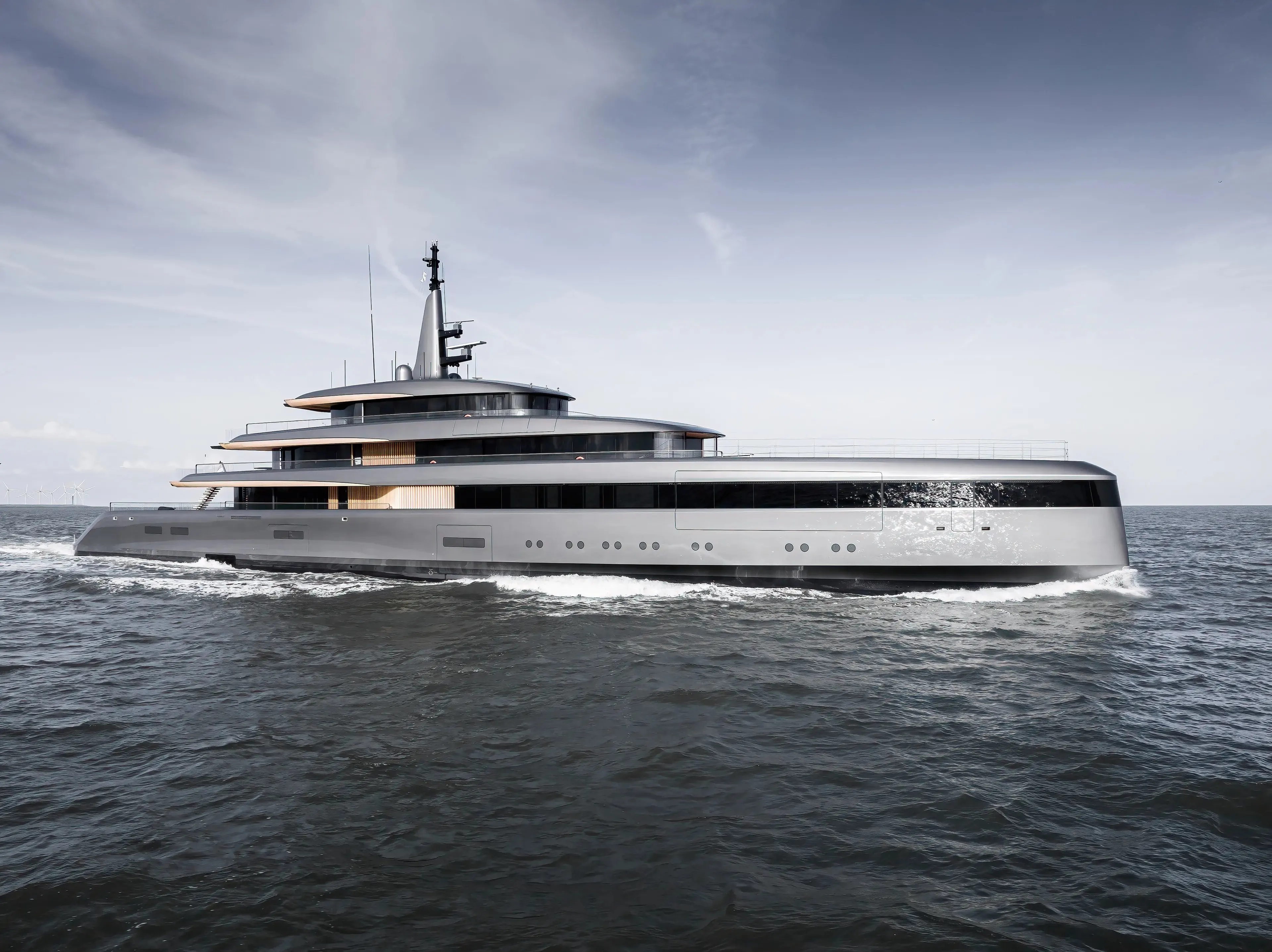
The exterior is the work of British studio RWD, developed in collaboration with MONK Design, and it wears its efficiency quietly. The profile is smooth and modern, shaped to reduce drag and to complement the low-emission systems beneath. Removing the drive shafts and rudders allowed the naval architects a freer hand with the hull form, since the appendages that usually add drag are gone. That cleaner underwater shape contributes directly to the yacht's efficiency.
Above the waterline the design frees up unusual space for guests. Without the machinery arrangement of a conventional yacht, the layout could be reorganised to give more room to living areas. Wide decks and generous glazing keep the interior connected to the sea and the surroundings. The exterior spaces are set up for relaxed use in a range of climates. The whole package shows how an environmental brief can shape the look and feel of a yacht in positive ways.
A new-generation Feadship built around carbon reduction, with no drive shafts and no rudders.
Space unlocked by clever engineering
Inside, RWD carried the design through to the guest spaces, which benefit directly from the yacht's unusual engineering. The absence of shafts and rudders and the compact electric drive allowed the accommodation to be laid out with more freedom than usual. Obsidian offers seven staterooms, with volumes that feel generous for an 84-metre yacht. The interior tone is contemporary and warm, in step with the exterior styling. Fine materials and Feadship joinery give the rooms the depth expected at this level.
The quiet running of the yacht shapes the interior experience as much as any finish. Because the battery bank can carry the hotel load at anchor for many hours, guests can enjoy still, silent nights without a generator humming in the background. That calm is a luxury in its own right and a direct product of the propulsion design. Living spaces are arranged for comfort across long stays aboard. The result is a modern interior that feels light, open and unusually peaceful.
The Feadship Advanced Electrical Drive
Obsidian is built around Feadship's Advanced Electrical Drive programme, a diesel-electric hybrid with a large lithium battery bank of about 4.5 megawatt-hours across 560 modules. That is roughly four and a half times the electrical storage of Savannah, the yard's first hybrid, and it runs at 1,000 volts against the earlier yacht's 560. Four variable-speed generators based on modified Caterpillar C32 engines feed the system. Propulsion and steering come from a pair of Veth contra-rotating thrusters, which do away with both drive shafts and rudders.
In practice the system gives Obsidian real electric capability. She can cover around 35 nautical miles at 10 knots on battery power alone, and hold her hotel loads at anchor for 10 to 15 hours in silence. Her generators can run on second-generation HVO biofuel, which the yard says cuts carbon emissions by about 90 per cent compared with fossil fuel. Together these features attack emissions from several directions at once. The engineering is the reason Obsidian can back up its environmental claims.
An owner brief that moved the market
Obsidian exists because her owner asked for it, setting a directive to reduce carbon emissions that shaped the entire project. Feadship has not named the owner, in keeping with its usual discretion. What the yacht demonstrates is that demand for cleaner superyachts is coming from clients themselves, not only from regulators. That shift matters for the whole industry, since owner appetite drives what yards develop. Obsidian turned a personal value into a working vessel.
As a market signal, Obsidian carries weight well beyond her own decks. She shows that a full-custom flagship can chase serious efficiency gains without giving up comfort or style, which reshapes what buyers can reasonably ask for. Feadship has used the lessons from her build to inform later projects on the path to its 2030 target. For owners weighing a new commission, she is proof that sustainability and desirability can be specified together. Her influence is likely to outlast the novelty of her technology.
Engines and systems
| Propulsion and hybrid-electric plant | Diesel-electric hybrid, Feadship's FAED system. Four custom variable-speed generators, two larger and two smaller, based on modified Caterpillar C32 diesel engines with permanent-magnet alternators feed a 1,000-volt DC system and a 4.5 MWh battery bank of 560 modules, housed in a chilled room amidships on the tank deck, up from 560 volts and roughly a quarter the storage on Feadship's previous hybrid, Savannah. Actual thrust and steering come from twin Veth CRP contra-rotating propeller electric azimuth thrusters rated a combined 4,000 kW, with no conventional shafts or rudders at all, a genuinely unusual configuration for a yacht this size. |
|---|---|
| Top speed | 17 knots. Consistent across Boat International, YachtCharterFleet, YachtBuyer and Y.CO. |
| Cruising speed | 12 knots. The hull was specifically tank-tested and optimized around this cruise speed rather than top speed, per Feadship's own CEO. |
| Range | Sources disagree: YachtCharterFleet and YachtBuyer both state 5,500 nautical miles at 12 knots; CharterWorld states more than 8,000 nautical miles at 12 knots. Both figures are reported here as a stated conflict rather than resolved, since neither source cites underlying fuel-consumption data. |
| Battery-only endurance | Approximately 35 nautical miles at 10 knots on battery power alone and 10 to 15 hours of fully silent hotel and house-load operation at anchor with generators off. |
| Fuel tankage | 255,000 litres. |
| Fresh water | 52,400 litres. |
| Stabilisers | Described only generically as capable underway and at anchor; no brand or model is published in any source found. |
| Hull, naval architecture and construction | Feadship De Voogt Naval Architects; steel hull, aluminium superstructure, teak decks. Carbon fibre is used for the aft deck overhangs specifically so they need no support pillars, offsetting some of the added weight of the battery bank and electrical system. The engine room is built on a single level, an unconventional layout for a project this size, requiring the thrusters, generators and batteries to be distributed rather than grouped in one central machinery space. |
| Tenders | Twin custom electric-powered tenders built by Tenderworks, served by four fast-charging stations built into the yacht's profile, among the first primary tenders on a yacht this size to be fully electric rather than diesel. |
| Guest amenities: beach club, pool, wellness | Beach club and pool area on the sun deck, a gym and a jacuzzi. An Aqua Lounge with large underwater-level windows doubles as a cinema or classroom space. A bow observation lounge has floor-to-ceiling double-curved glass. These amenity details are drawn from brokerage and trade-press coverage rather than a single authoritative deck plan, so treat specific room functions as broadly but not precisely sourced. |
| Classification | Lloyd's Register 100A1 SSC Yacht Mono, G6, LMC UMS, Hybrid Power notation. |
What owners and crew report
Feadship's CEO frames Obsidian as a deliberate break from top-speed thinking toward efficiency-first design
"We'd better start building something that has no impact!" "This is the first boat that I have sold that has been tied to cruising speed." "Being on board is like nothing you have experienced. It is almost completely flat." These are first-hand yard statements from the builder's own CEO, promotional in nature but genuine and specific about the design philosophy.
Henk de Vries, CEO, Feadship, quoted in SuperyachtNews.comThe build team says the energy-saving measures are too numerous to easily list, a first-hand but promotional statement from the project's own manager
"There are so many points of energy savings integrated on this yacht that it is hard to count." Jansen led the build project and is describing peak-load shaving, waste heat recovery and HVAC redesign carried out after trials showed 60 percent of onboard energy going to hotel load.
Mark Jansen, Project Manager, Feadship, quoted in Feadship's own press release and reproduced by YachtWorld and Marine Industry NewsFeadship's own CEO acknowledges the carbon-reduction ambition has a real fuel-flexibility cost
De Vries states that running on methanol instead of diesel or HVO requires double-walled tanks and piping that eat into usable tank volume and estimates roughly a 50 percent range reduction versus diesel or HVO operation if methanol were used. This is a rare instance of the yard itself naming a hard tradeoff rather than only listing benefits.
Henk de Vries, CEO, Feadship, quoted in SuperyachtNews.com
What is good, and what to watch
Strong points
- A genuine step-change in yacht hybrid-electric architecture, not an incremental updateA 4.5 MWh battery bank of 560 modules running at 1,000 volts DC, versus the 560-volt system on Feadship's previous hybrid Savannah, roughly 4.5 times the electrical storage of its own prior flagship hybrid, giving 35nm of pure-battery cruising at 10 knots and 10 to 15 hours of fully silent operation at anchor.
- Contra-rotating electric thrusters replace shafts and rudders entirely, a rare configuration at this sizeTwin Veth CRP electric azimuth thrusters, developed jointly with Feadship using CFD analysis of the drive legs and propellers to cut drag and vibration. Removing shafts and rudders is a structurally different propulsion layout from almost every other yacht in this size class.
- The carbon-reduction claims are backed by a documented, if modelled, methodology rather than marketing language aloneEnvironmental performance, 27 percent less impact than a comparable five-year-old fossil-fuel yacht and 60 percent less on HVO, is calculated using Feadship's own Yacht Environment Transparency Index, developed with the Water Revolution Foundation and since taken up industry-wide as a joint industry project.
- HVO biofuel compatibility is a working decarbonization path today, not a future promiseSea trials were run on hydrotreated vegetable oil, a drop-in renewable diesel substitute, giving a claimed 90 percent carbon emissions cut versus fossil diesel on the same generators, with no engine redesign required.
What to watch
- The headline environmental figures are projections, not measured in-service resultsThe 27 percent and 60 percent environmental-impact reduction numbers come from the YETI model's operational-profile predictions, based on fleet AIS data, not from metered performance after two-plus years in service. A buyer should treat them as engineering estimates rather than audited outcomes.
- The efficiency-first hull is explicitly optimized for 12-knot cruising, not for speed or performance flexibilityFeadship's own CEO says this is the first yacht he has sold that was tied to cruising speed rather than top speed. Top speed of 17 knots is modest for an 84m yacht. The hull's efficiency gains come partly at the cost of high-speed performance headroom.
- Contra-rotating azimuth thrusters are a newer, more mechanically complex configuration with a thin service track record at this sizeCoaxial contra-rotating drive arrangements are inherently more complex and maintenance-intensive to install and service than a conventional single-propeller shaft line, a point acknowledged in general marine engineering literature, even though Veth markets the units as designed for easy field maintenance. As a first-generation application on a yacht this size, long-term serviceability and parts or support depth outside Veth's own network is unproven.
- Ownership, build price and running costs are not officially published and the figures circulating are thinly sourcedNo broker or the yard has published a sale price. A widely repeated $180 million figure and a roughly $20 million annual running-cost estimate trace back to aggregator sites, not to Feadship, Boat International or any brokerage listing, all of which explicitly list price as unavailable. The same class of source names Karel Komarek as owner; this is single-sourced speculation, not confirmed by the yard or by Boat International or SuperYacht Times. It is treated here as unverified.
Practical detail
| Asking/build price | Not officially published by Feadship or any brokerage. Boat International, YachtBuyer, Yacht Harbour and Y.CO all list price as unavailable or on request. A $180 million figure and an approximate $20 million annual running-cost estimate circulate on yacht-spotter aggregator sites but are not independently confirmed and should be treated as unverified estimates. |
|---|---|
| Ownership and sale history | Obsidian was delivered new to her first owner in 2023 and no resale has been recorded. A single aggregator source names Czech billionaire Karel Komarek as owner; this is not confirmed by Feadship, Boat International or SuperYacht Times. That same source also carried inconsistent specs elsewhere on the same listing, which weakens confidence in the claim. |
| Charter availability | Not available for charter. YachtCharterFleet's own listing states the yacht is not for charter and confirms she is privately owned and operated. |
| Delivery date | Launched April 2023, delivered 31 July 2023. Some trade outlets date the delivery news to August 2023, likely reflecting when the story broke rather than the handover date itself, a minor discrepancy worth noting rather than resolving. |
| What is not published | No confirmed sale or build price, no confirmed owner identity, no audited real-world fuel or emissions performance data beyond the YETI model projections, no disclosed annual running costs, no stabiliser brand or model and no guest or owner testimonials about time actually spent aboard. |
Questions owners ask
How big is the Feadship Obsidian?
LOA: 84.2 m. Delivered: 2023.
What does the Feadship Obsidian cost?
Value estimated at approx. USD 180 million by SuperYachtFan. Unofficial estimate, no builder-published price.
Who is the Feadship Obsidian for?
Owners who want a large custom yacht with a genuinely lower environmental footprint, backed by measurable figures rather than claims.
What is the Feadship Obsidian good at?
A genuine step-change in yacht hybrid-electric architecture, not an incremental update. A 4.5 MWh battery bank of 560 modules running at 1,000 volts DC, versus the 560-volt system on Feadship's previous hybrid Savannah, roughly 4.5 times the electrical storage of its own prior flagship hybrid, giving 35nm of pure-battery cruising at 10 knots and 10 to 15 hours of fully silent operation at anchor.
What are the drawbacks of the Feadship Obsidian?
The headline environmental figures are projections, not measured in-service results. The 27 percent and 60 percent environmental-impact reduction numbers come from the YETI model's operational-profile predictions, based on fleet AIS data, not from metered performance after two-plus years in service. A buyer should treat them as engineering estimates rather than audited outcomes.
What do owners and crew report about the Feadship Obsidian?
"We'd better start building something that has no impact!" "This is the first boat that I have sold that has been tied to cruising speed." "Being on board is like nothing you have experienced. It is almost completely flat." These are first-hand yard statements from the builder's own CEO, promotional in nature but genuine and specific about the design philosophy. (Henk de Vries, CEO, Feadship, quoted in SuperyachtNews.com)
Design
| Exterior | RWD (Redman Whiteley Dixon), in collaboration with MONK Design |
|---|---|
| Naval architecture | Feadship - De Voogt Naval Architects |
Who it is for: Owners who want a large custom yacht with a genuinely lower environmental footprint, backed by measurable figures rather than claims.
Guide price: Value estimated at approx. USD 180 million by SuperYachtFan. Unofficial estimate, no builder-published price.