42 Classic
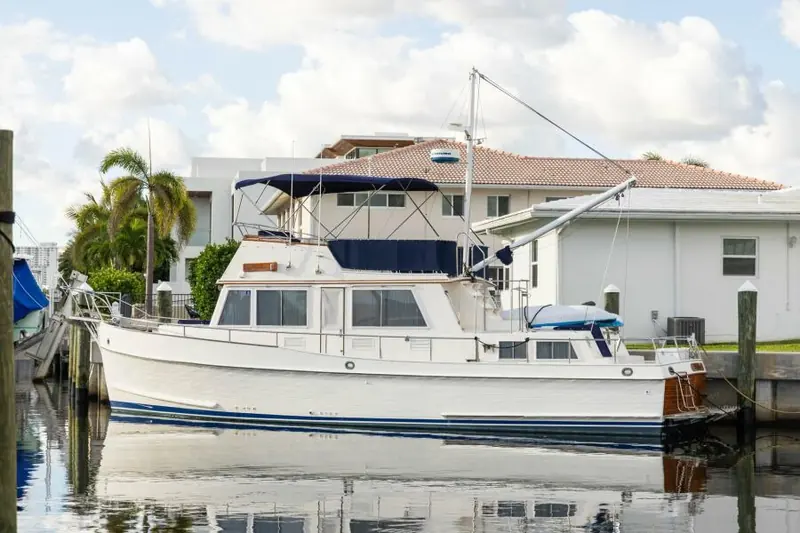
| Length overall 42 ft 7 in to 43 ft 3 in, beam 13 ft 7 in to 14 ft 1 in, draft about 4 ft 2 in | |
| Displacement 34,000 to 36,000 lb | |
| Diesel 600 US gal in two steel tanks, water 235 to 300 gal | |
| Twin Ford Lehman 120 or 135 hp, Caterpillar 210 or 375 hp, Cummins 300 hp; single engine standard | |
| Cruise 8 to 10 knots, top speed 15 to 21 knots depending on engines | |
| Mahogany to hull 352; fibreglass from hull 353 in 1973 | |
| Designer Ken Smith; 1,560 built by 2005 per the builder |
The boat that made the trawler a recreational category
Grand Banks says the 42 was conceived shortly after the 36 and that 1,560 of them came off the line before it was retired in 2005. Sea magazine's Eston Ellis dates the first 42 to 1966. A yacht directory lists a '42 Classic (Mk1)' as built from 1975 to 1991, which may reflect the 1991 hull change described below rather than the start of the model; no source we read says so. The Classic is the most popular of four versions, alongside the Motor Yacht, the Europa and the short-lived Sports Cruiser. Jack Hornor, writing in BoatUS Magazine, called it a near-perfect coastal cruiser and said the design changed little in four decades.
It isn't a boat for crossing oceans, and Hornor says so himself: it is not the right boat for someone who wants a full displacement ocean-going motor vessel. It is a boat people buy to go slowly and stay dry. Both Sea and BoatUS describe a dry, stable ride in conditions that would pound a flatter hull. We found no independent instrumented sea trial of a 42 Classic with measured fuel burn, so the performance picture below rests on a magazine survey, owner posts and seller claims.
Size, weight and tankage, and where sources differ
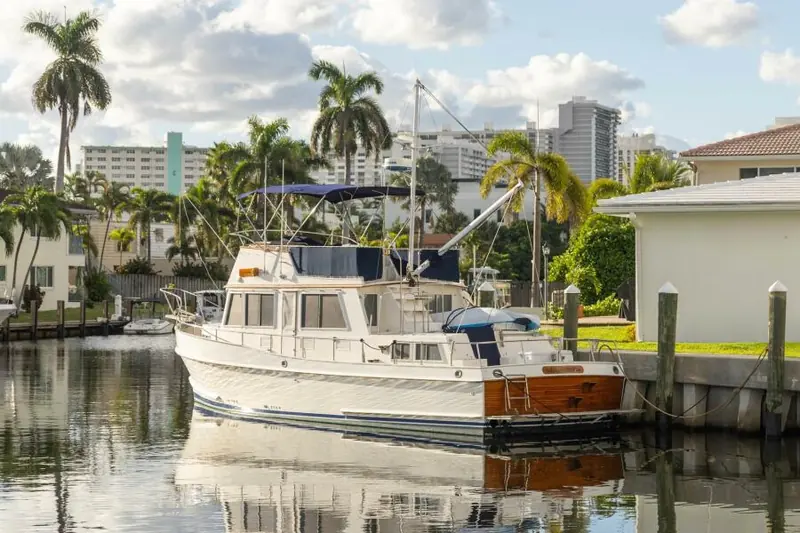
Those ranges come from Jack Hornor's BoatUS Magazine review, and he says the exact figures vary by model, year and engines. His text says the 1991 retool lengthened the hull by eight inches and widened it by six. Sea magazine says the 1991 change increased beam and waterline length slightly and lifted hull speed from 8 to 9 knots. A 1981 boat listed on YachtForums gave 42 ft 0 in by 13 ft 7 in at 34,000 lb, and a 1985 listing on Captain's Market gave 42 ft 7 in by 13 ft 7 in with 4 ft 2 in draft. Both agree with the lower end of Hornor's ranges.
Tank figures differ in small ways. Fuel is 600 gallons everywhere, and the YachtForums listing confirms two 300-gallon steel tanks. Hornor's own spec line lists fuel as 300 gallons while his text says 600, so read that as one tank. Fresh water is 235 to 300 gallons in Hornor's range, 271 gallons on the 1981 listing and 265 on the 1985 one. Holding tanks are listed at 50 and 80 gallons on those two boats. Air draft, the height with the mast and radar, is not published in any source we read.
A dry, steady 42-foot hull that has barely changed since the 1960s, at a price that depends entirely on what is under the deck.
Mahogany to fibreglass in 1973, with the wood still molded into the hull
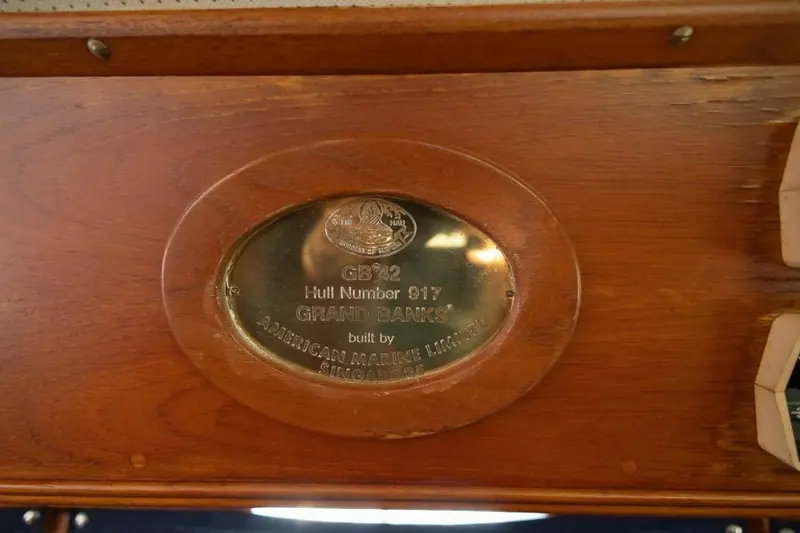
Hornor puts the wooden production at just under 350 hulls and Sea says just over 350 mahogany boats, which matches the hull-353 changeover. Sea adds that well over 1,000 fibreglass 42s followed, which adds up with the builder's total of 1,560. The fibreglass hulls kept molded planking lines to look like wood and a teak-planked transom, and the hull has fibreglass stringers with closed-cell foam. Hornor calls the construction not high tech but strong and well done. The builder plate on a 1985 boat in a recent listing reads 'GB42, Hull Number 917, built by American Marine Limited, Singapore', which fits the sequence: roughly 560 hulls in about twelve years after hull 353.
The deck is the weak point. It is fibreglass over a plywood core with a teak overlay fastened by screws, and Hornor warns that fastenings and bedding compounds loosen, letting water into the core. His repair estimate if it is left is over $25,000. Fibreglass hulls can blister; he says he has not seen a case that weakened a hull, but a repair commonly costs $10,000 to $15,000 and the condition hurts resale. Most 42s have mechanical steering with a sprocket, chain and stainless cable, which Hornor calls sound though it can feel sloppy; a hydraulic system was an option from about 1995.
Eight knots on 3 to 5 gallons an hour, and what faster costs
Sea magazine's Eston Ellis reported the following for the Classic. With twin 135 hp Sabre Lehmans it burned 3.1 gallons an hour at 9.2 knots and 6.6 at 12.2 knots. With twin 300 hp Cummins it made 11.9 knots on 5.6 gallons an hour and 18.9 knots flat out on 16.2. With twin 375 hp Caterpillars it burned 6.9 at 9.9 knots, 12 at 16.2 and 21.5 at its 21-knot top speed. Hornor gives twin 210 hp Caterpillars at about 10 knots on 9 gallons an hour and 15 knots on 23, which he describes as a 50 per cent speed gain for nearly a 200 per cent jump in fuel. Sea's article carries no date.
The Lehman figures from Sea look generous against what owners and sellers say. A 1981 listing on YachtForums had its seller claiming 3.5 gallons an hour at 7 knots on twin Ford Lehman 120s. Search excerpts of Trawler Forum threads put owners with twin 120s at 2.5 to 3.5 gallons an hour a little under 8 knots and an owner with twin 135s at about 4.9 gallons an hour at 8 knots; we could not open those threads to check them. Sea's range claim of about 1,000 miles at 8 knots on 600 gallons implies about 4.8 gallons an hour with a reserve, which sits nearer the higher owner number. A 1985 Caterpillar 3208 boat is listed at 4 to 5 gallons an hour, which is the seller's figure.
Two cabins, two heads, and a saloon in the middle
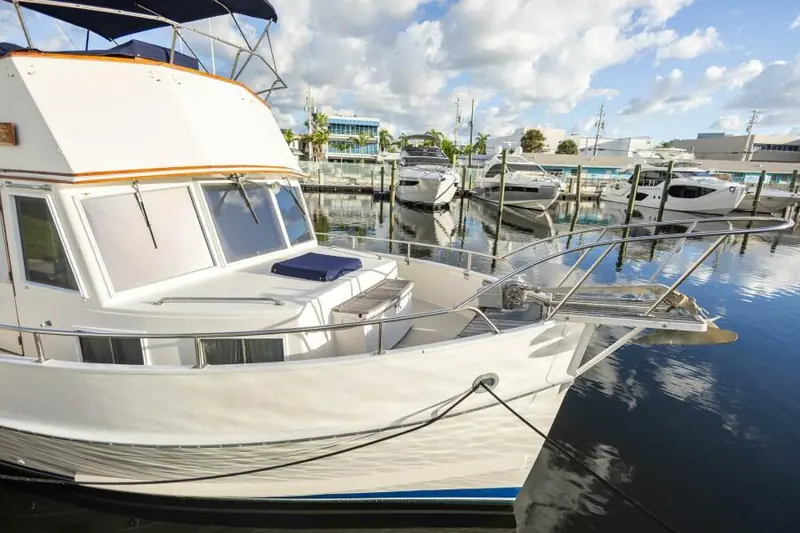
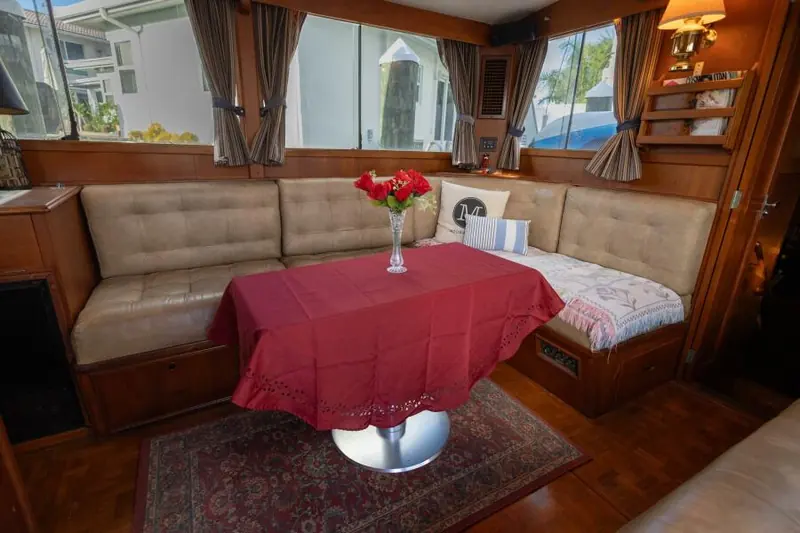
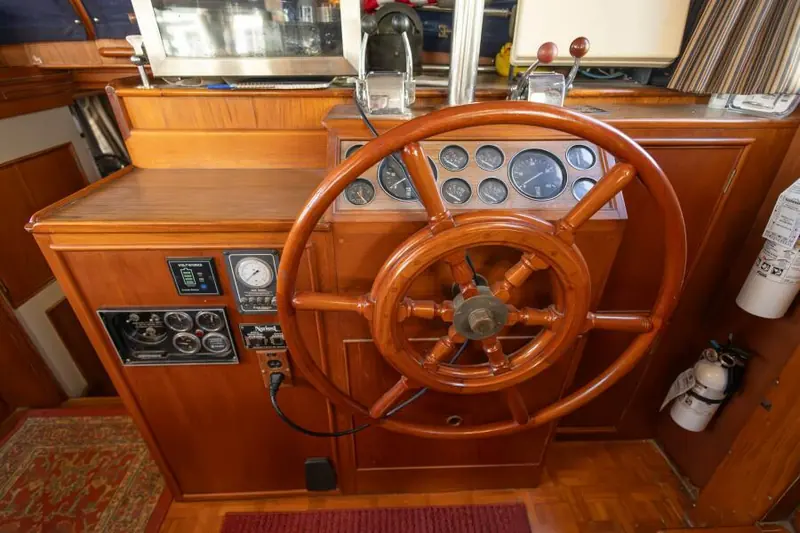
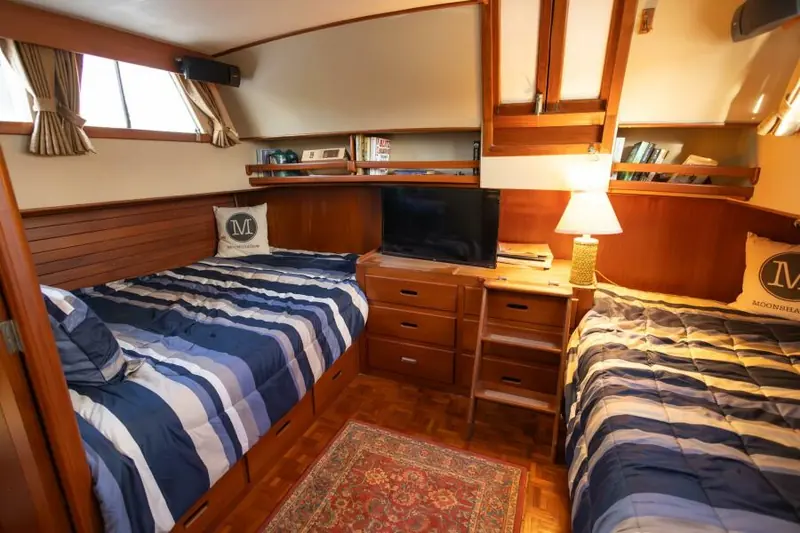
Sea describes the Classic's walk-around decks protected by rails, an easily reached flybridge and an aft deck behind a large master stateroom. Hornor adds that the saloon has an L-shaped dinette aft to starboard and a settee opposite, a galley forward to port that is short of counter but generous with storage, and a lower helm forward and to starboard. The forward cabin has a V-berth to starboard and headroom well over six feet. Aft there is either a double and a single berth or, in an optional layout, a queen island berth with a desk. The flybridge is nearly 15 feet long and seats six. Photographs of a 1985 boat show the same arrangement, with parquet floors, teak panelling, a wooden wheel and tan leather seating.
The Motor Yacht extends the aft cabin to the hull sides and transom and gives up the aft deck and rear walk-around. The Europa has covered side decks, a hardtop over the aft deck and a smaller second cabin forward in place of the big aft stateroom. The Sports Cruiser looks like the Europa without the covered side decks or hardtop and Sea says it was only built for a short time and is rare. Hornor's complaints about the Classic itself are practical ones: the deck areas are small and not for lounging, and the turning radius is poor with a single engine, so he recommends a thruster on those boats.
Lehman 120s to Caterpillar 375s: the engine generations
Hornor says a single diesel was always the standard equipment, but most original buyers took twins. Ford Lehmans of 120 and 135 hp dominated in the 1970s and 1980s and the 210 hp Caterpillar has been popular since its introduction because it runs efficiently at displacement speed while keeping reserve for planing. Sea adds 300 hp Cummins and 375 hp Caterpillars. A 1981 boat on YachtForums had twin Ford Lehman 2715E engines of 120 hp with Borg Warner direct-drive gearboxes, one engine rebuilt at 1,082 hours. A 1985 boat in a recent listing had twin Caterpillar 3208s of 210 hp with 2,400 hours each and a 7.5 kW Westerbeke generator with 580 hours. Single-engine boats range from 120 to 375 hp and cruise at 7 to 10 knots.
The engine room is roomy with access to the generator and other equipment. Until about 1991 the builder used commercial acoustic tiles for insulation, which hold moisture and were later replaced with a marine material. The 600 gallons sit in two steel tanks outboard of the engine space. Thrusters, stabilisers and a generator are not mentioned as standard anywhere; the 1985 boat in the listing carries a watermaker, stabilisers and an inverter, but the listing presents those as extras, not factory fit. We found no source for the factory propeller and shaft specification.
What a used 42 costs and what usually goes wrong
Prices disagree because the sources are from different years. A 2014 YachtForums listing asked $69,999 for a 1981 boat with 1,474 engine hours. A Captain's Market listing, which we read on 17 November 2026, asks $99,500 for a 1985 boat. Hornor's BoatUS review found ten for sale at asking prices starting at $55,000 for a wood-hulled boat, six fibreglass boats from $140,000 (1974) to $295,000 (1988), and asking prices on average 17 per cent above the highest published book value. Sea says most used models sell for $215,000 to $627,000, a range that covers Europas and Motor Yachts too. We could not establish what a 42 cost new, because the Classic was discontinued in 2005 and no price sheet turned up.
Hornor's costs for the big problems are a steel fuel tank at $4,000 to $6,000 each, blister repair at $10,000 to $15,000 or more, and deck core repair at over $25,000 if left. He also says a wooden pre-1973 boat adds at least $100 per foot a year over a fibreglass one in upkeep. Trawler Forum posts, again as excerpts, say the deck-fill leak, rotted core and rusted tank sequence is a known pattern, that one owner budgets $15,000 a year within 20 per cent for slip, insurance, hauling and 100 to 200 hours of use, and that Caterpillar owners should keep about $2,500 a side for turbocharger and engine work. Window leaks around the sliding sashes are another recurring job, usually controlled with annual cleaning of the tracks and drains.
Engines and systems
| Engines by generation | Ford Lehman 120 hp (2715E) and 135 hp (Sabre Lehman) in the 1970s and 1980s; Caterpillar 3208 210 hp from early on and the common choice since; Cummins 300 hp and Caterpillar 375 hp in later boats; Volvo Penta also offered. A single engine was standard, with 120 to 375 hp, though most original buyers took twins. |
|---|---|
| Gearboxes and propulsion | Borg Warner direct-drive gearboxes on a 1981 twin-Lehman boat per a YachtForums listing. Shafts and propellers: not published in any source we read. |
| Generator | Not a standard item in the sources. A 1985 boat in a recent listing carries a Westerbeke 7.5 kW unit with 580 hours; the engine room has access for a generator. |
| Stabilisers and thrusters | Neither is standard that we found. Hornor recommends a bow or stern thruster on single-engine boats because the turning radius is poor. A 1985 listing shows stabilisers fitted as an extra. |
| Steering | Mechanical sprocket, chain and stainless cable on most boats; hydraulic offered from about 1995. An emergency tiller exists but gives the helmsman no forward view. |
| Tankage | Diesel 600 US gallons in two steel tanks of 300 gallons each, outboard of the engine space. Fresh water 235 to 300 gallons. Holding 50 to 80 gallons on the two boats checked. |
| Steadying sail | A mast and boom for a steadying sail; the boom doubles as a davit for a dinghy of about 10 feet carried on the aft cabin top. |
| Hull and deck | Mahogany on sawn frames to hull 352; hand-laid fibreglass with foam-filled stringers and a full-length keel from hull 353 in 1973. Deck is fibreglass over plywood core with a teak overlay, screw-fastened. |
What owners and crew report
Teak decks leak around the fills, rot the core and rust the tanks
A Trawler Forum poster describes vintage Grand Banks with teak decks as notorious for water getting in at the deck fills, then into the core and then into the steel tanks. We read this only as a search excerpt because the forum blocked direct access, so the poster, date and context are unchecked.
Trawler ForumAbout $15,000 a year to run an active boat
One member put ownership at around $15,000 a year, give or take 20 per cent, covering slip, insurance, utilities, a diver, hauls and paint, scheduled maintenance and fuel for 100 to 200 hours. The excerpt described the thread as about four years old. Treat it as one person's budget.
Trawler Forum10 to 15 per cent of the boat's value a year after ten years of ownership
Another owner said maintenance runs 10 per cent, perhaps up to 15 per cent, of the boat's value each year after about ten years, and that replacing his fuel tanks convinced him the figure was realistic.
Trawler ForumLehman diesels are long-lived
A poster calls the old Lehmans great engines that can go 10,000 hours if well maintained. Separately, a 1981 boat listed with 1,474 hours had a rebuilt port engine at 1,082 hours; that is a seller's data, not an owner's report.
YachtForumsBudget for turbo and engine work on the Caterpillar boats
A forum post advises about $2,500 a side as a minimum for turbocharger or engine work on Caterpillar-era boats, even when the engines run well.
Trawler ForumAsking prices ran 17 per cent over book value
In his survey of ten boats for sale Jack Hornor found fibreglass boats asking on average 17 per cent above the highest book value for their year, and said bargains are unlikely. The article is undated.
BoatUS Magazine (Jack Hornor)No owner association or independent owner survey read in full
Two forums that carry long 42 Classic threads, Trawler Forum and a second site, put up bot checks that stopped our reading them directly, and we did not try to defeat them. Everything above from forums is excerpted and unchecked for context.
Yotters desk
What is good, and what to watch
Strong points
- A hull that is dry and stable at displacement speedsSea and BoatUS both describe an extraordinarily dry, stable ride with a deep forefoot, a full keel and hard chines aft, and a design little changed in four decades.
- Economical for a 42-footer at 8 to 9 knotsBetween 2.5 and 5 US gallons an hour on twin Lehmans depending on who is counting, with about 1,000 miles claimed from 600 gallons.
- It holds its value and has a long record1,560 built, over 1,000 in fibreglass, with a joinery quality Hornor calls the benchmark for the class and used boats he found asking above book value.
What to watch
- The deck core, the steel tanks and blisters are expensive failuresDeck repair over $25,000, tanks $4,000 to $6,000 each and blister repair $10,000 to $15,000 or more, all from BoatUS Magazine's reviewer.
- Slow, and costly to pushTwin 210 Caterpillars go from 10 knots on 9 gallons an hour to 15 knots on 23, so the boat is only economical when driven slowly.
- Small decks, poor turning, loose steering feelThe deck areas are small and not for lounging, single-engine boats need a thruster in tight spaces, and the chain and cable steering feels sloppy.
Practical detail
| New price | Not published. The Classic was retired in 2005 and no price list turned up. |
|---|---|
| Used price | $99,500 asking for a 1985 twin Caterpillar boat in a Captain's Market listing read on 17 November 2026; $69,999 asked in 2014 for a 1981 twin Lehman boat; Hornor's undated survey saw $55,000 for wood and $140,000 to $295,000 for 1974 to 1988 fibreglass boats. These are asking prices, not sale prices, and the sources are of different years. |
| Running costs | One forum member budgets about $15,000 a year for an active boat in a busy market, give or take 20 per cent; another says 10 to 15 per cent of value a year after ten years. Fuel is 2.5 to 5 US gallons an hour at 8 to 9 knots on twin Lehmans. All anecdotal. |
| Berthing and yard | No source gave a fee. For sizing a slip: 42 ft 7 in to 43 ft 3 in overall, 13 ft 7 in to 14 ft 1 in beam, 4 ft 2 in draft. Boats were built by American Marine in Singapore until 1995 and in Pasir Gudang, Malaysia after that; today's builder supports owners from Stuart, Florida and Newport, Rhode Island according to its filings. |
| What to check on a used one | Deck fastenings and the plywood core, especially around the fuel fills; the two steel fuel tanks; blistering; the sliding window tracks and drains; steering cables and chain; the engine-room insulation before 1991; turbochargers on Caterpillar boats. Pre-1973 boats are wood and need a wooden-boat survey. |
| Range under power | About 1,000 miles at 8 knots on twin Lehmans per Sea, which implies about 4.8 gallons an hour. Other sources suggest more at lower burn rates. |
| What is not published | Any independent sea trial with measured fuel burn, a factory price list, air draft, the propeller specification, and a verified owner survey of faults. |
Questions owners ask
How big is the Grand Banks Yachts 42 Classic?
Length overall 42 ft 7 in to 43 ft 3 in, beam 13 ft 7 in to 14 ft 1 in, draft about 4 ft 2 in. Displacement 34,000 to 36,000 lb.
What does the Grand Banks Yachts 42 Classic cost?
No new price published. Used asking about $70,000 to $100,000 in the listings read; see the practical block.
Who is the Grand Banks Yachts 42 Classic for?
A couple or small family who want a slow, dry, easily handled coastal cruiser with two cabins and two heads and who will pay for upkeep on a boat that is 30 to 50 years old.
What is the Grand Banks Yachts 42 Classic good at?
A hull that is dry and stable at displacement speeds. Sea and BoatUS both describe an extraordinarily dry, stable ride with a deep forefoot, a full keel and hard chines aft, and a design little changed in four decades.
What are the drawbacks of the Grand Banks Yachts 42 Classic?
The deck core, the steel tanks and blisters are expensive failures. Deck repair over $25,000, tanks $4,000 to $6,000 each and blister repair $10,000 to $15,000 or more, all from BoatUS Magazine's reviewer.
What do owners and crew report about the Grand Banks Yachts 42 Classic?
A Trawler Forum poster describes vintage Grand Banks with teak decks as notorious for water getting in at the deck fills, then into the core and then into the steel tanks. We read this only as a search excerpt because the forum blocked direct access, so the poster, date and context are unchecked. (Trawler Forum)
Who it is for: A couple or small family who want a slow, dry, easily handled coastal cruiser with two cabins and two heads and who will pay for upkeep on a boat that is 30 to 50 years old.
Guide price: No new price published. Used asking about $70,000 to $100,000 in the listings read; see the practical block.