Octopus
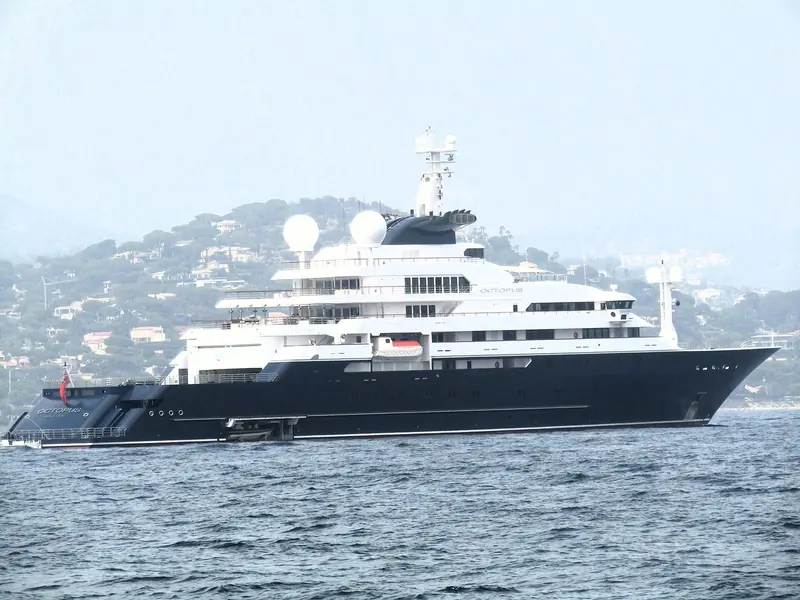
| LOA | 126.2 m |
|---|---|
| Builder | Lurssen |
| Delivered | 2003 |
| Gross tonnage | about 9,932 |
| Design | Espen Oeino |
| Hull | ice-class steel |
| Range | 12,500 nm |
| Signature | two submarines aboard |
The explorer that redefined the type
When Octopus was delivered in 2003, she effectively created the modern idea of the giant expedition yacht. At 126 metres and built to full ice class, she combined true exploration capability with the comfort of a great private yacht. She held the title of the world's largest explorer for well over a full decade. Lurssen built a vessel that genuinely changed how owners thought about going to sea. She turned the whole idea of the expedition yacht into a serious and lasting pursuit.
The demanding brief called for genuine scientific and exploration ability standing alongside real luxury, and the yard delivered both in full. Very few yachts before or since have ever carried her sheer range of capability. Octopus proved conclusively that a private yacht could reach the very ends of the earth in style. She remains the standing benchmark for the entire explorer category she helped to create. Her long legacy went on to shape a whole generation of explorer yachts.
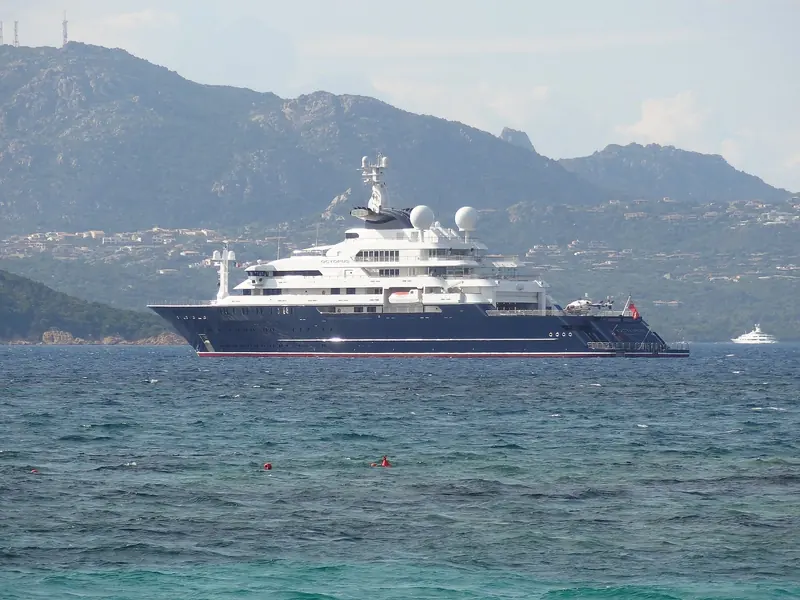
Espen Oeino's purposeful profile
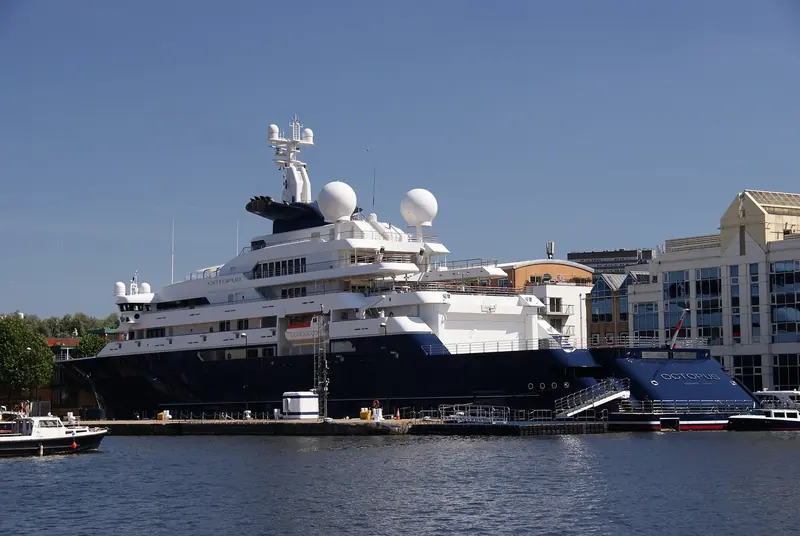
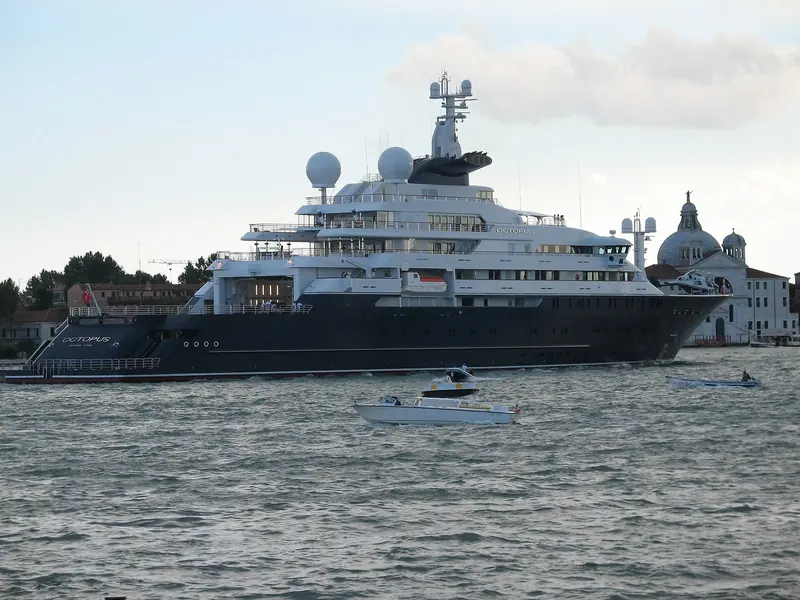
Espen Oeino gave Octopus a robust and deeply purposeful exterior built squarely for the wildest waters. Her ice-class steel hull and full eight decks give her the substance to operate safely in the polar regions. The profile is workmanlike and quietly confident, shaped closely around her exploration equipment. She looks exactly like the genuinely capable expedition ship that she is. Her form very clearly follows her purpose in every single line.
The design carefully integrates a helipad forward and a larger landing deck aft with a hangar for two helicopters. An internal dock houses a 20-metre guest tender alongside the yacht's two submarines. Oeino balanced all of that serious capability with the real presence of a great private yacht. The exterior carries her exploration mission openly and with evident pride. The internal dock is among the most capable systems ever built into any yacht.
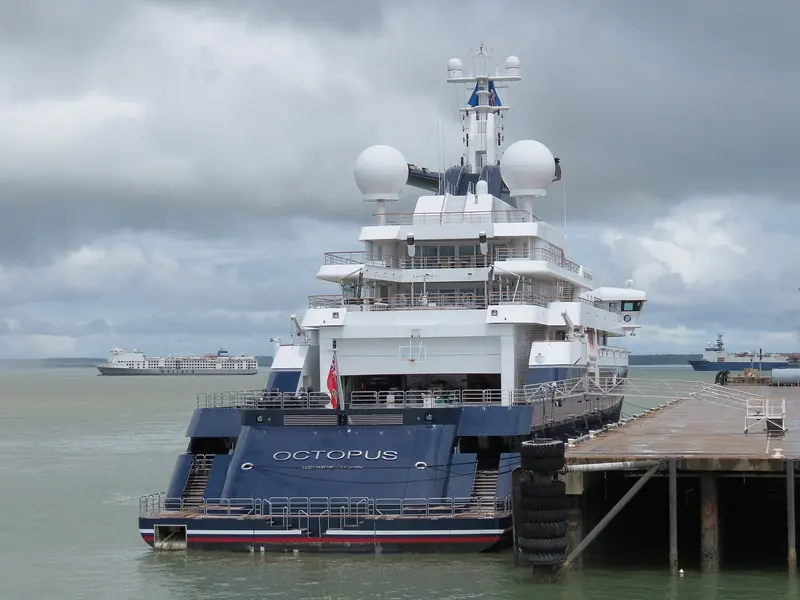
The explorer that located the Musashi, carrying two submarines and a studio.
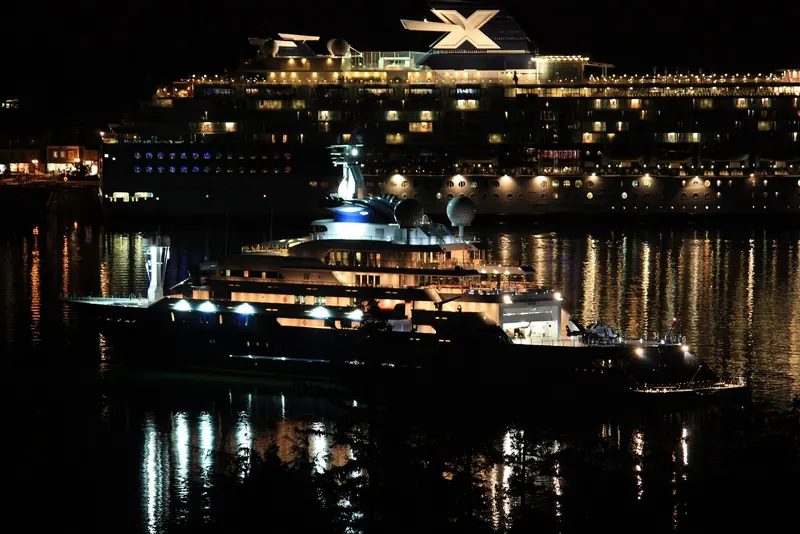
Two submarines and a recording studio
Octopus is every bit as remarkable inside and below decks as she is out on the water. She carries two submarines, one of them remotely operated for reaching greater depths, along with a professional recording studio. A dive centre, a beach club and extensive guest spaces complete the picture below. The vessel was equipped from the outset for both serious exploration and genuine enjoyment. Very few private vessels anywhere have ever carried such serious working equipment.
She accommodates 26 guests across thirteen staterooms with a large and experienced crew in support. The interior runs to a cinema, a spa and generous social areas spread right across her decks. Everything aboard was built for long voyages far from the nearest port. Octopus was made to be lived aboard for weeks at a time in genuinely remote waters. The living spaces make even months at sea feel genuinely comfortable.
Ice class and a 12,500-mile range
Octopus was engineered for true self-sufficiency in even the harshest of conditions. Her ice-class hull and 12,500-nautical-mile range let her reach the polar regions and cross whole oceans without support. She was built to operate far beyond the ordinary reach of other yachts. Sheer endurance was the guiding principle behind every part of her design. Her range and endurance set her clearly apart from almost every yacht afloat.
The propulsion and systems were chosen for deep reliability in remote waters where any help is distant. Full redundancy runs throughout the length of the vessel. Her onboard equipment allows genuine scientific work standing alongside private cruising. Octopus can go almost anywhere on the planet and comfortably stay there. She was built above all to look after herself in the most remote places on earth.
For the owner who wants to explore
Octopus suits an owner whose deepest ambition is genuine discovery. She has cruised the polar regions and supported expeditions that located historic wrecks, including a famous battleship found in 2015. She is ideal for those who want to combine real adventure with the comfort of a great yacht. Her sheer capability quietly opens up the whole world to her owner. She richly rewards an owner with a genuine and lasting appetite for adventure.
For an owner drawn to the remote and the truly extraordinary, very few vessels can match her reach. She rewards deep curiosity and a real spirit of exploration above all else. Octopus remains one of the most capable and most storied yachts ever built anywhere. Her legend continues to grow steadily with every single voyage she makes. Her many voyages have already earned her a permanent place in maritime history.
Built to Disappear, Not to Impress
None of it is visible at anchor. A 36-metre internal wet dock opens through a transom door onto gantry cranes that launch and recover Octopus's tenders and the ten-person submarine Pagoo, built specifically for her because no commercial submersible existed that could do the job. Two helicopters fold away into hangars fed by a dual pad aft and a second pad forward, and a hyperbaric chamber and dedicated dive centre sit below decks alongside roughly 54 tonnes of AV and IT equipment. Espen Oeino's brief was to make all of it vanish, and it does: from the water she reads as a long, low motor yacht, not the floating expedition base she has always been.
Paul Allen died in 2018 and Octopus stayed on the market for the better part of two years before Swedish businessman Roger Samuelsson bought her in 2021. She then went through two refits in quick succession, the second a nine-month rebuild at Lloyd Werft in Bremerhaven finishing in 2024 that covered her 20-year survey, a full repaint and an AV and IT overhaul. Rather than retire her, Samuelsson put Octopus back to work: she now charters through Big Blue Expeditions, running seasons in Antarctica and the Pacific for guests willing to pay roughly $2.2 million a week plus expenses for the yacht that found the Musashi.
Engines and systems
| Main engines | Eight MTU 16V 4000 M70 diesels, 19,200 hp (14,300 kW) combined, driving two ABB electric propulsion motors in a diesel-electric arrangement |
|---|---|
| Speed | 19 knots top speed, 12.5 knots economical cruise |
| Range | 12,500 nautical miles at 12.5 knots |
| Hull | Ice-classed 1A steel hull with an aluminium superstructure |
| Tenders and toys | Seven tenders including a landing craft, two helicopters with an aft dual pad and hangars plus a separate bow pad, the ten-person submarine Pagoo, an ROV, and a 36-metre internal wet dock reached through a transom door and gantry cranes |
| Dive and research gear | A hyperbaric chamber and dedicated dive centre, plus roughly 54 tonnes of AV, IT and expedition equipment carried aboard |
What owners and crew report
The whole brief was to hide the equipment, not show it off
Exterior designer Espen Oeino called the brief very ambitious, because none of the tenders, tools, ROVs, subs or helicopters could be left outside; all of it had to be concealed, which is why Octopus reads as a clean-lined motor yacht rather than the support ship she actually is.
Espen OeinoAllen thought of her as a working tool, not a trophy
He described Octopus as more of a Land Rover than a Bentley, built to be used hard on expeditions rather than admired at anchor.
Paul AllenThe submarine did real deep-ocean work, not joyrides
Robert Kraft, director of subsea operations at Allen's company Vulcan Inc, oversaw dives that recovered HMS Hood's bell from around 2,700 metres and located the wreck of the Japanese battleship Musashi at about 1,000 metres, genuine historical finds rather than publicity stunts.
Robert Kraft, Vulcan Inc
What is good, and what to watch
Strong points
- Everything stays hiddenTwo helicopters, seven tenders, a landing craft, a ten-person submarine and an ROV all stow inside the hull or under deck hatches, so she never looks like the support ship she actually is.
- A genuine expedition recordRecovering HMS Hood's bell and finding the wreck of the Musashi is real historical work, not the marketing many self-styled explorer yachts settle for.
- Still earning her keep two decades onShe now charters through Big Blue Expeditions in Antarctica and the Pacific rather than sitting idle, unusual for a yacht this old.
What to watch
- Not actually fastA 19-knot top speed and a 12.5-knot cruise is modest for 14,300 kW of installed power; the hull is built for range and displacement, not speed.
- A slow, discounted saleListed at $325 million in 2019, she took roughly two years to sell and finally went for 235 million euros in 2021, a reminder that even a famous explorer yacht is a thin, patient market.
- Even her own builder's owner thought the category had gone too farPaul Allen said of his own yacht fleet that they're too big, and there are too many of them.
Practical detail
| Build cost (2003) | about $200 million |
|---|---|
| 2021 sale price | 235 million euros, to Swedish businessman Roger Samuelsson, after roughly two years on the market |
| Charter rate | from about $2.2 to 2.3 million a week plus expenses, through Big Blue Expeditions |
| Guests and crew, owner configuration | 26 guests in 13 staterooms, with 63 crew in 30 cabins |
| Guests and crew, charter configuration | 12 guests with a crew of 45, per the current charter listing |
| Range | 12,500 nautical miles at 12.5 knots, enough for an ocean crossing without refuelling |
| Latest refit | nine months at Lloyd Werft in Bremerhaven, finishing in 2024: 20-year survey, full repaint, AV and IT overhaul |
| What is not published | Samuelsson has never confirmed a running-cost figure; the industry rule of thumb of roughly 10 percent of build value a year would put it near $20 million, but that is an estimate, not a disclosed number |
Questions owners ask
How big is the Lurssen Octopus?
LOA: 126.2 m. Builder: Lurssen.
Who is the Lurssen Octopus for?
For the owner who wants a true expedition yacht able to reach the poles while carrying submarines and a studio.
What is the Lurssen Octopus good at?
Everything stays hidden. Two helicopters, seven tenders, a landing craft, a ten-person submarine and an ROV all stow inside the hull or under deck hatches, so she never looks like the support ship she actually is.
What are the drawbacks of the Lurssen Octopus?
Not actually fast. A 19-knot top speed and a 12.5-knot cruise is modest for 14,300 kW of installed power; the hull is built for range and displacement, not speed.
What do owners and crew report about the Lurssen Octopus?
Exterior designer Espen Oeino called the brief very ambitious, because none of the tenders, tools, ROVs, subs or helicopters could be left outside; all of it had to be concealed, which is why Octopus reads as a clean-lined motor yacht rather than the support ship she actually is. (Espen Oeino)
Who it is for: For the owner who wants a true expedition yacht able to reach the poles while carrying submarines and a studio.