48
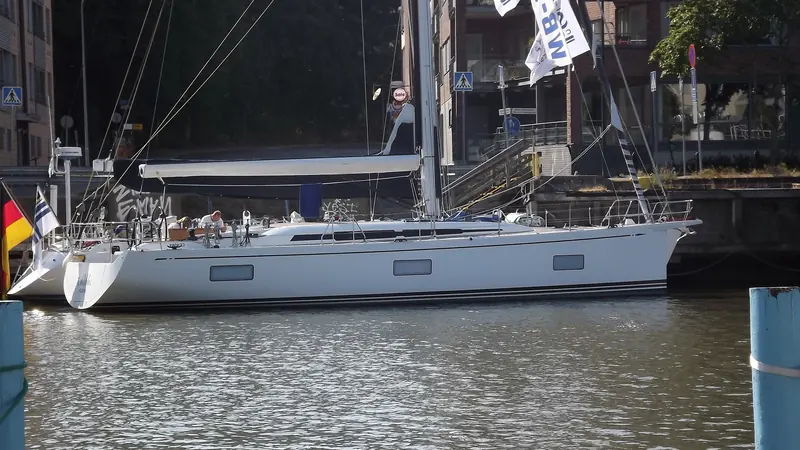
| Hull length 14.75 m (Nautor press text); overall length quoted as 15.56 m by Wikipedia | |
| Waterline 13.88 m, beam 4.59 m | |
| Draft 2.40 m standard, 2.00 m shoal | |
| Displacement 15,000 kg, ballast 5,200 kg | |
| Main 77 m2, jib 62.5 to 66 m2 depending on source | |
| Engine Volvo D2-75, about 75 hp (56 kW), saildrive | |
| Diesel 360 l, water 500 l | |
| Designer German Frers, interior Misa Poggi, twin rudders |
A Frers cruiser-racer that brought Nautor back under 50 feet
The name is confusing, so start with which boat this is. Nautor has built three different Swan 48s: the 1971 Sparkman & Stephens design, the 1995 Frers boat (the 48-2) and the current Frers boat (the 48-3) that first appeared at the Cannes Yachting Festival in September 2019. This page covers the current one. YACHT's Fridtjof Gunkel called it the first Nautor cruiser under 50 feet in a long time, and Wikipedia credits the interior to Misa Poggi. The brief, as Nautor's press material put it, was a boat a couple can manage, with private space for a family, that also does well under ORC and IRC. Yacht Style's Guy Nowell, who sailed it in Finland, concluded it sits closer to cruiser-racer than racer-cruiser.
Demand was real before anyone had sailed one. Nowell wrote that 16 boats were sold before the first launch and Sails magazine in Australia repeated the figure in 2020, adding that order books were full through 2022. Nautor's own 2023 premiere text for the MKII says the original model sold more than 50 units. No hull count is published, so treat anything more precise as unverified.
The numbers, and where the sources disagree
Displacement of 15 tonnes appears in Sails magazine and in the Wikipedia and Keelindex entries. Ballast of 5,200 kg, waterline of 13.88 m and beam of 4.59 m come from the Wikipedia entry, which cites sailboatdata, and Keelindex gives the same waterline and beam in feet. The standard draft of 2.40 m is confirmed by Nautor's own press text via Pressmare, and Wikipedia adds a 2.00 m shoal keel. Nowell and Yachting News both mention the deep keel as the performance choice. Length is the messy one: Pressmare gives 14.75 m (48.4 ft) for the hull, Wikipedia says 15.56 m and Keelindex 51.77 ft, almost certainly because they count the bowsprit and pushpit. Ask any seller which length their figure uses.
Tankage of 360 litres diesel and 500 litres water comes from Wikipedia and Keelindex, but both look like the same underlying data, so it counts as one source rather than two. Nautor's text says only that the tanks sit low in the hull. It's a sensible size for a Mediterranean or Baltic season. Nobody has published a motoring range, so range under power is not published. Sail area is also soft: the mainsail is 77 square metres in both Sails and Wikipedia, but the jib is 66 square metres in Sails and 62.5 in Wikipedia.
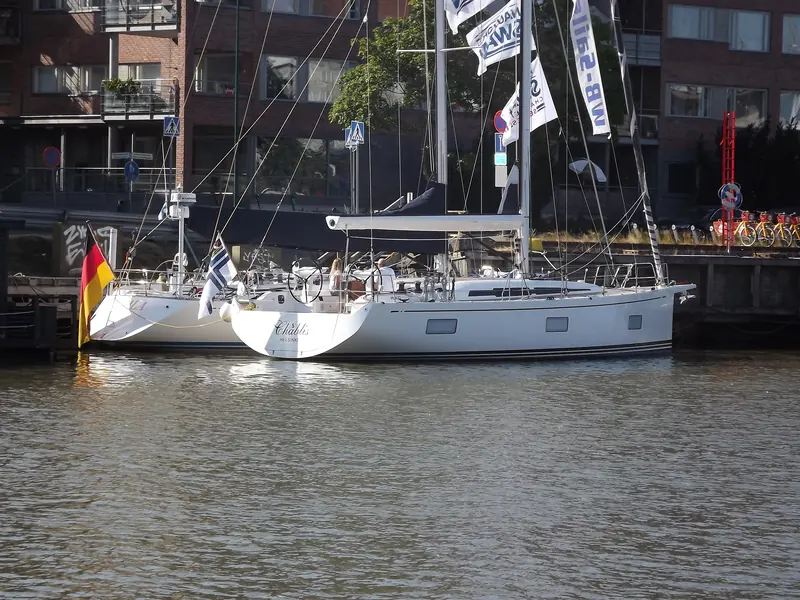
A 15-tonne Frers cruiser that gave 8.6 knots in 9 knots of wind and a helm light enough that the crew asked for slower tacks.
Light helm, 8.6 knots in 9 knots of wind, and no traveller
Nowell boarded in about 14 knots of breeze and then sailed in about 9 knots on flat water for that 8.6 knot reading. He found the helm gentle with a good fore-and-aft balance, and he says the boat is quickest at 22 to 24 degrees of heel, when the windward rudder is vertical. The hull is designed to be sailed at a maximum of about 20 degrees of heel according to YACHT, with a mast set well aft and a fixed bowsprit for a gennaker or Code 0. Sails' Crosbie Lorimer tested one in Sydney in spring 2020, but he's honest that the instruments weren't tuned, so his figures are design polars, not measurements: about 7.5 knots upwind at 10 knots true and a little over 11 under spinnaker in 20 knots. Under engine the same boat made 8 knots at 2,200 rpm.
Lorimer's critical points are specific. The German mainsheet system in a stainless frame, with no traveller, divides opinion online, and it's a racing trade-off that Nowell flags as well. The helm is so light that his crew asked for slower tacks. The sprayhood is tall against the low coachroof and shallow cockpit. None of this is a dealbreaker, but a keen trimmer will miss the traveller. Another gap: at the time of Nowell's test there was no IRC certificate, so how competitive the boat is on the racecourse was an expectation, not a result.
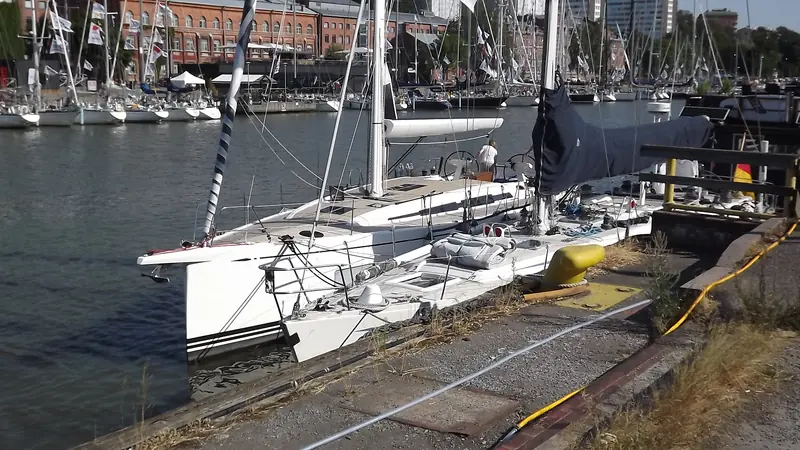
Infused vinylester, a one-piece structural grid and two watertight bulkheads
Nautor's description, reproduced by Pressmare, covers glass and foam core with vinylester resin, vacuum infusion, post-curing and a gelcoat finish, with 9 mm teak on the sidedecks, cockpit and swim platform as standard. Nowell adds the Corecell foam core and says the bottom frame carries the water and electrical services, which makes the keel loads and the tankage one engineered unit. His other observation is practical: the lockers have fabric back panels held on with Velcro so you can reach the wiring, and lines run in conduits to the winches. The mast sits on top of the keel, with loads concentrated low and amidships. YACHT also notes the dinghy garage and sail locker are sealed off from the hull.
Down below the standard layout is three cabins and two heads, each with its own shower. The owner's cabin is forward with a private bathroom, the VIP cabin is aft to starboard with two singles that join into one large berth, and a guest cabin is to port. Interior styles by Misa Poggi are called Northern Light, Blue Eyes and Red Velvet according to Yachting News, with European oak as standard in Nautor's text. Lorimer found it light and airy with full headroom in the saloon and a compact, well-braced galley, but warned the owner's shower may be tight for broad shoulders.
A Volvo saildrive of about 75 hp, with room for a generator
Sails names a 55 kW Volvo saildrive and Wikipedia lists a Volvo D2-75 of 75 hp (56 kW), which agree. Lorimer found the boat quiet enough under power to sleep through. Pressmare reports good engine room access and a space for an optional genset, and the Australian test boat carried a generator as an option, along with carbon mast and boom, 3Di sails, the deep keel, a self-furling headsail and an electric stove. That boat had no bow thruster, which is a reminder that thrusters are optional. Steering is twin rudders by Jeffa on the test boat. Nowell lists a carbon mast, a 70 cm crane and a V-boom among the options, and Lorimer mentions a 700 mm masthead crane for a flat-topped main.
In 2023 Nautor launched the MKII. Its changes are a new bowsprit, moved chainplates, a new window design on the coachroof (shared with the Swan 55 according to coverage of the Dusseldorf debut), a hydraulic transom door, a Corian galley top with rounded corners and a redesigned saloon sofa with more storage. If you're shopping used, find out which version you're standing on. The pre-2023 boats are the ones the magazine tests describe.
EUR 730,000 base in 2019, and EUR 1 million or more used
The 2019 base price came with Nowell's remark that no Swan is cheap, and the test-boat options he lists were carbon mast, crane and V-boom. Sails put the Australian price at AUD 1.2 to 1.6 million in 2020. Both are well below what the boats later asked on the brokerage market: listings seen in search results included a 2019 boat at EUR 966,000 in Rapallo, another 2019 at EUR 985,000 with Nautor's Monaco brokerage, a 2022 boat at EUR 995,000, a 2021 boat at EUR 1,240,000 in Hamburg and GBP 1,200,000 at Berthon in the UK, while 2023 MKII boats ran between about EUR 1.29 million and EUR 1.6 million. We couldn't open every listing page, so these are asking prices reported through search snippets, not sale prices.
What that suggests is that a used Swan 48 has held value well against its 2019 base price, but base price is not options price, and Swans are rarely sold bare. Nobody has published a running cost for the boat, so we won't invent one. As a rough planning rule the owner pays for a 15-tonne, 15 m yacht: berth, insurance, rig and sail maintenance and a yearly haul-out. Ask for the survey history, the engine hours and the options list, not just the headline.
Engines and systems
| Engine | Volvo diesel, 55 kW (Sails) or D2-75, 75 hp / 56 kW (Wikipedia), saildrive. 8 knots at 2,200 rpm on Sails' test boat. |
|---|---|
| Generator | Engine room has space for an optional genset (Nautor press text). Fitted as an option on the Australian test boat. |
| Rig | Fractional sloop, mast well aft on the keel, fixed bowsprit, up to four forestays (gennaker, Code 0, jib, staysail). Optional carbon mast and boom, 70 cm crane. |
| Steering | Twin rudders, Jeffa steering on the Australian test boat. Light helm per Yacht Style and Sails. |
| Mainsheet | Two systems offered, cruising and racing. The test boat had a German mainsheet system and no traveller. |
| Tankage | Fuel 360 litres, water 500 litres (Wikipedia and Keelindex, likely one underlying source). |
| Keel options | Standard 2.40 m, shoal 2.00 m, deep (named by Yachting News and Yacht Style as the performance choice). |
| Garage | Optional tender garage in the lazarette, sealed from the hull (YACHT, Nautor text). |
What owners and crew report
Light, responsive helm, easy two-up
Lorimer raised and unfurled main and jib with one person on the first Swan 48 in Australia and said the helm was so light the crew asked for slower tacks.
Sails magazine (Crosbie Lorimer, September 2020)8.6 knots in about 9 knots of wind
Nowell recorded the speed on flat water with sheets eased. He felt no sense of loading up and expected owners to cover miles without stress.
Yacht Style (Guy Nowell, September 2019)No mainsheet traveller divides opinion
Both testers flag the missing traveller. Lorimer says looks and function are divisive online and it's a racing trade-off.
Sails magazine and Yacht StyleDelivery cadence and hull numbers
Hull 218 left Finland for Spain and hull 222 reached the Dutch sales office in early 2021, which shows a steady build run in the boat's second year.
Nautor's Swan newsletter (February 2021)No independent owner forum reports found
We found no owner thread on reliability or running costs. Everything above is magazine testing or builder news, so owner experience over several years is unverified.
Yotters desk
What is good, and what to watch
Strong points
- Genuinely fast and easy8.6 knots in 9 knots of wind and a light twin-rudder helm, confirmed by two independent magazines.
- Serious constructionVacuum-infused vinylester sandwich, one-piece bottom structure and two watertight bulkheads.
- Strong sales record16 sold before launch and more than 50 by 2023 per Nautor, with a MKII update in 2023.
What to watch
- ExpensiveEUR 730,000 base in 2019 and used asking prices of EUR 966,000 to EUR 1.6 million, with no published running costs.
- No mainsheet travellerRacing trimmers will miss it, and the helm is light enough to catch crew out.
- Soft spots in the paperworkLength and jib area vary by source, tankage is modest, and no independent owner reports exist yet.
Practical detail
| New price | Not currently published. EUR 730,000 base (USD 820,000) at the 2019 launch per Yacht Style; AUD 1.2 to 1.6 million in Australia per Sails (2020). Options extra. |
|---|---|
| Used price | Asking prices from broker listings: EUR 966,000 to 985,000 (2019), EUR 995,000 (2022), EUR 1,240,000 (2021, Hamburg) and GBP 1,200,000 (UK), about EUR 1.29 to 1.6 million (2023 MKII). Asking, not sale prices. |
| Running costs | Not published. No source gave fuel burn, berthing or yearly maintenance. |
| Range under power | Not published. 360 litres of diesel; 8 knots at 2,200 rpm on the Australian test boat. |
| Options that matter | Keel (shoal, standard, deep), carbon mast and boom, mainsheet system, generator, thrusters (none on the test boat), interior style, tender garage. |
| What to check on a used one | Which version (pre-2023 or MKII), the options list, engine hours and whether a generator and thruster are fitted. No documented fault pattern was found. |
| Hull count | Not published. Sixteen boats sold before launch and more than 50 sold on the first version per Nautor in 2023. |
Questions owners ask
How big is the Nautor's Swan 48?
Hull length 14.75 m (Nautor press text); overall length quoted as 15.56 m by Wikipedia. Waterline 13.88 m, beam 4.59 m.
What does the Nautor's Swan 48 cost?
Base EUR 730,000 at the 2019 launch (Yacht Style); no current list price published. Used asking prices EUR 966,000 to about EUR 1.6 million.
Who is the Nautor's Swan 48 for?
A couple or small family who want a quick, quiet, well-finished 15-tonne cruiser with three cabins and two heads, can handle it short-handed and are happy to pay Swan money.
What is the Nautor's Swan 48 good at?
Genuinely fast and easy. 8.6 knots in 9 knots of wind and a light twin-rudder helm, confirmed by two independent magazines.
What are the drawbacks of the Nautor's Swan 48?
Expensive. EUR 730,000 base in 2019 and used asking prices of EUR 966,000 to EUR 1.6 million, with no published running costs.
What do owners and crew report about the Nautor's Swan 48?
Lorimer raised and unfurled main and jib with one person on the first Swan 48 in Australia and said the helm was so light the crew asked for slower tacks. (Sails magazine (Crosbie Lorimer, September 2020))
Who it is for: A couple or small family who want a quick, quiet, well-finished 15-tonne cruiser with three cabins and two heads, can handle it short-handed and are happy to pay Swan money.
Guide price: Base EUR 730,000 at the 2019 launch (Yacht Style); no current list price published. Used asking prices EUR 966,000 to about EUR 1.6 million.