N68
| LOA | 20.73 m (68 ft), beam 6.20 m, draft 2.18 m |
|---|---|
| Displacement | 92.99 MT (205,000 lb) full load |
| Main engine | single John Deere 6135AFM75 M2, 425 hp at 1,900 rpm |
| Wing engine | John Deere 4045AFM85, 160 hp, independent shaft and controls |
| Cruising speed 9.5 knots, top speed just over 10 knots | |
| Fuel | 3,136 to 3,230 US gallons depending on pilothouse configuration |
| Reported range 3,000 to 4,000 nm at 7 to 9 knots depending on source and load | |
| First hull launched 2007, still in production, 44+ hulls delivered by May 2025 | |
Built for owners who had already outgrown the N62
Nordhavn did not design the 68 to open a new market segment. The brief came from its own owner base, couples who had taken a Nordhavn 62 across an ocean and wanted a bigger, more comfortable boat without adding a professional crew to run it. The yard answered by stretching the platform onto the same hull mold used for the smaller N64, so the 68 shares its underwater lines and much of its systems architecture with a boat one size down, rather than starting a new hull form from a blank sheet.
The first hull splashed in 2007, slotting into the range between the N62 and the larger N72, and the model has stayed in continuous production since, unusually long for a semi-custom yacht of this size. Nordhavn's own delivery log put the most recent hull at number 44 in May 2025, and the yard was still quoting the 68 as a current, orderable model through 2026, which for a design now approaching its twentieth year is a genuine vote of confidence from repeat buyers rather than a boat kept alive on paper.
One hull, three very different boats on deck
What sets the 68 apart from a typical production model is that Nordhavn sells three distinct superstructures on the same hull. The Aft Pilothouse follows the older N62 layout, with the owner's cabin forward on the main deck for a single-level, liveaboard feel and a flybridge above the pilothouse. The Forward Pilothouse borrows from the N64, moving the owner's cabin amidships on the lower deck, further from the bow's motion at sea, which many offshore owners prefer for long passages.
The third option, the Non-Flybridge, drops the flybridge entirely and opens that deck space to give the pilothouse full headroom and better mast access, at the cost of the elevated helm view some owners rely on for docking. Nordhavn built its first NFB hull for an owner heading to Scotland who did not expect to use a flybridge in North Sea conditions, and reviewer Nick Burnham, writing as Aquaholic for YachtBuyer, noted the same hull was commissioned by an experienced owner running the boat without crew, so the layout has no crew cabin at all and gives that space over to a larger, more open pilothouse with its own daybed.
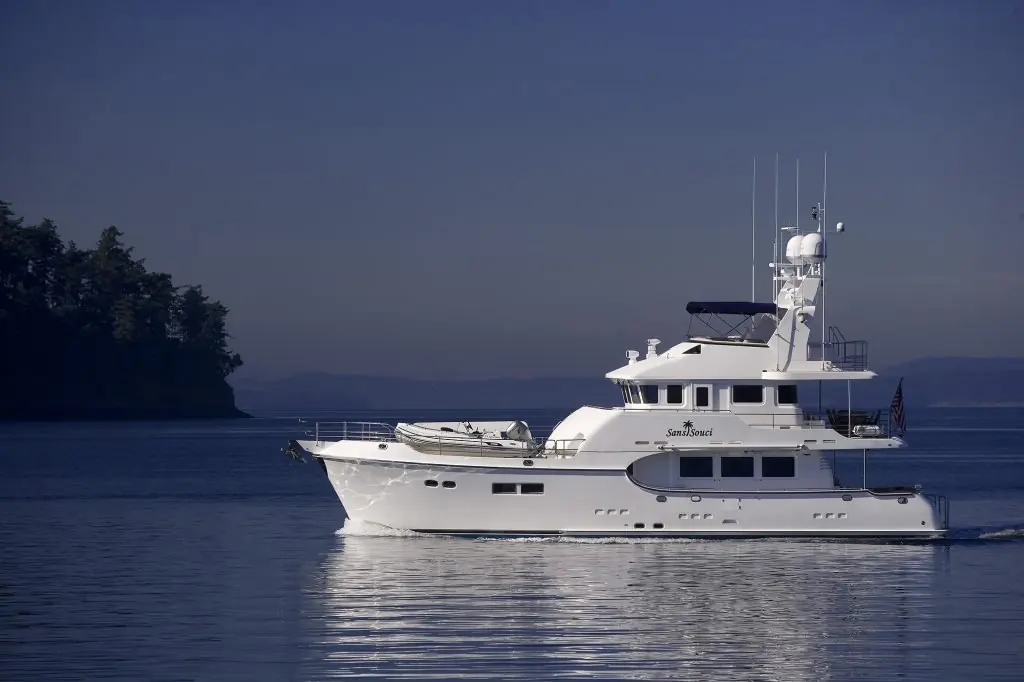
A single John Deere turning one propeller, a wing engine standing by purely as insurance and a fuel tank sized for an ocean: the N68 is the boat Nordhavn's own N62 owners asked for when they wanted more room but still no crew.
One main engine, a wing engine and a fuel tank built for oceans
Power is deliberately simple rather than powerful. The standard 68 runs a single John Deere 6135AFM75 M2 diesel rated at 425 hp at 1,900 rpm, turning one propeller through a Twin Disc gearbox, backed by a separate 160 hp John Deere 4045AFM85 wing engine on its own shaft, tank and controls purely as a get-home backup (Nordhavn Yachts official specification, cross-checked against YachtBuyer and itboat aggregated spec data, which independently list the same main engine and a closely matching wing engine rating). A Scania DI13 080M is offered as an alternative main engine.
Cruising speed is 9.5 knots and top speed sits just over 10, numbers that will not impress anyone cross-shopping a flybridge motor yacht, because the full-displacement hull was never meant to plane. What it buys instead is range: fuel capacity runs 3,136 US gallons on the Aft Pilothouse and 3,230 gallons on the Forward Pilothouse (Nordhavn official specification, matching independent aggregated data from YachtBuyer and itboat), and reported range varies with speed and source rather than settling on one number. Nordhavn's own materials and several reviewers cite figures from 3,000 to 4,000 nautical miles at 8 to 9 knots, and a fuel-burn test run by N68 owner David Sidbury and published on fellow owner Ken Williams' KensBlog measured 6.25 gallons an hour at 7 knots, working out to roughly 3,000 nautical miles on the tank. Rather than pick one figure, the honest answer is a boat that reliably clears an ocean crossing at passagemaking speed, with the exact number depending on load, weather and how hard the owner runs the single engine.
Sans Souci: 60,000 miles under one Nordhavn 68
The most documented N68 afloat is Sans Souci, owned by Ken and Roberta Williams, the Sierra On-Line co-founders who became well known in the Nordhavn community after crossing the Atlantic in a Nordhavn 62 during the 2004 Nordhavn Atlantic Rally and writing the book Crossing an Ocean Under Power about it. They moved up to a Nordhavn 68 afterward and, across roughly 60,000 nautical miles logged on Ken's own blog, took the boat through the Panama Canal, up the US East Coast and Hudson River past the Brooklyn Bridge, across the Atlantic again and along the Mediterranean and Pacific coasts, running it themselves without permanent crew.
Williams eventually sold Sans Souci not because the boat disappointed him but because it could not do a different trip he wanted next. Planning America's Great Loop, the roughly 5,000-mile circuit up the Atlantic coast, through the Great Lakes and down the Mississippi, he found the 68's draft of just over 7 feet and roughly 40-foot air draft ruled out the shallow rivers, low bridges and locks the Loop requires. His own words on the decision: Sans Souci had been more than a boat, having guided them safely around the world, but he did not expect another boat to match her comfort, accepting that tradeoff deliberately to reach water she could never have entered.
Karajas: the Art Deco N68 built for the South Pacific
A second well-documented hull, Karajas, shows how far the 68 can be pushed away from its default look while keeping the same platform underneath. Delivered new to Sydney owners Bob and Pam Shelston as hull number 25 and the first N68 built to CE certification, Karajas paired Nordhavn's standard passagemaking engineering with an Art Deco interior designed by Scott Cole of Seattle-based Ardeo Design, in satin-stained mahogany, marble and stainless detailing, a look PassageMaker magazine covered as a genuine departure from the usual trawler interior.
What matters for a buyer is less the styling than what the boat then did with it: Karajas has cruised extensively through the South Pacific to some of the most isolated anchorages on earth, solely with her owner-operators aboard, which is the same real-world argument every N68 owner report makes in different words. The boat is customizable enough to be a Sydney couple's Art Deco showpiece and an offshore singlehander's Scottish expedition boat on the same hull, without changing the engineering that gets either of them home.
What owning one actually costs
Nordhavn does not publish a base price for the 68, and every dealer inquiry is quoted against the owner's chosen engine, layout and equipment list, so there is no single new-build figure to point to. The closest independent estimates come from boat-tour producers who have priced fully equipped current hulls at roughly USD 5 million to 5.3 million, a ballpark for a loaded example rather than an official starting price and one that should be read as informal, since neither Nordhavn nor a broker has confirmed it.
The used market is thin. Only a handful of N68s change hands in any given year, and recent asking prices have run from around USD 2.5 million for a 2011 hull to USD 2.995 million for a well-equipped Seattle-based example named Hokulani, a range that has held fairly steady rather than showing clear appreciation or depreciation, simply because too few sales exist to establish a trend. Running costs are not independently published either; industry rule-of-thumb estimates of roughly 10 percent of a boat's value per year are commonly cited for yachts this size but are not specific to the 68, and neither insurance nor haul-out costs for a full-displacement 68-footer built in Taiwan are broken out anywhere in public sources.
Engines and systems
| Main engine | Single John Deere 6135AFM75 M2 diesel, 425 hp at 1,900 rpm, through a Twin Disc #5114 gearbox at 3.43:1 (Nordhavn Yachts official specification, cross-checked against aggregated YachtBuyer and itboat spec data). A Scania DI13 080M is offered as an alternative. |
|---|---|
| Wing (get-home) engine | John Deere 4045AFM85 HE, 160 hp at 2,300 rpm, on its own shaft, fuel supply and controls, independent of the main engine (Nordhavn Yachts official specification; independent press coverage of a delivered hull cites a closely matching wing engine on the same architecture) |
| Generators | Standard fit is a single Onan MDKBT, 27.5 kW at 120/240V AC (Nordhavn Yachts official specification). At least one delivered hull has been reported running twin generators, 26 kW and 16 kW, as a build option (YachtBuyer/Aquaholic review of a 2022 Non-Flybridge hull) |
| Stabilizers | TRAC #300 digital fin stabilizer system with 12 sq ft fins (Nordhavn Yachts official specification, single-sourced for the exact model number) |
| Bow and stern thrusters | 38 hp ABT hydraulic units standard (Nordhavn Yachts official specification); at least one custom-built hull has been reported with a 50 hp bow thruster upgrade (YachtBuyer/Aquaholic review) |
| Fuel tankage | 3,136 US gallons / 11,871 litres (Aft Pilothouse) or 3,230 US gallons / 12,226 litres (Forward Pilothouse), plus an 80-gallon accessible day tank (Nordhavn Yachts official specification, matching independent aggregated data from YachtBuyer and itboat) |
| Fresh water tankage | 673 US gallons / 2,548 litres (Nordhavn Yachts official specification, matching Nordhavn Europe's published figure) |
| Range | Reported inconsistently: figures from 3,000 to 4,000 nm depending on cruising speed (7 to 9 knots) and source. An owner fuel-burn test at 7 knots (David Sidbury, published on KensBlog) measured 6.25 gal/hr for about 3,000 nm; Nordhavn and other reviewers cite up to 4,000 nm at the low end of the speed range. Both figures are given here rather than picked. |
What owners and crew report
60,000 nautical miles across three ocean basins
Ken and Roberta Williams ran their N68 Sans Souci themselves through the Panama Canal, up the US East Coast past the Brooklyn Bridge, across the Atlantic and through the Mediterranean and Pacific, logging roughly 60,000 nm on Ken's own blog, after first crossing the Atlantic in a Nordhavn 62 during the 2004 Nordhavn Atlantic Rally.
Ken Williams (N68 owner, KensBlog)Real-world fuel burn and range at passagemaking speed
A fuel-burn test ahead of a planned Hawaii passage measured 6.25 gal/hr at 7 knots (about 3,000 nm on the tank) and 7.02 gal/hr at 8 knots (about 2,370 nm), the actual numbers behind Nordhavn's advertised range rather than a brochure figure.
David Sidbury (N68 owner), published on KensBlogA boat capable enough that its owner sold it only for a trip it could never make
Williams sold Sans Souci not for any fault in the boat but because her 7-plus-foot draft and roughly 40-foot air draft ruled out America's Great Loop, a route through the Great Lakes and the Mississippi that needs a shallow-draft, low-air-draft boat. He called her more than a boat and said he did not expect another to match her comfort.
Ken Williams (N68 owner, KensBlog)A single hull, pushed to two very different real-world uses
Karajas, delivered new to Sydney owners Bob and Pam Shelston as hull 25 and the first N68 built to CE certification, carries a bespoke Art Deco interior and has cruised extensively through the South Pacific to isolated anchorages with only her owner-operators aboard.
PassageMaker magazineA Non-Flybridge hull built for an owner running it solo, without crew
The first Non-Flybridge N68, delivered for a North Sea owner heading to Scotland, was commissioned by an experienced owner who plans to run it without crew, which is why it has no crew cabin and gives that space to a larger, more open pilothouse instead.
Nick Burnham (Aquaholic, writing for YachtBuyer)
What is good, and what to watch
Strong points
- A genuine, well-documented ocean-crossing recordIndividual N68 owners, not just the brand's marketing, have logged tens of thousands of miles across the Atlantic, Pacific and Mediterranean on this exact model, with fuel and performance data published by the owners themselves rather than the yard.
- Deliberately simple, redundant propulsionA single main engine kept simple and accessible, backed by a genuinely independent wing engine on its own shaft and fuel supply, trades outright speed for the kind of get-home redundancy a shorthanded couple actually wants offshore.
- One hull, three real layoutsAft Pilothouse, Forward Pilothouse and Non-Flybridge configurations let an owner pick motion comfort, crew provision or sightline priorities on the same proven hull, rather than forcing one compromise on every buyer.
What to watch
- Full-displacement speed is a hard ceilingCruise of 9.5 knots and a top speed just over 10 is inherent to the hull form and will not change with options. A buyer who wants to make time between anchorages, not just cross oceans efficiently, is shopping the wrong hull shape.
- A genuinely thin resale marketOnly a handful of N68s trade in any given year, which keeps pricing data sparse and can mean a real wait to find a buyer when it is time to sell, whatever the model's underlying reputation for holding value.
- Draft and air draft close off inland cruisingThe 68's own most famous owner sold his after concluding its draft and air draft made America's Great Loop impossible. Anyone drawn to shallow rivers, canals or low bridges as part of the cruising plan needs a different boat.
- No published new-build priceNordhavn quotes every 68 against the buyer's own equipment list, so there is no public base price to compare against other builders, and independently reported figures around USD 5 million for a loaded hull are estimates from boat-tour producers, not confirmed pricing.
- Interior styling reads plain to some buyers at this priceOwner forum discussion of the wider Nordhavn range has described standard interior finishes as functional rather than luxurious for the price bracket, a critique buyers weighing a 68 against more style-forward competitors should go in expecting.
Practical detail
| New build price | Not published. Nordhavn quotes each 68 against the buyer's chosen engine, layout and equipment; boat-tour producers have informally priced loaded current hulls at roughly USD 5 million to 5.3 million, which should be read as an estimate, not a confirmed base price |
|---|---|
| Typical used price | Roughly USD 2.5 million to 3.0 million for hulls built 2009 to 2011 or later, based on recent listings including a 2011 hull at about USD 2.5 million and the Seattle-based Hokulani at USD 2,995,000 |
| Annual running cost | No published figure specific to the model; the general industry rule of thumb of roughly 10 percent of the boat's value per year is commonly applied to yachts of this size and type but is not independently confirmed for the N68 |
| Resale liquidity | Thin. Market-watch data has recorded as few as one N68 changing hands in a three-year window, so pricing trends are hard to establish and a sale can take time to find the right buyer |
| Not publicly known | Confirmed new-build base price, insurance premiums for a Taiwan-built full-displacement 68-footer, haul-out and yard costs by region and a verified total hull count beyond the most recently reported delivery |
Questions owners ask
How big is the Nordhavn N68?
LOA: 20.73 m (68 ft), beam 6.20 m, draft 2.18 m. Displacement: 92.99 MT (205,000 lb) full load.
Who is the Nordhavn N68 for?
An experienced owner-operator couple moving up from a smaller Nordhavn who want genuine ocean range and three-cabin comfort on one hull, without hiring permanent crew to run it.
What is the Nordhavn N68 good at?
A genuine, well-documented ocean-crossing record. Individual N68 owners, not just the brand's marketing, have logged tens of thousands of miles across the Atlantic, Pacific and Mediterranean on this exact model, with fuel and performance data published by the owners themselves rather than the yard.
What are the drawbacks of the Nordhavn N68?
Full-displacement speed is a hard ceiling. Cruise of 9.5 knots and a top speed just over 10 is inherent to the hull form and will not change with options. A buyer who wants to make time between anchorages, not just cross oceans efficiently, is shopping the wrong hull shape.
What do owners and crew report about the Nordhavn N68?
Ken and Roberta Williams ran their N68 Sans Souci themselves through the Panama Canal, up the US East Coast past the Brooklyn Bridge, across the Atlantic and through the Mediterranean and Pacific, logging roughly 60,000 nm on Ken's own blog, after first crossing the Atlantic in a Nordhavn 62 during the 2004 Nordhavn Atlantic Rally. (Ken Williams (N68 owner, KensBlog))
Who it is for: An experienced owner-operator couple moving up from a smaller Nordhavn who want genuine ocean range and three-cabin comfort on one hull, without hiring permanent crew to run it.