Aquariva Special
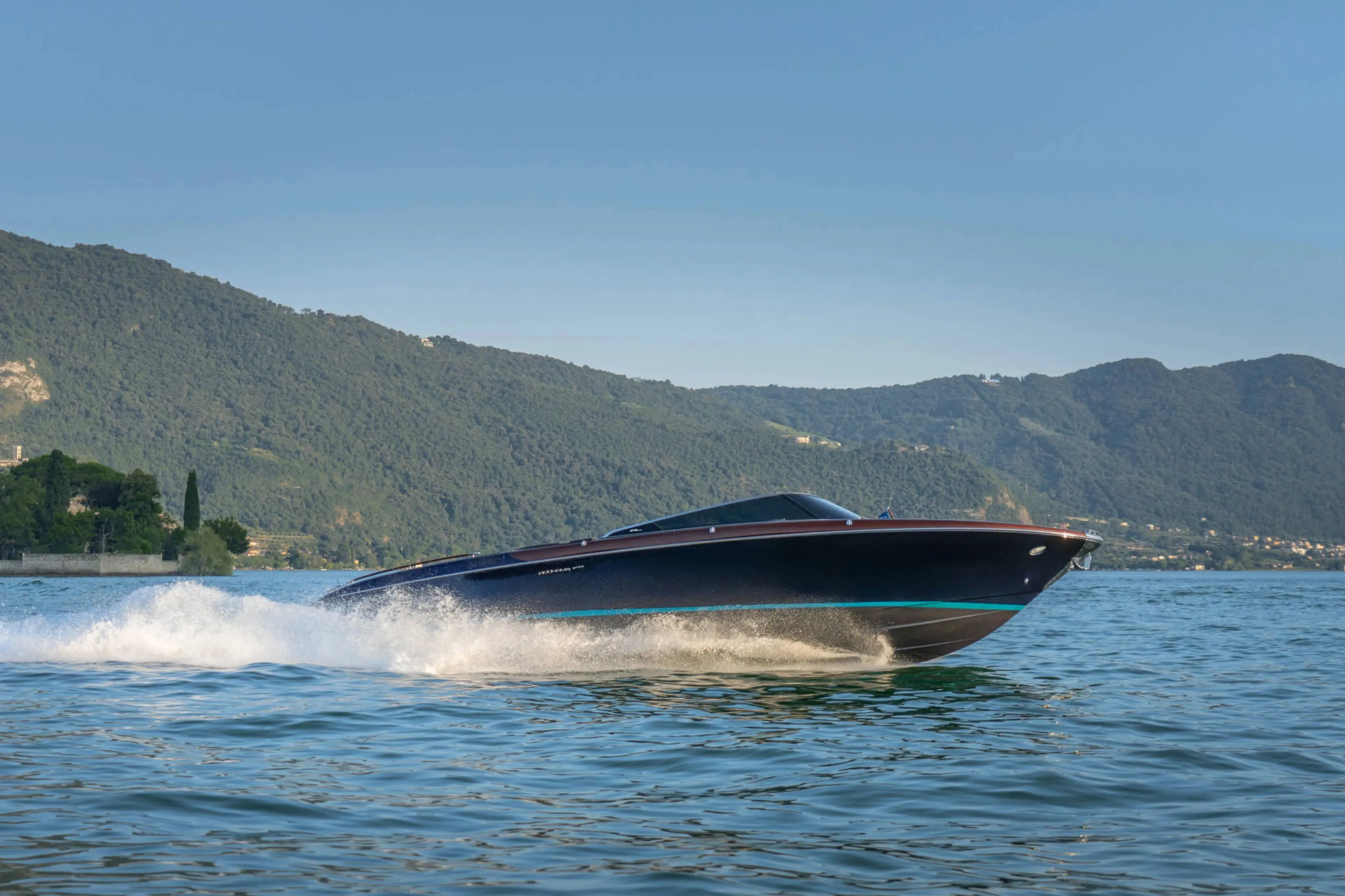
| LOA | 10.07 m (33 ft) |
|---|---|
| Beam | 2.80 m |
| Engines | twin Yanmar 8LV, 370 hp each |
| Top speed | approx 41 knots, cruise approx 36 knots |
| Construction | GRP hull with varnished mahogany decking |
| Accommodation | single cabin with berth and heads |
| Designer | Officina Italiana Design (Mauro Micheli) |
| Lineage | successor to the Aquariva Super, heir to the 1962 Aquarama |
The heir to the runabout line
Riva's identity was built on small open motorboats, and the Aquariva Special sits at the base of the current range as their living continuation. It succeeds the long-running Aquariva Super, itself a fibreglass reworking of the 1960s Aquarama silhouette. The boat measures 10.07 metres overall with a beam of 2.80 metres. Its role in the line-up is emotional as much as commercial, keeping the founding idea alive. Every larger Riva can trace its styling language back to a boat of roughly this shape and size.
Where the larger Rivas are cruising yachts, the Aquariva Special is a day boat in the oldest sense. It seats a group in the cockpit and offers a single cabin below for shelter more than living. Owners tend to keep one beside a bigger yacht or a lakeside villa. The appeal rests on heritage and proportion far more than on volume. A summer afternoon along the coast is the natural setting the model was drawn for.
Lines that quote the Aquarama
The profile is unmistakably Riva, low and long with a raked wraparound windscreen. The Special refines the earlier Super with a redrawn screen and a larger swim platform reached by curved steps. Officina Italiana Design has kept the visual grammar tight so the boat reads as a Riva from any angle. The changes are measured and never dramatic. Continuity matters more than novelty on a boat that trades on instant recognition.
Mahogany runs across the foredeck and around the cockpit coamings, varnished to the deep gloss that is a Riva signature. Stainless steel fittings and chromed details punctuate the woodwork. The result looks closer to a restored classic than a contemporary sportsboat. That effect is the whole point of the model. Each hull passes through the hand-finishing traditions the Sarnico yard has kept alive for decades.
The closest thing Riva still builds to the wooden runabout that made its name.
A cockpit built for daylight hours
Life aboard happens in the open cockpit, arranged around a U-shaped sofa and a central teak table. An electrohydraulic Bimini top extends over the seating for shade. The helm keeps analogue-style dials alongside a modern multifunction display. Materials run to leather and varnished wood in place of the harder finishes of a sports cruiser. The layout is set up for lunch at anchor and short hops between coves.
Below deck the single cabin holds a berth and a compact heads with a shower. It is meant for changing and stowing gear on a long day out. Storage is worked into the joinery to keep the cockpit clear. The interior follows the exterior in treating restraint as luxury. Nothing below is asked to do more than a day boat needs.
Modern power under classic skin
Twin Yanmar 8LV diesels of 370 hp each drive the Aquariva Special. Riva quotes a top speed in the region of 41 knots with a fast cruise around 36 knots. Humphree interceptors trim the running attitude for a cleaner ride. For the first time in the series a Seakeeper gyro stabiliser is offered as an option. That gyro makes time at anchor noticeably steadier for a boat of this weight.
The hull is moulded in GRP, which gives a stiffness and low maintenance that varnished wood never could. That combination lets the boat look like a 1960s runabout while behaving like a current design at speed. The engineering is deliberately hidden so the eye stays on the woodwork. Reliability here is a modern expectation built into an old shape. The wood is decorative today, applied over a composite structure that carries the loads.
Who buys the smallest Riva
The Aquariva Special tends to appeal to buyers who value the marque's history over outright space. Many already own property on a lake or coast where a runabout is part of the scenery. Others add it to a fleet as the boat they actually drive themselves. Its price positions it as a considered purchase and not an impulse toy. The buyer is often someone who has owned larger boats and wants something simpler to enjoy.
In market terms it competes less with other day boats and more with the idea of a classic car. Its value rests on a name that predates almost every rival afloat. Resale has historically held up well across the Aquariva family. For the right owner it is jewellery that moves. Few small boats carry this much cultural weight for their length.
Questions owners ask
How big is the Riva Aquariva Special?
LOA: 10.07 m (33 ft). Beam: 2.80 m.
Who is the Riva Aquariva Special for?
An owner who wants the Riva name in its purest and smallest form, usually as a second boat beside a lake house or a larger yacht.
Design
| Exterior | Officina Italiana Design (Mauro Micheli / Sergio Beretta) |
|---|---|
| Interior | Officina Italiana Design |
| Naval architecture | Ferretti Group Engineering Department |
Who it is for: An owner who wants the Riva name in its purest and smallest form, usually as a second boat beside a lake house or a larger yacht.