Croatia's premium charters rose 26%, its biggest marina caps at 70m
A fixed fleet chasing a bigger premium
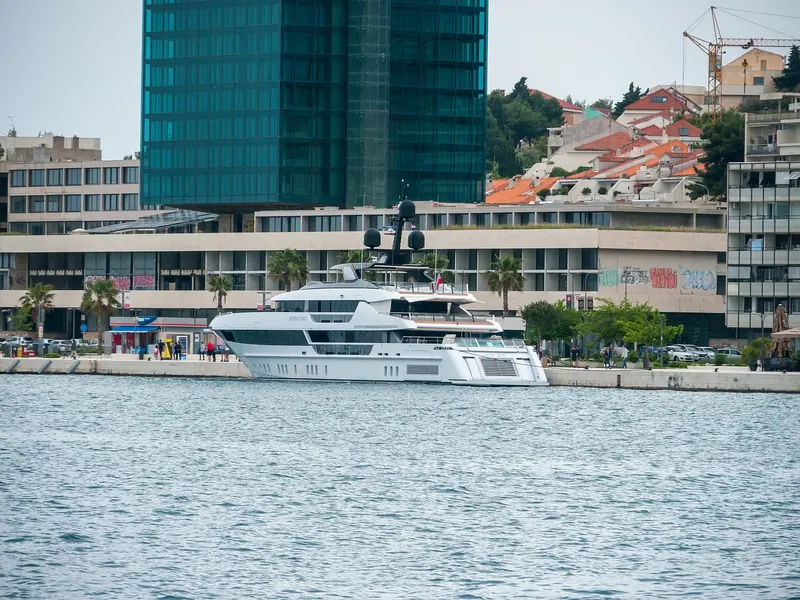
Croatia's charter market has not grown the way its prices have. Auto Moto Nautika, the boating division of the Croatian classifieds site Njuskalo, has tracked between 430 and 470 charter listings a month for four years without meaningful change. Over that same period, overall charter rates rose 11 percent, but the premium segment, vessels above 20 metres, rose 26 percent. Drazen Mijoc, the division's director, reads that gap as a market maturing rather than expanding: owners are investing in better boats and guests are paying for the difference, while the raw count of vessels on offer barely moves.
For a yacht above 30 metres, that has a direct consequence: the supply an owner or a charter guest is actually competing for is smaller than the headline fleet number suggests, and it is not being replenished at the rate demand is climbing. Split-Dalmatia County alone accounts for close to 80 percent of Croatian charter listings, concentrating that competition into one stretch of coast rather than spreading it along the whole Adriatic, and it is that same stretch that holds most of the marinas an owner would actually want to reach.
The country's biggest marina still tops out at 70 metres
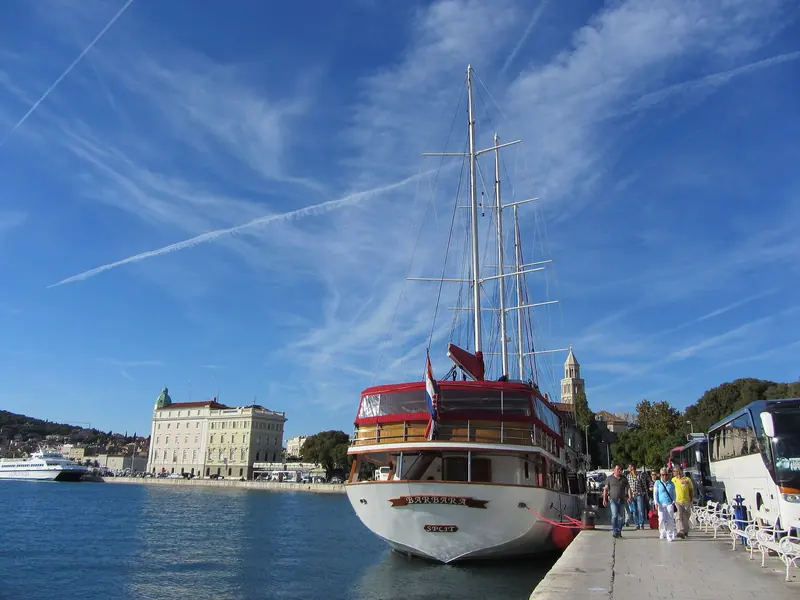
Croatia's marina network is genuinely large by Adriatic standards, but the size ceiling is lower than the berth counts suggest. D-Marin Dalmacija, at Sukosan near Zadar, is the largest marina on the coast by a wide margin, with 1,036 berths and a boatyard rated for 300 vessels on the hard. Its own published specification caps its dedicated superyacht pier at 70 metres LOA on a 6-metre draft. ACI, the state-linked network of 21 marinas from Umag to Dubrovnik, tells the same story at its flagship sites: ACI Split, 318 berths, takes up to 90 metres on a daily transit berth but only 26 metres on an annual contract; ACI Rovinj, 195 berths, caps at 50 metres daily and 35 metres annual.
Past 90 metres, one facility stands apart. Marina Kastela, a privately run site in the Bay of Kastela seven kilometres from Split, built dedicated mega-yacht piers in recent years: an eastern pier of roughly 115.5 metres and a western pier of roughly 94 metres, with draft running to 14 metres on both, deeper than anywhere else named here. For a yacht past 100 metres, Kastela is, in practical terms, the one address on the entire Croatian coast built for it; everywhere else, an owner is choosing between a transit slot sized for something smaller or an anchorage with no wall at all.
Hvar, Korcula and the Kornati book out weeks ahead
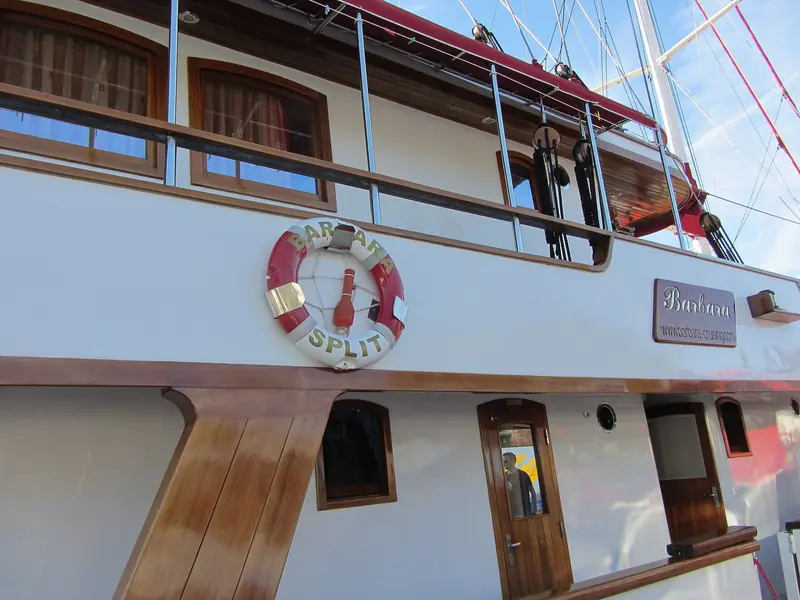
Fabian Gruber, co-founder of the Sibenik-based charter operator Splendid Yachting, wrote in SuperyachtNews on 5 August that the itinerary conversation with a charter guest now starts earlier and carries more contingency than it did five years ago. Popular stops such as Hvar Town, Korcula and the Kornati anchorages routinely need a berth booked weeks in advance for anything larger than a mid-size motor yacht, and permitting and construction timelines for new coastal infrastructure move far slower than charter bookings do.
Gruber is careful to frame this as a structural gap rather than a criticism of Croatian marina operators, several of whom, ACI and D-Marin included, have expanded meaningfully over the past five years. The problem is one of pace: demand for premium berths is compounding faster than concrete and permits can follow, and that mismatch shows up first at the handful of anchorages every broker's client already wants to see, long before it shows up in a coastwide capacity figure.
The shoulder season is the release valve
The operators adapting best, in Gruber's account, are the ones building flexibility into planning rather than assuming a berth will be there on demand: anchoring-focused itineraries with a marina night held in reserve, and a harder push toward September and October, when the water, weather and scenery are essentially unchanged but the July-August scramble for a wall in Hvar Town is not.
That shift also plays to Croatia's broader trajectory: the country's share of Mediterranean charter activity has grown from around 12 percent to 15 percent in recent years, so the shoulder season is less a workaround than the shape the market is settling into. An owner who can move a charter week, or a delivery passage, out of peak August gets the same coastline with a fraction of the competition for a berth, and at a lower daily rate on top of it.


What this means for booking next season
For an owner or a charter broker planning 2027, the practical reading is straightforward. Above 90 metres, Marina Kastela is, in practice, the only formal option on the entire Croatian coast with a purpose-built pier and the draft to match, and it should be approached months ahead rather than weeks. Below that size, ACI's and D-Marin's network is genuinely capable, 1,036 berths at Sukosan alone, but the marquee stops, Hvar, Korcula, the Kornati islands, still need an early call, especially in the six to eight peak weeks of July and August.
No single operator, ACI and D-Marin included, publishes a coastwide count of superyacht-capable berths, so there is no one figure that tells a buyer exactly how tight the market is; the picture has to be built marina by marina, as it is here. What is clear from the numbers that do exist is the direction: charter rates for larger yachts are rising faster than the berths built to hold them, and that gap, not the headline size of the Croatian marina network, is the single most useful thing an owner planning an Adriatic season can know before, not after, they commit to a date.
What owners and crew report
Itinerary planning now starts earlier and carries more contingency than five years ago
Guests choosing Croatia over the Western Mediterranean are told upfront that anything larger than a mid-size motor yacht needs its Hvar, Korcula or Kornati berth booked weeks ahead, with an anchoring-focused backup itinerary built in from the start.
Fabian Gruber, co-founder, Splendid Yachting (SuperyachtNews, 5 August 2026)The fleet is not growing, but the boats on it are getting better
Listing volume has been flat for four years; the 26 percent jump in premium pricing reflects owners upgrading their vessels and guests paying for the improvement, not more boats entering the market.
Drazen Mijoc, director, Auto Moto Nautika at Njuskalo (Croatia Week, 5 June 2026)
What is good, and what to watch
Strong points
- Real, expanding infrastructure21 ACI marinas plus D-Marin and independent operators give Croatia more formal superyacht berthing than any other Adriatic coast, and D-Marin Dalmacija's 1,036 berths and 300-vessel boatyard make it the largest single facility on the coast.
- The shoulder season genuinely worksSeptember and October keep the same anchorages and weather without the July-August competition for a wall, and operators are now actively steering charter guests toward those months rather than treating them as a fallback.
What to watch
- Supply has not moved while premium demand hasCharter listings have held at 430 to 470 a month for four years while charter rates for yachts over 20 metres rose 26 percent in a year, so a buyer trading up is competing for the same fixed set of berths, not a growing one.
- Past 90 metres, the coast narrows to one addressEven Croatia's largest marina by berth count caps at 70 metres, and ACI's own flagship site tops out at 90 metres on a transit berth; only Marina Kastela's purpose-built piers are confirmed to take a yacht past 100 metres.
Practical detail
| Croatia's largest marina by berth count | D-Marin Dalmacija, Sukosan: 1,036 berths, 300-vessel boatyard, but capped at 70 metres LOA and 6-metre draft on its superyacht pier |
|---|---|
| Only site confirmed past 100 metres | Marina Kastela, near Split: mega-yacht piers of approximately 115.5m (east) and 94m (west), draft to 14 metres |
| ACI flagship capacity | ACI Split: 318 berths, 90m on a daily transit berth, 26m on an annual contract. ACI Rovinj: 195 berths, 50m daily, 35m annual |
| Booking lead time at peak spots | Weeks in advance for Hvar Town, Korcula and the Kornati anchorages in July-August, per Splendid Yachting |
| Premium charter price growth | 26 percent year-on-year for yachts over 20 metres, against 11 percent for the fleet overall (Auto Moto Nautika/Njuskalo, June 2026) |
| Fleet supply | 430 to 470 charter listings a month, essentially flat for four years |
| What is not published | No operator, ACI or D-Marin included, publishes a single coastwide figure for superyacht-capable berths; capacity has to be checked marina by marina, and this piece does not cover every marina on the coast |
Questions this story answers
What happened?
Charter rates for yachts over 20 metres on the Adriatic climbed 26 percent this year, while the fleet chasing that demand is the same size it was four years ago. For an owner or broker weighing next July against the Western Mediterranean, that gap means booking earlier, and knowing that Croatia's single largest marina, 1,036 berths, still cannot take a yacht past 70 metres.
What is good about it?
Real, expanding infrastructure. 21 ACI marinas plus D-Marin and independent operators give Croatia more formal superyacht berthing than any other Adriatic coast, and D-Marin Dalmacija's 1,036 berths and 300-vessel boatyard make it the largest single facility on the coast.
What should an owner or buyer watch?
Supply has not moved while premium demand has. Charter listings have held at 430 to 470 a month for four years while charter rates for yachts over 20 metres rose 26 percent in a year, so a buyer trading up is competing for the same fixed set of berths, not a growing one.
What do owners and crew report?
Guests choosing Croatia over the Western Mediterranean are told upfront that anything larger than a mid-size motor yacht needs its Hvar, Korcula or Kornati berth booked weeks ahead, with an anchoring-focused backup itinerary built in from the start. (Fabian Gruber, co-founder, Splendid Yachting (SuperyachtNews, 5 August 2026))
Who reported this?
Fabian Gruber, co-founder, Splendid Yachting, writing in SuperyachtNews, 5 August 2026, Drazen Mijoc, director, Auto Moto Nautika at Njuskalo, quoted in Croatia Week, 5 June 2026, D-Marin Dalmacija, official published berth, length and draft specifications (d-marin.com), ACI Marinas, official published berth and length-capacity listings for ACI Split and ACI Rovinj (aci-marinas.com), Marina Kastela, official published mega-yacht pier and draft specifications (marina-kastela.hr).
We do this for everyone who loves this world. The people who have spent their lives in it, and the people just discovering it. Yotters exists so that what we learn belongs to all of them.
Nobody pays us for this. No ads, no sponsors, nothing for sale. We just believe the world is a little better when knowledge is shared instead of kept.
If it gave you something today, tell us to keep going. Follow us, leave a like, or write a positive comment. We read every one, and they are what keeps us going.