DYDXL's Wanderlust95 Concept Splits a 32m Stern Into Two Levels
A Stern That Works Two Ways
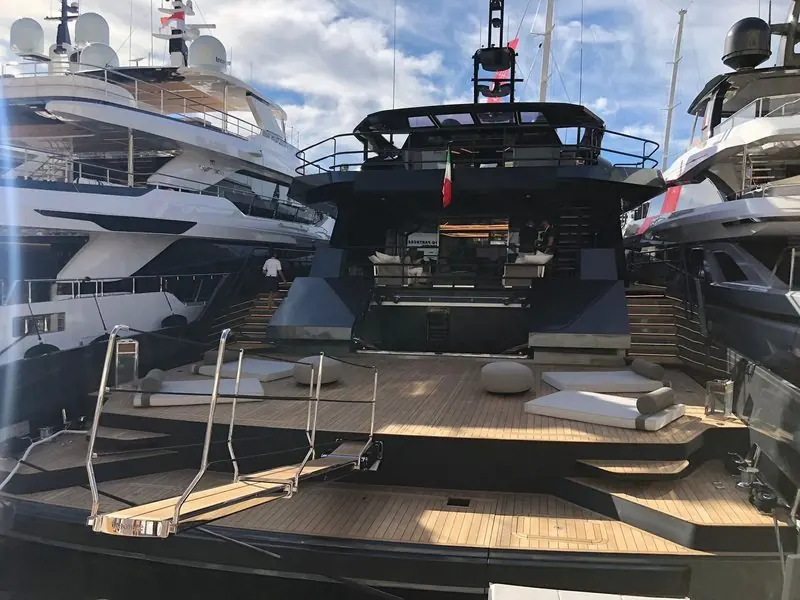
Wanderlust95's defining idea is not her hull or her styling but a transformable, two-level stern. At water level, a full-beam teak beach deck carries movable furniture, chaise longues and ottomans over built-in storage for dive gear and water toys; folding side terraces swing out to double the usable width when the yacht is at anchor. The same area converts back to an operational platform for launching tenders and toys when the owner wants to move rather than lounge, so the space is never locked into one job.
Above it, a second outdoor lounge reached by symmetrical side staircases overlooks the beach deck without blocking the view down to the water, so the two levels can be used at once - guests swimming below, others reading above - rather than one crowd sharing one deck. For an owner choosing between a compact 32-metre custom build and a larger, crewier yacht bought mainly for its entertaining space, the pitch is that Wanderlust95 gets most of that square footage from clever geometry rather than extra metres, which is what keeps her berthing fees, insured value and crew bill down.
The Numbers Behind the Small Footprint
Gnessi's own studio and SuperYacht Times both give Wanderlust95 as 32.49 metres; BOAT International's coverage of the same reveal rounds that to 33 metres in its headline, and no third figure has surfaced to settle which is the more precise draughting number, so the 32.49-metre figure carries here as the one two independent outlets state exactly. She is drawn for 10 guests and a crew of four, and for propulsion the yard has a genuine choice still open: twin MAN V12-1900 diesels on a shaft-line as drawn, or Volvo Penta IPS pod drives, or a diesel-electric hybrid with a battery pack sized for silent, emissions-free running at anchor.
None of the three propulsion options comes with a published range, top speed or fuel-burn figure, which matters more here than on a bigger yacht: at 32 metres, the difference between a shaft-line diesel and an IPS or hybrid setup changes both the boat's handling at low speed around a beach club stern designed for close-quarters anchoring, and the annual fuel bill an owner running a lean four-person crew actually has to justify. A 10-guest, four-crew ratio is unusually lean for a yacht with this much dedicated social deck; it reads as a boat meant to be run by its owner with a small professional crew, not operated as a small hotel.
Gnessi's Case for Restraint
Franco Gnessi founded DYDXL Design Forge - originally Dynaship Yacht Design - on a reputation for disruptive layouts rather than incremental styling, and he has framed Wanderlust95 explicitly against size-first luxury: the studio's stated brief was luxury as "the quality of the onboard experience" rather than "a mere display of size." His own line on the result, carried by Robb Report, is that "every cubic inch has been capitalised on, giving the yacht a sense of openness and grandeur that belies its overall length" - a claim aimed squarely at a buyer who assumes more space always means more metres.
The design leans on large glazed surfaces and open sightlines from the main saloon out to the stern to support that claim inside as well as outside, so the sense of scale is meant to carry through the accommodation deck and not stop at the transformable stern. Whether that holds up against a same-length rival with a conventional single-level cockpit is untestable from renders alone - it is the kind of claim only a sea trial and a walk-through settle, and none exists yet because no hull has been ordered.
What Wanderlust95 Is Not, Yet
Wanderlust95 has no shipyard, no price and no delivery date. DYDXL Design Forge is a design house, not a builder, so the concept still needs a yard capable of a roughly 32-metre custom hull to commission it, and that yard's own engineering will very likely settle the propulsion choice, the exact beam and draught, and possibly the hull material Gnessi has left open between aluminium and fibreglass - each with its own weight, cost and resale consequences an owner would need to weigh before signing.
One number does work in the design's favour on paper: capped at 10 guests, Wanderlust95 stays comfortably under the 12-guest threshold that triggers the Large Yacht Code and equivalent commercial passenger-vessel rules, the same compliance step that a 36-guest commercial configuration on a rival concept this month does not avoid. That keeps her certification path simpler if she is built as drawn - but it is a paper advantage only until a class society and a yard's naval architects are actually engaged, which has not happened.
A Crowded Season for Concepts
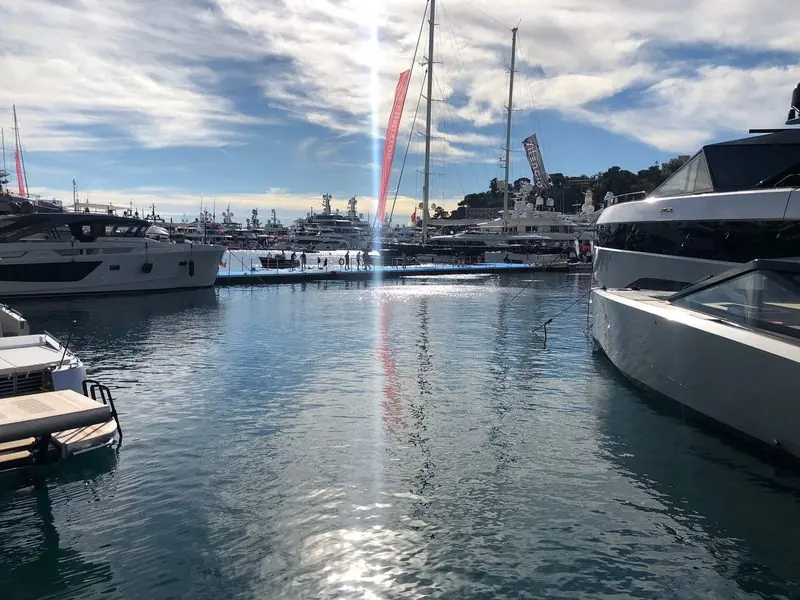
Wanderlust95 landed in the middle of an unusually dense run of design-studio reveals timed ahead of the Monaco Yacht Show: Edoardo Ridoli's 70-to-80-metre Genesis surfaced on 17 August, AB Yacht Design's 92-metre Project Always followed on 18 August, and RMK Yachts split its Livia concept into three separate owner lifestyles on 20 August. Against that field, Wanderlust95 is by far the smallest, and deliberately so - it is pitched at an owner-operator with a four-person crew, not the near-hotel staffing the 92-metre and 70-to-80-metre concepts assume.
For a buyer actually shopping this size bracket, the useful comparison is not which concept looks most striking in a render but which running model fits: a lean crew and a compact hull that leans on layout for its sense of scale, against a larger yacht whose scale is real but whose crew bill and berthing costs scale with it. Wanderlust95 will not move past a rendering until a specific owner commissions a specific yard to build it, and until then every figure attached to her - guest count and crew size aside - can still change.
What is good, and what to watch
Strong points
- A genuinely multi-use stern, not a rendering trickthe beach-club-to-launch-platform conversion and the two-level lounge arrangement are specific, buildable mechanisms, not just a caption on a pretty picture.
- A lean crew ratio that keeps running costs down10 guests to 4 crew is unusually efficient for a yacht carrying this much dedicated social deck, pointing to an owner-operator budget rather than a small-hotel one.
- Staying under 12 guests sidesteps the Large Yacht Codeunlike a rival concept's 36-guest commercial configuration revealed the same week, Wanderlust95's certification path stays simpler on paper.
What to watch
- No yard, no price, no delivery dateas a design-house concept with no builder attached, nothing here is a specification an owner can actually order yet.
- No published range, speed or fuel-burn figure for any propulsion optionan owner cannot yet compare running costs against a same-size rival, and the three propulsion paths on offer would each answer that question differently.
- Two open engineering decisions - hull material and propulsion - could still change the boataluminium versus fibreglass and shaft-line versus IPS versus hybrid are exactly the choices a commissioning yard's naval architects would settle, and each carries different weight, cost and resale consequences.
Practical detail
| Design studio | DYDXL Design Forge (Franco Gnessi), Italy |
|---|---|
| Length | 32.49m as stated by the studio and SuperYacht Times; BOAT International's headline rounds this to 33m |
| Guests / crew | 10 guests / 4 crew |
| Propulsion (undecided) | twin MAN V12-1900 shaft-line as drawn, or Volvo Penta IPS, or a diesel-electric hybrid with a silent-running battery pack |
| Hull material (undecided) | aluminium or fibreglass, not yet fixed |
| Not yet published | shipyard, price, delivery date, beam, draught, and range, speed or fuel-burn under any of the three propulsion options |
Questions this story answers
What happened?
Italian designer Franco Gnessi has unveiled Wanderlust95, a 32.49-metre explorer concept whose entire pitch rests on one stern that works as both a beach club and a private lounge. For an owner comparing a compact custom build against a bigger, crewier yacht, the idea is to buy the entertaining space of a larger boat without the running costs that come with one.
What is good about it?
A genuinely multi-use stern, not a rendering trick. the beach-club-to-launch-platform conversion and the two-level lounge arrangement are specific, buildable mechanisms, not just a caption on a pretty picture.
What should an owner or buyer watch?
No yard, no price, no delivery date. as a design-house concept with no builder attached, nothing here is a specification an owner can actually order yet.
Who reported this?
SuperYacht Times (Ann Yabut, 14 August 2026), BOAT International (Eilis Cronin, 13 August 2026), Robb Report via Yahoo Life Singapore, 14 August 2026, DYDXL Design Forge.
We do this for everyone who loves this world. The people who have spent their lives in it, and the people just discovering it. Yotters exists so that what we learn belongs to all of them.
Nobody pays us for this. No ads, no sponsors, nothing for sale. We just believe the world is a little better when knowledge is shared instead of kept.
If it gave you something today, tell us to keep going. Follow us, leave a like, or write a positive comment. We read every one, and they are what keeps us going.