ISA opens an 80m class, and Amarcord 82 is the first
ISA draws its line at 80 metres
ISA Yachts, part of Palumbo Superyachts, has presented the ISA Large Yacht Collection, a design platform reserved for yachts between 80 and 90 metres, or 262 to 295 feet. The collection sits above the yard's Gran Turismo 80, Gran Turismo 100 and ISA Custom ranges, and is aimed at owners commissioning one-off boats rather than buyers picking from a model list. Giuseppe Palumbo, who runs Palumbo Superyachts as amministratore unico, framed it as the next stage of the group's move into large tonnage. The yard that would build these hulls is in Ancona, on the Italian Adriatic coast.
The company describes the collection as an evolution of the full-custom concept, in which each project is developed around the owner while resting on an engineering platform that is already drawn and proven. That phrasing matters more than it reads. A yard that starts every 80-metre hull from a blank sheet carries engineering risk into the contract, and the owner pays for it in delivery time and change orders. A platform validated in advance moves part of that risk off the owner's side of the table.
Amarcord 82 is the opening design
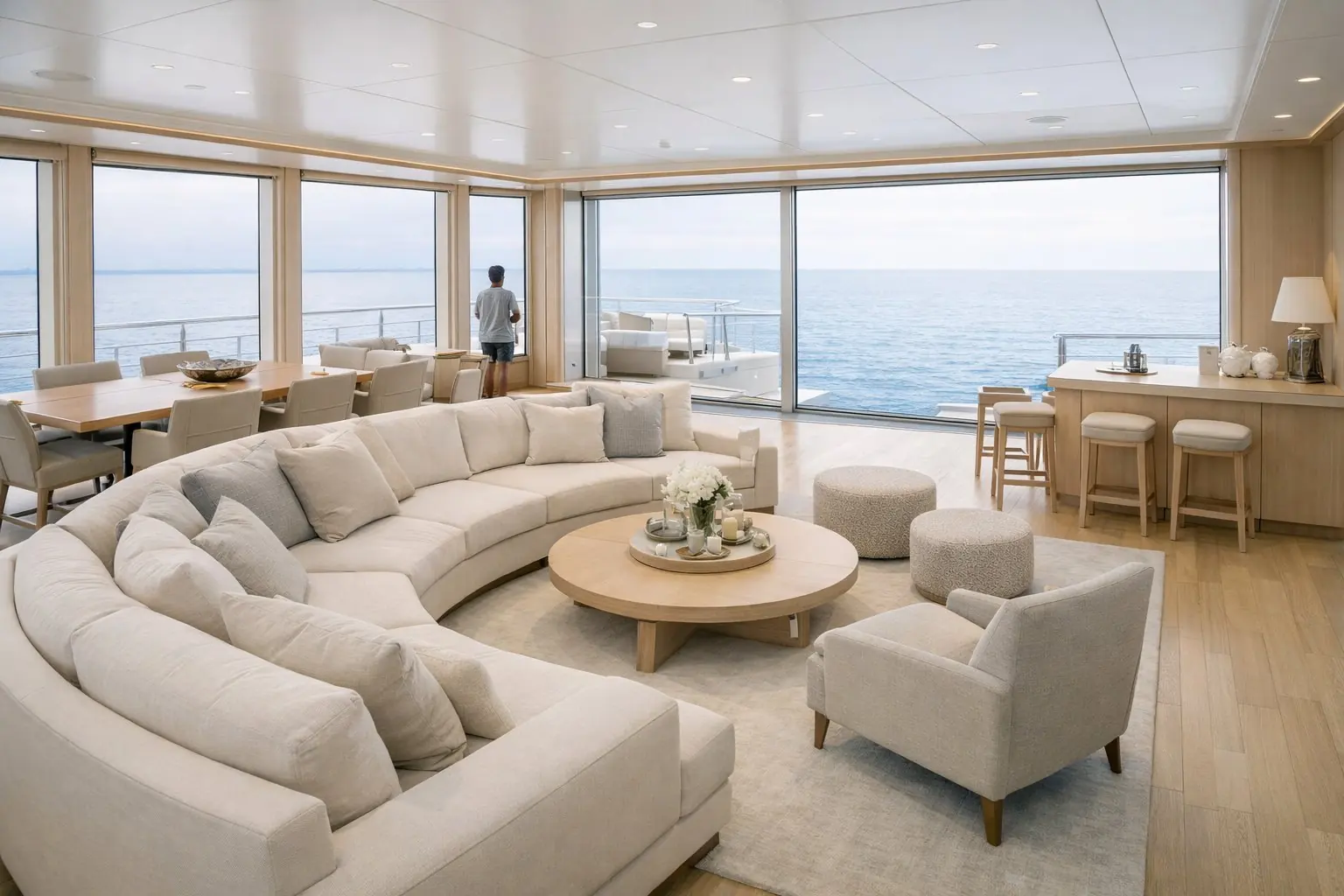
The first project in the collection is Amarcord 82, an 82-metre yacht, 269 feet, designed by Nuvolari Lenard. The exterior runs to sporty proportions with large glazed surfaces and openings cut into the hull, pushing interior volume out towards the water rather than up into the superstructure. A helipad takes up most of the foredeck. The profile reads closer to a fast Italian motor yacht than to the vertical-bow explorer look that has spread through the 80-metre class.
Nuvolari Lenard being on the drawing is part of the proposition. An owner signing for an 82-metre hull at a yard that has not delivered one before is buying the design office's record alongside the builder's. The studio has drawn yachts well beyond 82 metres for other European builders, giving the collection a reference at this size that Ancona cannot yet supply itself.
The water level is where the money went
The main deck aft carries a swimming pool with a glass bottom, so daylight passes through into the beach club below. That is a structural decision rather than a styling one. A glazed pool floor over an occupied space has to carry load, drain and stay watertight while people sit underneath it, and yards charge accordingly. The return is a beach club lit from above rather than from side openings alone.
The beach club itself extends outwards on two large fold-down balconies. Together with the stern platform, that turns the lowest deck into the main social space at anchor, where a yacht this size spends most of her working life. The arrangement follows where the market has moved over the past decade. Volume at the waterline now sells better than another lounge one deck up.
Twelve guests in 82 metres
The layout carries 12 guests in five VIP cabins plus an owner's suite of more than 100 square metres, over 1,070 square feet. Twelve guests in 82 metres is a low density for the class, and a deliberate signal. The owner is not being offered a charter-optimised layout with cabins pushed to the limit of what the rules allow. Every cabin gets unusual floor area, and the owner's deck stays genuinely private.
That choice has consequences a buyer should price at contract stage. A yacht configured this way spends its volume on suites rather than on cabins. It also narrows the resale pool, since buyers who want charter income tend to want more berths and will discount for their absence. Owners who intend to keep a yacht for a decade usually accept that trade. Owners who expect to sell inside five years should look at it hard before signing.
What a buyer should test at Ancona
ISA's largest delivery to date is Sea Raider X, a 67-metre Gran Turismo handed over in July and the biggest the builder has launched in its quarter-century. Moving from 67 to 82 metres is not a small increment. It changes class requirements, systems complexity, crew numbers and the commitments the yard makes to its suppliers. The segment above 80 metres has been held for years by Lurssen, Feadship, Oceanco and Amels, each of which has delivered at that length repeatedly.
None of that makes the collection unserious, and Palumbo has spent several years buying yard capacity across Italy and the Mediterranean. It does mean the questions asked at Ancona differ from those asked at a builder with ten 80-metre deliveries behind it. A buyer should establish which parts of the platform are engineered and validated today rather than scheduled, who carries the cost if class requirements shift mid-build, and what the yard's slot commitment looks like in writing before any deposit moves.
Questions this story answers
What happened?
ISA Yachts has opened a design class for hulls between 80 and 90 metres, and the first of them is Amarcord 82, an 82-metre full-custom project drawn by Nuvolari Lenard. The yard's largest delivery so far is 67 metres, so this is a step up rather than a line extension. For a buyer it puts an Italian yard back into a size bracket that northern European builders have held for years.
Who reported this?
ISA Yachts, Palumbo Superyachts, Barche Magazine, Robb Report, Skipper ONDECK.
We do this for everyone who loves this world. The people who have spent their lives in it, and the people just discovering it. Yotters exists so that what we learn belongs to all of them.
Nobody pays us for this. No ads, no sponsors, nothing for sale. We just believe the world is a little better when knowledge is shared instead of kept.
If it gave you something today, tell us to keep going. Follow us, leave a like, or write a positive comment. We read every one, and they are what keeps us going.