JFA's Canoa is its biggest build in 33 years, price unpublished
JFA's biggest build yet, after 33 years in Concarneau
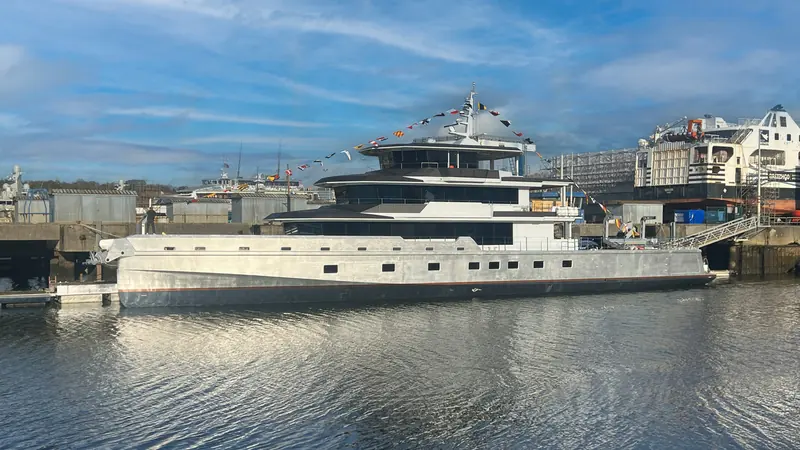
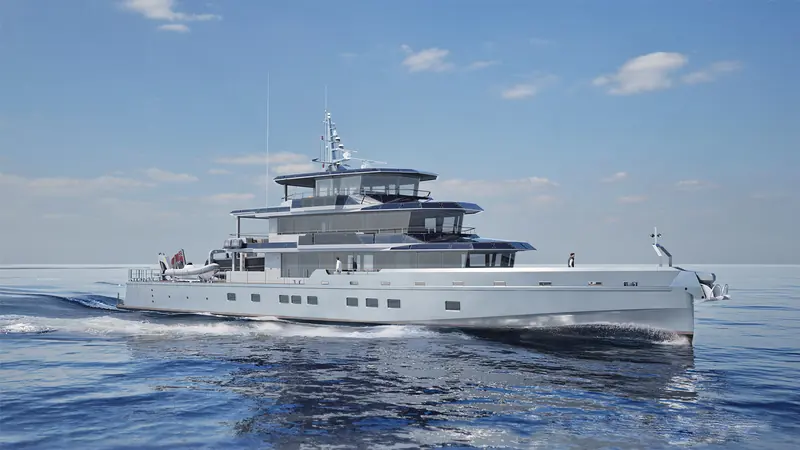
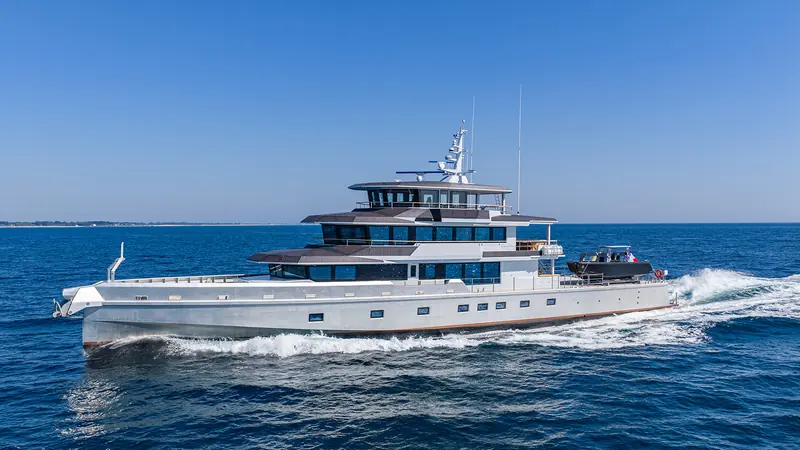
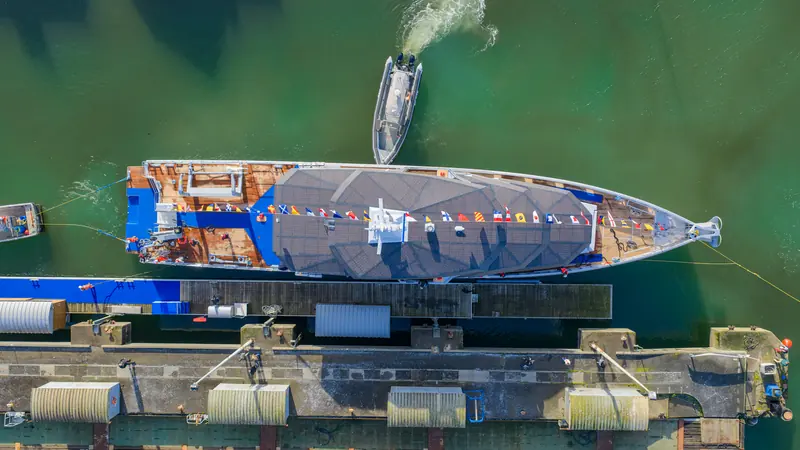
JFA Yachts, the custom builder founded in Brittany in 1993 by Frederic Jaouen and Frederic Breuilly, delivered the 49.9-metre Canoa on 7 August 2026, becoming the flagship of a yard that turned 30 in 2023 and had never before built past 42 metres. Canoa's aluminium hull carries a glass-epoxy composite superstructure and a teak deck, is flagged in the Cayman Islands, and measures 498 GT across four decks - a full size class beyond JFA's previous largest yacht, the 2003-built 42-metre Bystander. "Our objective was to build a true explorer capable of travelling far, for long periods, in outstanding comfort," said JFA Yachts president Frederic Jaouen of the project. The naval architecture and exterior are by Humphreys Yacht Design, a British studio in its fifth decade of both racing and explorer work, with interiors from the Milan practice m2atelier.
The yard's history is mostly in refits and mid-size custom sail and motor yachts rather than long-range steel-and-aluminium explorers - JFA's other notable large project is the 37-metre Axantha, delivered in 2001 - so Canoa represents a deliberate step up into a segment currently led by yards such as Cantiere delle Marche, which has built exclusively in the 26-to-50-metre explorer range since 2010. BOAT International's 2026 Global Order Book counted 101 expedition-oriented vessels in build or on order worldwide at the start of the year, the second-highest total ever recorded, so JFA is entering a crowded and growing field rather than a quiet corner of the market.
A hybrid drivetrain built for silence, not headlines
Canoa runs a parallel hybrid system pairing twin MTU diesel engines with electric motors on the same shaft line, backed by a large battery bank and a solar array on the upper decks, plus a dynamic positioning system for holding station without dropping anchor. Humphreys Yacht Design's Tom Humphreys said the ambition was "an explorer combining long-range capability with exceptional efficiency and refined seakeeping" rather than raw speed, and the numbers back that framing: Canoa is rated to reach 20 knots in hybrid boost mode but is built to cruise at 12 knots, where she is quoted at over 5,000 nautical miles of range - enough for an Atlantic crossing with margin to spare and no refuelling stop.
The electric motors let Canoa run silent and at zero local emissions at anchor and at low cruising speed, which matters more to a genuine explorer owner than to a Mediterranean-season motor yacht buyer: dropping the generators at anchor removes the hum and the diesel smell that follow most yachts this size into a quiet bay. None of that is independently verified yet - JFA and Humphreys are the only parties who have published a number, and no sea trial report or third-party fuel-burn figure exists to check the claimed range or speed against.
Ten guests, nine crew, and a garage sized for the tender
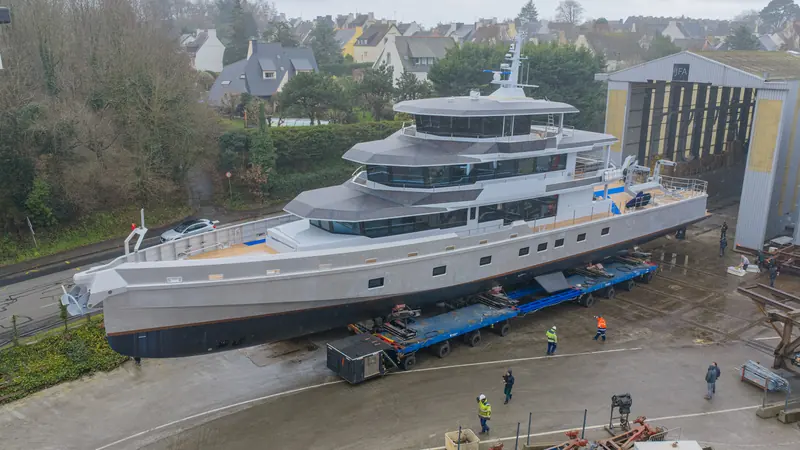
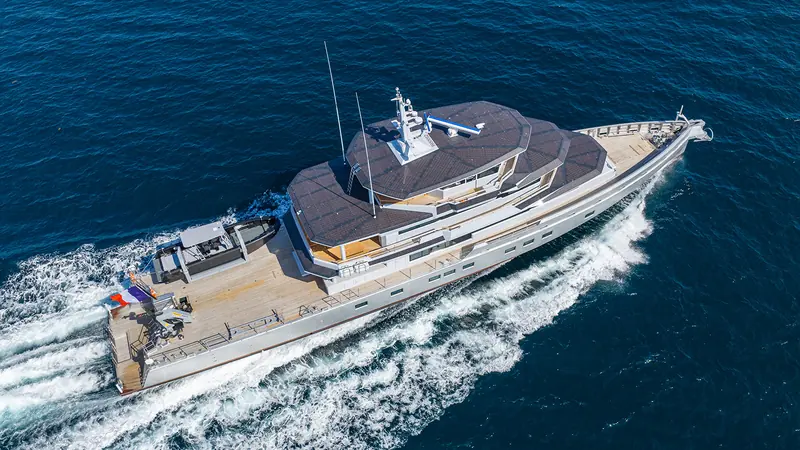
Canoa sleeps 10 guests across five staterooms and carries nine crew, spread over four decks behind a 9.1-metre beam and a notably shallow 2-metre draught - shallow enough to reach anchorages a deeper-draught 50-metre explorer has to skip, which is close to the entire point of buying an explorer over a conventional motor yacht. The owner's suite runs to a private lounge, an office and a Jacuzzi terrace, and the yacht carries three cranes including a dedicated C-davit rated for a 9.2-metre tender - a genuinely large chase or dive boat for a yacht this size, and the kind of detail that tells an explorer buyer more about intended use than any brochure copy.
Extensive glazing across the accommodation decks is the one concession here to conventional motor-yacht styling rather than expedition function, and it is a trade-off worth noting: more glass means more heat gain and more to protect on an ocean passage, set against the panoramic views that owners in this bracket increasingly expect even on an explorer hull. Nothing published so far describes ice-class, reinforced plating or other polar-specific features, so Canoa reads as a long-range, go-anywhere-temperate cruiser rather than a true polar explorer in the Damen SeaXplorer mould.
The comparison JFA invited by building this big
Cantiere delle Marche, the Ancona yard most closely associated with the modern explorer category, prices its semi-custom Darwin Class in the open: the 102 model, at roughly 31 metres, lists new at EUR 14.3 million. Canoa is nearly 20 metres longer and fully custom rather than semi-custom, and general market pricing for a top-tier European 50-metre new build runs USD 45 million to USD 70 million, according to SuperYachtReview's 2026 superyacht cost guide - a wide enough band that it says more about the scale of the commitment than about what JFA actually charged.
JFA has not published a price for Canoa, and has not named her owner. That is common practice for a genuinely custom one-off at this size, but it leaves a prospective buyer with no benchmark: nobody outside the yard and its client knows whether Canoa cost nearer the bottom or the top of that range, or whether her hybrid drivetrain carried the premium that parallel-hybrid propulsion usually does over a straight-diesel install of the same range and speed.
What is not published is the most useful line here
Every figure attached to Canoa so far - the 5,000-nautical-mile range, the 20-knot boost speed, the silent-running claim - comes from JFA Yachts or Humphreys Yacht Design, and neither has published an independent sea trial or third-party fuel-burn table. That is normal for a yacht delivered this recently; it is also exactly the gap a buyer or a broker valuing a similar commission needs to know about before treating any of those numbers as proven rather than promised.
For an owner weighing a custom explorer commission, Canoa is worth watching for two reasons that have nothing to do with her specification sheet: whether JFA, a yard that spent three decades below 45 metres, can support a 50-metre flagship through her first ocean seasons the way an established explorer builder would, and whether a French custom yard can compete on delivery time and price against the increasingly crowded Italian and Dutch expedition-yacht establishment. Both answers will only come from her first year in service, not from the numbers published at delivery.
What is good, and what to watch
Strong points
- Genuinely long range for the size5,000nm at 12 knots without refuelling puts Canoa within reach of ocean crossings that would strand most 50m motor yachts, and the parallel hybrid drivetrain adds a silent, zero-emission mode at anchor a straight-diesel explorer cannot match.
- A shallow draught built for actually going somewhereAt 2 metres, Canoa can reach anchorages a deeper-draught 50m explorer has to skip, which is close to the entire point of buying an explorer over a conventional motor yacht.
- Three decades of custom-build experience behind the hullJFA's history running large refits alongside new construction, including the 2001 Axantha and 2003 Bystander, means the yard has handled ocean-capable engineering before, even if never at this length.
What to watch
- No independent verification of any performance figureEvery range, speed and efficiency number attached to Canoa so far comes from JFA Yachts or Humphreys Yacht Design, with no sea trial report or owner account yet published.
- JFA has never built anything close to this sizeCanoa is roughly eight metres longer than JFA's previous largest yacht, the 42m Bystander delivered in 2003; the yard is stepping up a full size class on its flagship rather than working up gradually.
- Price and buyer are both undisclosedUnlike Cantiere delle Marche's semi-custom Darwin range, which lists at fixed prices, Canoa's cost and the identity of the owner who commissioned it are both withheld, leaving no benchmark for what a similar commission would cost.
Practical detail
| Length / GT | 49.9m LOA, 498 GT |
|---|---|
| Draught | 2.0m - shallow for the class, reaches anchorages a deeper-draught 50m explorer has to skip |
| Beam | 9.1m |
| Range / speed | 5,000nm at 12 knots cruise; up to 20 knots in hybrid boost mode |
| Guests / crew | 10 guests in 5 cabins; 9 crew |
| Flag | Cayman Islands |
| Price | Not published; comparable top-tier 50m European new builds run USD 45-70 million per SuperYachtReview's 2026 cost guide |
| Not published | The owner's identity, the contract price, and any independent sea-trial figures - every speed and range claim so far is the builder's or designer's own |
Questions this story answers
What happened?
A 50-metre hybrid explorer named Canoa left the Brittany yard JFA Yachts on 7 August 2026, the largest yacht the 33-year-old builder has ever delivered and its first attempt at the long-range segment Cantiere delle Marche has dominated since 2010. She pairs a 5,000-nautical-mile range with a parallel diesel-electric drivetrain built to run silent at anchor, on a hull drawing just 2 metres - genuinely useful numbers for an owner who wants to go further and quieter than a conventional motor yacht allows. JFA and her designer have published the specification in full; what they have not published is the price, the owner, or a single independent sea trial to check any of it against.
What is good about it?
Genuinely long range for the size. 5,000nm at 12 knots without refuelling puts Canoa within reach of ocean crossings that would strand most 50m motor yachts, and the parallel hybrid drivetrain adds a silent, zero-emission mode at anchor a straight-diesel explorer cannot match.
What should an owner or buyer watch?
No independent verification of any performance figure. Every range, speed and efficiency number attached to Canoa so far comes from JFA Yachts or Humphreys Yacht Design, with no sea trial report or owner account yet published.
Who reported this?
BOAT International (yacht delivery report, 7 August 2026), BOAT International (Superyacht Directory, Canoa listing), Humphreys Yacht Design (Tom Humphreys, project page), Megayacht News (JFA Yachts Turns 30 Years Old, 2023), SuperYachtReview (2026 superyacht cost guide), BOAT International (2026 Global Order Book).
We do this for everyone who loves this world. The people who have spent their lives in it, and the people just discovering it. Yotters exists so that what we learn belongs to all of them.
Nobody pays us for this. No ads, no sponsors, nothing for sale. We just believe the world is a little better when knowledge is shared instead of kept.
If it gave you something today, tell us to keep going. Follow us, leave a like, or write a positive comment. We read every one, and they are what keeps us going.