Raja Ampat has no fuel dock, and a new 30m explorer went anyway
The boat somebody built for this reef
Safe Passage is hull 9620, the second Nordhavn 100 the yard has built and the first in the production configuration. She was launched in September 2025, commissioned in Hong Kong and handed to an American owner, then ran an 800-nautical-mile maiden passage to Palawan before continuing through the Philippines into Raja Ampat. Palau, the Galapagos and a Panama transit are on the plan after that. The brief behind her is unusually specific: the owner had chartered traditional Phinisi in Raja Ampat, liked the cruising ground enough to want it on his own terms, and asked for a boat that could go there without needing anything from the shore. Jeff Leishman, Nordhavn's chief of design, drew her.
What that brief bought is visible in the numbers. She measures 30.76 metres with a 7.32-metre beam and a 2.49-metre draft, displaces 400,000 pounds, and carries 7,000 US gallons of fuel and 900 of water on twin Caterpillar C-18s rated 600hp each. The owner-driven changes are all in the same direction: full captain's quarters on the bridge deck, a full deck-width owner's suite aft with a private balcony, an enlarged lazarette sized for commercial ice makers and a dive compressor, and a 5,000-pound davit where the standard boat carries 3,500. Wood was kept to a minimum because varnish work in the tropics is a standing bill. None of that is styling. It is a list of things you cannot buy locally where she is going.
What the reef is, in numbers
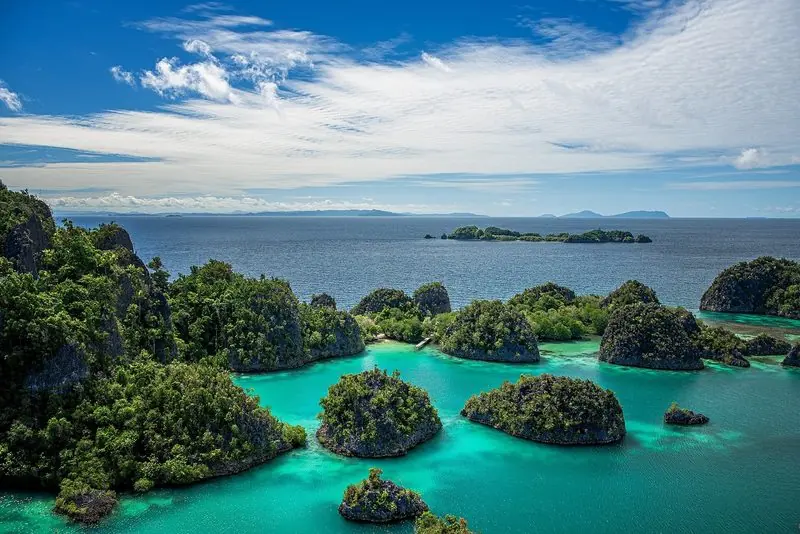
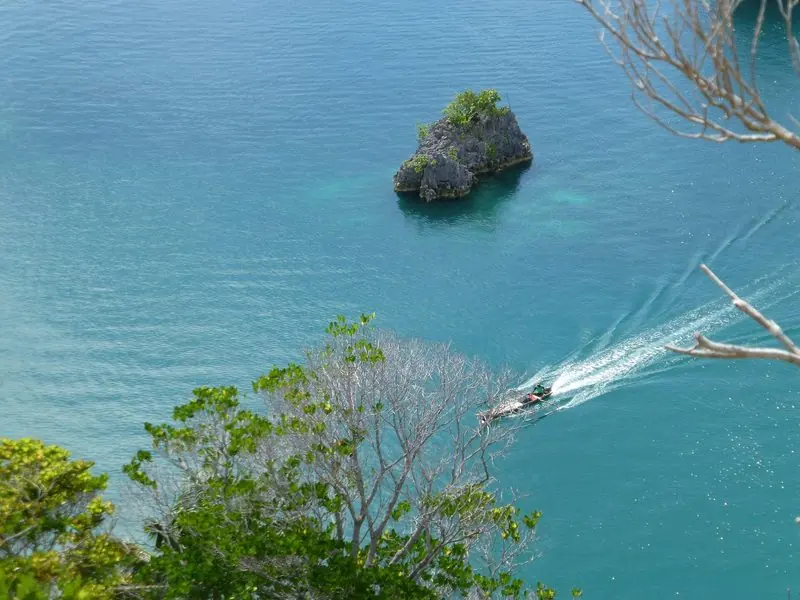
Raja Ampat sits off the Bird's Head of Southwest Papua, four main islands - Waigeo, Batanta, Salawati and Misool - with a scatter of limestone karst around them. Conservation International's rapid ecological surveys and the follow-up work established it as the richest part of the Coral Triangle in species terms, which is a strong claim given what it is being compared against. Published counts put it at roughly 540 hard coral species, about three quarters of every hard coral known to science. Reef fish counts vary by survey and run from over 1,000 to more than 1,400. For context, the Coral Triangle covers about 1.6 per cent of the ocean surface and holds more than 3,000 species of reef fish.
In cruising terms that density is the point. There is no single site the itinerary is built around: the limestone cones at Wayag in the north, the lagoons below the Piaynemo viewpoint, the walls and caves off Misool in the south and the central reefs near Arborek are all first-rank, and they are a long way apart. Operators put seven nights as the working minimum and 10 to 12 for anything unhurried, which is a function of distance rather than of appetite. A yacht that can move overnight and anchor where it likes gets a version of the archipelago that a resort-based visitor cannot buy. That is the argument for taking your own boat rather than chartering a Phinisi, and it is the argument Safe Passage was built on.
The permit, and the number nobody agrees on
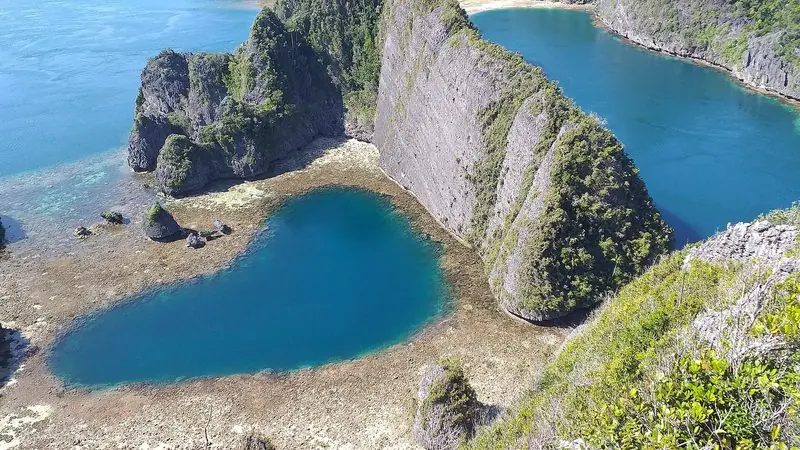
Every visitor needs the Marine Park Entry Permit, known locally as the kartu TLPJL and sometimes described as the environmental service fee. The Raja Ampat Marine Park Authority's own published rate is IDR 700,000 for foreign passport holders and IDR 425,000 for Indonesian citizens, with children under 12 exempt, and it is valid for 12 months from the date of purchase rather than per visit. It is bought at the Authority's office in Waisai, the regency seat on Waigeo. The Authority is explicit that this is not a formality: entering the marine park without the card breaches the regulations and can be penalised with expulsion from the park.
The second levy is where the published record falls apart, and a buyer should know that before budgeting. A separate Visitor Entry Ticket has existed since December 2019 and funds tourism infrastructure rather than conservation. Amounts quoted for it by reputable operators range from IDR 300,000 to around IDR 1,000,000, a factor of three, and at least one otherwise careful guide puts the marine park permit's validity at 30 days against the Authority's own 12 months. The Authority has been migrating its website and online sales have not been dependably available through the change. The honest instruction is to treat every figure published online as indicative, budget for the higher one, and settle both levies in person at Waisai.
Sorong is the entire support network
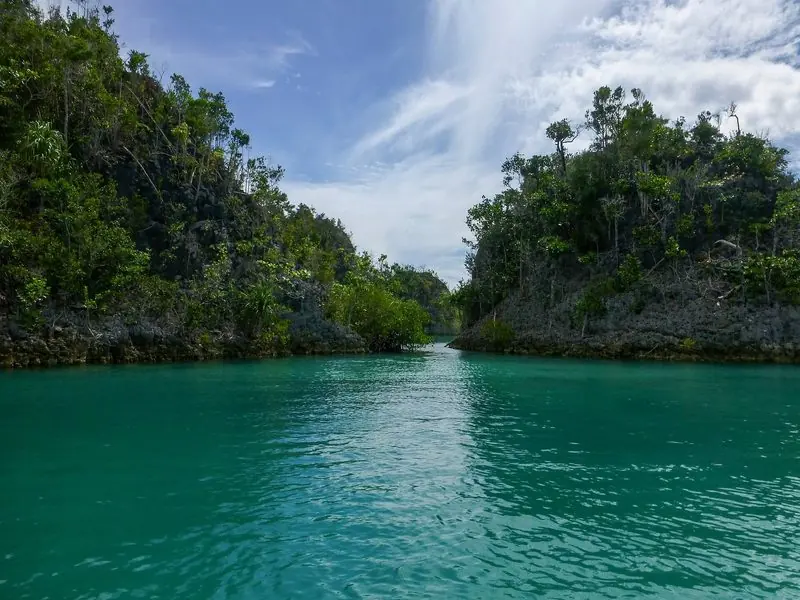
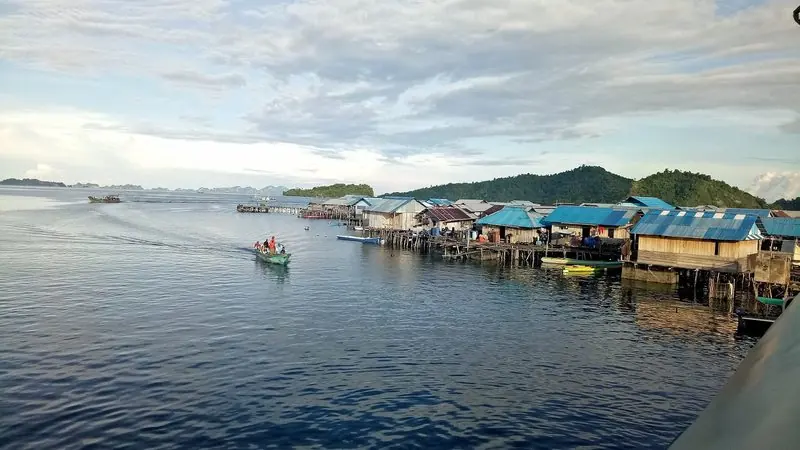
Clearance runs the standard Indonesian sequence of quarantine, customs, immigration and the harbourmaster, handled at the CIQP office near the commercial port at Sorong. Printed inventories of spares, provisions, medical stores, alcohol and tools speed the process considerably, and crew changes have to be formally recorded. There is no dedicated yacht fuel dock anywhere in the region. Diesel is taken by jerry can from the Pertamina station on Jalan Basuki Rahmat, which has the turnover to keep it clean, and moved to the boat by motorbike, pickup or hired porter. Fuel bought in the villages is worth avoiding on contamination risk alone.
There is no potable water at the yacht wharf and none at the outlying anchorages including Doom Island, so tanks are filled by jerry can and filtered. The Doom Island anchorage lies in 20 to 30 metres over mud and holds reliably on adequate scope, while the channel between Sorong and Doom carries 8 to 12 metres with margins that shoal abruptly to 2 to 4. Tidal flow can exceed two knots on springs with a noticeable cross-set, and unlit fishing craft are a genuine night hazard. Sorong offers basic mechanical, electrical, welding and fabrication support, but engine parts are typically sourced from Jakarta or Manado and major work belongs somewhere else. Outside the commercial ports much of the survey data still predates 1970 and was taken by lead line, so satellite imagery does the reef reading. Crew fly through Domine Eduard Osok airport, about 8km from the public harbour, and the express ferry to Waisai runs twice daily each way in roughly two hours.
When to go, and the honest read
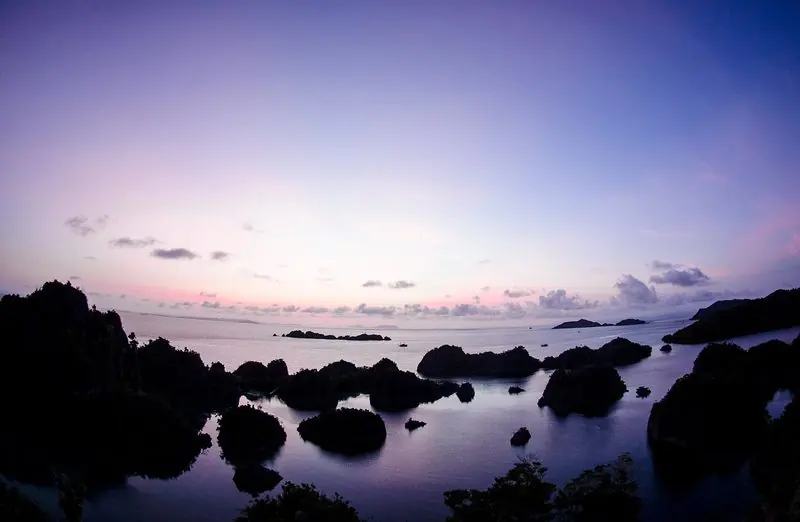
The season splits depending on who is answering, and the split is real rather than careless. Dive and charter operators put the window from October to April, with the peak from December to March, on the basis of calm water and underwater visibility. The cruising guidance written for yachts rather than divers prefers May to September, the southeast monsoon, for drier weather and a steadier 10 to 20 knots. Both readings agree on April and October, which bring variable winds and calm seas. They are not contradicting each other so much as optimising for different things, and which one applies depends on whether the boat is there to dive or to move.
The wider change is where such a yacht can be based. Bali's Benoa is building Indonesia's first international marina with berths for hulls up to 90 metres, which will shorten the empty legs that currently eat an Asian season. Until that is finished, a yacht in Raja Ampat is entirely self-supporting, and that is precisely why an owner who had already chartered here specified 7,000 gallons of fuel, a dive compressor in the lazarette and a heavier davit. The reef rewards the boat that needs nothing from the beach. For a buyer weighing a long-range explorer against another Mediterranean summer, that is the calculation, and Safe Passage is the current worked example of it.
What owners and crew report
The cockpit was traded for interior volume
Safe Passage carries a traditional cockpit rather than the five-foot California cockpit and fishing deck extension of the first Nordhavn 100, Serenity, which was built for an owner who fished. Nordhavn's project manager said the traditional arrangement buys outdoor entertaining space and interior gains.
Trever Smith, Nordhavn project manager (September 2025)The longer hull is marginally more efficient than the 96
Nordhavn's chief of design said the extra waterline gives the 100 a slight edge in efficiency over her N96 sisterships, with speed and fuel capacity otherwise consistent with a typical N96.
Jeff Leishman, quoted by Peter Swanson, Passagemaker (February 2018)What the platform was reported to do
On the N96, which shares this hull's beam, draft, displacement, tankage and power, the published figures were a 10-knot cruise, 12.5 knots top and roughly 4,000 nautical miles, at a base price of USD 9.5m delivered in the United States.
Capt. Bill Pike, Power and Motoryacht (May 2016)The first 100 was a one-off, not this boat
Serenity was delivered in June 2018 as a custom 100-footer on the Nordhavn 86/96 hull, gaining 36 inches through an extended transom and swim step, with five staterooms and crew for four. She is a different configuration from the production boat.
Miranda Blazeby, Boat International (June 2018)The permit is enforced rather than nominal
The Marine Park Authority states that entering the marine park without the entry card is in breach of the regulations and can be penalised with expulsion from the park.
Raja Ampat Marine Park Authority (BLUD UPTD) entry card guidanceNo independent account of this boat in these waters exists
No independent sea trial or pilotage report of a production Nordhavn 100 in Raja Ampat has been published. Every range and consumption figure attributed to her is the yard's own.
Yotters desk
What is good, and what to watch
Strong points
- The reef has no real rivalRoughly 540 hard coral species, about three quarters of every hard coral known, and reef fish counts from over 1,000 to more than 1,400 depending on the survey. Conservation International's work ranks it the richest part of the Coral Triangle.
- The window is longThe archipelago sits outside the main typhoon belt and both monsoons are workable, so the usable season is generous by Mediterranean standards and the shoulder months are genuinely good.
- Entry costs almost nothingThe conservation permit is a once-a-year sum in the low hundreds of dollars and runs 12 months, not per visit. The expense of Raja Ampat is getting the boat there, not being there.
- No berth to compete forThere is no marina, so there is no berthing queue and no season-ahead booking. A yacht that anchors and makes its own water has the good anchorages largely to itself.
What to watch
- There is no infrastructure at allNo fuel dock, no potable water at the wharf, no haulout. Diesel arrives by jerry can and anything beyond basic mechanical, electrical or welding work has to be planned for another country.
- The charting is oldMuch of the non-commercial survey data predates 1970 and was taken by lead line, so reef approaches are read off satellite imagery. In poor light that is a real operational risk, not a footnote.
- Support is weeks awayEngine parts are typically sourced from Jakarta or Manado. A failure is measured in weeks rather than days, which is the argument for redundancy and spares depth rather than for speed.
- The paperwork is unsettledPublished figures for the second levy differ by a factor of three, one guide contradicts the Authority on the permit's validity, and online sales have been intermittent during a site migration.
- Indonesia still has no finished superyacht baseBali's Benoa marina is not complete. Until it is, an Asian season carries long empty legs and the nearest full-service yard support is a passage away.
Practical detail
| Marine park permit | IDR 700,000 for foreign passport holders, IDR 425,000 for Indonesians, under 12 exempt. Valid 12 months from purchase, bought at the Marine Park Authority office in Waisai. |
|---|---|
| Second levy | A separate Visitor Entry Ticket has run since December 2019 and funds tourism infrastructure. Published amounts diverge from IDR 300,000 to about IDR 1,000,000. Confirm in person. |
| Enforcement | The Authority states that entering the marine park without the entry card breaches the regulations and can be penalised with expulsion from the park. |
| Gateway | Sorong, Southwest Papua. Domine Eduard Osok airport (SOQ) for crew changes, roughly 8km from the public harbour. |
| Ferry to Waisai | Two express services a day each way, about two hours in calm water. Tickets are bought at the counter on the day, not online. |
| Clearance | Quarantine, customs, immigration and harbourmaster at the CIQP office near the commercial port. Printed inventories of spares, stores, alcohol and tools speed it up. |
| Fuel | No yacht fuel dock in the region. Diesel by jerry can from the Pertamina station on Jalan Basuki Rahmat, moved by bike, pickup or porter. Avoid village fuel. |
| Water | None potable at the yacht wharf or at Doom Island. Fill by jerry can and filter. Plan multiple runs. |
| Main anchorage | Doom Island, 20 to 30 metres over mud, reliable holding with adequate scope. The Sorong to Doom channel runs 8 to 12 metres, shoaling abruptly to 2 to 4 at the margins. |
| Tide and traffic | Over two knots on springs with a cross-set. Numerous unlit fishing craft, particularly at night. |
| Charts | Outside the commercial ports much of the survey data predates 1970 and was taken by lead line. Satellite imagery is the working tool for reef approaches. |
| Yard support | Basic mechanical, electrical, welding and fabrication at Sorong. Engine parts usually come from Jakarta or Manado. Plan major work elsewhere. |
| Season | Dive and charter operators say October to April, peak December to March. Yacht cruising guidance prefers May to September. April and October suit both. |
| Time needed | Seven nights is the operator minimum, 10 to 12 nights for an unhurried itinerary. The distances between Wayag, Misool and the central reefs drive it. |
| What is not published | No official tariff page reconciles the two levies against each other, and the Authority's online sales have been unavailable during a site migration. There is no independent yacht pilotage for most of the archipelago. |
Questions this story answers
What happened?
Safe Passage, the second Nordhavn 100, has run 800 nautical miles from Hong Kong to Palawan and is now working through Raja Ampat, the reef her owner had previously only seen from a chartered Phinisi. The cruising ground he built her for holds roughly three quarters of the world's known hard coral species and almost no yacht infrastructure at all: one gateway town, no fuel dock, and charts still resting on lead-line surveys. For anyone specifying a long-range boat or planning a season east of Bali, the gap between the reef and the support is the whole brief.
What is good about it?
The reef has no real rival. Roughly 540 hard coral species, about three quarters of every hard coral known, and reef fish counts from over 1,000 to more than 1,400 depending on the survey. Conservation International's work ranks it the richest part of the Coral Triangle.
What should an owner or buyer watch?
There is no infrastructure at all. No fuel dock, no potable water at the wharf, no haulout. Diesel arrives by jerry can and anything beyond basic mechanical, electrical or welding work has to be planned for another country.
What do owners and crew report?
Safe Passage carries a traditional cockpit rather than the five-foot California cockpit and fishing deck extension of the first Nordhavn 100, Serenity, which was built for an owner who fished. Nordhavn's project manager said the traditional arrangement buys outdoor entertaining space and interior gains. (Trever Smith, Nordhavn project manager (September 2025))
Who reported this?
Nordhavn (Pacific Asian Enterprises), Passagemaker (Peter Swanson, February 2018), Power and Motoryacht (Capt. Bill Pike, May 2016), Boat International (Miranda Blazeby, June 2018), Raja Ampat Marine Park Authority (BLUD UPTD), Conservation International, Stay Raja Ampat, Raja Ampat Biodiversity.
We do this for everyone who loves this world. The people who have spent their lives in it, and the people just discovering it. Yotters exists so that what we learn belongs to all of them.
Nobody pays us for this. No ads, no sponsors, nothing for sale. We just believe the world is a little better when knowledge is shared instead of kept.
If it gave you something today, tell us to keep going. Follow us, leave a like, or write a positive comment. We read every one, and they are what keeps us going.