Royal Huisman's New 65m Aquarius Wins Sailing Yacht of the Year
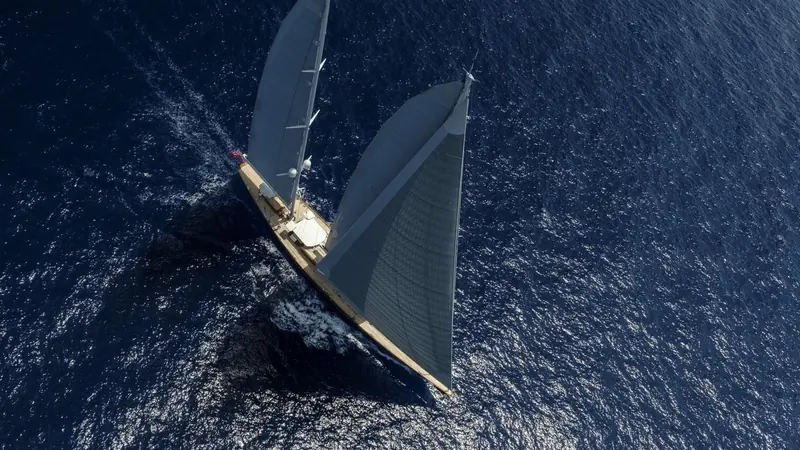
Why did Aquarius's owners replace a boat they already loved?
The husband and wife who commissioned the 56-metre Aquarius in 2018 called her close to perfect, then replaced her anyway because their family had grown and they wanted to cruise longer distances than the original boat comfortably allowed.
Royal Huisman's own account of the project is blunt about the starting point: the owners loved their first Aquarius, a 56-metre world-cruising ketch delivered in January 2018 with exterior and naval architecture by Dykstra Naval Architects and interiors by Mark Whiteley Design. They kept the same design team for the replacement, which is unusual on its own. Most owners who commission a bigger boat change at least one member of the creative team to signal a fresh start. This owner wanted the opposite: a bigger version of a boat that already worked, not a new boat that happened to be bigger.
Royal Huisman confirmed the new 65-metre hull and the original 56-metre look identical from a distance, by the owners' own request. The old boat was not scrapped or laid up. She was sold and renamed Apsara, and remains an active charter and private yacht today. The new Aquarius was announced under the working name Aquarius II in March 2022 and delivered under the simpler name Aquarius in 2025, a seven-year gap between the two deliveries that tracks almost exactly with how long it takes a young family to need a second owner's cabin and a bigger cinema room.
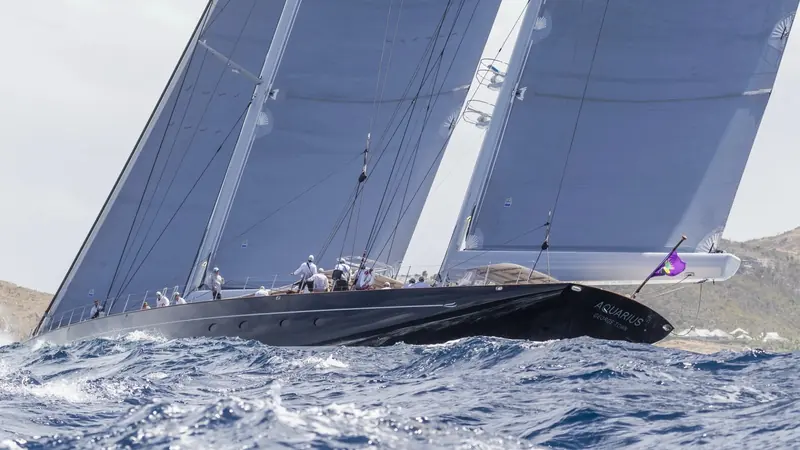
What did the extra 9 metres and nearly 50 percent more volume buy the owners?
The new Aquarius carries close to 50 percent more interior volume than the 2018 boat, and almost all of it went into one thing: turning a split-level owner's suite into a single-level one, with a larger galley, gym and cinema built around it.
Royal Huisman and Mark Whiteley Design put the volume gain at nearly 50 percent over the 56-metre original, and the extra length went almost entirely into the accommodation deck rather than tankage or machinery space. The owner's suite moved to a single level for the first time, with its own study, skylights around the mizzenmast and a full bathtub. The galley grew 67 percent, sized for a crew feeding guests on long ocean passages rather than day trips between marinas. Aquarius sleeps up to 8 guests across 4 suites, one fewer cabin than some yachts her size carry, in favour of making each one larger.
The deckhouse carries the most visibly reworked space: U-shaped seating, an integrated fridge and a pop-up television turn what was a passage space on the 56-metre boat into a room the family actually lives in underway. A forward cinema lounge with a full surround system and a well-equipped gym, dumbbells, a bench, an exercise bike and a treadmill, both read as spaces built for weeks aboard rather than a weekend charter. None of it is visible from outside the hull, which is exactly the point: the owners asked for more room to live in, not a bigger-looking boat.
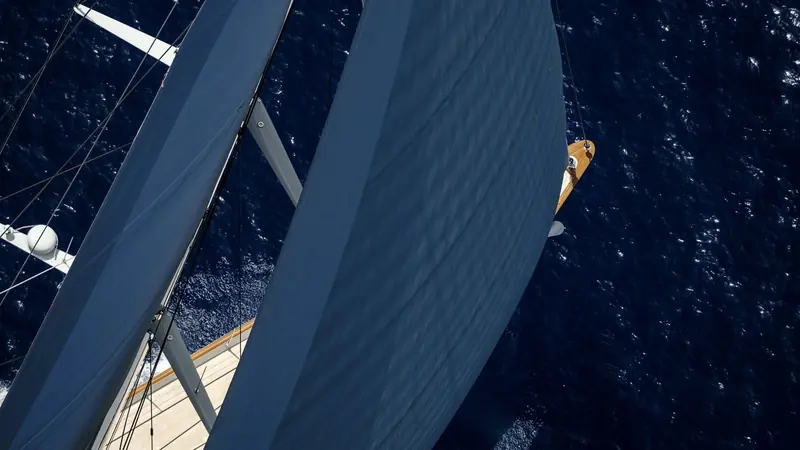
How did Royal Huisman add 9 metres and keep the classic ketch profile?
Dykstra Naval Architects kept Aquarius's performance-ketch rig and long-keeled profile deliberately close to her predecessor's, while replacing the keel with a lifting design and adding electric-assisted steering, changes that show up in how she sails rather than how she looks.
The rig is a performance ketch with a 67.5-metre carbon main mast and a 61-metre mizzen, built by Rondal with an Integrated Sailing System that automates much of the trim a crew this size would otherwise handle by hand. A lifting keel, new on this boat, lets Aquarius reduce her draught for shallow anchorages without the compromise a fixed deep keel forces on a world-cruising yacht of this length. Edson supplied electric-assisted steering, a system more associated with raceboats than 65-metre cruising ketches, fitted here so two masts and a hull nearly 50 percent larger still handle the way the owners were used to.
The hull and superstructure are Alustar aluminium with teak decks, the same material choice as the 2018 boat, which is part of why the family resemblance holds up at close range as well as from a distance. Royal Huisman has not published displacement, sail area or engine specifications for Aquarius, which is unusual for a yard that is normally detailed about its own builds, and it means a genuinely independent comparison against her 56-metre predecessor on those numbers is not possible from what the yard has released.
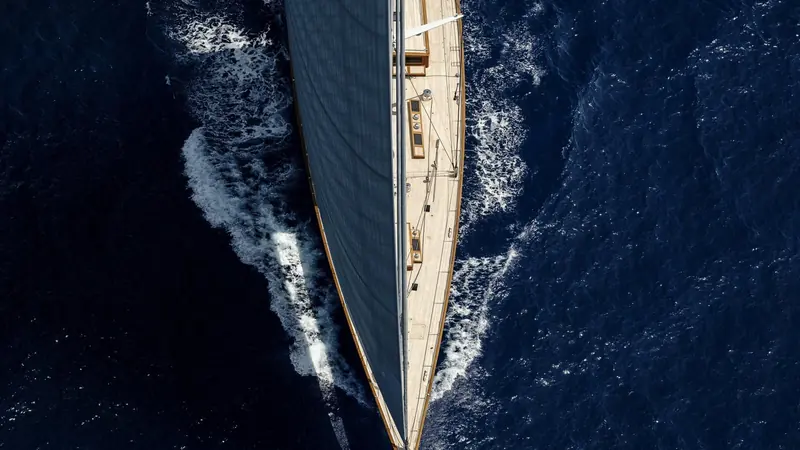
What does a mast that tall actually rule out for an owner?
A 67.5-metre air draft on the main mast puts most Mediterranean marina berths and several fixed road and rail bridges out of reach for Aquarius regardless of her length, which is the practical cost of keeping a tall traditional ketch rig on a modern hull.
Marina berths are rated for length and beam, but a mast of this height is what actually decides where a classic ketch like Aquarius can go. Most Mediterranean superyacht marinas, including several berths built specifically for 60-plus-metre yachts, have no air-draft restriction because their neighbours are motor yachts with far shorter masts or none at all. The restriction that matters is fixed infrastructure: road bridges, rail bridges and overhead cabling across the approaches to a number of major harbours cap out well under 67.5 metres, which pushes a yacht like Aquarius toward anchoring off rather than berthing on several stretches of coastline a similarly sized motor yacht would use without a second thought.
Royal Huisman has never published a price for Aquarius, and none of the coverage around her delivery or her Sailing Yacht of the Year win names a figure, so there is no public number to report. What is publicly known is the scale of the undertaking: a full-custom 65-metre replacement for a boat the owners already considered close to perfect, built by the same yard and the same design team inside seven years. That is a decision available to very few owners, and it is the context a reader needs before treating this as an aspirational upgrade path rather than what it actually is, a bespoke rebuild for a family whose needs had changed.
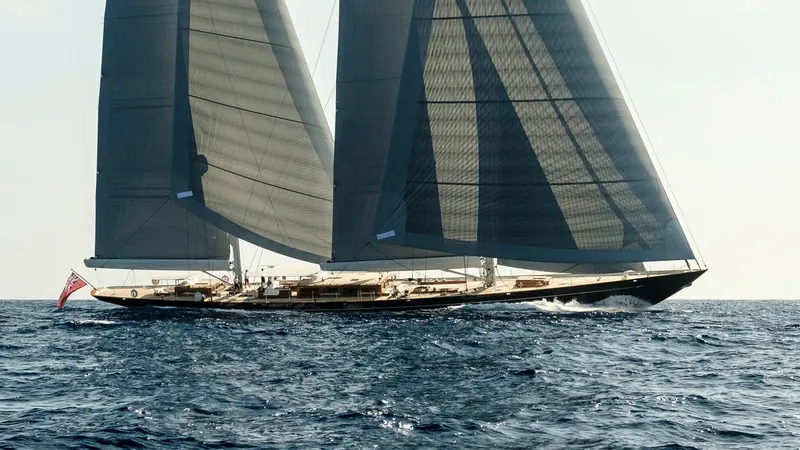
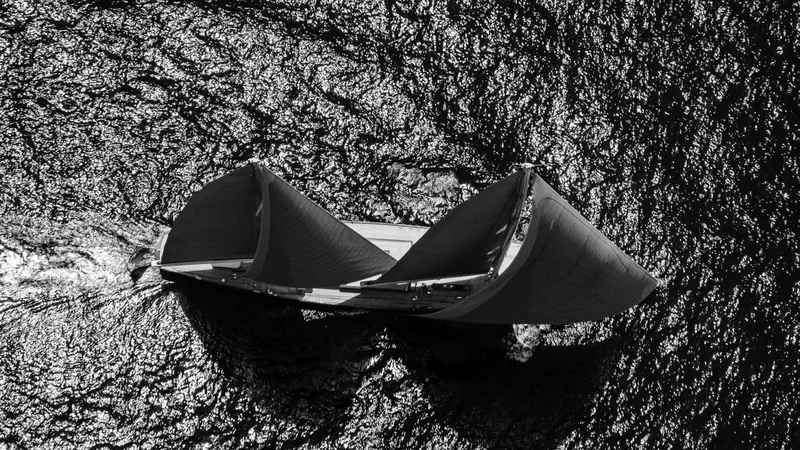
Why did Aquarius win Sailing Yacht of the Year at the 2026 World Superyacht Awards?
Aquarius won Sailing Yacht of the Year at the World Superyacht Awards in Venice on 1 and 2 May 2026, a prize BOAT International's judging panel credited to her design, engineering, craftsmanship and high-performance naval architecture rather than to size alone.
The World Superyacht Awards are judged by the trade rather than voted on by the public, which is why the win carries weight beyond a marketing line: the people scoring Aquarius build, design and deliver competing yachts for a living. The citation named design, engineering, craftsmanship and high-performance naval architecture specifically, language that tracks with the yacht's own engineering story, the lifting keel, the Integrated Sailing System, the electric-assisted steering, more than with her interior alone.
It is also, in a narrow sense, the second time this owner's design brief has been recognised at this level: the 2018 Aquarius, now sailing as Apsara, built the reputation that made Royal Huisman, Dykstra and Whiteley the obvious team to call again in 2022. A reader weighing a full custom-build against a stock yard model is looking at exactly this trade: continuity of a proven design team against the risk, and the cost, of building the same relationship from nothing.
What is good, and what to watch
Strong points
- Trade-judged awardSailing Yacht of the Year 2026 at the World Superyacht Awards is scored by builders and designers who compete with Royal Huisman, not by the owners who paid for her.
- Volume went into living spaceNearly 50 percent more interior volume than the 2018 boat became a single-level owner's suite, a 67 percent larger galley and an enlarged gym and cinema, not extra tankage or crew space nobody would notice.
- Real engineering, not badgesThe lifting keel and Edson electric-assisted steering are functional changes that let a 65-metre ketch with two masts still handle the way the owners were used to on the 56-metre boat.
What to watch
- No published priceRoyal Huisman has never disclosed what Aquarius cost, and a full-custom 65-metre build from this yard is available to a vanishingly small number of owners regardless.
- A 67.5-metre air draft is a real limitFixed bridges and overhead cabling on the approaches to several major harbours cap out well under her main mast height, forcing her to anchor off where a similarly sized motor yacht would simply berth.
- A ketch costs more to run than a sloopTwo masts' worth of rigging and sail area to maintain and crew is the real, ongoing cost of the silhouette the owners specifically asked Royal Huisman to keep.
Practical detail
| Length overall | 64.62m / 212ft |
|---|---|
| Beam | 10.8m |
| Gross tonnage | 450 GT |
| Guests / suites | 8 guests in 4 suites |
| Rig | Performance ketch, Rondal carbon spars, 67.5m main mast / 61m mizzen |
| Keel | Lifting keel (new on this hull) |
| Hull and superstructure | Alustar aluminium, teak decks |
| Naval architecture and exterior | Dykstra Naval Architects |
| Interior design | Mark Whiteley Design |
| Builder | Royal Huisman, Vollenhove, Netherlands |
| Delivered | 2025 |
| Predecessor | 56m Aquarius (2018), sold and renamed Apsara |
| Price | Not published by Royal Huisman |
| What is not published | Displacement, sail area, engine power and purchase price are not disclosed by the yard |
Questions this story answers
What happened?
Royal Huisman delivered the new 65-metre Aquarius in 2025, a full rebuild that replaced a 56-metre sister her own owners once called close to perfect. A year later she won Sailing Yacht of the Year at the World Superyacht Awards, and almost every gain that earned it, a single-level owner's cabin, a much larger galley, a lifting keel, exists because a family outgrew a yacht built for them only seven years earlier.
What is good about it?
Trade-judged award. Sailing Yacht of the Year 2026 at the World Superyacht Awards is scored by builders and designers who compete with Royal Huisman, not by the owners who paid for her.
What should an owner or buyer watch?
No published price. Royal Huisman has never disclosed what Aquarius cost, and a full-custom 65-metre build from this yard is available to a vanishingly small number of owners regardless.
Who reported this?
Royal Huisman, BOAT International, World Superyacht Awards.
We do this for everyone who loves this world. The people who have spent their lives in it, and the people just discovering it. Yotters exists so that what we learn belongs to all of them.
Nobody pays us for this. No ads, no sponsors, nothing for sale. We just believe the world is a little better when knowledge is shared instead of kept.
If it gave you something today, tell us to keep going. Follow us, leave a like, or write a positive comment. We read every one, and they are what keeps us going.