Project 821 (Breakthrough)
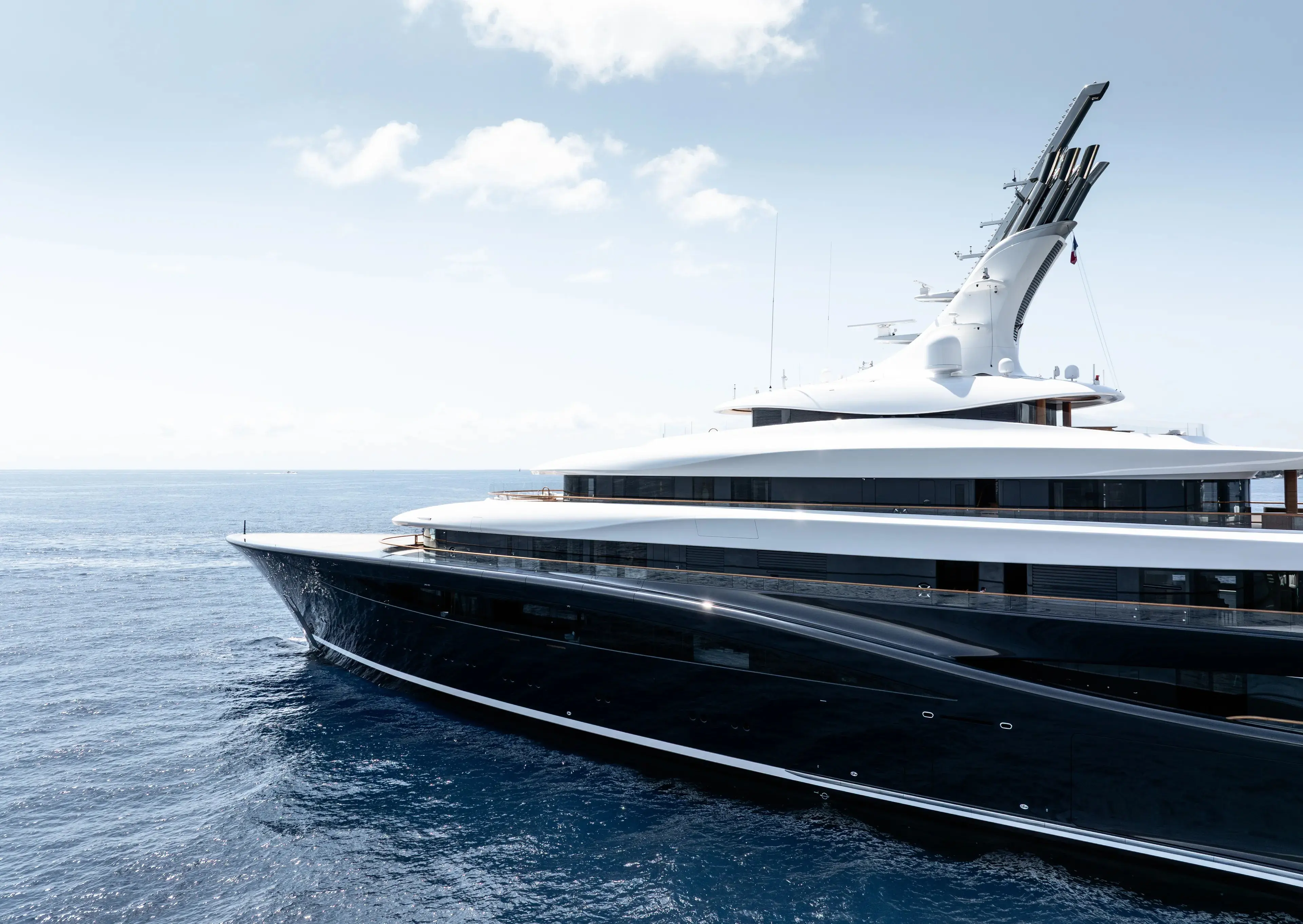
| 118.8 m LOA (390 ft), 7,247 GT | |
| World's first hydrogen fuel-cell superyacht | |
| Fuel-cell system approx. 3.2 MW, liquid hydrogen at -253 C | |
| About 4 tonnes of hydrogen, powers the full hotel load | |
| Range approx. 6,500 nm at 14 knots, hybrid diesel-electric | |
| Exterior and interior by RWD, 14 balconies | |
| Largest yacht ever built in the Netherlands | |
| Launched Amsterdam 2024, sea trials off IJmuiden, hydrogen-bunkered 2025 |
The first of its kind
Project 821, delivered under the name Breakthrough, is the first superyacht in the world to run on a hydrogen fuel cell. Feadship spent close to a decade turning that sentence from a research ambition into a 118.8 metre yacht that left the covered dock in Amsterdam in 2024. None of it is a retrofit or a token gesture. The hydrogen system was designed first, and the yacht was built to carry it.
The significance is not the novelty, it is the proof. Until Breakthrough, a zero-emission superyacht was a slide in a conference talk. Now there is a hull in the water that can sit at anchor for around a week and produce no local emissions at all, running its lights, air conditioning, galley and systems entirely on hydrogen. That is the most carbon-heavy part of how a large yacht is actually used, and it is the part Feadship chose to solve first.
How the hydrogen works
At the centre of the yacht is a fuel-cell system of roughly 3.2 megawatts, fed by liquid hydrogen held in a cryogenic tank at minus 253 degrees Celsius. That temperature is the hard part. Hydrogen only becomes dense enough to carry in useful quantity when it is chilled to near absolute zero, and keeping it there safely aboard a moving yacht was a problem the marine industry had not solved at this scale before.
The tank holds around four tonnes of liquid hydrogen, enough to cover the hotel load, the everyday electrical demand that runs whether the yacht is moving or not. When the fuel cells convert that hydrogen into electricity the only by-product is water. There is no combustion, no exhaust and no engine noise, which is why the experience at anchor sits closer to silence than anything a conventional yacht of this size can offer.
A zero-emission superyacht used to be a conference slide. Breakthrough is the hull that made it real.
A yacht built around a tank
Breakthrough is the largest yacht Feadship has ever built and the largest ever launched in the Netherlands, at 118.8 metres and 7,247 GT. Part of that size is a direct consequence of the engineering. The cryogenic hydrogen installation and its safety zones take up real volume, and the naval architecture had to grow to house them without surrendering the interior space owners at this level expect.
The exterior and interior are the work of RWD, with Edmiston representing the owner through the build. The yacht carries fourteen balconies, the most hull openings of any Feadship to date, a detail that shows how hard the design pushed glass and daylight into a hull that also had to accommodate a first-of-kind power plant. The result reads as a modern Feadship, not as a science project wearing a yacht's clothes.
Power, range and how she moves
The hydrogen fuel cells carry the hotel load. Movement is handled by a hybrid diesel-electric arrangement, because the energy density needed to cross oceans on hydrogen alone does not yet exist. The installation pairs two 900 kilowatt and three 2,500 kilowatt MTU generators with sixteen 185 kilowatt PowerCell hydrogen units, a layout that lets the yacht draw on whichever source suits the moment.
That combination gives a range of about 6,500 nautical miles at 14 knots, genuine transoceanic capability. Breakthrough was launched at the Amsterdam dock in May 2024 and completed her first sea trials off IJmuiden that November, with hydrogen bunkering following in 2025. The staged commissioning reflects how much of this was new, not only for Feadship but for the ports and suppliers around her.
What it signals for the fleet
The reported cost sits near 600 million euros, and the yacht was sold in-house at Edmiston. Feadship has never confirmed who owns her, and we do not trade in owner names. For a first-of-kind build the ownership matters far less than the plain fact that someone was willing to fund the risk.
That is the real story of Project 821. A yard, an owner and a long chain of suppliers absorbed the cost and the uncertainty of proving that hydrogen can work at this scale, and the rest of the industry now has a reference point that did not exist before. Whether the next hydrogen Feadship arrives in three years or ten, every one of them will trace back to this hull.
What happened after delivery
Breakthrough did not stay with the family who commissioned her. Bill Gates never boarded the finished yacht, and Feadship's landmark hydrogen project was quietly remarketed within about a year of delivery. Canadian waste-management entrepreneur Patrick Dovigi bought her in a deal reported at more than USD 650 million, becoming the owner who has actually put the technology to work at sea.
Running her has proven expensive in ways a conventional yacht would not be. Her first annual class survey and maintenance program, carried out at the MB92 yard in La Ciotat over about a month in mid-2026, was reported at around USD 5 million, largely spent inspecting the cryogenic hydrogen installation alongside the five MTU generator sets and the twin ABB azimuth propulsion pods. And because the fuel cells cannot yet cover a transoceanic passage on their own, moving the yacht from Europe to Miami under her new owner meant loading roughly 605,000 litres of conventional fuel at a single stop, a bill reported at about USD 435,000. The zero-emission story holds up at anchor. Getting the yacht across an ocean still means a diesel bill like any other superyacht her size, which is the honest limit of where the technology stands today. That gap between the anchor-side promise and the open-ocean reality is exactly what the rest of the industry is watching Breakthrough to answer over the coming years.
Двигатели и системы
| Hydrogen fuel-cell system | 16 PowerCell H2 fuel-cell modules producing about 3.2 MW combined, fed by liquid hydrogen stored at minus 253 C in a 92 cubic metre vacuum-insulated Type C tank supplied by MAN Cryo, holding about 4 tonnes (BOAT International, Luxurylaunches agree) |
|---|---|
| Backup and hybrid power | Three MTU 2,500 kW and two MTU 900 kW diesel generator sets, switching to conventional diesel-electric power when hydrogen is unavailable or for ocean crossings (BOAT International, Wikipedia) |
| Propulsion | Twin ABB 3,200 kW azimuth pods, top speed 17 knots, range about 6,500 nm at 14 knots (Wikipedia, Luxurylaunches) |
| Hull and naval architecture | De Voogt Naval Architects, steel hull with aluminium superstructure, 118.8 m LOA, 19.0 m beam, 7,247 GT (Wikipedia) |
| Accommodation | Reported inconsistently across the trade press: cabin counts of 12, 13 and 15 all appear for the same 30-guest capacity, and crew is reported as 43 or 44. Both ranges are given here rather than picked, per the two-source rule |
Что сообщают владельцы и экипажи
Commissioned by Bill Gates, delivered to a different owner
Project 821 was built to a brief shaped in part by Melinda French Gates, but Bill Gates never boarded the finished yacht. It was quietly remarketed after delivery and bought by Canadian waste-management entrepreneur Patrick Dovigi in a deal reported at more than USD 650 million.
Wikipedia and Luxurylaunches, corroborated by SuperYachtFan and Supercar BlondieFirst-year running cost
The new owner's first annual class survey and maintenance program, carried out at MB92 La Ciotat over about a month in mid-2026, was reported at around USD 5 million, covering the five MTU generator sets, the twin ABB azimuth pods and a full inspection of the cryogenic hydrogen installation.
LuxurylaunchesFuel bill for an ocean crossing
Moving the yacht from Europe to Miami under her new owner required about 605,000 litres of fuel at a single stop, reported to cost around USD 435,000, because the hydrogen system cannot cover a transoceanic passage on its own.
Supercar BlondieBroker's assessment
Jamie Edmiston, whose brokerage represented the seller, called Breakthrough "the most extraordinary yacht ever built, the one that will change it all."
Jamie Edmiston, Edmiston, quoted by BOAT International
Сильные стороны и что учесть
Сильные стороны
- A working zero-emission system, not a conceptThe hydrogen fuel cells genuinely cover the hotel load, roughly 70 to 78 per cent of a yacht's annual energy use, letting Breakthrough sit at anchor for about a week producing only water as exhaust, the first time this has been proven at superyacht scale.
- Engineering that reshaped the hullFeadship grew the design specifically to house a 92 cubic metre cryogenic tank and its safety zones, and still delivered the largest yacht ever built in the Netherlands, at 118.8 m and 7,247 GT, with 14 balconies and seven fold-out platforms.
На что обратить внимание
- Cannot yet cross an ocean on hydrogenThe fuel cells cannot power a transoceanic passage. Long-range cruising still means loading hundreds of thousands of litres of conventional or biofuel diesel, as the delivery run to Miami showed.
- Very expensive to keep runningA single early maintenance cycle was reported at about USD 5 million, and the first Atlantic refuelling stop alone cost roughly USD 435,000, costs a buyer of a pioneering system should expect to sit well above a conventional yacht of the same size.
Практическая информация
| Reported price | Asking price reported at approximately EUR 600 million / USD 645 to 650 million; sold to Patrick Dovigi in a deal reported at over USD 650 million. Figures are press-reported, not an official Feadship price (BOAT International, Wikipedia, Supercar Blondie). |
|---|---|
| Reported running cost | First annual maintenance program reported at about USD 5 million in 2026, on top of normal crew, insurance and berthing for a roughly 44-crew, 118.8 m yacht (Luxurylaunches). |
| Fuel for long range | Hydrogen covers hotel load only. An Atlantic crossing under diesel or biofuel power was reported to need about 605,000 litres, costing roughly USD 435,000 at a single stop (Supercar Blondie). |
| Bunkering infrastructure | Received the first liquid-hydrogen bunkering ever supplied to a superyacht in the Netherlands, in June 2025, which required new regulatory sign-off (BOAT International). |
| Not publicly known | An official Feadship-confirmed sale price, the exact cabin count (reported variously as 12, 13 or 15), and independent third-party verification of the claimed one-week zero-emission endurance at anchor. |
Design
| Экстерьер | RWD (Redman Whiteley Dixon) |
|---|---|
| Морская архитектура | Feadship - De Voogt Naval Architects |
Для кого: An owner willing to fund first-of-kind technology and put their name behind the industry's zero-emission roadmap.
Ориентировочная цена: Reported asking price approx. EUR 600 million / USD 645 million, sold in-house at Edmiston. Figures are press-reported, not an official Feadship price.