Swan 80
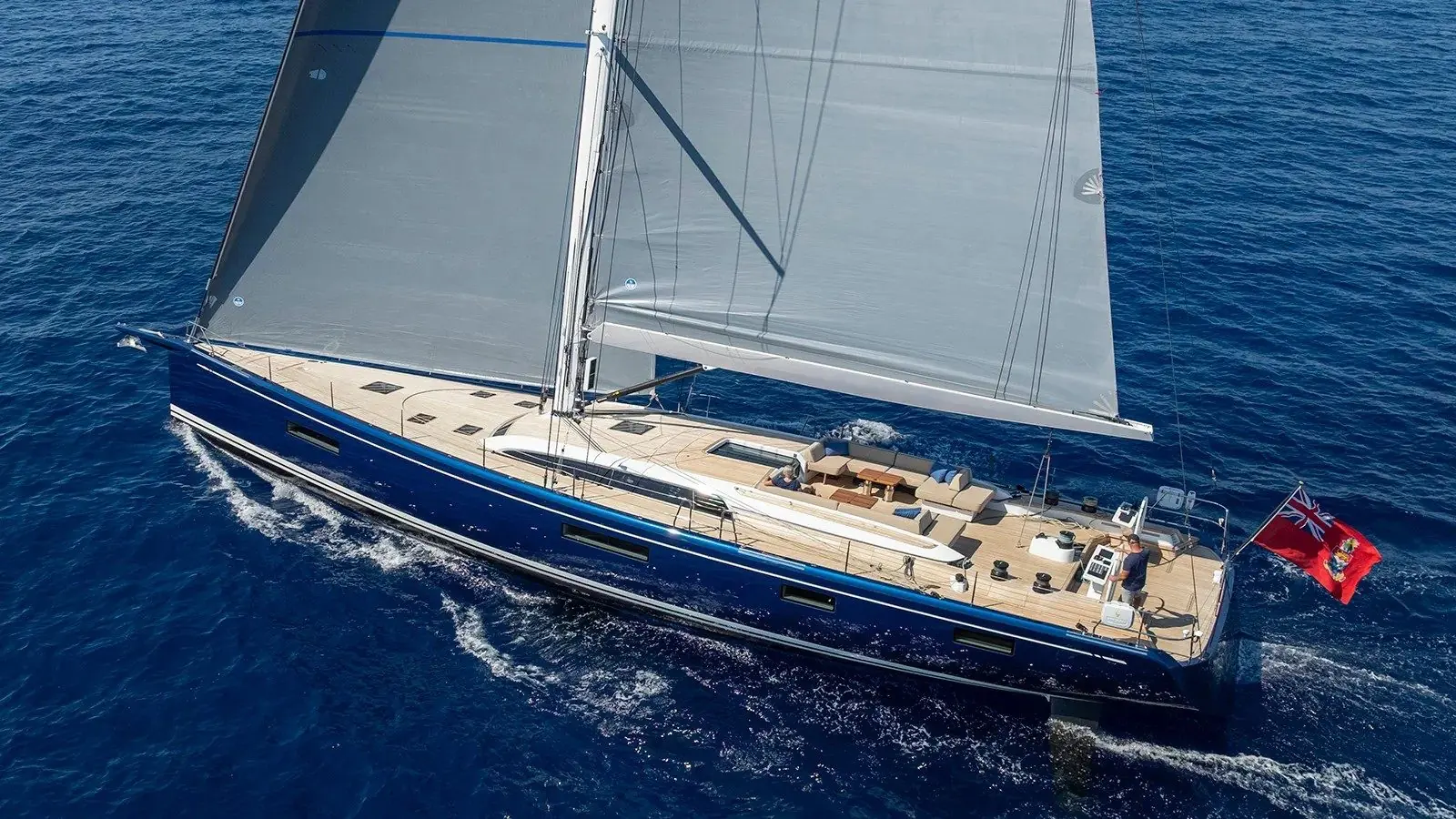
| LOA overall (with bowsprit) | 25.55 m / 83.8 ft |
|---|---|
| Hull length | 23.99 m / 78.7 ft |
| Beam | 6.40 m / 21.0 ft |
| Draft | 3.00 m to 4.30 m depending on keel option |
| Displacement (light) | 42,600 kg |
| Ballast | 11,600 kg |
| Mainsail | 196.0 sq m |
| Genoa | 174.3 sq m |
| Guests | up to 8 in 4 cabins, crew 2 to 5 |
| Designers | German Frers (naval architecture), Lucio Micheletti (exterior), Misa Poggi (interior) |
The boat that stops one centimetre short of 24 metres
The number that every piece of coverage of the new Swan 80 leads with is 23.99 metres, the measured length of the hull itself, deliberately kept one centimetre under the 24 metre mark that features and forward attachments such as the pulpit or bowsprit are excluded from under the relevant measurement rules. With the bowsprit included the boat is 25.55 metres end to end, a genuinely large yacht by any visual measure, but for regulatory purposes she is judged on the shorter hull figure. That is not a rounding curiosity. Twenty four metres is the threshold at which a yacht typically moves from recreational rules into a materially heavier regime, closer to the Large Yacht Code frameworks used by flag states such as the UK's Maritime and Coastguard Agency, which brings with it SOLAS-aligned construction standards, formal crew certification requirements, tonnage and load line certificates, and in many ports higher anchoring and harbour fees along with steeper insurance premiums.
By staying under that line, Nautor is selling the Swan 80 as a yacht an owner can run more like a large private boat than a commercially regulated superyacht, while still offering, according to the yard and to the trade press that has covered the launch, the volume, presence and offshore capability of a noticeably bigger vessel. It is a genuine engineering and commercial decision rather than a marketing footnote: the same logic explains why Nautor's own Swan 88, the next size up in the Maxi range, is also built and pitched with an explicit eye on staying compliant with MCA-style rules for its size class. The Swan 80 simply takes that logic and applies it one size down, to a boat pitched as the accessible entry point into the Maxi range rather than a full-blown, professionally crewed superyacht.
Frers' study in balance
The Swan 80 is credited as an evolution of the Swan 78, which the yard and reviewers describe as one of the best-in-class boats of its generation, rather than a clean-sheet design. German Frers did the naval architecture, with Lucio Micheletti responsible for the exterior styling and Misa Poggi for the interior, the same three-way design split Nautor now uses across its current Maxi range. Frers has described his approach on this generation of Swan Maxis as a complete fresh study of balance, performance, rig position and sail shape before the hull itself was finalized, rather than simply scaling up an existing set of lines. The result is a hull built from foam-cored, glass-fibre-reinforced epoxy with unidirectional carbon fibre reinforcement, a construction method chosen for strength to weight rather than cost, carrying a light displacement of 42,600 kg with 11,600 kg of that in the ballast keel.
Buyers get a genuine choice of underwater profile: a standard fixed deep keel drawing 4.00 metres, a shallow fixed option at 3.50 metres for owners who cruise thin water more often than they race, and a telescopic keel that lifts from 3.00 metres up to a full 4.30 metres, letting one boat do coastal cruising in the morning and a properly ballasted upwind leg in the afternoon. Twin rudders with sacrificial tips protect the steering gear and the hull from grounding damage, a detail that matters more on a cruising Maxi likely to see unfamiliar anchorages than on a pure raceboat. Under sail she carries a mainsail of 196.0 square metres, a genoa of 174.3 square metres and a fore triangle of 154.4 square metres, figures that put her firmly in Maxi territory despite the sub-24 metre hull length that keeps her out of Maxi-level red tape.
Twenty four metres is the line where a yacht stops being a big private boat and starts being a regulated one. The Swan 80 is built, to the centimetre, to stay on the right side of it.
Living aboard, and who Nautor built her for
On deck, the Swan 80 carries wood-covered cockpit coamings extended further aft than on the Swan 78 she succeeds, specifically to give crew more secure footing and seating when the boat is working hard, alongside twin helm stations and a near-flush teak deck that keeps the coachroof low and unobtrusive. The transom opens into an integrated beach platform with a full-beam lazarette large enough for tender storage, a feature that has become close to mandatory on modern Maxis but is genuinely useful on a boat meant to combine racing with family cruising. Below, the first hull is laid out with a forward owner's suite, a forward VIP cabin and two aft guest cabins, each en suite, for up to eight guests in four cabins, with one guest cabin able to convert into a media lounge or extra dining space, and crew quarters aft with their own independent access for two to five crew depending on how the owner configures the boat.
Systems are modest for the boat's size by design, in keeping with the sub-24 metre, lighter-crew philosophy: a Volvo Penta D4 diesel of 129 kW (175 hp) for docking and motoring, a Northern Light 20 kW generator running at 230V and 50Hz, 2,000 litres of fuel and 1,300 litres of fresh water plus a 100 litre hot water tank. None of that is exotic, and that is rather the point. Nautor is not pitching the Swan 80 at owners who want a floating superyacht with a full engineering department; it is pitched at an owner who already knows Swans, wants genuine offshore performance and Maxi-level volume, but wants to run the boat with a compact crew and without tripping into the paperwork, fees and insurance costs that a few centimetres of extra hull length would otherwise trigger.
Where she fits, what she costs, and how her debut is planned
The first hull, number 301 and christened Elvi, was floated at Nautor's Pietarsaari yard on 4 June 2026 in the traditional Finnish ceremony the yard uses for every launch, finished in a custom bright blue livery, and delivered to her owner in July 2026. Her public unveiling is scheduled for the Cannes Yachting Festival in September 2026, timed to land in the same year as Nautor's 60th anniversary, with her sailing debut to follow immediately afterward at the 2026 Rolex Swan Cup in Porto Cervo, arguably the toughest test available for a brand new design, since it puts her straight onto a start line against decades of established Swan raceboats and their sail-hardened crews. The Swan 80 sits as the smallest model in Nautor's current Swan Maxi range, one step below the Swan 88, and one step above the standard Swan cruising line, positioned explicitly as the accessible entry point into Maxi ownership rather than a scaled-down superyacht.
Nautor has not published a base price for the Swan 80, which is standard practice for the yard's semi-custom Maxi range but does make cross-shopping harder for a first-time Maxi buyer; earlier Swan 80 hulls from a different, unrelated 2000s-era design of the same name now trade on the used market for figures in the low millions of euros, but those numbers say nothing useful about the new boat's pricing. What is public is that Nautor announced the sale of this first new-generation Swan 80 in 2024, well ahead of the 2026 launch, and that four other Maxi Swans, two Swan 108s and further Swan 88 and Swan 98 hulls, sold alongside her, evidence of real order book momentum behind the range this boat anchors rather than a one-off show boat built to generate headlines.
Двигатели и системы
| Engine | Volvo Penta D4 diesel, 129 kW / 175 hp |
|---|---|
| Generator | Northern Light M864W3, 20 kW, 230V 50Hz |
| Rig and sails | Fractional sloop; mainsail 196.0 sq m, genoa 174.3 sq m, fore triangle 154.4 sq m |
| Thrusters | Not specified in the yard's published technical data |
| Fuel tankage | 2,000 litres / 528 US gal |
| Fresh water tankage | 1,300 litres / 343 US gal, plus 100 litre hot water tank |
Что сообщают владельцы и экипажи
Built to be sailed hard, not just anchored off a beach club
Coverage of hull 301's launch framed Elvi's brief explicitly as a yacht meant to cruise, race and potentially even circumnavigate, an unusually ambitious use case for a boat marketed as the accessible entry point into Nautor's Maxi range.
Megayacht NewsThe sub-24 metre hull is the sales pitch, not a footnote
Launch reporting consistently led with the regulatory logic of the 23.99 metre hull, noting that staying under 24 metres lets an owner avoid the crew certification, harbour fee and insurance costs that apply once a yacht crosses that line, while still delivering Maxi-level volume.
Boat InternationalHer first real test is the toughest one on the calendar
Rather than a quiet shakedown season, Elvi's sailing debut was scheduled directly into the 2026 Rolex Swan Cup at Porto Cervo, the same regatta marking Nautor's 60th anniversary and drawing the brand's most competitive owner-driver fleet.
Yacht Style
Сильные стороны и что учесть
Сильные стороны
- Genuine regulatory advantage, not a marketing trickKeeping the hull at 23.99 metres is a documented, verifiable way to avoid Large Yacht Code-style crew certification, fee and insurance burdens that apply to boats over 24 metres, a real practical saving for an owner-operator.
- Frers pedigree and a proven predecessorShe is an evolution of the Swan 78, a design reviewers already rate as best in class, refined through a fresh study of balance, rig position and sail shape rather than a rushed new hull.
- Real cruising flexibility from the keel optionsA shallow fixed keel and a telescopic keel that ranges from 3.00 to 4.30 metres give one hull genuine access to thin-water cruising grounds as well as a properly ballasted racing draft.
На что обратить внимание
- No published base priceNautor has not disclosed a list price for the new Swan 80, standard practice for its semi-custom Maxi range but a real friction point for a buyer trying to compare her against other Maxis before speaking to the yard.
- Options can add substantially to the headline figureYachting World's review of the closely related Swan 88 notes that its hybrid propulsion option alone comes at considerable extra cost, a pattern that runs across Nautor's current Maxi range and applies just as much to the Swan 80's option list.
- Sub-24 metre status does not remove the need for trained crewEven with lighter formal crew certification requirements, handling a boat with a 196 square metre mainsail and Maxi-scale loads in anything but light conditions still calls for competent, ideally professional, hands on deck, which somewhat undercuts the pitch of an easy step up for a first-time Maxi owner.
Практическая информация
| New build price | Not publicly disclosed by the yard; sold on a semi-custom, quote basis |
|---|---|
| Typical used price | Not yet applicable; hull 301 Elvi delivered July 2026 as the first of the new-generation model |
| Annual running cost | Not publicly known; comparable Swan Maxis are typically budgeted at several hundred thousand euros a year once crew, berthing and insurance are included |
| Not publicly known | Exact number of hulls sold or currently in build beyond hull 301 |
Для кого: An experienced Swan owner moving up to genuine Maxi volume and offshore range who wants to run the boat with a compact crew and without crossing into large-yacht regulatory territory, rather than a first-time sailor or a buyer who wants a fully crewed superyacht experience.