Koru (Y721)
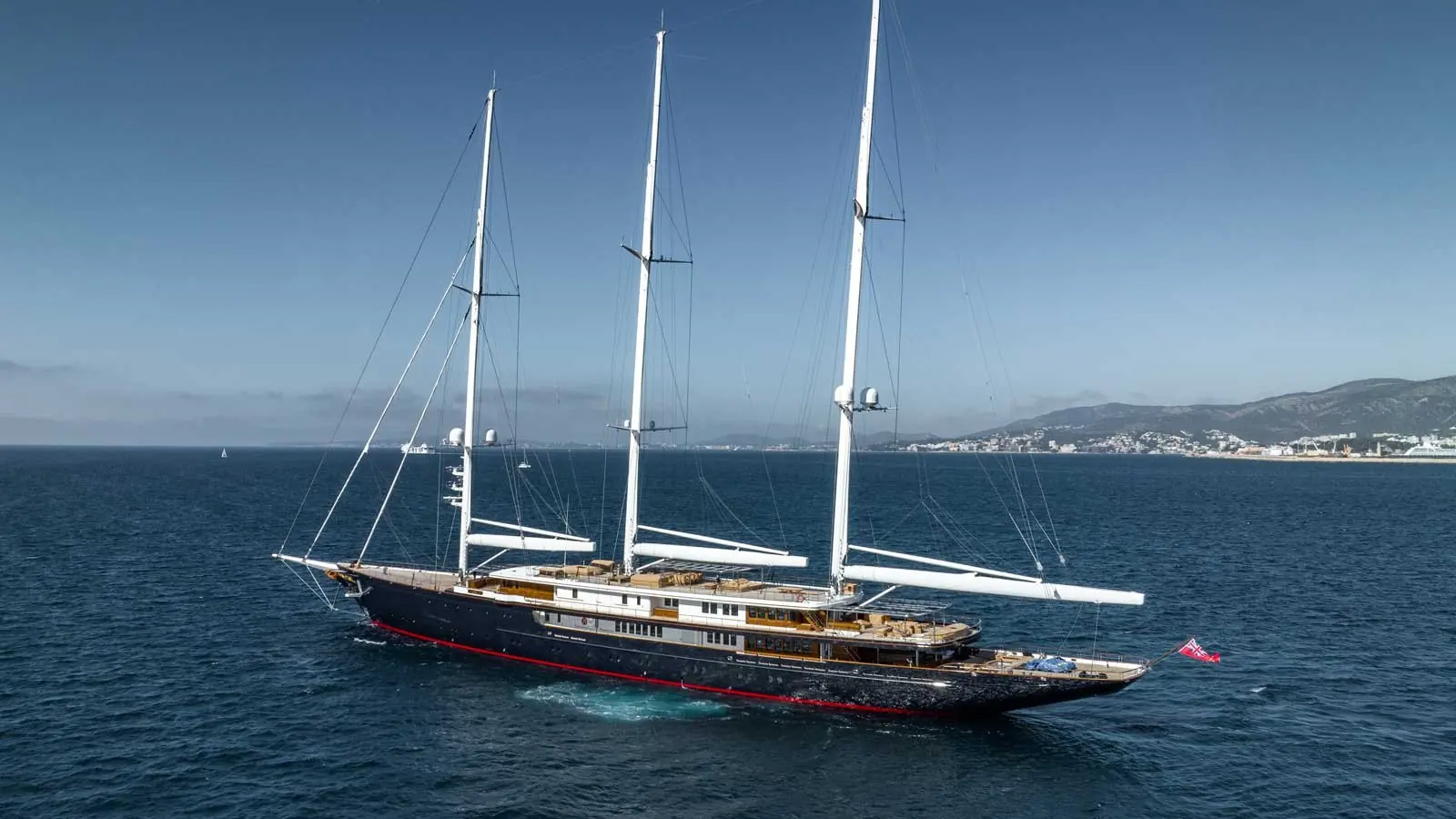
| Builder | Oceanco, Alblasserdam, Netherlands |
|---|---|
| Length | approximately 127 metres (reported) |
| Type | three-masted sailing yacht, schooner rig |
| Delivered | 2023 |
| Gross tonnage | reported at roughly 3,000 to 3,500 GT |
| Naval architecture and rig | Dykstra Naval Architects with Lateral Naval Architects |
| Interior design | Mlinaric, Henry and Zervudachi |
| Distinction | largest sailing yacht in the world and largest yacht built in the Netherlands |
The record that reset the sailing class
Koru occupies a position that few yachts ever reach, sitting at the very top of the sailing fleet by length. At a reported 127 metres she pushed past every existing sailing record and became the largest yacht of any kind ever completed on Dutch soil. The scale matters because sail adds problems that motor yachts avoid, from rig loads to the height of the masts against every bridge between the shed and the sea. Oceanco took that on rather than steer the design towards an easier motor profile.
The project ran under the yard name Y721 for years before the name Koru appeared, a Maori word for the unfurling frond associated with new beginnings. That reticence was deliberate, since the owner has never been publicly named by the builder. The care around her identity became part of the story.
A hull drawn for the open ocean
The exterior carries the hand of Dykstra Naval Architects, a studio with a long record in large sailing yachts. The navy hull runs long and low, with three masts spaced along a clean sheerline and very little clutter above deck. Guest volume sits within the hull rather than piled into a tall superstructure, which keeps the silhouette closer to a classic schooner than to a modern motor yacht. That restraint is what allows the rig to dominate the profile.
Interior work went to the London studio Mlinaric, Henry and Zervudachi, a firm better known for houses and grand rooms than for yachts. The choice fits a vessel that reads as a private residence under sail rather than a charter platform. Reliable detail on the interior is scarce, in keeping with the secrecy around the whole project. What is clear from the exterior is a preference for line and proportion over spectacle.
The masts that almost forced a historic Rotterdam bridge apart.
Masts, bridges and the limits of scale
Building a sailing yacht of this height created a problem that no interior could solve. The finished masts were too tall to pass beneath the Koningshaven bridge, known locally as De Hef, on the route out of Alblasserdam to open water. A proposal to partially dismantle the historic bridge drew public anger in Rotterdam and became an international news story in its own right. In the end the yard stepped the masts only after the hull had been moved downstream, and the bridge was left untouched.
The engineering beneath that episode is substantial. A rig of this size demands careful load paths through a steel hull and aluminium superstructure, along with a sail handling system that a modest crew can manage safely. Oceanco worked with Lateral Naval Architects on the naval side alongside Dykstra. The result is a yacht that can be sailed rather than merely displayed, which is not a given at these dimensions.
Life aboard a private record
Koru is configured for private use rather than charter, and the yard has released little about her accommodation. Reporting points to space for around eighteen guests and a large professional crew, with the numbers that a full sailing rig requires. The long hull gives generous deck runs and the kind of quiet that sail makes possible when the engines are off. This is a yacht meant for long passages rather than harbour display.
She does not travel alone. A separate support vessel named Abeona, built by Damen, carries a helicopter, tenders and water toys that the sailing yacht keeps off her own clean decks. That division of labour lets Koru stay uncluttered while the owner still has the equipment of a large motor yacht nearby. The pairing has become a common pattern at the top of the market, and Koru is among its most visible examples.
The price of being the largest
A yacht of this scale is a statement whether or not the owner wants one. Estimates of her cost have circulated widely in the press, often near half a billion dollars, though no figure has been confirmed and such numbers should be treated with caution. What is certain is that she reset the sailing record and drew attention that a motor yacht of similar value might have avoided. The bridge dispute guaranteed that even people outside yachting knew her name.
For Oceanco the project is a demonstration of reach. Completing the largest sailing yacht in the world, and the largest yacht ever built in the country, places the yard on a very short list of builders able to attempt such a thing. For the reported owner it is a private vessel that has become unusually public. Both facts now travel with the name Koru.
A record with an asterisk, and a sale price nobody confirmed
Koru's own naval architects at Dykstra can point to real ocean-going pedigree behind her rig, and her kinetic energy recovery system is a genuine engineering first for a sailing yacht of any size, not a marketing claim. But even her headline record is contested: Sailing Yacht A is four metres longer overall, and Koru only leads the 'largest sailing yacht' table because trackers classify Sailing Yacht A as sail-assisted rather than a pure sailing yacht.
Her build cost is treated the same way across the industry - the widely repeated $500 million figure, plus a further $75 million said to have gone into the support vessel Abeona, has never been confirmed by Oceanco itself. That pattern, a specific number everyone repeats and nobody can source to the yard, runs through almost every large yacht built for a owner who values privacy over publicity, and Koru is one of the clearest examples of it afloat today. Abeona herself carries up to 45 people between crew, guests and specialist staff, which is more than double Koru's own guest capacity and underlines how much of the support operation for a yacht this size now happens on a second hull entirely.
Двигатели и системы
| Rig and hull | Three-masted schooner rig on a steel hull with aluminium superstructure and teak decks; her masts are reported as the tallest fitted to any sailing yacht afloat |
|---|---|
| Auxiliary power | A prototype kinetic energy recovery system converts wave-induced motion - heave, pitch and roll - into electric power for onboard systems |
| Naval architecture | Dykstra Naval Architects drew the exterior and rig, with Lateral Naval Architects on structure; interiors by Mlinaric, Henry and Zervudachi |
| Support vessel | A dedicated 75-metre, 1,900 GT support ship, Abeona, built by Damen Yachting, carries tenders, water toys and a helicopter so Koru's own decks stay clear |
Что сообщают владельцы и экипажи
No account from the owner, his family or his crew has ever been published
Even at the height of the Rotterdam bridge controversy, when the story ran worldwide and a Facebook event calling for eggs to be thrown at the yacht drew over 5,000 members, neither Jeff Bezos nor anyone aboard Koru issued a public comment; Oceanco simply withdrew its bridge application and towed the bare hull through at night with her masts stepped downstream instead.
Heart research
Сильные стороны и что учесть
Сильные стороны
- Genuinely novel auxiliary powerA kinetic energy recovery system turns the hull's own motion at sea into usable electricity, unusual engineering for a sailing yacht of any size
- A support vessel built to matchThe dedicated Abeona keeps Koru's own decks free of tenders and toys, a solution few sailing yachts her size can justify
- Real sailing pedigreeDykstra Naval Architects' rig and hull work makes her a genuine ocean-going sailing yacht, not a motor yacht with masts added for looks
На что обратить внимание
- The 'largest' title is contestedBy raw length she is second to the 143-metre Sailing Yacht A; the 'largest sailing yacht' claim rests on how that vessel is classified
- No confirmed costsThe widely quoted $500 million figure, like the rest of her costs, has never been confirmed by the yard and should be treated as an estimate
- A reputational cost before she sailedThe Rotterdam bridge controversy became her most widely told story before delivery, an outcome the owner did not choose
Практическая информация
| Guests / crew | 18 guests in 9 cabins, crew of 40 |
|---|---|
| Gross tonnage | 3,493 GT |
| Timeline | Launched August 2022, delivered April 2023 |
| Reported cost | Widely reported at around $500 million for Koru, plus a further $75 million reported for Abeona; neither figure has been confirmed by the yard |
| Running costs | Industry estimates put annual running costs at $30 million or more |
| The bridge episode | Rotterdam's historic De Hef bridge was not dismantled in the end - Koru's masts were stepped downstream of the bridge after the bare hull passed underneath, avoiding the demolition that had caused public outcry |
| The 'largest' claim | By length she is second among sailing yachts, after the 143m Sailing Yacht A - but Sailing Yacht A is classed as a sail-assisted motor yacht (sails supplement diesel propulsion), which is why several trackers still list Koru as the largest pure sailing yacht in the world |
Design
| Экстерьер | Dykstra Naval Architects (exterior styling / rig) |
|---|---|
| Интерьер | Mlinaric, Henry & Zervudachi |
| Морская архитектура | Lateral Naval Architects (with Dykstra Naval Architects) |
Для кого: An owner who wants the outright sailing record and the privacy of a residence at sea, and who can absorb the scrutiny that both attract.
Ориентировочная цена: Not officially for sale. Build cost widely reported at approx. US$500 million (estimate, Bloomberg / BOAT International). No verified public asking price.