Sirena's 118 Debuts at Cannes, RINA-Certified Under 300 GT
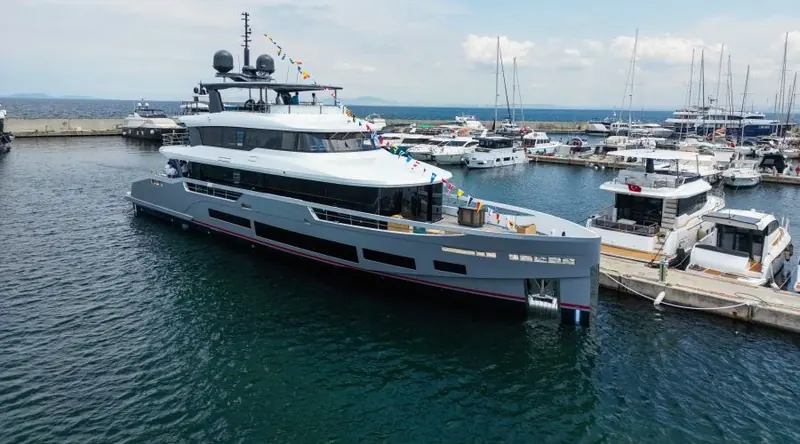
When did the Sirena 118 make its first public appearance?
The Sirena 118 floated at the builder's Yalova yard in Turkey on 14 July 2026, and made her first public showing at the Cannes Yachting Festival on 8 September, docked on Sirena's stand QML 135 for the six-day show.
The gap between the two dates is normal for a first-of-class hull: two months to move a freshly launched composite yacht from an inland build hall through sea trials, systems commissioning, teak-laying and paint touch-ups, then transport her to the French Riviera in time for the industry's first autumn show. Sirena's own press materials and two independent Italian trade titles, Barche a Motore and Barche Magazine, both dated their launch coverage to mid-July, with the CEO, Cagin Genc, quoted by both on the day: he called the boat proof that the yard has 'delivered a design that stretches the advantages of composite construction well into the realm of superyachting.'
The first hull is not a show boat built on spec. BOAT International reported in July that she is already sold to a repeat Sirena client stepping up from a smaller model in the range, meaning the 118 arrives at Cannes as a fitted-out, sold yacht rather than a demonstrator looking for a buyer. For anyone at the show comparing her against a rival flagship, that detail changes what to ask: the questions worth putting to Sirena's stand crew are about hull two and three, not hull one, since the boat on the dock is already spoken for.
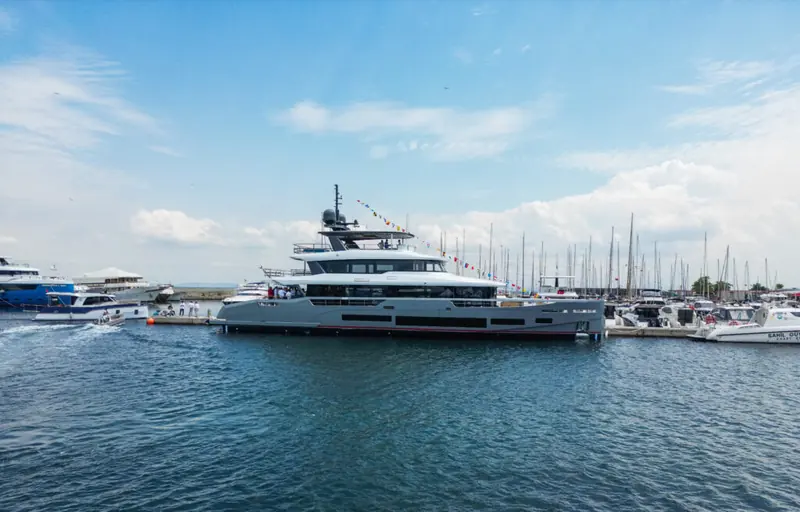
What classification society certified the Sirena 118, and why does that matter?
RINA has certified the Sirena 118 as a Pleasure Craft rather than under a commercial code, and Barche a Motore's published technical sheet puts her at exactly 265 gross tons on a 36-metre overall length, 34 metres at the waterline and a 7.9-metre beam - comfortably inside the 300 GT line that keeps a yacht out of heavier commercial rules.
Most of the trade coverage around the July launch described the 118 as being kept 'under 300 GT' without giving the actual number or naming the classification society doing the certifying. Barche a Motore's spec sheet, published alongside its launch report, is the first source to put a precise figure on it and to name RINA - Registro Italiano Navale, one of the two class societies most Italian and Turkish-built composite yachts use - as the certifying body, with a Pleasure Craft classification rather than a commercial or passenger code. That distinction is not paperwork trivia: a commercial-code vessel of this length typically needs a larger certificated crew, more frequent surveys and a different insurance and tax treatment in several flag states, all of which raise the running cost an owner carries every year regardless of how the yacht is used.
The 300 GT line is precisely where Sirena chose to draw the boundary, and doing it on a 36-metre hull is the harder version of the trick. Builders that want to stay under a commercial threshold usually do it by building shorter and narrower; Sirena instead built to the length of a genuine superyacht and then engineered the volume down, favouring exterior deck space over enclosed interior cubic metres in places where a heavier design would have pushed the tonnage over the line. A buyer comparing the 118 against a similarly sized aluminium or steel semi-custom yacht from a rival yard should ask that yard directly what GT figure and what class code its own boat carries at the same length, because the answer is very often not the same.
How fast does the Sirena 118 go, and what engines does she use?
The standard Sirena 118 runs on twin MAN V12 engines rated at 1,550 hp each, 3,100 hp combined, for a cruising speed of around 15 knots and a top speed reported at 16 to 18 knots depending on the source; an optional 1,900 hp-each package, 3,800 hp combined, raises the top end to 21 knots.
Three separate outlets, Barche a Motore, Yachting Magazine and Barche Magazine, converge on the same combined horsepower figures for both the standard and optional engine packages, and all three describe the hull as an all-GRP 'fast-displacement' design rather than a full planing hull, which is the reason the top speed sits in the high teens rather than the high twenties a similarly powered planing yacht of this length could reach. Barche a Motore's own spec sheet is the most precise on the standard package's numbers, listing a 15-knot cruise and an 18-knot maximum, while Barche Magazine and Yachting Magazine both round the standard top speed to 16 knots; none of the three has published an independent sea trial report to settle the half-knot difference, so both figures are given here rather than picking one.
For a buyer, the practical read is that the 118 is built for range and low fuel burn at a steady cruise rather than for outright pace, which fits the fast-displacement hull form and the composite construction Sirena has built its whole range around. An owner who wants to keep pace with the planing motor yachts common in this size bracket needs to specify the optional 3,800 hp package from the order sheet, since Sirena has not indicated the heavier engines can be retrofitted to an already-built hull without the naval architecture work that goes with a different power-to-weight ratio.
What does the Sirena 118's owner's suite offer, and how does the model fit into Sirena's lineup?
The 118's owner's accommodation is a two-level suite linking a main-deck stateroom to a private lower-deck room with its own fold-down balcony onto the water, and the model sits as the flagship of Sirena's composite line, above the 48, 60, 68, 78 and 88, and separate from the yard's newer steel-and-aluminium 42-metre line.
Interior design is by the Dutch studio Cor D. Rover, with naval architecture by German Frers and exterior styling from Sirena's own in-house team, a pairing all three trade sources confirm. Barche a Motore's spec sheet lists five guest cabins plus the owner's suite for up to twelve people, with seven bathrooms and crew quarters for five across three cabins - a crew-to-guest ratio that is generous for a composite production yacht and is itself a function of staying under the commercial-code crewing thresholds the RINA Pleasure Craft classification avoids. The lower-deck half of the owner's suite, reachable by a private stair and opening directly onto the water through a fold-down section of hull side, is the layout detail every one of the three outlets singled out as the model's signature feature.
Positioned against the rest of the range, the 118 is nine metres longer than the 88, the yard's previous largest composite model, and marks Sirena's twentieth-anniversary year. It is a distinct project from the 42-metre steel-and-aluminium flagship the yard revealed separately in July, which uses a Van Oossanen hull and is aimed at a heavier, more custom segment above the composite line's ceiling. A buyer working through Sirena's range should treat the two as different products for different briefs rather than points on the same ladder: the 118 is the top of what composite construction and a sub-300 GT footprint can deliver, and the 42-metre steel boat is where an owner goes when the answer is more volume regardless of tonnage.
What has Sirena not disclosed about the 118, and what should a buyer ask at Cannes?
Sirena has not published a price for the 118, has not released an independent sea trial report, and has not said whether the fold-down balcony and lower-deck suite carry any speed or sea-state restriction when open - three gaps a buyer at the Cannes stand can close in the time it takes to walk the boat.
No trade outlet covering the launch or the Cannes debut has reported a price, standard or optional-package delivered cost, or even a broad range, which for a flagship this size is unusual; Sirena's smaller models are listed with indicative pricing on the yard's own site, but the 118 configurator page carries none. The absence is worth noting rather than filling in with a guess: a first-of-class flagship at a production yard is frequently priced hull-by-hull against the buyer's options list rather than off a fixed sheet, and the honest answer for a shopper right now is that the number is not public.
The fold-down lower-deck balcony that makes the owner's loft suite work is a moving hull panel below the waterline when closed and an open deck when extended, and none of the three sources describes what sea state or speed range it is rated for, which is a normal and important seakeeping question for a feature every write-up treats as the boat's headline selling point. Combined with the still-unsettled 16-versus-18-knot top speed and the missing sea trial data, a buyer's stand visit is best spent on those three questions rather than the ones already answered in the trade press: the tonnage, the certification and the engine options are now a matter of record, and the balcony's rating, the trial numbers and the price are not.
What is good, and what to watch
Strong points
- Superyacht length at production-yacht running costsA RINA Pleasure Craft classification at 36 metres and 265 GT avoids the heavier crewing, survey and insurance costs a commercial-code yacht of the same length usually carries.
- A genuinely new accommodation ideaThe two-level owner's loft with direct water access via a fold-down lower-deck balcony is not a layout seen on Sirena's smaller models or on most rivals at this size.
- A sold first hull, not a demonstratorThe boat at Cannes already belongs to a repeat Sirena buyer, which is a vote of confidence from someone who owns the yard's smaller boats and chose to stay in the brand.
What to watch
- Standard top speed trails the segment16 to 18 knots standard is well below what planing motor yachts of similar length offer; reaching 21 knots requires the optional, presumably costlier, engine package.
- No independent verification of any performance figureEvery speed, range and fuel figure in circulation traces back to Sirena or trade-press paraphrase of Sirena's own material; no sea trial report has been published.
- No price transparencyA shopper cannot get even a broad indicative figure from Sirena's own site or any outlet that has covered the launch, unlike the yard's smaller, standard-priced models.
- GRP at this length is still the newer choiceComposite construction at 34 metres waterline length has a shorter service-life track record in the superyacht bracket than the steel and aluminium hulls most rivals this size are built from.
Practical detail
| Length overall / waterline / beam | 36 m / 34 m / 7.9 m (Barche a Motore spec sheet) |
|---|---|
| Gross tonnage / classification | 265 GT, RINA Pleasure Craft (not a commercial code) |
| Standard engines / speed | Twin MAN V12, 1,550 hp each (3,100 hp combined); cruise ~15 kn, top speed reported 16-18 kn |
| Optional engines / speed | Twin MAN V12, 1,900 hp each (3,800 hp combined); top speed 21 kn |
| Guests / cabins / crew | Up to 12 guests in 5 cabins plus owner's suite, 7 bathrooms; crew of 5 in 3 cabins |
| Naval architecture / exterior / interior | German Frers / Sirena in-house team / Cor D. Rover |
| Price | Not published by Sirena as of the Cannes debut |
| Independent sea trial | None published; all speed figures are the yard's own or trade-press estimates |
| Where to see her | Cannes Yachting Festival, stand QML 135, 8-13 September 2026 |
Questions this story answers
What happened?
Sirena Yachts brought its 36-metre flagship to the Cannes Yachting Festival this week for its first public showing, two months after floating the hull at the builder's Turkish yard. The certificate that comes with her matters more than the ribbon-cutting: RINA has classed the 118 as a private pleasure craft, not a commercial vessel, which is the whole point of keeping her under 300 GT at a length where most rivals cross into heavier, costlier territory.
What is good about it?
Superyacht length at production-yacht running costs. A RINA Pleasure Craft classification at 36 metres and 265 GT avoids the heavier crewing, survey and insurance costs a commercial-code yacht of the same length usually carries.
What should an owner or buyer watch?
Standard top speed trails the segment. 16 to 18 knots standard is well below what planing motor yachts of similar length offer; reaching 21 knots requires the optional, presumably costlier, engine package.
Who reported this?
Sirena Yachts, Barche a Motore, Barche Magazine, Yachting Magazine, BOAT International, Cannes Yachting Festival.
We do this for everyone who loves this world. The people who have spent their lives in it, and the people just discovering it. Yotters exists so that what we learn belongs to all of them.
Nobody pays us for this. No ads, no sponsors, nothing for sale. We just believe the world is a little better when knowledge is shared instead of kept.
If it gave you something today, tell us to keep going. Follow us, leave a like, or write a positive comment. We read every one, and they are what keeps us going.