Sirena's 118 Is the Turkish Yard's Largest Composite Yacht Yet
What is the Sirena 118 and why is it significant for the yard?
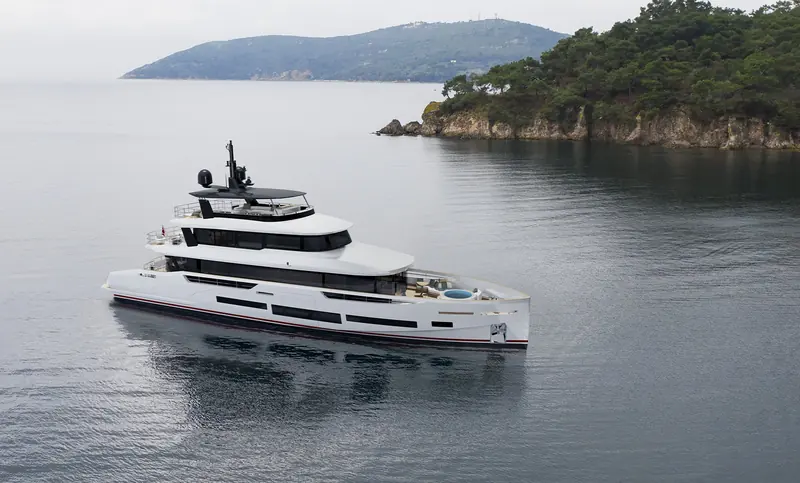
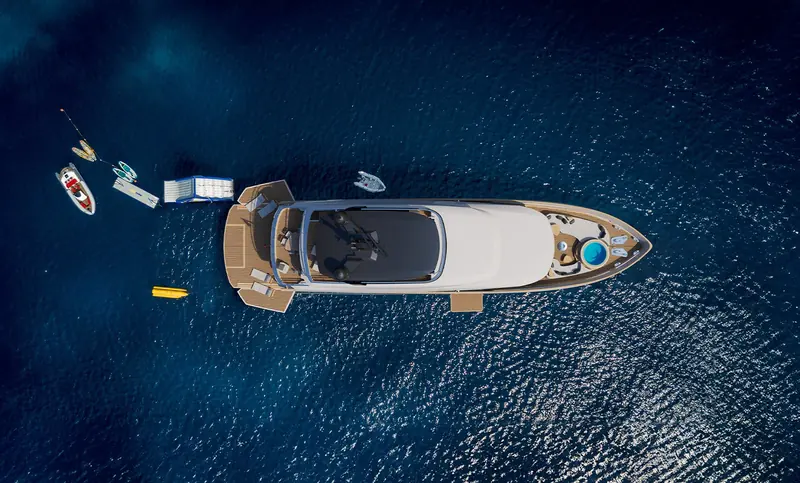
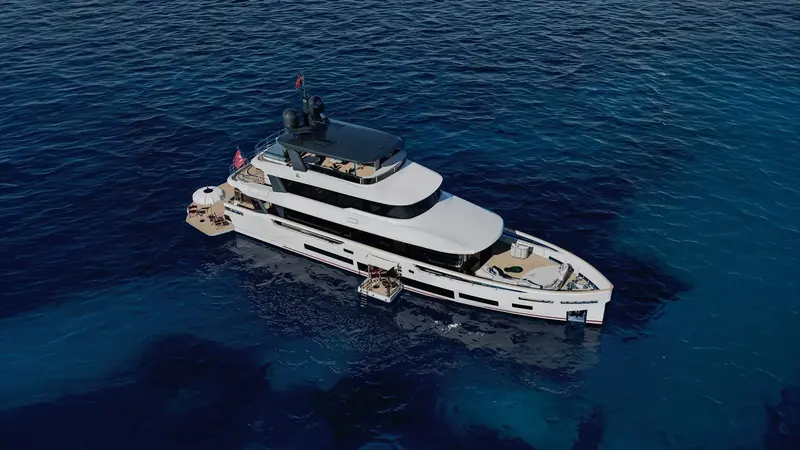
The Sirena 118 is a 36-metre, all-GRP tri-deck motoryacht that floated out in July 2026 and had its world premiere this week at the Cannes Yachting Festival, making it Sirena Yachts' largest composite model to date and its most direct push yet into the superyacht bracket.
Sirena Yachts, the Turkish builder based at Yalova on the Sea of Marmara, has spent the past decade building its name on long-range GRP motoryachts between roughly 12 and 27 metres. The 118 breaks that pattern by nearly a third: at 36 metres it is the largest hull the yard has ever laid up in fibreglass, and it now sits above the existing Sirena 42M as the flagship of the range. The yacht floated out in July 2026 and made its public debut this week at the Cannes Yachting Festival, running 8 to 13 September 2026 across the Vieux Port and Port Canto, an event drawing more than 680 exhibitors and roughly 150 world premieres this year.
Choosing Cannes for the debut puts the 118 in front of exactly the brokers, charter agents and owners' representatives who decide whether a yard's jump into a new size bracket is credible. For Sirena, a builder whose reputation was built on smaller cruising yachts, showing up at the industry's biggest launch platform with its largest-ever hull is as much a statement to the trade as it is a sale.
Who designed the Sirena 118?
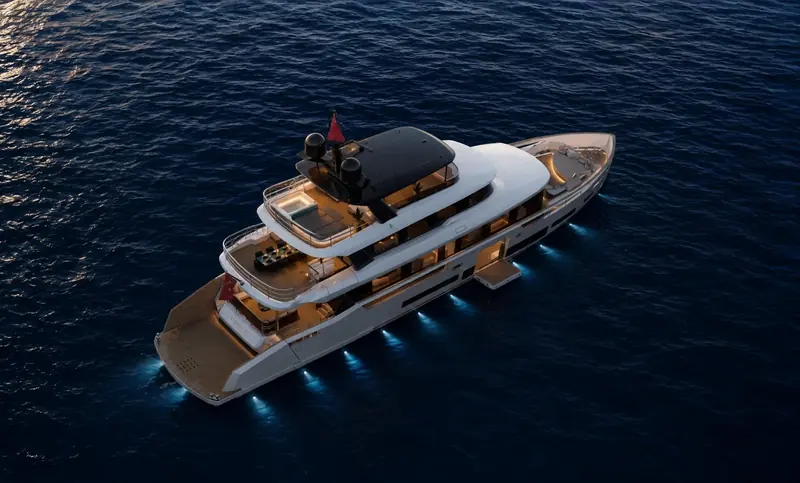
Naval architecture on the 118 comes from Germain Frers, the veteran Argentine designer known across both sailing and motoryacht projects, with the interior by Dutch studio Cor D. Rover and exterior styling handled in-house by Sirena's own design team.
Frers' involvement is the yacht's strongest credibility marker: a naval architect with decades of offshore sailing yacht pedigree lending his name to a composite motoryacht signals that the hull form, not just the styling, has had serious engineering behind it. Sirena has paired that with Cor D. Rover for the interior, a Netherlands-based studio with a track record on European motoryacht cabins, while keeping the exterior lines an in-house Sirena project rather than outsourcing the whole design brief to one outside name.
That division of labour - outside naval architecture, outside interior, in-house exterior - is typical of a yard stretching into a new size class without abandoning the house look its existing owners recognise. It also means the 118's silhouette reads as a scaled-up Sirena rather than a wholly new design language, which cuts both ways: existing Sirena owners get continuity, but the yacht has less of the singular 'name designer' marketing hook that a full outside styling commission would carry at boat shows.
How fast does the Sirena 118 go and what powers it?
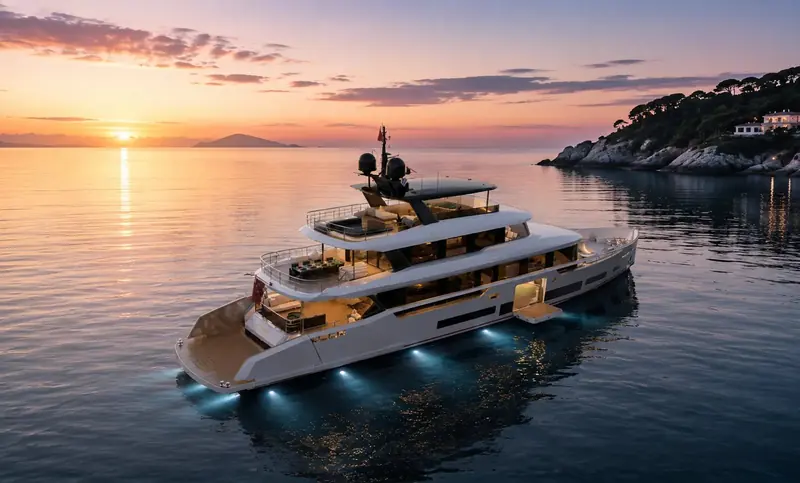
Sirena offers the 118 with a standard twin MAN V12 package rated at 3,100 hp per engine for a 16-knot top speed, or an optional twin MAN V12 package at 3,800 hp per engine for 21 knots, on an all-GRP fast-displacement hull with a plumb bow.
The propulsion choice mirrors how Sirena has built its smaller models: a standard powertrain aimed at efficient cruising, with a materially more powerful option for owners who want speed on tap. The base twin MAN V12s at 3,100 hp each give a 16-knot maximum, a fast-displacement figure consistent with the plumb-bow hull form Sirena has used across its range for better seakeeping and fuel efficiency at cruise. The optional twin MAN V12s at 3,800 hp each lift that to 21 knots, a meaningful jump for a 36-metre GRP hull and one that puts the 118 within range of some lighter aluminium yachts of similar length.
Keeping the entire structure in GRP at 36 metres is itself the harder engineering story: composite construction gets progressively more expensive and more difficult to certify for stiffness and weight as length increases, which is why most yards move to aluminium or steel well before 30 metres. Sirena's decision to stay in fibreglass at this size is a deliberate bet that GRP tooling and lay-up costs, spread across a production run rather than a one-off custom hull, still beat a semi-custom metal build on price and lead time - provided the naval architecture, which is where Frers comes in, can make the weight and stiffness numbers work.
What is the Sirena 118's owner's suite, and why does the tonnage cap matter?
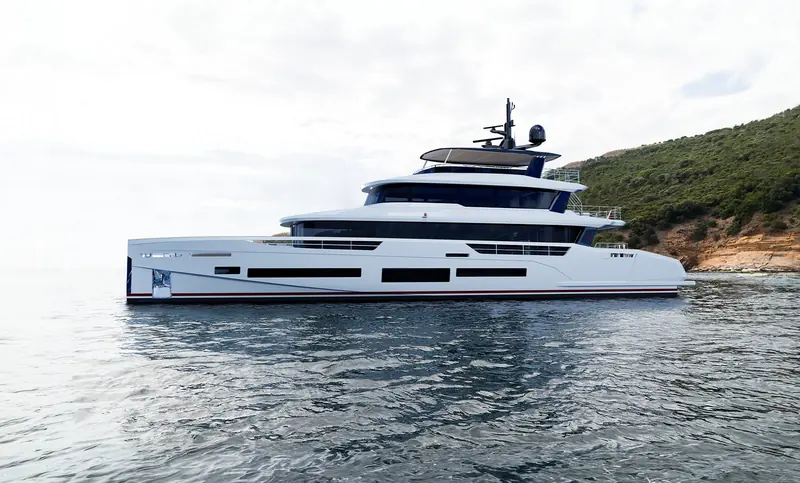
The 118 is offered with an optional two-level 'loft' owner's suite connecting a main-deck stateroom to a private lower-deck retreat with direct water access, and the whole yacht is engineered to stay under 300 gross tons, the threshold above which commercial-yacht code and flag-state manning rules tighten considerably.
The loft suite is the 118's signature layout feature: rather than a single owner's cabin on one deck, Sirena links a main-deck stateroom vertically to a lower-deck space with its own access to the water, giving the owner a private two-level retreat rather than a single room bordered by guest and crew traffic. Alongside it, the yacht carries a tri-deck layout for up to six guest staterooms, keeping the 118 competitive on accommodation against motoryachts several metres longer.
The under-300 GT figure is not a marketing footnote - it is a design constraint that shapes the whole brief. Yachts above 300 GT typically trigger a heavier commercial code, larger minimum crew complements under flag-state rules, and additional survey and certification costs that scale with tonnage rather than length. By engineering the 118's volume to stay under that line at 36 metres, Sirena gives an owner superyacht-scale interior space without stepping into the operating-cost bracket that a bigger, code-triggering yacht would carry - the same calculation that has pushed several builders, including Sirena's own compatriot Turkish yards, to hold flagship models just below 300 GT rather than push past it for a few extra metres of bragging rights.
Where does the Sirena 118 fit in the wider composite-yacht market?
The Sirena 118 is part of a broader push by Turkish shipyards into the large-yacht segment, competing against established Italian and Dutch composite builders by combining production-yard pricing with imported design pedigree, though it enters the water with no independent sea trial or owner account yet on record.
Turkish yards have spent the past decade building a reputation on value and speed of delivery in the 24 to 40-metre bracket, and the 118 is Sirena's clearest attempt yet to carry that reputation into a segment still dominated by Italian composite specialists and semi-custom Dutch and Italian steel-aluminium yards. Bringing in Frers for naval architecture and a Dutch interior studio is a direct answer to the usual objection to a Turkish-built flagship: that the engineering and finish pedigree lags the price advantage.
None of that is independently tested yet. Every performance figure in this piece - the 16 and 21-knot top speeds, the tonnage under 300 GT, the loft suite's livability - comes from Sirena's own press materials around this week's Cannes debut; no sea trial report or owner account has been published, because the boat only floated out in July and made its public premiere this week. An owner evaluating the 118 today is buying on Frers' name, Sirena's production track record on smaller models, and Cannes-floor first impressions, not yet on a tested record.
What is good, and what to watch
Strong points
- A rare all-composite flagship at 36 metresmost yards move to aluminium or steel well before 30 metres; staying in GRP this large is a genuine engineering commitment, not just a cost-saving shortcut.
- Naval architecture pedigree from Germain Frersa designer with decades of offshore sailing-yacht credibility lending his name to the hull form is a stronger credibility signal than an in-house-only design brief.
- Engineered to stay under 300 GTgives an owner superyacht-scale volume and a tri-deck, six-cabin layout without the heavier commercial-code and crewing requirements that kick in above that tonnage line.
What to watch
- No independent sea trial or owner account existsthe boat floated out in July 2026 and premiered publicly this week at Cannes; every performance and livability figure so far is Sirena's own.
- No price has been publishedan owner cannot yet compare the 118 on cost against established Italian composite or Dutch semi-custom rivals of similar length.
- Turkish-yard resale pedigree is still unproven at this sizeSirena's reputation was built on smaller cruising yachts; the 118 is the yard's first real test of whether that reputation carries into the superyacht bracket against longer-established Western European flagships.
Practical detail
| Length overall | 36 m (118 ft) |
|---|---|
| Gross tonnage | under 300 GT (by design) |
| Hull construction | all-GRP (fibreglass), fast-displacement, plumb bow |
| Layout | tri-deck, up to 6 guest staterooms |
| Standard engines | 2 x MAN V12, 3,100 hp each - 16 knots max |
| Optional engines | 2 x MAN V12, 3,800 hp each - 21 knots max |
| Naval architecture | Germain Frers |
| Interior design | Cor D. Rover |
| Exterior design | Sirena Yachts in-house |
| Signature feature | optional two-level 'loft' owner's suite with lower-deck water access |
| Launched (float-out) | July 2026 |
| World premiere | Cannes Yachting Festival, 8-13 September 2026 |
| Price | not published |
| Independent sea trial | none published yet |
Questions this story answers
What happened?
Sirena Yachts has floated out and now premiered at Cannes its biggest fibreglass hull to date, a 36-metre tri-deck built to Germain Frers naval architecture and staying under 300 GT by design. For an owner weighing a composite flagship against a full-custom steel or aluminium build, the 118 is a bet that a GRP hull can still deliver superyacht scale, volume and a loft-style owner's suite without the cost and lead time of a one-off.
What is good about it?
A rare all-composite flagship at 36 metres. most yards move to aluminium or steel well before 30 metres; staying in GRP this large is a genuine engineering commitment, not just a cost-saving shortcut.
What should an owner or buyer watch?
No independent sea trial or owner account exists. the boat floated out in July 2026 and premiered publicly this week at Cannes; every performance and livability figure so far is Sirena's own.
Who reported this?
Marine Industry News, Yachting Magazine, Barche Magazine.
We do this for everyone who loves this world. The people who have spent their lives in it, and the people just discovering it. Yotters exists so that what we learn belongs to all of them.
Nobody pays us for this. No ads, no sponsors, nothing for sale. We just believe the world is a little better when knowledge is shared instead of kept.
If it gave you something today, tell us to keep going. Follow us, leave a like, or write a positive comment. We read every one, and they are what keeps us going.