Tankoa's 51.5m Spirit puts a spa where the toys used to go
What is Tankoa's Spirit and what did the beach club become?
Spirit is Tankoa's 51.5-metre T52 Vitruvius, launched at Genoa on 11 July 2026, and her aft beach club is built around a gym and spa instead of the tender garage most yachts put there.
Tankoa Yachts launched its custom T52 Vitruvius, now named Spirit, from its Genoa yard on 11 July 2026. The 51.5-metre motor yacht carries naval architecture and exterior lines by Vitruvius Yachts, the London studio led by Philippe Briand and Veerle Battiau, with interiors by the Ancona practice FM Architettura. She sleeps up to 12 guests in six cabins and nine crew in five, and runs a full-hybrid propulsion package from E-motion, with a top speed of 17 knots and a 15-knot cruise. Tankoa says the yacht has now entered final outfitting, with sea trials under way ahead of delivery to her owner later this year.
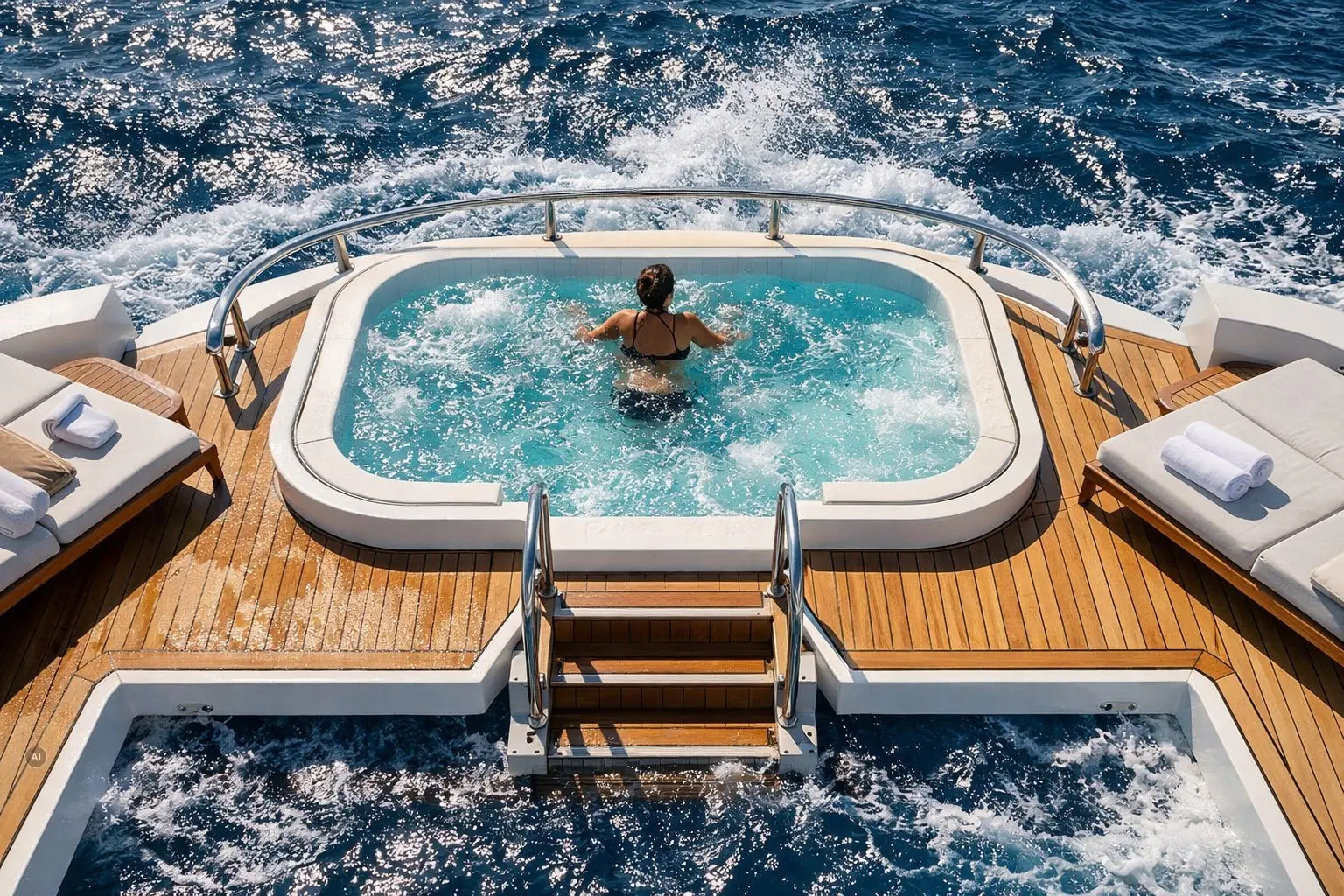
The centrepiece is the aft beach club, which Tankoa built around a gym and a spa that open onto a full-width terrace at the stern. A plunge pool sits on the aft deck, fold-down side platforms extend the floor area toward the water, and a two-section glazed stern door with full-height side glazing brings light and sightlines into a space that on many yachts is handed to jet skis and dive gear. Noise and vibration work was carried out by van Cappellen Consultancy, a detail that matters more for a treatment room than for a toy store.
Why did the owner move wellness space to the beach club?
Placing the spa and gym in direct contact with the sea trades some garage volume for daylight and a wellness area that guests and charterers increasingly ask for over a bigger toy store.
Spirit reads as one clear example of a shift that BOAT International and several yard newsrooms have tracked through 2026, where owners commission wellness space early in the design rather than fitting a gym around the machinery once everything else is placed. On Spirit that logic reaches the beach club, the one part of the yacht in direct contact with the sea, which builders have long used for tenders, toys and a bar. Putting the spa and gym there trades some garage volume for daylight and direct access to the water.
For an owner, the location is the whole point. A treatment room buried on a lower deck is just a room. A spa that opens onto the water at anchor is a reason to buy the boat. It also travels well into the charter market, where guests increasingly ask for recovery and fitness programming over a bigger club. A buyer weighing a resale or a new build can read Spirit as a market signal that wellness square-metres near the waterline now hold value, and that a conventional toy-garage layout may date faster than it once did.
What makes the wellness deck usable at anchor?
Spirit's E-motion full-hybrid drive and a dedicated van Cappellen noise and vibration package let her run quiet hotel systems without the main engines turning, which is what makes a spa treatment or a cold plunge actually work at anchor.
Spirit's full-hybrid drive from E-motion pairs conventional engines with electric motors and batteries, which lets the yacht run quietly at low load and hold hotel systems at anchor without the main engines turning. Combined with the van Cappellen vibration package, that is the practical enabler behind the wellness brief, because a massage or a cold plunge is undermined by engine drone and hull buzz. The interior design and the machinery are aimed at the same result.
For a prospective owner, the lesson is to specify the quiet before the finishes. Hybrid propulsion, resilient mounts and acoustic engineering are hard to retrofit and cheap to plan, and they decide whether a spa deck performs or merely photographs well. Tankoa has not published gross tonnage, range or interior volumes for Spirit, so buyers comparing her against rivals should ask the yard for verified figures rather than launch-day descriptions. The wider read is simpler, in that a beach club given to health is now a saleable position, and the yards are building to it.
What is good, and what to watch
Strong points
- A beach club built around wellness, not storageThe gym and spa open onto a full-width aft terrace with a plunge pool and fold-down platforms, answering a brief that put recovery space ahead of the usual tender garage.
- Hybrid running built specifically to make that brief workThe E-motion full-hybrid plant and a separate van Cappellen vibration and noise package let the spa run quietly at anchor, which is the real engineering behind the design idea.
- 499 GT on a 51.5-metre one-offAll-aluminium construction holds her a tonne under the 500 GT line while carrying a genuine Vitruvius (Philippe Briand) design pedigree, not a shared-platform series hull.
What to watch
- No published priceNeither Tankoa nor any outlet covering the launch has disclosed what Spirit cost her owner, so a buyer weighing a similar wellness-led commission has no benchmark beyond the yard's own quote.
- Other key figures are withheld tooTankoa has not published range or interior volumes for Spirit at launch; buyers comparing her against rivals should ask the yard for verified figures rather than launch-day copy.
- A one-off is a resale unknownWith no sistership on a shared specification sheet, a future buyer prices Spirit on provenance and the wellness brief alone, which can support a premium or just as easily find no ready comparison.
Practical detail
| Price | Not published. Tankoa has not disclosed what Spirit cost her owner; she was a private full-custom commission, not a priced series build. |
|---|---|
| Owner and origin | Commissioned in 2022 by a Canadian owner, introduced to Tankoa by Albert McIlroy of Optimusnavis (Florida Yachts International; Marine Industry News). |
| Delivery | Expected later in 2026, after the sea trials under way at launch (Florida Yachts International; Marine Industry News). |
| Tonnage and class | 499 GT on a 51.5-metre all-aluminium hull, one tonne under the threshold that would push her into a heavier crewing and survey regime (Marine Industry News; Robb Report). |
| What is not published | Build price, the E-motion battery bank's exact capacity, and fuel burn at cruise are not disclosed by the yard or by any source checked. |
Questions this story answers
What happened?
Tankoa launched the 51.5-metre Spirit in Genoa on 11 July, and its beach club is built around a gym and spa instead of a tender garage. The London studio Vitruvius drew a wellness deck that opens onto the water, with a stern plunge pool and fold-down platforms. For any owner writing a new brief, it is a clear sign the health suite now competes with the toy store for the best real estate on board.
What is good about it?
A beach club built around wellness, not storage. The gym and spa open onto a full-width aft terrace with a plunge pool and fold-down platforms, answering a brief that put recovery space ahead of the usual tender garage.
What should an owner or buyer watch?
No published price. Neither Tankoa nor any outlet covering the launch has disclosed what Spirit cost her owner, so a buyer weighing a similar wellness-led commission has no benchmark beyond the yard's own quote.
Who reported this?
Tankoa Yachts, BOAT International, Marine Industry News, Robb Report, SuperYacht Times, Vitruvius Yachts, FM Architettura.
We do this for everyone who loves this world. The people who have spent their lives in it, and the people just discovering it. Yotters exists so that what we learn belongs to all of them.
Nobody pays us for this. No ads, no sponsors, nothing for sale. We just believe the world is a little better when knowledge is shared instead of kept.
If it gave you something today, tell us to keep going. Follow us, leave a like, or write a positive comment. We read every one, and they are what keeps us going.