A 6,000-tonne floating dock lands near Naples as Italy runs short of refit space
What has been added
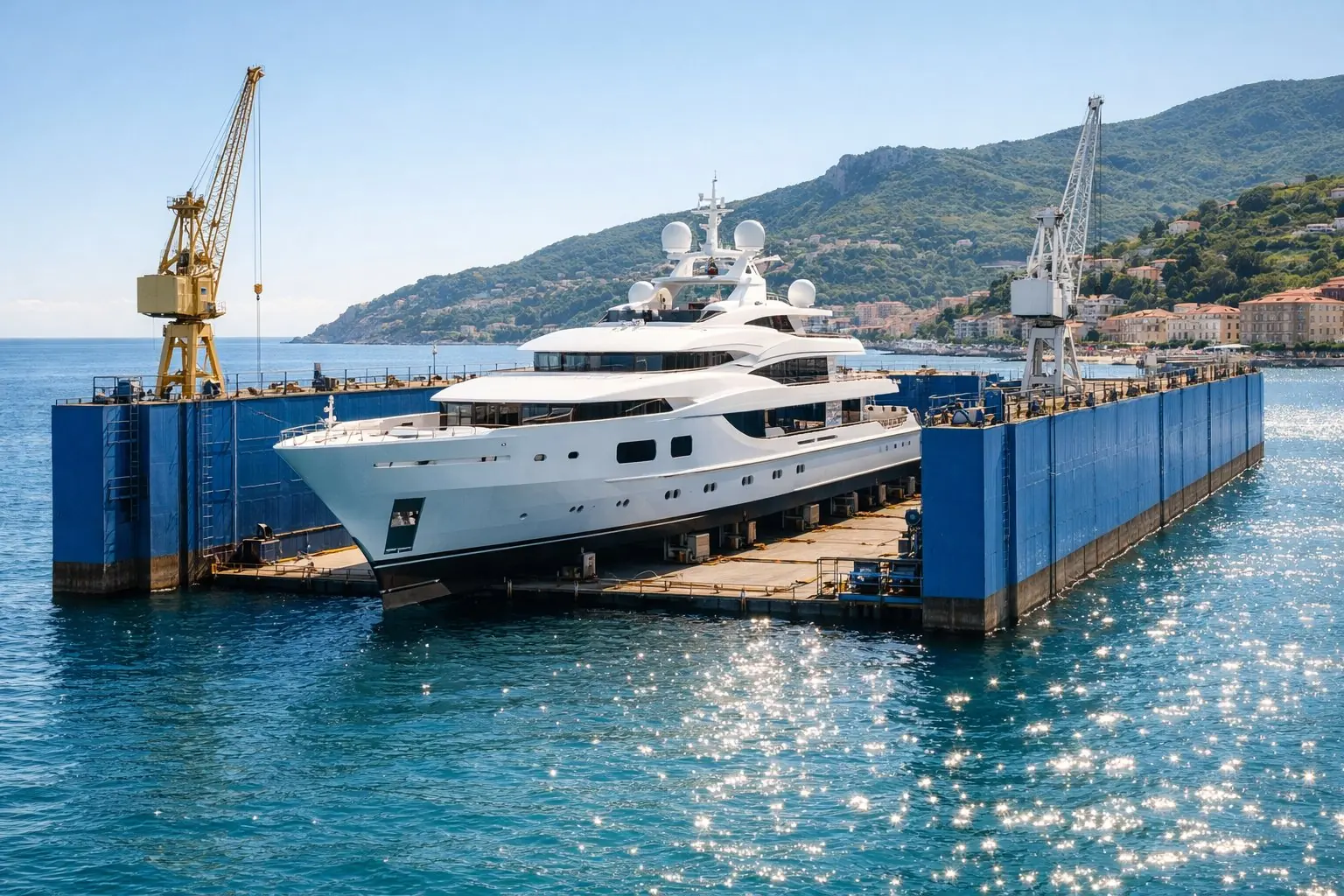
Piloda Yachting, the refit and repair arm of the Piloda Group, operates from Torre Annunziata in the Bay of Naples and from Brindisi on the Adriatic, handling vessels up to around 40 metres. Its new floating dock Annamaria measures 143 metres by 30 metres and lifts up to 6,000 tonnes. The point of a dock that size at a yard working smaller boats is throughput. Several hulls can sit in it at once, which is what turns a promised redelivery date into a real one.
Walter Di Palo, who co-founded the group, has a list of further work planned across the sites: a reinforced electrical supply, conversion to LED lighting, water purification and treatment, solar panels, and a paint booth of 30 by 10 metres built to very low emission standards. Paint is usually the long pole in a refit programme, and a dedicated booth is the difference between a controlled repaint and a weather-dependent one.
Why the demand is there
Di Palo's account of the season is straightforward. Demand for refit rose significantly, driven by two things at once. The global fleet has grown steadily for fifteen years, so a large cohort of boats is now arriving at the ten and twenty year points where the serious money gets spent. At the same time new-build sales have softened, so owners are putting capital into the boat they already have.
That combination is why refit capacity has become the constraint it is. It also explains the pricing. When yard space is scarce, quotations firm up, contingency budgets get padded, and the yard has less reason to absorb the cost of its own delays. An owner booking a 2027 winter slot is negotiating from a weaker position than he was five years ago.
The labour problem an owner pays for
The sharper part of Di Palo's argument is about people. Training specialised workers is complex, he says, partly because there are no structured incentives to do it. His response has been to set up a Piloda Academy with university partnerships. That is a yard solving a national problem with its own money, which tells you how bad the shortage is.
This is not an abstract industry worry. Labour scarcity is the single largest driver of refit overruns. A yard that cannot staff a job runs it in sequence instead of in parallel, and the boat sits. Owners paying day rates on crew, insurance and berthing while a hull waits for a welder are financing someone else's recruitment failure. Asking a yard for its manning plan by trade, in writing, before signing is a reasonable defence.
The wider Italian picture
Di Palo is blunt about the country he works in. Italy is the world's leading producer of megayachts and, in his view, has bureaucratic obstacles, administrative delays and infrastructure that does not compare well with Korea or Turkey. Most pointedly, it has no zones designated specifically for refit, so refit work competes for space against commercial shipping in ports designed for cargo.
For an owner choosing where to spend a winter, that comparison is now live. Turkey has been adding very large yacht refit capacity, and Spain's east coast has just taken delivery of a 5,000-tonne shiplift able to handle yachts far larger than anything Italy will lift on the Tyrrhenian side. Italian yards keep the advantage of proximity to the builders and their spare parts. They no longer have a monopoly on the work.
What owners and crew report
Refit demand rose sharply as new-build sales softened
Walter Di Palo, Piloda Yachting co-founder, said demand for refit work rose significantly this past season, driven by an ageing global fleet reaching the ten and twenty year service points at the same time owners are putting capital into existing boats rather than new orders.
Walter Di Palo, Piloda YachtingItaly is losing its refit advantage to bureaucracy and infrastructure gaps
Di Palo said Italy, despite being the world's leading megayacht producer, has bureaucratic obstacles, administrative delays and infrastructure that compares unfavourably with Korea and Turkey, and has no zones designated specifically for refit work.
Walter Di Palo, Piloda YachtingSkilled labour, not dock space, is the harder constraint
Di Palo said training specialised refit workers is complicated by a lack of structured incentives, and that Piloda has responded by founding its own Piloda Academy with university partnerships rather than waiting for a national fix.
Walter Di Palo, Piloda Yachting
What is good, and what to watch
Strong points
- Real added throughput at a named, verifiable facilityA 143m by 30m, 6,000-tonne dock capable of holding several hulls at once is a genuine capacity increase, and the wider works list - LED conversion, water treatment, solar and a low-emission paint booth - point to a serious, not cosmetic, investment.
- The yard is solving its own labour problem rather than waiting for oneFounding an in-house academy with university partnerships is a concrete response to a shortage Di Palo describes as structural to Italy, not just to Piloda.
What to watch
- More capacity does not by itself fix the labour shortageA bigger dock increases how much work can physically fit at the yard, but Di Palo's own account makes the workforce, not floor space, the binding constraint - so throughput gains from the new dock could still be capped by how many trained welders and painters Piloda can field.
- Italy's structural disadvantages are outside any one yard's controlNo dedicated refit zones and competition with commercial shipping for port space are national policy problems Di Palo names directly - a single dock, however large, does not resolve them, and Spain and Turkey are actively adding capacity of their own in the meantime.
Practical detail
| Dock specification | 143 metres by 30 metres with a lifting capacity of up to 6,000 tonnes, confirmed independently by both SuperYacht24's interview with Walter Di Palo and SuperYachtTimes' separate July 2025 coverage of the same Piloda Naples dock. |
|---|---|
| Investment | SuperYachtTimes' coverage of the dock's unveiling states a private investment exceeding EUR 15 million and up to 180 direct and indirect jobs created - a figure this article's own sourcing (SuperYacht24, Piloda Yachting) does not carry, so we are adding it here as a second, independent source on the same facility. |
| What this article's sources call it, and a discrepancy we found | This article and its SuperYacht24 source refer to the dock as Annamaria. Researching further, SuperYachtTimes' July 2025 unveiling story describes what appears to be the same dock at the same Piloda Naples site, with identical dimensions (143m x 30m) and identical 6,000-tonne capacity, under the name Donn'Anna. We could not confirm from public sources whether this is a renaming, two names for one dock, or two separate docks, so we are flagging the discrepancy rather than silently picking one name. |
| Regional comparison | Spain's east coast has taken delivery of a 5,000-tonne shiplift, and Turkey has been adding large-yacht refit capacity, both named in this article's own reporting as competing directly for the winter refit slots Italian yards used to hold by default. |
| What is not published | Neither SuperYacht24 nor Piloda Yachting's own materials state a day rate or per-metre refit cost for work done at the new dock, so an owner cannot yet price a slot from public information alone. |
Questions this story answers
What happened?
Piloda Yachting has commissioned Annamaria, a floating dock of 143 by 30 metres with a lifting capacity of up to 6,000 tonnes, at its yards near Naples and in Brindisi. Chief executive Walter Di Palo says refit demand rose sharply last season as the fleet ages and new-build sales soften. He also says Italy has no dedicated refit zones and not enough trained people, which is the part that shows up on an owner's invoice.
What is good about it?
Real added throughput at a named, verifiable facility. A 143m by 30m, 6,000-tonne dock capable of holding several hulls at once is a genuine capacity increase, and the wider works list - LED conversion, water treatment, solar and a low-emission paint booth - point to a serious, not cosmetic, investment.
What should an owner or buyer watch?
More capacity does not by itself fix the labour shortage. A bigger dock increases how much work can physically fit at the yard, but Di Palo's own account makes the workforce, not floor space, the binding constraint - so throughput gains from the new dock could still be capped by how many trained welders and painters Piloda can field.
What do owners and crew report?
Walter Di Palo, Piloda Yachting co-founder, said demand for refit work rose significantly this past season, driven by an ageing global fleet reaching the ten and twenty year service points at the same time owners are putting capital into existing boats rather than new orders. (Walter Di Palo, Piloda Yachting)
Who reported this?
Piloda Yachting, SuperYacht24, SuperYachtTimes, Walter Di Palo.
We do this for everyone who loves this world. The people who have spent their lives in it, and the people just discovering it. Yotters exists so that what we learn belongs to all of them.
Nobody pays us for this. No ads, no sponsors, nothing for sale. We just believe the world is a little better when knowledge is shared instead of kept.
If it gave you something today, tell us to keep going. Follow us, leave a like, or write a positive comment. We read every one, and they are what keeps us going.