Abbasli Design's Mava Targets the 70-Metre Segment
What is Mava, exactly?
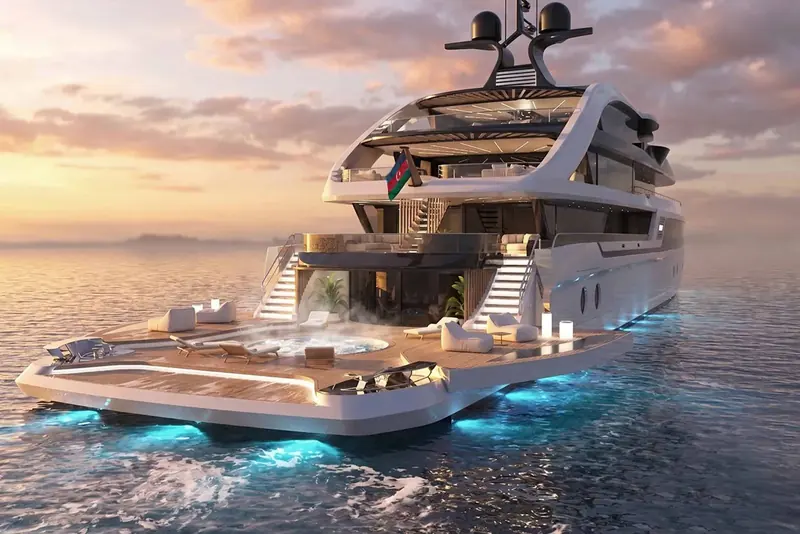
Mava is a 70-metre motor yacht concept from Abbasli Design, unveiled at the Monaco Yacht Show, with both exterior and interior authored by the same studio and a headline feature of a beach club built into her stern.
Founder and yacht designer Ujal Abbasli described the brief behind the concept: "With Mava, we wanted to create a 70-metre yacht that feels substantial without becoming visually heavy. The exterior has a strong identity, but the lines remain clean and controlled." Abbasli Design is a small, founder-led studio rather than an in-house yard design office, which means Mava is a specification and a look the studio can bring to any client and any builder, not a project already tied to a yard, the way a yard's own concept normally is. Abbasli founded the studio in Baku, Azerbaijan in 2021, after working as an industrial and yacht designer at J&J Design, and has since drawn more than 30 yachts and boats ranging from 8 to 80 metres for yards and private clients around the world. Mava is not the studio's first large concept either: Abbasli Design unveiled a 45-metre expedition concept, Caspian Star, before this one, giving Mava a design pedigree beyond a single show render.
The exterior's defining move is an arch that sweeps through the superstructure, visually connecting the decks from bow to stern, paired with vast, dark glazing that reads against the white hull as a two-tone effect rather than a single continuous surface. The render shown at Monaco flies a flag referencing the studio's own origins on the mast, a detail of studio identity rather than a stated owner or build nationality, and one that also signals the growing number of design houses from outside the traditional Italian and Dutch design centres now competing for 70-metre commissions.
What does the beach club actually offer?
The aft end of Mava folds into a wraparound lounge deck built around a sunken spa pool, making the stern rather than the sundeck the yacht's social centre.
The published render shows twin staircases flanking a central pool with visible jets, sunbeds run along both rails, and a fold-down transom platform doing double duty as a swim step, all lit from below the waterline in a way that reads as evening ambience rather than daytime function. That arrangement puts the loudest design idea at water level rather than up on the sundeck, where most 70-metre yachts still put their showpiece pool several decks above the sea and several flights of stairs from the tenders.
Abbasli Design gives Mava accommodation for up to 12 guests, with the lower decks providing dedicated living and working space for 14 professional crew, a ratio that leaves more crew than guests, typical for a yacht built around full-service charter or heavy owner use rather than a lean private-only layout, and one that also reflects how much staff a beach-club-style aft deck this elaborate needs to run and reset between uses through a single day. None of that crew provision is disclosed as fixed, since Mava remains a concept without a confirmed yard or interior contractor, but the ratio itself is a design statement: it signals a yacht meant to run at full service level from day one, rather than a private-only layout that could later be adapted for charter.
How does Mava perform on paper?
The design targets a modest 16 to 17 knot maximum speed and a 13 to 14 knot cruise, prioritising interior volume, 1200 gross tons on an 11.3-metre beam, over outright pace, a common trade in this size bracket.
An 11.3-metre beam is on the wide side for a 70-metre hull, and it is what buys the extra interior volume: 1200 GT is generous for the length compared with narrower yachts of the same size, which more commonly sit in the 950 to 1100 GT range at 70 metres. The trade is speed, and the 16 to 17 knot maximum sits well below what a finer-hulled 70-metre from a performance-oriented yard would target, closer to the pace of a full-displacement long-range cruiser than a planing or semi-displacement design. Abbasli Design's own description of the studio's approach, "sculpting architecture on water," reads consistently with that choice: the brief prioritises how the volume is organised and how the deck spaces connect to the sea over outright pace, the same trade-off that shaped the 45-metre Caspian Star before it.
Every performance figure here is a naval-architecture projection rather than a measured result, because no hull has been built. There is nothing yet to sea trial, and nothing to independently confirm the speed, fuel burn or seakeeping the studio is projecting, which is the normal state for any concept at this stage but worth stating plainly rather than repeating the projected numbers as settled fact.
What has to happen before Mava becomes a real yacht?
As a design-only concept from an independent studio, Mava still needs an owner to commit and a yard to build her, and nothing published names either.
That is a different starting point from Grandweld's Grandar range or Brabus's AB110, both unveiled at the same show with a builder already fixed and, in Brabus's case, a running boat in the water. Here the design exists independently of any yard, which is a common position for a smaller studio trying to win a commission: show the concept at the show where the buyers already are, then let an owner pick the yard that actually builds it, with the studio staying on for the interior and exterior design work through the build.
No price has been disclosed, no yard has been named, and because nobody owns a Mava yet, there is no independent owner report to draw on. That is a normal state for a first-unveiling concept, not a shortcoming specific to this design, and it is worth an owner remembering that the gap between a striking render and a signed contract, in this size bracket, is usually measured in years rather than months. An owner who likes the studio's language but wants a faster or slower boat, or a different guest count, is not locked into this exact specification either: unlike a yard's in-house concept, Mava is explicitly a starting brief that Abbasli Design would refine around whichever yard and engineering team eventually took the commission. That gap between a render and a keel is the real state of play here.
What is good, and what to watch
Strong points
- Generous volume for the length1200 GT on a 70-metre hull, helped by an 11.3-metre beam, buys more interior room than many yachts this size.
- A beach-club-first layoutthe aft arrangement puts the spa pool and lounge at the social centre of the boat rather than as an afterthought on the sundeck.
What to watch
- Modest projected speed16 to 17 knots is slow next to contemporary 70-metre builds, a direct trade for the extra volume.
- No yard, no owner, no priceas an independent concept, Mava is further from becoming a real yacht than the other builder-backed unveilings at the same show.
Practical detail
| Length | 70 m |
|---|---|
| Beam | 11.3 m |
| Volume | 1200 GT |
| Guests | Up to 12 |
| Crew | 14 |
| Max speed | 16 to 17 knots (projected) |
| Cruise speed | 13 to 14 knots (projected) |
| Designer | Abbasli Design (exterior and interior) |
| Yard | Not yet confirmed |
| Price | Not disclosed |
Questions this story answers
What happened?
A concept from a small, independent design studio is making its case for the crowded 70-metre bracket with an arched superstructure and a beach club built around a sunken spa pool. For an owner scouting that size class, Mava is a specification and a design language to bring to any yard, not yet a signed build.
What is good about it?
Generous volume for the length. 1200 GT on a 70-metre hull, helped by an 11.3-metre beam, buys more interior room than many yachts this size.
What should an owner or buyer watch?
Modest projected speed. 16 to 17 knots is slow next to contemporary 70-metre builds, a direct trade for the extra volume.
Who reported this?
Yacht Kings, SuperYacht Times, Boat International.
We do this for everyone who loves this world. The people who have spent their lives in it, and the people just discovering it. Yotters exists so that what we learn belongs to all of them.
Nobody pays us for this. No ads, no sponsors, nothing for sale. We just believe the world is a little better when knowledge is shared instead of kept.
If it gave you something today, tell us to keep going. Follow us, leave a like, or write a positive comment. We read every one, and they are what keeps us going.