Feadship's 115m Hive Concept Deletes Its Own Bridge
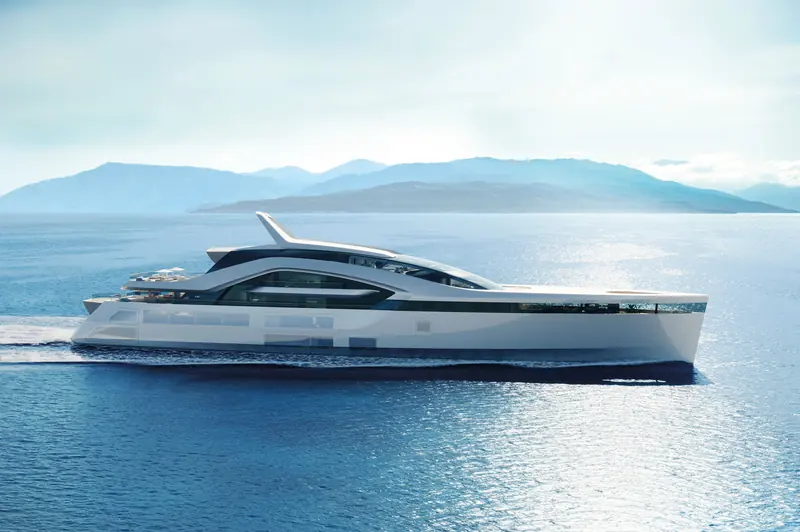
What actually changes when Feadship deletes the bridge on Hive?
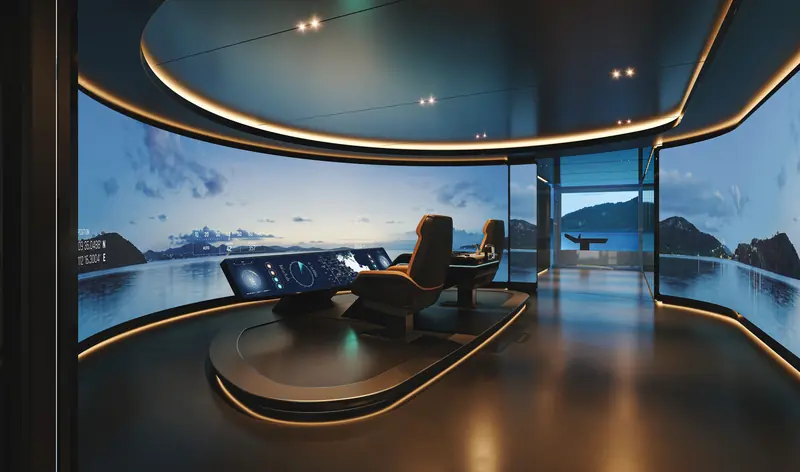
Moving navigation off the conventional bridge position frees the whole forward superstructure for guest use, an idea Feadship first tested on its Pure and C concepts, and on Hive it becomes an observation lounge with a retractable glass roof and wing stations that give a direct outside view during close-quarters manoeuvring.
Studio De Voogt, Feadship's in-house design office, built Hive around what it calls a virtual bridge: navigation and manoeuvring move off the traditional forward-facing command deck and onto systems that do not need a fixed line of sight out of a wheelhouse window. The same idea appeared first on Feadship's Pure and C concepts, both of which used a relocated bridge to free premium space elsewhere on the hull, so Hive is a continuation of an approach the yard has now tested across at least three design studies rather than a one-off gimmick. On Hive, at 115 metres, the freed space becomes an observation lounge with a retractable glass roof, open on two sides, with wing stations built in for the moments when a real outside view still matters most, echoing the wing-station practice large commercial vessels use for tight quayside work.
The trade is straightforward for an owner to picture: the single best sightline on a superyacht, forward and high, usually belongs to the operating crew, not the guests. Hive hands that position to an observation lounge instead and pushes navigation into instruments and cameras lower in the hull. Feadship has not said whether any class society has signed off on a virtual bridge at 115 metres specifically, and nothing about Hive has been built, so the idea remains proven only at concept stage, not yet demonstrated on a certified hull this size. For a buyer, that means the feature is a request to make of the design team, not yet a line item with a fixed cost or a delivery precedent.
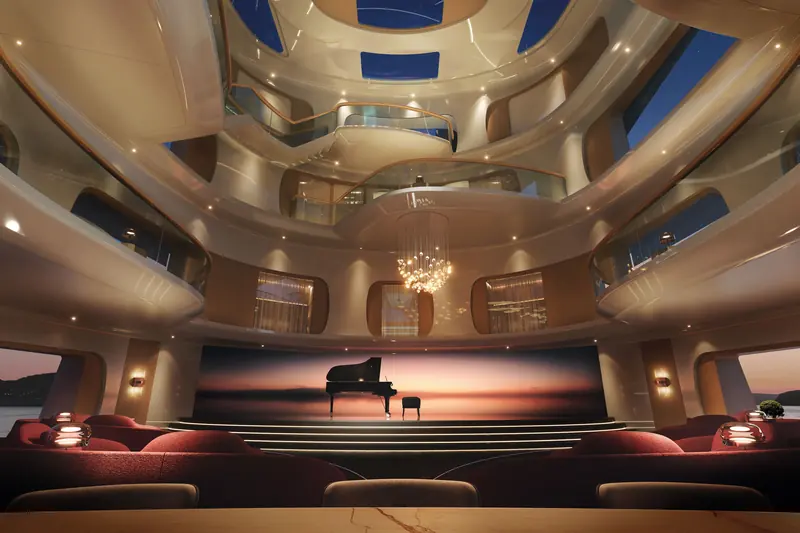
What actually fills the four-deck atrium at the centre of Hive?
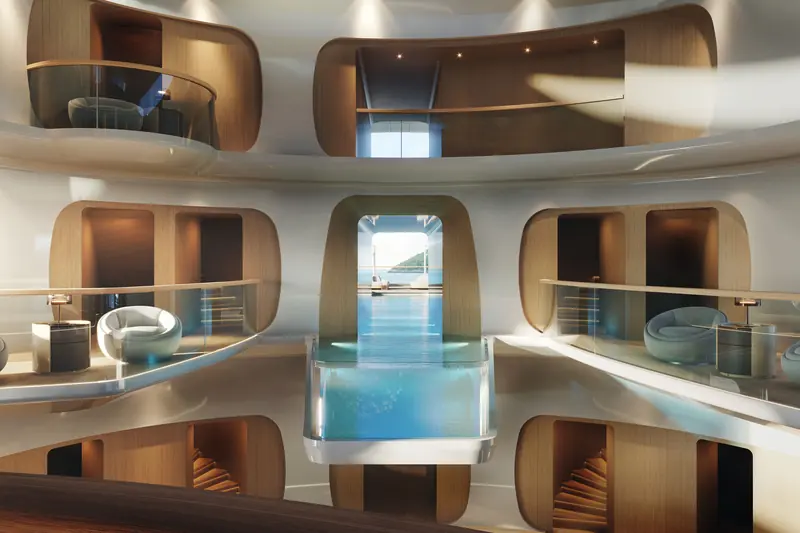
The centrepiece is a four-deck open space that Feadship describes shifting between a family living room, a performance venue and an auditorium, linked by curved staircases running past small private balconies, so one volume serves whatever the day calls for instead of being cut into fixed rooms.
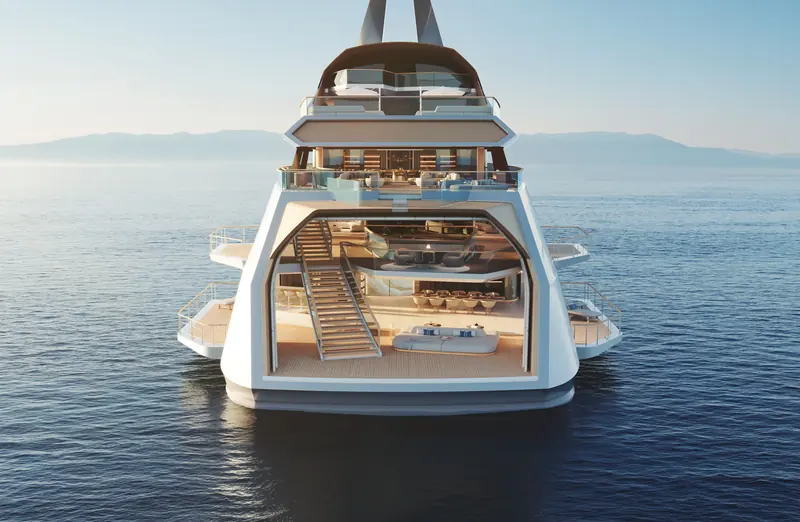
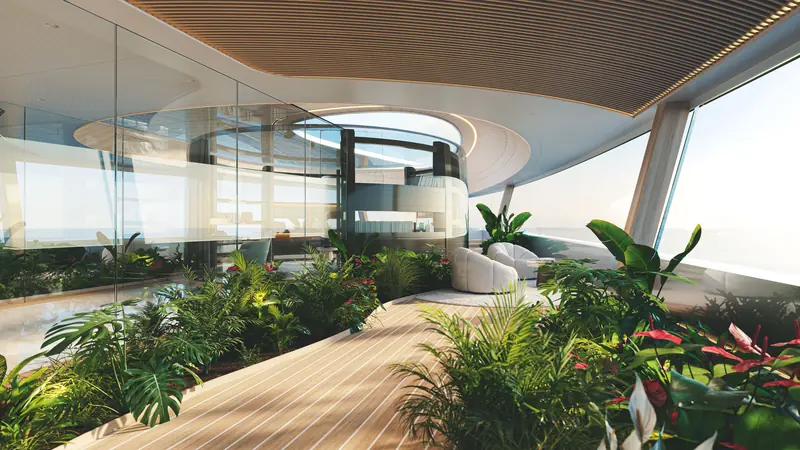
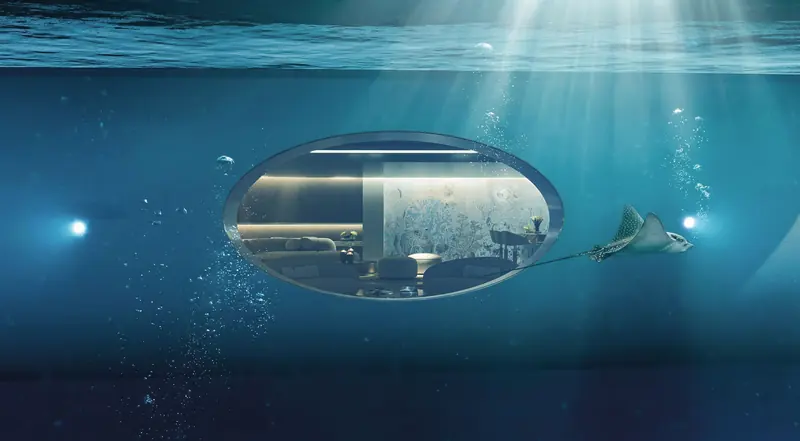
Around that central hub, Hive stacks a run of single-purpose spaces that lean hard on water access and scale rather than formality. A two-storey beach lounge sets water-level dining for 24 or more guests, putting the dining table at the same level as the sea rather than several decks above it. The owner's deck carries a 20-metre pool fitted with ContraWave current technology, which lets a swimmer hold position against a generated current instead of needing open water, alongside a separate suspended, glass-bottomed infinity pool positioned so a swimmer looks straight down through the hull. A circular library, enclosed in glass on the foredeck, opens onto a private garden, and a dedicated underwater lounge sits below the waterline with its own view out.
Senior designer Jan Schaffers has described the brief as starting with people rather than square metres: 'Hive is designed around the idea that experiences can change people,' he said of the concept, framing the whole layout as an argument that a yacht this size should serve moods and gatherings rather than a fixed floor plan of named rooms. That is a different design starting point from a conventional 100-metre-plus brief, which typically begins by allocating guest cabins, crew quarters and technical space first and fits lifestyle features around what is left. Whether that people-first sequencing actually survives contact with a real owner's must-have list, cabin count included, is untested outside the concept stage.
How would Hive actually run at 9,500 nautical miles without diesel?
Hive pairs three 900kW HVO-burning generators with a 5 MWh battery bank, then offers two separate zero-emission paths, seven 75kW solid oxide fuel cells or nine 250kW PEM fuel cells with a methanol reformer, covering 9,500 nautical miles at 12 knots on HVO or 5,000 nautical miles at 12 knots on methanol.
The base power plant is three variable-speed, permanent-magnet generators, each rated at 900kW and running on HVO, feeding a DC electrical grid backed by a 5 MWh battery bank, roughly five times the size of the battery Feadship fitted to its own delivered yacht Savannah. Propulsion runs on Voith Schneider units, a cycloidal-propeller design more commonly seen on tugs and ferries for its manoeuvrability, in place of conventional rudders and fixed-pitch propellers. Fuel capacity is set at 410,000 litres, with a cruise speed of 12 knots and a maximum of 16 knots, and diesel-free range on HVO alone runs to 9,500 nautical miles at cruise.
For genuinely zero-emission legs, Feadship has sketched two separate routes rather than committing to one: seven 75kW solid oxide fuel cells, or nine 250kW PEM fuel cells paired with a methanol reformer, cutting range to 5,000 nautical miles at 12 knots when running on methanol instead of HVO. Neither fuel-cell system is standard equipment on a delivered superyacht today, and carrying both as parallel options rather than picking one suggests Feadship itself is not yet certain which fuel-cell chemistry will actually be buildable, bunkerable and supportable in the ports an owner actually uses, first.
Is Hive an actual yacht order, or a design exercise?
Hive is a concept design, not a build: Feadship has disclosed no client, no price and no keel-laying date, and the yard's concept series exists to test ideas rather than commit a hull, so nothing here is guaranteed to reach the water at 115 metres or any other length.
Feadship called Hive its largest concept design to date when it was shown at the Monaco Yacht Show this week, a framing that is itself the news: it signals the yard thinks there is a genuine buyer conversation to be had above 100 metres, a size bracket where Feadship already has real delivered yachts to point to rather than only concepts. But a concept carries none of the commitments a contract does. No guest capacity, cabin count or gross tonnage has been published for Hive, which is usually the first number a serious buyer asks for, and Feadship has given no indication of build cost or a construction slot.
For an owner actually shopping in this size bracket, Hive is best read as a menu rather than a yacht: the virtual bridge, the atrium, the dual fuel-cell options and the twin-pool owner's deck are all things Feadship can now say it has engineered to a real level of detail, available to discuss on a full custom commission. Whether any of it has cleared class-society approval at 115 metres, what it would actually cost against a conventional 100-metre-plus newbuild, and how long a real build would take are all questions the yard has not answered. Studio De Voogt's own concept series has moved ideas like the relocated bridge from sketch to repeated feature before; whether Hive's atrium and dual fuel-cell system make the same journey is, for now, an open question rather than a stated plan.
What is good, and what to watch
Strong points
- Two zero-emission paths, not one betOffering both solid oxide and PEM/methanol fuel cells hedges against either chemistry failing to mature in time, rather than committing the whole concept to a single unproven system.
- A real ocean-crossing range9,500 nautical miles at 12 knots on HVO is a genuine long-range figure for a yacht this size, not a harbour-hop number dressed up for a press release.
- The bridge trade actually frees usable spaceDeleting the conventional bridge for a virtual one hands the best forward sightline on the ship to a guest observation lounge instead of an operations room.
What to watch
- No guest capacity disclosedFeadship has not published how many guests or cabins Hive carries, usually the first number a buyer asks for.
- It is not an orderNo client, no price and no keel-laying date have been announced, and a Feadship concept does not automatically become a hull.
- Two fuel-cell systems means two unresolved choicesSolid oxide and PEM/methanol need different refuelling infrastructure and sit at different levels of maturity; Feadship has not said which, if either, it would actually build.
Practical detail
| Length | 115m |
|---|---|
| Beam | 17.5m |
| Draft | 4.05m |
| Guest capacity | Not disclosed |
| Base power | 3 x 900kW HVO generators, DC grid, 5 MWh battery bank |
| Zero-emission option | 7 x 75kW solid oxide fuel cells, or 9 x 250kW PEM fuel cells with methanol reformer |
| Range | 9,500nm at 12kn on HVO; 5,000nm at 12kn on methanol |
| Speed | 12kn cruise, 16kn maximum |
| Fuel capacity | 410,000 litres |
| Designer | Studio De Voogt, led by Senior Designer Jan Schaffers |
| Status | Concept design only - no client, no price, no keel-laying date announced |
Questions this story answers
What happened?
Feadship's in-house Studio De Voogt has drawn Hive, a 115-metre concept that is the yard's largest design study to date, built around a bridge removed entirely to free a four-deck atrium and a glass-bottomed pool. The power plant behind it pairs a 5 MWh battery with a choice of two zero-emission fuel-cell systems, a concrete answer to how a yacht this size might actually run clean. For an owner weighing a 100-metre-plus newbuild, Hive reads less like a fantasy sketch and more like a list of what Feadship is prepared to engineer next.
What is good about it?
Two zero-emission paths, not one bet. Offering both solid oxide and PEM/methanol fuel cells hedges against either chemistry failing to mature in time, rather than committing the whole concept to a single unproven system.
What should an owner or buyer watch?
No guest capacity disclosed. Feadship has not published how many guests or cabins Hive carries, usually the first number a buyer asks for.
Who reported this?
Feadship / Studio De Voogt, usaonboard.com, SuperYacht Times.
We do this for everyone who loves this world. The people who have spent their lives in it, and the people just discovering it. Yotters exists so that what we learn belongs to all of them.
Nobody pays us for this. No ads, no sponsors, nothing for sale. We just believe the world is a little better when knowledge is shared instead of kept.
If it gave you something today, tell us to keep going. Follow us, leave a like, or write a positive comment. We read every one, and they are what keeps us going.