Sinot's Fusion Would Be the Largest Trimaran Ever Built, at 118m
How big is Sinot's Fusion trimaran concept?
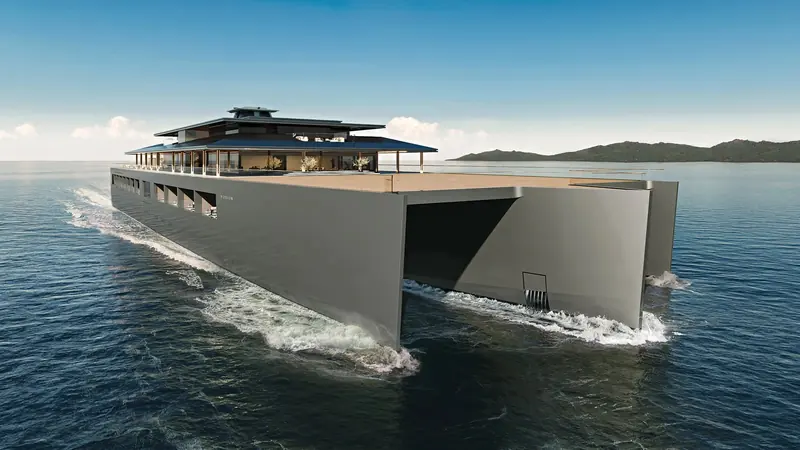
Fusion measures 118 metres overall on a 115-metre waterline, with a 30-metre beam split across a 17.5-metre centre hull and two 4.7-metre side hulls, for an estimated 8,200 GT and berths for 18 guests and 49 crew.
Sinot's own general arrangement, published alongside the Monaco unveiling, gives Fusion a length overall of 118 metres and a waterline length of 115 metres. The beam overall is 30 metres, made up of a 17.5-metre centre hull flanked by two 4.7-metre side hulls that Sinot says are structural and inhabited, not stabilisers bolted on for balance. Estimated gross tonnage is 8,200 GT, and the accommodation plan holds nine staterooms, one owner's suite, two VIP cabins and six guest cabins, for 18 guests, plus quarters for a crew of 49. A tender and vehicle deck of 834 square metres sits low in the structure, sized for four 15-metre tenders and the expedition vehicles the concept carries.
That would make Fusion substantially larger than any trimaran built to date. The current record belongs to White Rabbit, the 84-metre, roughly 3,000 GT trimaran Australian yard Echo Yachts delivered in 2018 to a Sam Sorgiovanni exterior with naval architecture by One2Three, carrying 28 guests and a crew of 36. Fusion, at 118 metres and 8,200 GT, would be 40 percent longer and close to three times the tonnage, with a smaller guest count but a larger crew, if it is ever built. Fusion's Monaco debut falls inside the show's 35th edition, which organisers say carried 43 world premieres across the fleet this year, Fusion among the concepts rather than the delivered hulls.
Why did Sinot design Fusion as a trimaran rather than a monohull?
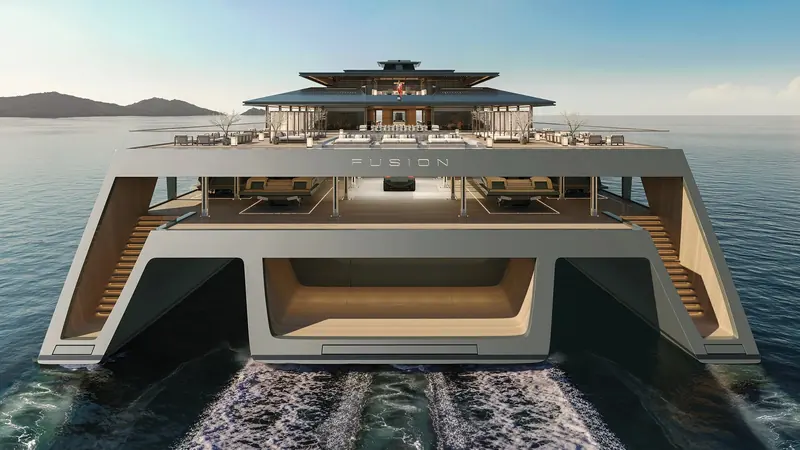
Sinot's founder says the three hulls are not a stabilising afterthought but the architecture itself, built to hold two briefs, culture and wellbeing on one side, sport and exploration on the other, inside the same vessel without one crowding out the other.
Sander J. Sinot, the studio's founder, framed the choice directly: Fusion is not a standard yacht with extra stabilisers, he said, adding that owners no longer want to choose between culture and adventure, so Fusion is designed so they do not have to. The practical result is 3,340 square metres of exterior deck space, spread across a centre hull and two side hulls rather than stacked into one narrow superstructure, space Sinot says a monohull of the same length could not offer without going far taller. Sinot presents the idea across nine named design chapters, running from 'Two Worlds, One Architecture' through 'Monumental Clarity' and 'Movement, Light and Sea' to a closing 'Perfect Balance', a narrative device the studio uses to pitch a concept as a lived idea rather than a spec sheet.
The layout uses that spread deliberately. A foredeck 'playdeck' is built to take either a helicopter or VTOL landing or a tennis court, while the stern of the centre hull opens into a concealed beach club at the waterline, reached by the side-hull staircases visible in the yard's own renders. Naval architecture is by Azure Yacht Design & Naval Architecture working with Sinot, and the concept carries four 15-metre tenders, two of them limo tenders, plus dive equipment and expedition vehicles for the sport-and-exploration half of the brief. Sinot's renders show the aft structure open on three sides at the waterline, a shape only possible because the load is carried by three hulls rather than one, which is the structural argument behind the whole design.
What is inside the Fusion superyacht concept?
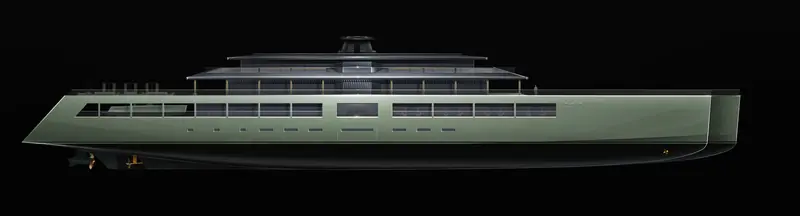
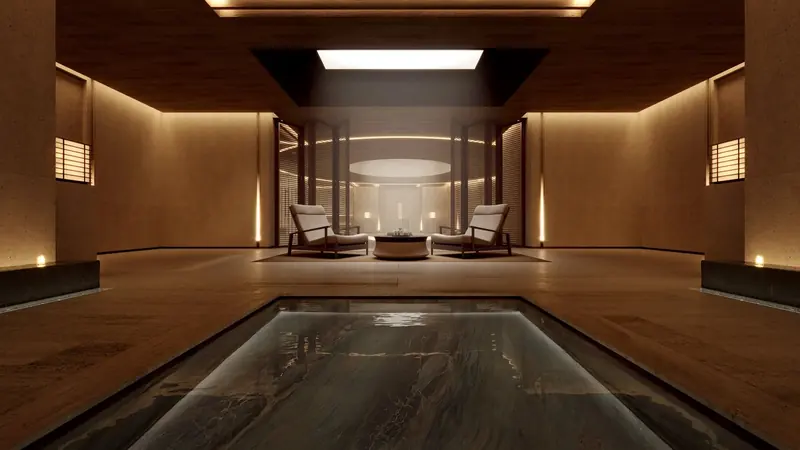
The interior splits the same way as the brief: a wellness deck built around a circular sanctuary, hammam, sauna and plunge pool sits alongside a gym with a counter-current pool, a cinema for more than 20 guests and a dining room laid for the whole party at once.
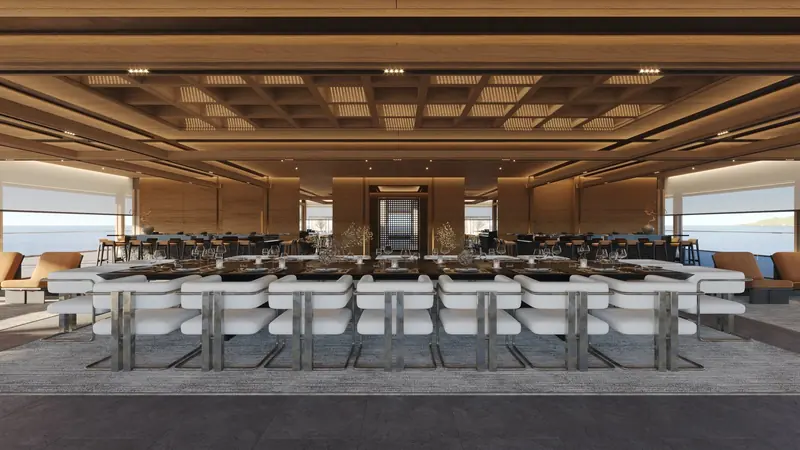
The wellness deck centres on a circular sanctuary housing a Foucault pendulum, with a hammam, sauna, plunge pool and massage rooms around it, and a separate gym and health centre adds a counter-current swimming pool, treatment rooms and a yoga platform. A cinema seats more than 20 guests in front of a 16-square-metre video wall, and the formal dining room, visible in Sinot's own renders, is laid for a party the size of the yacht's full 18-guest capacity, its long table run under a coffered timber ceiling with the sea visible on both sides. The two VIP suites sit on the main deck beside the six guest staterooms, each reached from the accommodation lobby rather than through a shared corridor, and the same deck carries the twin staircases down into the side hulls that show up repeatedly in Sinot's renders.
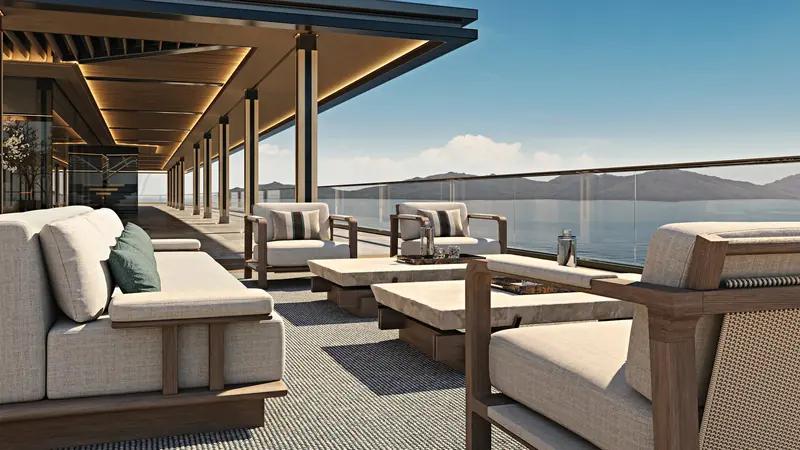
The owner's residence takes the full beam of its deck: a master suite with dual bathrooms, dressing rooms, a private lounge and a 100-square-metre exterior deck of its own. One level up, the upper-deck pool measures 8.2 by 12.5 metres with a glass bottom, set into a terrace laid for dining for 18. Minimalist interiors run natural stone against smoked glass and latticework, with a cast-glass water installation over 2.6 metres tall on the main deck as the concept's signature art piece, alongside a second freestanding piece combining illuminated glass with handcrafted natural stone. Sinot describes the palette as deliberately quiet against the scale of the vessel, letting the 3,340 square metres of deck and the view do the work rather than dense decoration.
Will Sinot's Fusion trimaran concept ever be built?
Sinot calls Fusion ready to build, but that is a design house's claim, not a commitment: no client, yard or price has been named, and Sinot's own 141-metre concept from last year's Monaco show, Aura, carried the identical claim and still has neither a year on.
Sinot presented Aura, a 141-metre concept, at the 2025 Monaco Yacht Show with the same 'ready-to-build, fully operational' language now attached to Fusion. A year on, Aura has no named client and no confirmed yard. Concept unveilings at Monaco function as much as a design house's annual showcase as they do a genuine sales pitch, and most never convert to a signed contract, a pattern Fusion would need to break. That said, Sinot's design work does reach steel: the studio's interior for the 117-metre Infinity was delivered in 2022, and Sinot has worked with Benetti since 2011, starting with the custom FB255 Formosa and continuing through the FB274 Zazou, so a Fusion order would not be the studio's first time seeing a project through, even if a from-scratch concept unveiled cold at Monaco rarely is.
Beyond a client, Fusion's own numbers raise the harder questions. A 30-metre beam is roughly a quarter of the yacht's overall length, far wider than a monohull of the same size, and would need a berth built for that width, not just that length, a real constraint given how few superyacht marinas are laid out for anything but a monohull's proportions. And only one yard, Echo Yachts, has ever built a trimaran superyacht at scale, and that was White Rabbit at under 3,000 GT and a 20-metre beam, itself ten metres narrower than what Fusion proposes. Whoever builds Fusion, if anyone does, would be proving three-hull construction works at nearly triple that tonnage and half again the beam, with no yard track record at this scale to point to, and no published price to say what solving that would cost.
What is good, and what to watch
Strong points
- Real naval architecture stands behind itFusion was developed with Azure Yacht Design & Naval Architecture rather than presented as a pure styling render, which is what separates a genuine ready-to-build claim from a stylist's sketch.
- The hull form buys real, usable space3,340 square metres of exterior deck and 8,200 GT of interior volume is a direct consequence of spreading the yacht across three hulls instead of stacking one, not just a marketing figure.
- The two-brief layout is actually deliveredthe spa sanctuary, gym and cinema sit in the general arrangement alongside a lower-deck beach club, dive gear and expedition vehicles, matching the culture-and-adventure brief Sinot set out to solve rather than just describing it.
What to watch
- No client, yard or price has been nameda year after Sinot's 2025 concept Aura was presented in identical ready-to-build language, Aura still has no named owner or builder, so Fusion carries the same risk of staying a render.
- A 30-metre beam is a real berthing problemat roughly a quarter of the overall length, Fusion is far wider than a monohull of the same size and would need a berth built for that width, not just that length, at marinas mostly laid out around monohull proportions.
- Only one yard has ever built anything closeEcho Yachts delivered the current record-holder, the 84-metre White Rabbit, in 2018 at under 3,000 GT, so Fusion at 8,200 GT would need a yard to prove three-hull construction at nearly triple that tonnage, with no precedent to draw on.
Practical detail
| Overall length | 118m (387ft) |
|---|---|
| Waterline length | 115m |
| Beam overall | 30m (17.5m centre hull, two 4.7m side hulls) |
| Estimated GT | 8,200 GT |
| Guest capacity | 18, across 9 staterooms (1 owner's suite, 2 VIP, 6 guest) |
| Crew | 49 |
| Tenders and toys | Four 15m tenders, dive equipment, expedition vehicles |
| Naval architecture | Azure Yacht Design & Naval Architecture, with Sinot |
| Not yet published | No named client, no confirmed build yard, no price, no propulsion or speed figures |
Questions this story answers
What happened?
Sinot Yacht Architecture & Design used Monaco to unveil Fusion, a 118-metre trimaran concept it calls ready to build, a hull form no yard has attempted at anything close to this size. For an owner weighing a three-hull design against a conventional monohull, the trade is real: nearly double the usable deck space of a monohull the same length, against a 30-metre beam that no ordinary marina berth is built to hold.
What is good about it?
Real naval architecture stands behind it. Fusion was developed with Azure Yacht Design & Naval Architecture rather than presented as a pure styling render, which is what separates a genuine ready-to-build claim from a stylist's sketch.
What should an owner or buyer watch?
No client, yard or price has been named. a year after Sinot's 2025 concept Aura was presented in identical ready-to-build language, Aura still has no named owner or builder, so Fusion carries the same risk of staying a render.
Who reported this?
Sinot Yacht Architecture & Design, BOAT International, SuperyachtTimes, Robb Report, Echo Yachts.
We do this for everyone who loves this world. The people who have spent their lives in it, and the people just discovering it. Yotters exists so that what we learn belongs to all of them.
Nobody pays us for this. No ads, no sponsors, nothing for sale. We just believe the world is a little better when knowledge is shared instead of kept.
If it gave you something today, tell us to keep going. Follow us, leave a like, or write a positive comment. We read every one, and they are what keeps us going.