ShadowCat's Foundation Series Cuts a Shadow Yacht to 20 Months
What is ShadowCat's Foundation Series?
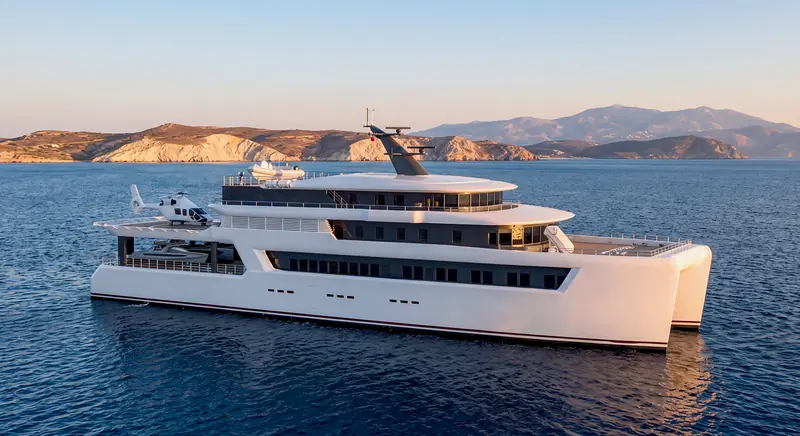
The Foundation Series is three semi-custom, build-ready shadow yachts from ShadowCat, each roughly 67 metres on a catamaran hull, with delivery targeted at about 20 months from contract rather than the several years a fully custom support vessel typically takes.
ShadowCat opened build slots for the Foundation Series at the Monaco Yacht Show this week, offering three fixed configurations instead of a ground-up commission. Altitude, at roughly 2,100 gross tons, is built around helicopter operations, with a fully enclosed hangar that lets a machine move from deck to shelter with its blades still attached. Waypoint, at around 1,700 GT, splits the difference between aviation and water toys, with a hangar that stores a helicopter blades-off. Basecamp, also close to 1,700 GT, drops the aviation emphasis in favour of large tenders, dive gear and space for expedition guides and mission equipment. All three share a 67-metre length overall, a beam of 14 to 15.5 metres, a certified helicopter deck and a shallow draft built for anchoring close to a mothership in places a deep-draft yacht cannot reach.
The naval architecture is by Incat Crowther of Sydney, working with YCTS Ltd under the ShadowCat name, with exterior styling on parts of the range by Berlin-based T. Fotiadis Design. Build is at Astilleros Armon's Burela yard in Spain, the yard that has built every ShadowCat support vessel delivered to date. Jennifer Smith, ShadowCat's commercial director, framed the pitch as one of certainty rather than novelty: today's owners, she said, value certainty as much as capability. That is a direct answer to what a custom shadow vessel actually costs a buyer, which is not money so much as time, since a bespoke design and build cycle can run past the point where the mothership itself is due for a refit.
Who already owns a ShadowCat support vessel?
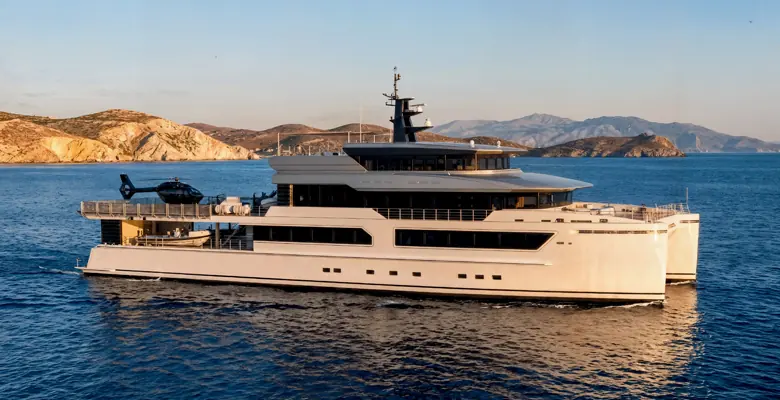
ShadowCat has delivered three support catamarans before the Foundation Series: Hodor in 2019, reportedly for Lorenzo Fertitta, Wayfinder in 2021, reportedly for Bill Gates, and Nebula in 2022, built to shadow Jan Koum's Feadship Moonrise.
Trade coverage has named all three owners without ShadowCat itself confirming any of them. BOAT International reports Wayfinder as belonging to the former Microsoft chief executive, a 68.2-metre catamaran delivered in 2021 and now asking EUR 55 million in Antibes, with Wayfinder still chartering from EUR 375,000 a week. Hodor, the 66-metre sistership delivered two years earlier, is reported by the same trade press as belonging to Lorenzo Fertitta, the former UFC chief executive. Nebula, delivered in 2022, was built specifically to shadow Moonrise, the roughly 220 million dollar Feadship reported to belong to WhatsApp co-founder Jan Koum.
None of the three has gone on the record about the boat itself, so this is reported ownership, not owner testimony, and Yotters is naming it as such. What the pattern does establish is that ShadowCat's buyers to date have been owners of some of the largest private yachts afloat, people who could have commissioned a fully bespoke support vessel from any yard and chose the ShadowCat platform instead. That is the credibility the Foundation Series is selling forward, a proven hull form with three known past clients rather than a concept with none.
What does a shadow yacht carry that the main yacht cannot?
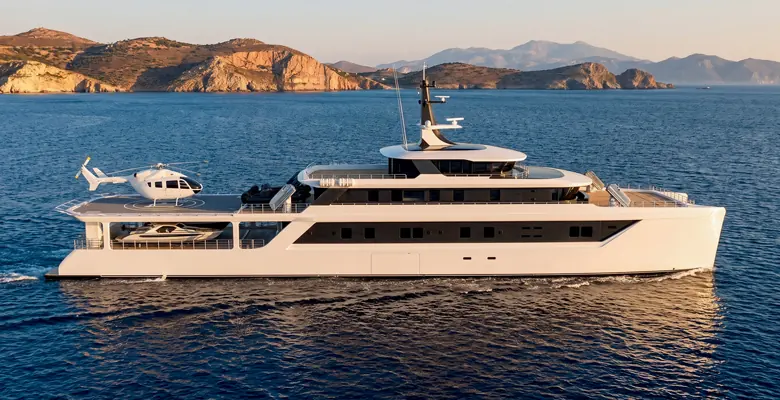
A shadow yacht exists to hold the tenders, jet skis, a helicopter and the overflow crew a mothership has no room for, launched and retrieved through gear engineered for sea states a conventional yacht's garage cannot handle.
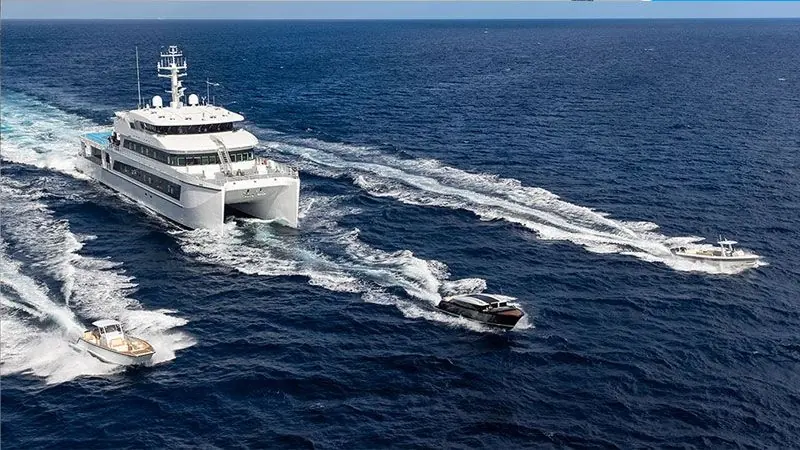
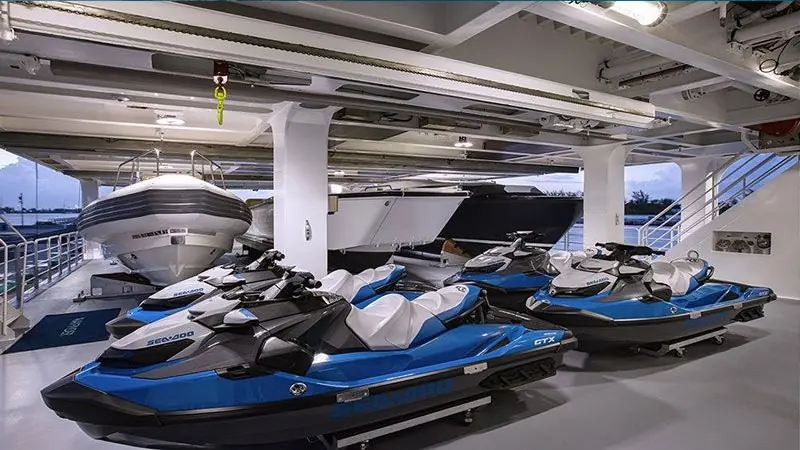
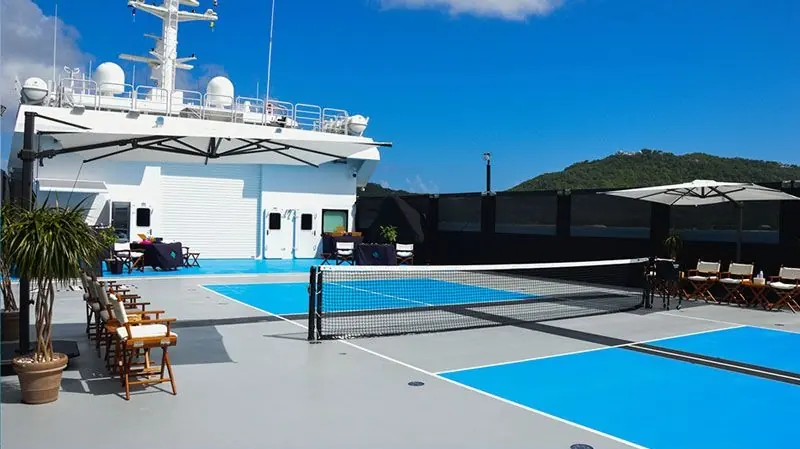
Wayfinder is the clearest working example of what the Foundation Series is selling. Her garage stows four Sea-Doo jet skis and a rigid inflatable boat under a full-beam overhead crane, and BOAT International's own photography shows her running with three tenders deployed at once, a load-out a standard superyacht garage would need several trips to launch. The helideck folds into a padel or pickleball court when no aircraft is aboard, the kind of dual-use thinking the Foundation Series repeats across all three configurations. Basecamp pushes that logic furthest, trading hangar space for tender and dive-gear capacity aimed at expedition guides and scientific mission equipment rather than aviation.
Altitude sits at the opposite end, built around a fully enclosed hangar that keeps a helicopter's blades attached between flights, cutting the turnaround time against a blade-off hangar where the rotor has to be folded or removed before stowage. Waypoint is the compromise most buyers are expected to choose, according to ShadowCat, a blade-off hangar paired with dive tenders, beach landers and rugged-duty RIBs. Total capacity across the range is 35 people including crew, a figure that reflects the vessels' real job, supporting a much larger yacht's operation rather than standing in for it.
What else did ShadowCat reveal at Monaco this year?
ShadowCat used the same week to unveil two larger concepts, the 69-metre catamaran Sustain and the 69.2-metre monohull SHADOWOLF, its first single-hulled support yacht design.
Sustain, developed by YCTS Ltd with Incat Crowther as naval architect, is built around marine science and conservation work rather than pure toy storage. She carries a manned submersible from Triton Submarines, a dive shop with its own decompression chamber, wet and dry labs for data gathering, a hospital and a dedicated video-editing suite for documenting expedition and research findings. Propulsion runs on WABTEC EGR marine engines burning renewable or biodiesel fuel, which ShadowCat says cuts emissions by 50 to 90 percent against conventional diesel, backed by solar panels charging battery banks for tenders and toys and a stated zero-discharge target for wastewater. Founder Robert Smith described the goal as sustainability built into operation, not bolted on afterward.
SHADOWOLF, at 69.2 metres, is ShadowCat's first monohull support concept, a departure from the catamaran hulls of every vessel the company has delivered or proposed before it, including the Foundation Series. Neither Sustain nor SHADOWOLF has a named client or a confirmed build slot, and ShadowCat has not said whether either will join the Foundation Series' fixed-configuration, fixed-timeline model or remain a fully bespoke commission. Showing both alongside a build-ready range aimed at a faster, cheaper decision reads as ShadowCat testing how far up the size and mission-complexity scale its buyers are willing to go before they want a one-off design again.
How much does a ShadowCat shadow yacht cost?
ShadowCat has not published a price for any Foundation Series configuration, describing the range only as comprehensively priced to include interiors, machinery, systems and principal equipment, with the closest real anchor being Wayfinder's EUR 55 million resale asking price for a comparable, already-built 68-metre platform.
That gap between a firm delivery promise and a published price is the single most useful thing missing from ShadowCat's own materials. A 20-month delivery clock is a specific, checkable commitment. Comprehensively priced is not a number, and additional costs tied to mission-specific customisation, ShadowCat's own language, are left open-ended. For an owner used to a full-custom yard quoting a fixed contract price before steel is cut, the Foundation Series pitch inverts the usual order: the timeline is fixed and public, the price is not.
Wayfinder's own history offers the only real comparison available. Delivered in 2021 at 68.2 metres and 1,737 GT, close in scale to Waypoint and Basecamp, she is currently asking EUR 55 million as a five-year-old resale and chartering from EUR 375,000 a week. A new-build Foundation Series hull, comprehensively equipped and delivered in under two years, would reasonably be expected to price above that resale figure once ShadowCat or a buyer's broker eventually confirms one. Until that number surfaces, the Foundation Series remains a real, buildable product with a genuine track record behind it, priced by inquiry only.
What is good, and what to watch
Strong points
- A fixed, checkable delivery promiseAbout 20 months from contract is a specific commitment in a market where a bespoke shadow-vessel commission can run years, long enough to outlast the refit cycle of the mothership it is meant to support.
- A hull form already proven under real ownersWayfinder, Hodor and Nebula are reported to have been built for Bill Gates, Lorenzo Fertitta and Jan Koum respectively, real sea time on the same catamaran platform rather than a concept with no history.
- Purpose-built launch and retrieval, not an afterthoughtWayfinder's own photography shows three tenders running simultaneously off gear engineered for sea states a standard superyacht garage is not built to handle, the practical reason a shadow yacht exists at all.
What to watch
- No price, for any of the three configurationscomprehensively priced tells a buyer what is included, not what it costs, and mission-specific customisation is explicitly open-ended, the opposite of the fixed-timeline certainty ShadowCat is otherwise selling.
- Three fixed configurations, not a blank sheetan owner who wants a genuinely bespoke shadow vessel, a different hull form, a different beam, a mission profile none of Altitude, Waypoint or Basecamp covers, is still better served by a full custom commission.
- A resale market of exactly one data pointWayfinder's EUR 55 million asking price is the only comparable on the market right now, too thin a sample to say with confidence what a Foundation Series hull will be worth in five years.
Practical detail
| Models | Altitude, Waypoint, Basecamp |
|---|---|
| Length overall | 67m (220ft), all three |
| Beam | 14m to 15.5m (46ft to 51ft) |
| Total capacity | 35 people including crew |
| Delivery | About 20 months from contract |
| Naval architecture | Incat Crowther (Sydney) with YCTS Ltd |
| Exterior design | T. Fotiadis Design (Berlin), on parts of the range |
| Builder | Astilleros Armon, Burela, Spain |
| Comparable resale | Wayfinder, 68.2m, 2021, asking EUR 55m in Antibes |
| Comparable charter | Wayfinder, from EUR 375,000 a week |
| Not published | Per-model Foundation Series price, hull slots sold so far, whether Sustain or SHADOWOLF join the fixed-price model |
Questions this story answers
What happened?
ShadowCat used Monaco to put three build-ready shadow yachts up for order, each one promised in roughly 20 months instead of the multi-year wait a custom support vessel usually demands. The Foundation Series leans on a catamaran platform already proven under owners reported to include Bill Gates and Lorenzo Fertitta, and it arrives alongside two larger concepts built for expedition science. For an owner weighing whether a mothership needs a shadow of its own, the trade is speed and certainty against a blank sheet of paper.
What is good about it?
A fixed, checkable delivery promise. About 20 months from contract is a specific commitment in a market where a bespoke shadow-vessel commission can run years, long enough to outlast the refit cycle of the mothership it is meant to support.
What should an owner or buyer watch?
No price, for any of the three configurations. comprehensively priced tells a buyer what is included, not what it costs, and mission-specific customisation is explicitly open-ended, the opposite of the fixed-timeline certainty ShadowCat is otherwise selling.
Who reported this?
BOAT International, Megayacht News, SuperyachtNews.com.
We do this for everyone who loves this world. The people who have spent their lives in it, and the people just discovering it. Yotters exists so that what we learn belongs to all of them.
Nobody pays us for this. No ads, no sponsors, nothing for sale. We just believe the world is a little better when knowledge is shared instead of kept.
If it gave you something today, tell us to keep going. Follow us, leave a like, or write a positive comment. We read every one, and they are what keeps us going.