Amer's first steel explorer runs 8,900nm at 60 litres an hour
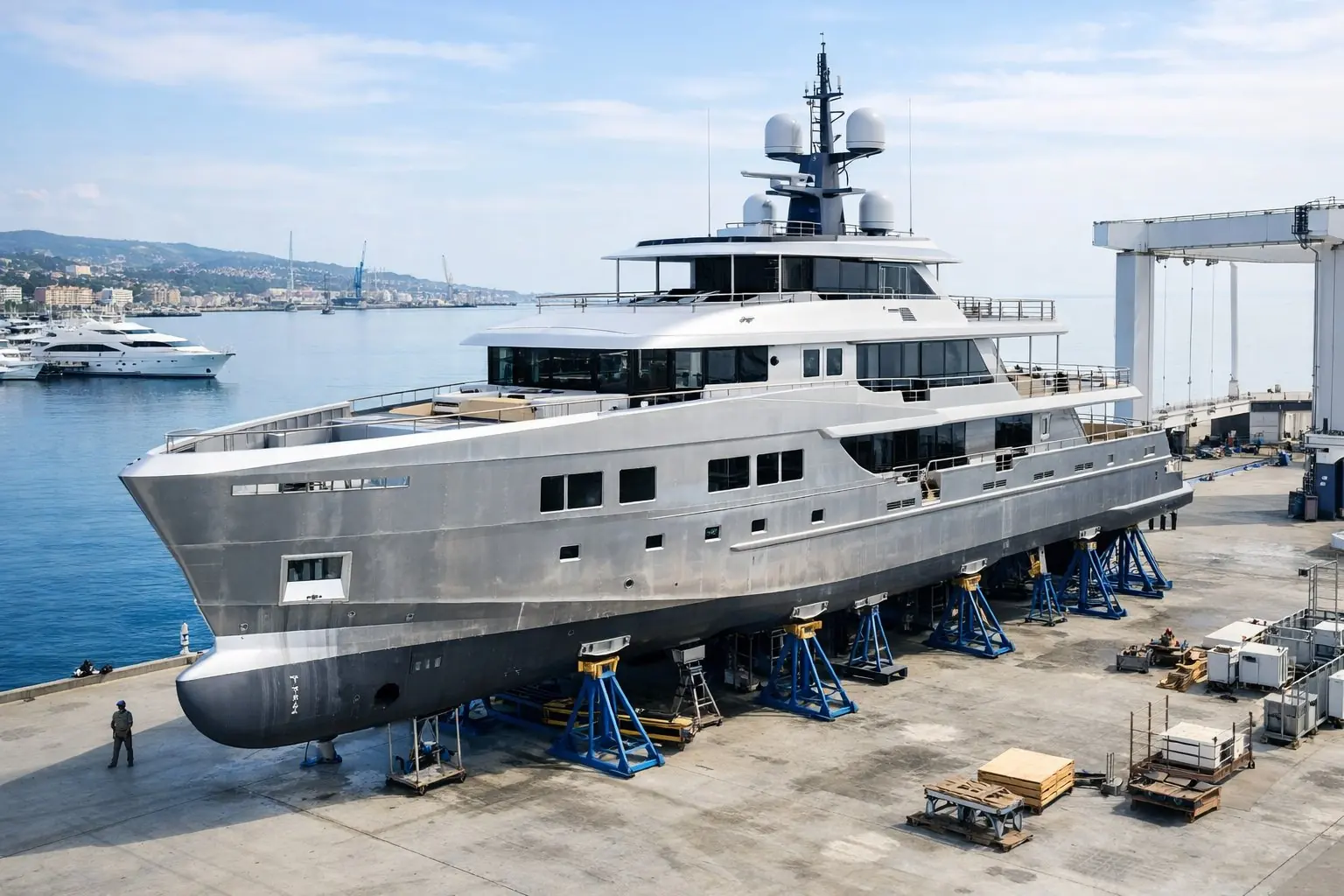
Delivered, and already off Corsica
Even Further was delivered on 23 July and is already working the Corsican coastline. She started life as the Amer Steel Explorer 41, shown as a project at the 2022 Monaco Yacht Show, and reached the water this summer as the 41.45-metre Amer 42 Explorer. She is the first steel hull the Amer yard has built and the founding boat of its new custom line.
Luiz de Basto drew both the exterior and the interior. Naval architecture is by the Italian studio Optima Design, a third credit most of the coverage has left off. The hull is steel with an aluminium superstructure, and she measures 486 GT on a displacement of 440 tonnes.
Four engines so that two can be switched off
Explorers at this size almost always run twin diesel shafts. Even Further instead carries Volvo Penta's Professional Platform, four D13 engines coupled to two IPS40 pod drives. That is the pod thinking Amer has used on its smaller composite yachts, scaled up to a 440-tonne steel hull for the first time.
The reason for four smaller engines instead of two large ones is the eco mode. In it only two of the four are engaged, so the pair that are running sit near their efficient load instead of loafing at a fraction of it. A conventional twin-shaft explorer cannot do that. It has to throttle both big diesels well below their best point to reach the same speed.
The range number, and whether it holds up
On initial open-sea trials the yard recorded 60 litres of diesel an hour in eco mode at 9.5 knots. Fuel capacity is 56,300 litres and Amer puts the range at 8,900 nautical miles. Cruising speed is 14 knots and top speed is 16.3.
The arithmetic behind that claim is checkable, which is not always true of range figures. At 60 litres an hour, 56,300 litres is about 938 hours of running, and 938 hours at 9.5 knots is about 8,900 nautical miles. It assumes dry tanks and a flat sea, so it is a ceiling and not a passage plan, but it is not a number pulled out of the air.
Built to go cold, and to carry things
The hull is built to Ice Class standards with a high bow for open water. Twin 8,000-kilogram cranes are integrated into the superstructure for launching and recovering tenders and toys, so dive gear and a serious chase boat are not a compromise. There is a touch-and-go helipad forward.
Volume goes into living as well as into range. The flybridge runs about 17 metres, more than 40 per cent of the length overall. At 486 GT she also sits under 500, which keeps her clear of the heavier crewing and survey band that begins above that line.
Why Amer moved to steel
Even Further is a double first, the yard's first steel hull and the opening boat of a new custom line. Amer, part of the Permare group, has spent years selling fuel economy on composite yachts. Chief executive Barbara Amerio dates the strategy to the late 1980s, long before efficiency became an industry talking point, and argues it now reads as an advantage for owners and charter operators facing higher fuel costs.
For a buyer the choice is the whole point. A steel explorer that burns like a far smaller boat, and can be built to order, is a different proposition from the shaft-driven norm at this length. Even Further is not for sale, so the real test of the line is what the yard books in behind her.
What owners and crew report
The designer frames her as a explorer that hides its own capability
Luiz de Basto, who drew both the exterior and interior, said that glancing at her profile, no one would realise they were looking at a fully capable explorer - the designer's own account of the brief, not an independent view.
Luiz de Basto, designerThe yard's chief executive frames this as decades of strategy paying off
Barbara Amerio called the fuel-consumption result the outcome of a long and relentless pursuit of improved performance and reduced fuel consumption - the yard's own framing of a strategy it dates back to the late 1980s.
Barbara Amerio, CEO, Amer YachtsVolvo Penta's own account credits the propulsion choice
Volvo Penta's VP for Yacht & Superyacht said the technology can radically transform the future of navigation, even over long distances - the engine supplier's own account of its Professional Platform pods.
Nicola Pomi, Volvo Penta
What is good, and what to watch
Strong points
- The range claim is checkable arithmetic, not a marketing number60 litres an hour against a 56,300-litre tank works out to about 938 hours of running, and at 9.5 knots that is close to the claimed 8,900nm - a figure that survives being checked, which most range claims are never asked to do.
- Four smaller engines let eco mode actually workRunning two of four D13 engines near their efficient load in eco mode is something a conventional twin-shaft explorer cannot do, since it would have to throttle two large diesels well below their best point to hold the same speed.
- Built for real expedition use, not just the look of itIce Class construction, twin 8,000kg integrated cranes for tenders and toys, and a touch-and-go helipad are working features, not styling.
What to watch
- One hull, no track record yetEven Further is not for sale, so the real test of the four-engine steel platform - reliability, service costs, resale - is what the yard books in behind her, not anything provable from this one delivery.
- The range figure is a still-water ceiling, not a passage planThe 8,900nm claim assumes dry tanks and a flat sea; the yard's own trial number is the best case, and real passages will run shorter.
- Sitting under 500 GT looks like a rule constraint as much as a design choiceAt 486 GT she stays clear of the heavier crewing and survey requirements that begin above that line - worth knowing if comparing her volume against size-class rivals that were not built to stay under it.
Practical detail
| Delivered | 23 July 2026, working the Corsican coastline |
|---|---|
| LOA / GT / displacement | 41.45m / 486 GT / 440 tonnes |
| Fuel capacity | 56,300 litres |
| Range (claimed) | About 8,900nm at 9.5 knots / 60 litres an hour in eco mode |
| Cruising / top speed | 14 knots cruise; 16.3 knots top |
| Availability | Not for sale - the first hull of a new custom line |
| Price | Not published by the yard |
Questions this story answers
What happened?
Permare has delivered Even Further, the first steel-hulled Amer and the opening boat of the yard's new 42-metre custom line. She runs four Volvo Penta engines on two pod drives instead of twin shafts, and posted 60 litres an hour at 9.5 knots on trials for a claimed 8,900 nautical miles. The arithmetic behind that claim holds up, which is not always the case.
What is good about it?
The range claim is checkable arithmetic, not a marketing number. 60 litres an hour against a 56,300-litre tank works out to about 938 hours of running, and at 9.5 knots that is close to the claimed 8,900nm - a figure that survives being checked, which most range claims are never asked to do.
What should an owner or buyer watch?
One hull, no track record yet. Even Further is not for sale, so the real test of the four-engine steel platform - reliability, service costs, resale - is what the yard books in behind her, not anything provable from this one delivery.
What do owners and crew report?
Luiz de Basto, who drew both the exterior and interior, said that glancing at her profile, no one would realise they were looking at a fully capable explorer - the designer's own account of the brief, not an independent view. (Luiz de Basto, designer)
Who reported this?
BOAT International, SuperYacht Times, Salone Nautico Genova, Volvo Penta.
We do this for everyone who loves this world. The people who have spent their lives in it, and the people just discovering it. Yotters exists so that what we learn belongs to all of them.
Nobody pays us for this. No ads, no sponsors, nothing for sale. We just believe the world is a little better when knowledge is shared instead of kept.
If it gave you something today, tell us to keep going. Follow us, leave a like, or write a positive comment. We read every one, and they are what keeps us going.