Antonini Navi Sells Its First XPD95, a 33m Pocket Explorer
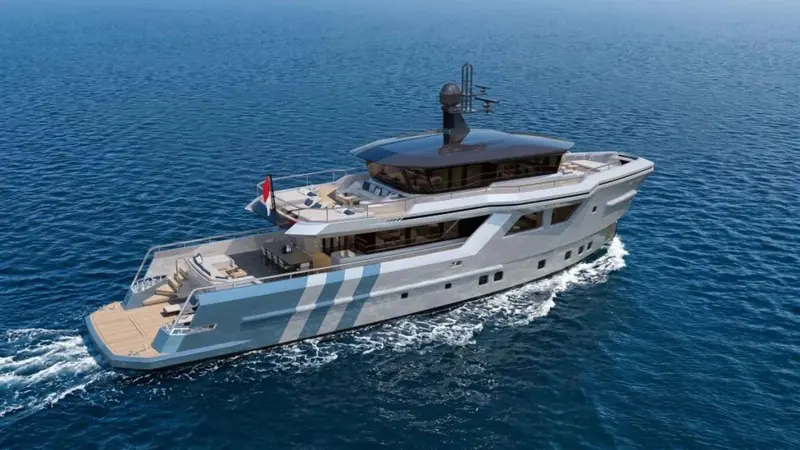
What is the XPD95, and who is building it?
The XPD95 is a new semi-custom model from Antonini Navi's Pertusola yard in La Spezia, a 33-metre steel-hulled, aluminium-superstructured pocket explorer whose first unit was announced sold on 4 September 2026 for delivery in 2028.
Antonini Navi built its name on full-custom expedition and long-range yachts, and the XPD95 is a deliberate step toward a repeatable, semi-custom product built on that expedition styling but sized for the Mediterranean rather than an ocean crossing: gross tonnage is designed to stay under 199, the threshold that keeps a yacht out of the heavier commercial-style flag and crewing rules that apply above it. That is a different project from Matilde 7, the 33.5-metre full-custom yacht Antonini delivered in July 2026 to open its unrelated Seamore 34 line - the two are close in length and from the same yard, but the XPD95 is a new, separate model aimed at being sold and built repeatedly rather than a one-off commission.
Exterior lines are drawn by Sculli & Covini, interiors by Milan-based Hot Lab, and construction supervision is credited to Camper & Nicholsons - the brokerage and yard-management house acting here in its project-oversight capacity rather than as the selling broker. Aldo Manna, the yard's co-founder and sales director, said the sale 'represents the result of long work and deep trust we've always placed in the project,' language that reads as much a comment on how long the design has been shopped as an announcement of the sale itself. Neither the buyer's identity nor a price has been published.
How does an 83-year-old repair yard end up building explorer yachts?
Antonini Navi began in 1943 as a metal-structure repair business in La Spezia, moved into industrial marine structures for oil platforms in the 1960s, acquired the Pertusola shipyard site in 1977, and did not build its first yacht until 2000 - a longer industrial history behind the brand than most buyers shopping a pocket explorer would assume.
Walter Antonini founded the company in 1943 repairing metal structures damaged in wartime bombing around La Spezia, work that built a reputation solid enough to make the yard a trusted contractor to ENI, the Italian energy group. By 1963 the business had expanded into fabricating marine structures and installations for offshore oil platforms, and in 1977 Walter Antonini bought the Pertusola shipyard site in the Gulf of La Spezia, the facility the XPD95 will be built at. Yacht construction did not begin until 2000, more than half a century after the company's founding, and the yard now says it can build full-custom yachts up to 70 metres alongside its long-running refit, after-sales and superyacht mooring services.
That history matters for a specific reason: a shipyard with decades of structural and industrial fabrication experience behind it is a different proposition from a yacht brand with no heavy-engineering background, even when - as with the XPD95 - the yacht itself is a new, unproven model. The engineering discipline is inherited; the yacht-specific design and finish record is not, since the semi-custom XPD95 line has no delivered hull yet to judge against.
What do the numbers say about how the space is used, and how does she compare with the pocket-explorer field?
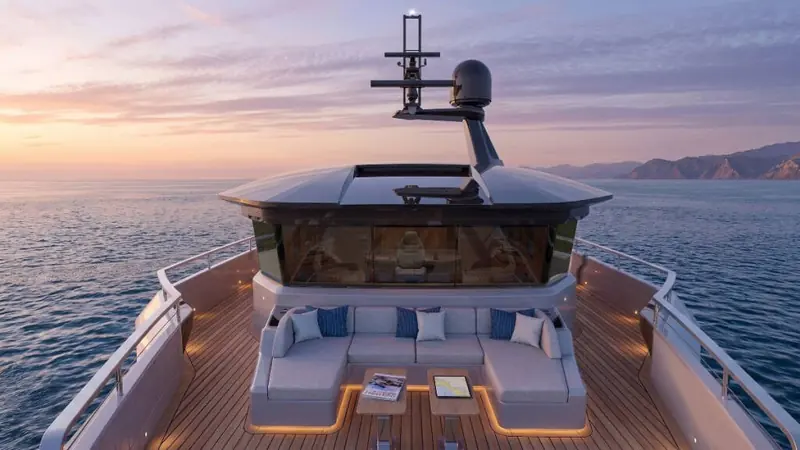
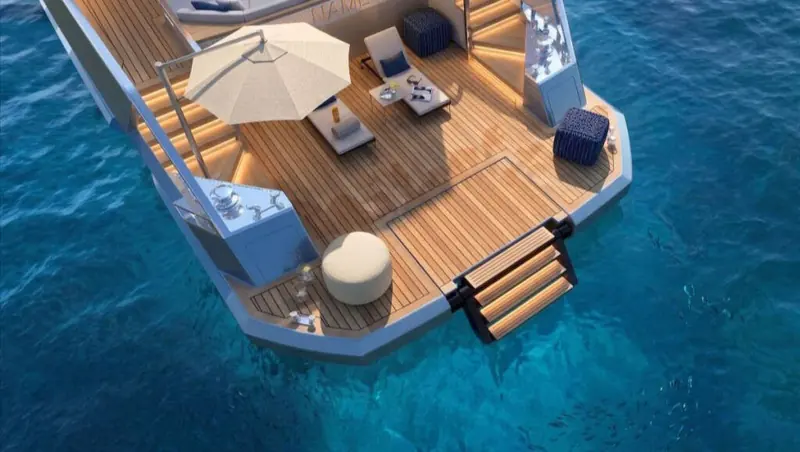
The XPD95's headline feature is deck space rather than raw length: a roughly 35 square-metre convertible beach area, a 60 square-metre owner's deck split between 25 square metres of interior and a 35 square-metre private terrace, and a 44 square-metre aft cockpit, entering a segment where established yards are moving upmarket rather than building smaller.
For a 33-metre yacht, those are unusually generous outdoor figures, and they are the clearest evidence of what 'pocket explorer' means in Antonini's own marketing: a low, flared profile borrowed from long-range expedition designs, built instead around living space at anchor rather than range at sea. A 33-square-metre foredeck living area adds a second outdoor zone forward of the wheelhouse, splitting guest space across the boat rather than concentrating it aft, the arrangement most 33-metre semi-custom yachts default to.
The XPD95 arrives as several established explorer builders are moving the other way. Rossinavi's Berserk 47 is a 47-metre explorer under construction in Viareggio, built for transatlantic range in the same steel-hull, aluminium-superstructure combination and asking around EUR 38,500,000 for 10 guests in 5 suites; Cantiere delle Marche launched Presence, a 40-metre Acciaio 130 full-displacement explorer, in 2026 with no price published. Both are larger than the XPD95, and both come from yards with a longer explorer-specific track record than Antonini's. Industry reporting on the 2026 order book describes established Italian yards reallocating capacity away from the 24-to-30-metre bracket toward larger semi-custom and custom tonnage, which makes a fresh 33-metre entrant a deliberate bet against that drift rather than a move with the market - and, absent a published XPD95 price, there is no way yet to say whether Antonini is undercutting the Berserk 47 or simply building a smaller boat at a similar cost per metre.
What is not yet public, and what should a buyer weigh before ordering hull two?
Buying into a semi-custom line's first hull two years before delivery means paying for a design and a yard's reputation rather than a built, surveyable boat, and the XPD95's own published material leaves the figures a second buyer would most want to check - price, engines, range, guest capacity - unstated.
No price has been published for the first XPD95, no engine make or horsepower has been disclosed, and no range or tankage figures have been released - unusual gaps even for a design this far from delivery, since a semi-custom model line is normally sold partly on exactly those numbers. What is known is the gross tonnage design ceiling of 199, the deck-space figures above, and a 2028 delivery date, which puts roughly two years between the first sale and any owner or independent surveyor actually setting foot aboard a built hull.
The honest comparison is with Antonini's own Matilde 7, delivered the same summer as a full-custom, one-off yacht with published sea trial acoustics - a very different kind of transparency from a semi-custom model sold on renderings alone. A buyer weighing the XPD95 against a delivered, surveyable resale of similar size, or against the larger Berserk 47 and Cantiere delle Marche explorers already in the water, is buying design intent and an 83-year-old yard's reputation now against the possibility of engine, range and pricing figures changing before 2028; that is a normal trade on a first hull of a new line, but it is a trade, not a free option, and it is worth asking the yard directly for whatever engine and range numbers it is currently designing to before signing. A written schedule for design freeze, keel-laying and sea trials, with penalties for slippage on any of the three, is the minimum a buyer commissioning a sister hull should expect before paying a deposit against a 2028 date that is currently backed by nothing more than the yard's word.
What is good, and what to watch
Strong points
- Unusually generous outdoor living space for 33 metresroughly 35 sq m beach area, 60 sq m owner's deck and a 44 sq m cockpit, figures normally seen on longer hulls
- Sub-199 GT by designkeeps the yacht out of the heavier crewing and flag rules that apply above that threshold
- An industrial engineering pedigree behind a new yacht brand83 years of structural and marine fabrication work, including offshore oil-platform installations, precede the yard's yacht-building arm
What to watch
- No engine, range or tankage figures publishedunusual even for a design this early, and central to what a long-range-styled yacht is actually capable of
- No price discloseda buyer cannot yet benchmark the first hull's cost against a comparable semi-custom explorer
- A smaller entrant into a segment moving the other wayestablished explorer yards are reallocating capacity toward larger tonnage, and rivals like the Berserk 47 and Cantiere delle Marche's 40m are both bigger with longer track records
Practical detail
| Length | 33 metres |
|---|---|
| Gross tonnage | Designed to stay under 199 GT |
| Construction | Steel hull, aluminium superstructure |
| Builder | Antonini Navi, Pertusola yard, La Spezia (founded 1943, acquired the Pertusola site 1977, building yachts since 2000) |
| Exterior design | Sculli & Covini |
| Interior design | Hot Lab (Milan) |
| Construction supervision | Camper & Nicholsons |
| Beach area | Approximately 35 sq m, convertible into a seaside terrace |
| Owner's deck | Approximately 60 sq m total: 25 sq m interior plus a 35 sq m private terrace |
| Aft cockpit | 44 sq m |
| Foredeck living area | 33 sq m |
| Comparable explorers | Rossinavi Berserk 47, 47m, under construction, asking approx EUR 38,500,000 for 10 guests/5 suites; Cantiere delle Marche's Presence, a 40m Acciaio 130 explorer launched 2026, price undisclosed - both larger, both from yards with longer explorer track records |
| Delivery | 2028 |
| Not published | Price, engine make and horsepower, range, tankage, and guest cabin configuration |
Questions this story answers
What happened?
Antonini Navi has sold the first hull of its new XPD95 before a keel has been reported laid, a 33-metre steel-and-aluminium pocket explorer designed to fit expedition proportions into a Mediterranean-sized yacht. Delivery is not due until 2028, which makes her a case study in what a buyer is actually purchasing when a semi-custom model line sells before anyone can see, let alone survey, the boat.
What is good about it?
Unusually generous outdoor living space for 33 metres. roughly 35 sq m beach area, 60 sq m owner's deck and a 44 sq m cockpit, figures normally seen on longer hulls
What should an owner or buyer watch?
No engine, range or tankage figures published. unusual even for a design this early, and central to what a long-range-styled yacht is actually capable of
Who reported this?
Citta della Spezia, Economia del Mare, Blue Economy.
We do this for everyone who loves this world. The people who have spent their lives in it, and the people just discovering it. Yotters exists so that what we learn belongs to all of them.
Nobody pays us for this. No ads, no sponsors, nothing for sale. We just believe the world is a little better when knowledge is shared instead of kept.
If it gave you something today, tell us to keep going. Follow us, leave a like, or write a positive comment. We read every one, and they are what keeps us going.