100
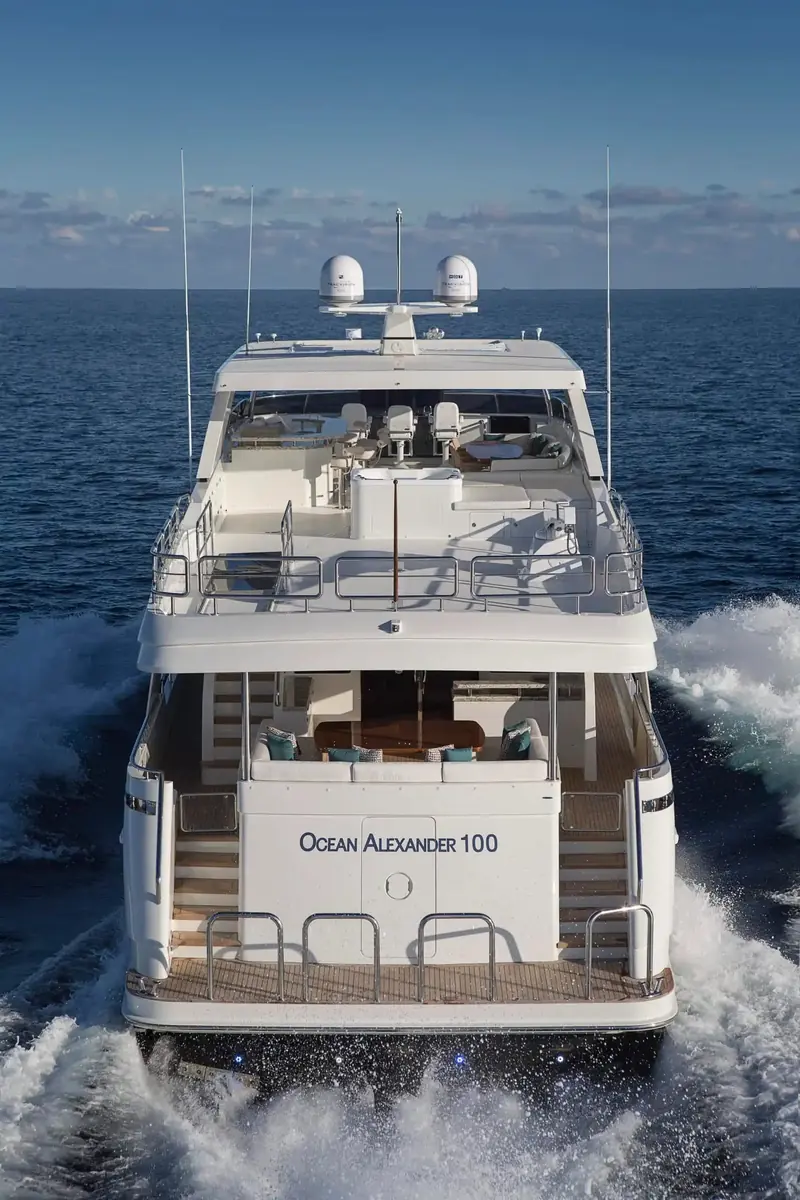
| LOA | 100'2" / 30.53m (Gen 1-2); 100'9" / 30.7m (Gen 3) |
|---|---|
| Beam | 23'0" / 7.01m |
| Draft | approx 5'6"-6'5" / 1.68-1.96m depending on load and generation |
| Displacement | approx 229,900 lb / 104,280 kg |
| Fuel | 4,000 US gal / 15,141 L; Water: 650 US gal / 2,461 L |
| Engines | twin CAT C32 ACERT (approx 1,900-1,925hp) or twin MTU 12V2000-family (approx 1,920-2,400hp) |
| Builder | Ocean Alexander, Kaohsiung, Taiwan |
| Production | 2015-2020 (three generations) |
The natural step up from the 90
Evan K. Marshall designed both the exterior and interior of the 100, and Power & Motoryacht's Andrew Parkinson, reviewing the boat for the magazine's May 2015 issue, reported that hull number one had been sold to owners transitioning out of a Ferretti 88, with a second, skylounge-configured hull already planned. The 100 was pitched explicitly as the next logical size up from the Ocean Alexander 90, a boat the yard had already proven, rather than as a clean-sheet design, which let Ocean Alexander scale up a known formula instead of gambling on an unproven one at flagship size.
The model then stayed in production for six years, unusually long for a series at this size, running across three generations that YachtBuyer's own model-tracking pages date to 2015, 2016 to 2018, and 2018 to 2020, before the line was discontinued. A run that long for a semi-custom 100 footer says something about sustained demand rather than a single strong launch year, and it is also why enough hulls now exist across enough age brackets to support an active, generation-differentiated secondhand market.
Three generations, two engine choices
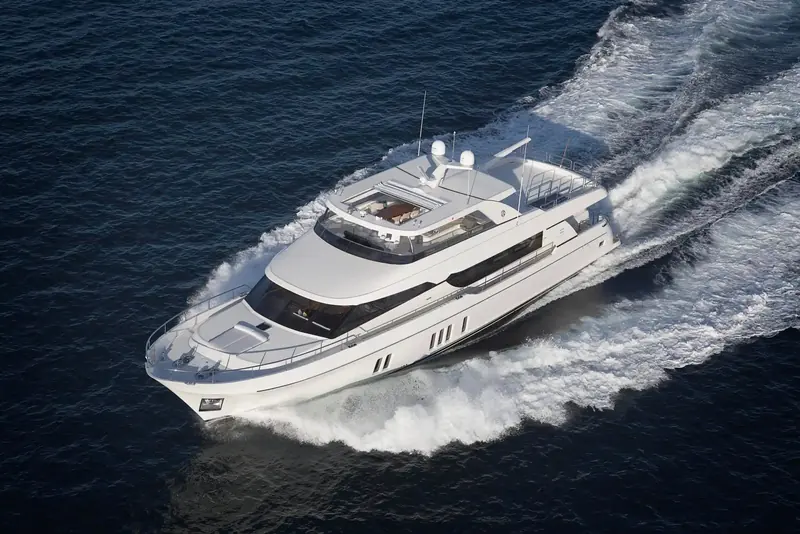
Power & Motoryacht's 2015 test of the first-generation boat listed twin 1,925hp Caterpillar C32 ACERTs as standard, with twin 2,400hp MTU 16V-2000 engines as the performance option, running through ZF 3055 gearboxes and 50x46.5 inch Nibral four-blade propellers. Yachting Magazine's own sea trial, with Captain Wegner at the helm, recorded the same generation's Caterpillars at 1,950hp rather than 1,925, a small discrepancy between two otherwise closely matched independent tests that most likely reflects rounding or a slightly different engine rating point rather than a real production change.
By the third generation, built 2018 to 2020, YachtBuyer's own generation-by-generation spec pages record the engine choice as twin MTU 12V 2000 M96L units at 1,920hp each, or twin Caterpillar C32 ACERT E03 units at 1,900hp each, both slightly detuned from the original launch figures. In practice both engine families delivered a similar performance envelope across all three generations: a top speed in the low-to-mid twenty knot range and genuine long-range displacement cruising in the low teens, which is the more important number for the kind of owner this boat is built for.
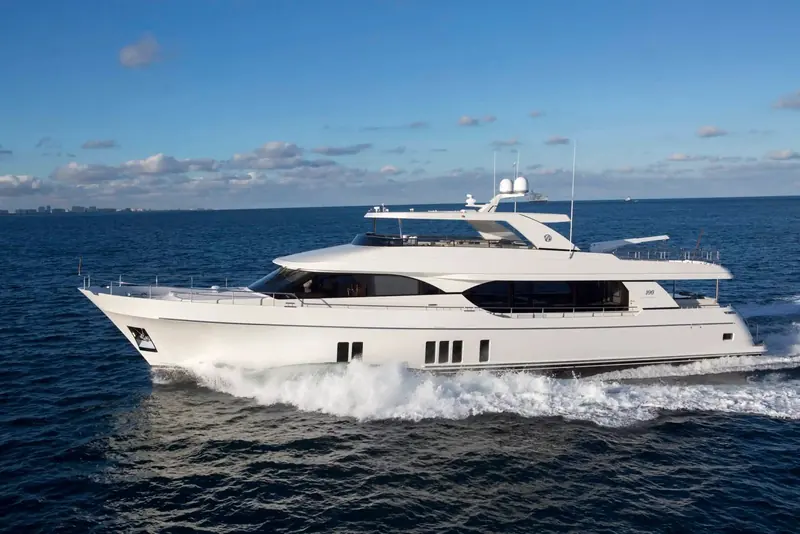
A six-year production run and three distinct generations turned the Ocean Alexander 100 into an owner-operable entry point to superyacht-scale cruising, not a one-off flagship.
A hull built for two speeds
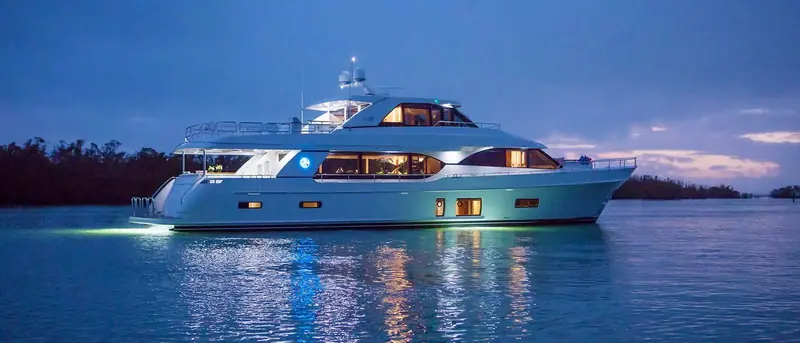
Power & Motoryacht ran its 2015 test in 4 to 6 foot seas with 17 to 26 knot winds and still recorded 23.8 knots at wide-open throttle (2,300rpm, 204 gallons per hour), describing the ride as smooth enough to call a joyride despite the conditions. Yachting Magazine's separate sea trial, in a comparable 3 to 5 foot sea state and 25 knot wind, had Captain Wegner push the same 229,000lb hull to just over 23 knots while staying dry on deck thanks to the bow flare, with the stabilisers eliminating roll entirely. Both reviews independently credit Side-Power fin stabilisers and a 55hp bow thruster paired with a 40hp stern thruster for the boat's reported close-quarters precision.
BoatTest's own review of the same generation is more cautious about its own conclusions: it praises the boat's dock manners and calm-water stability but states plainly that its own sea trial happened in calm conditions only, so it could not itself validate rough-water handling. Reading the three reviews together rather than any one alone is what actually answers the question: two independent tests in genuinely rough water back the semi-displacement hull's reputation, and the third, more cautious review does not contradict that, it simply never tested it.
Full-beam living for ten guests
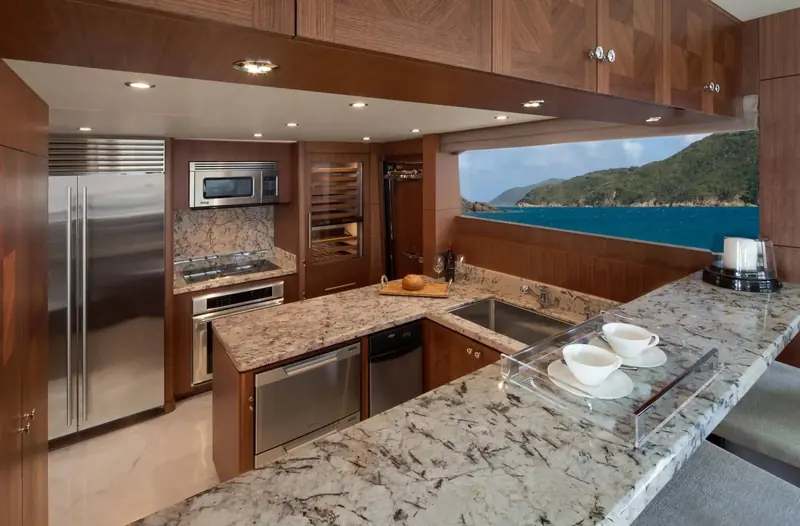
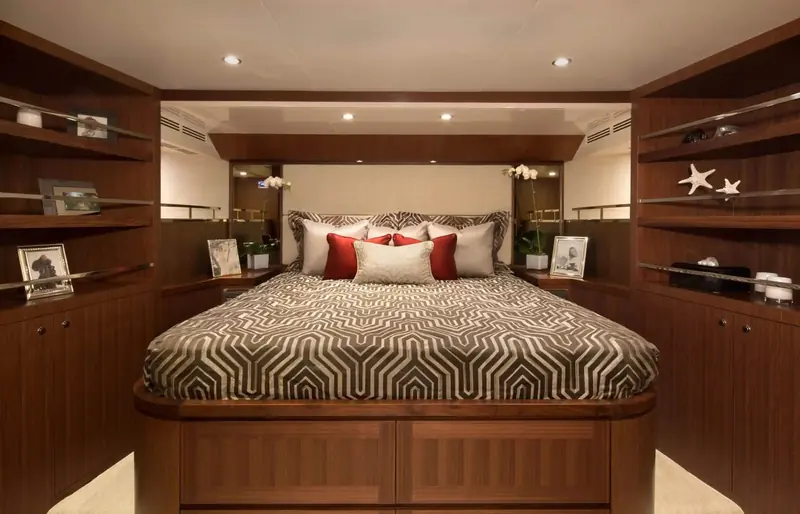
The full-beam master stateroom runs the boat's entire 23 foot beam and carries dual heads and walk-in closets, with a forward VIP stateroom and two further convertible twin-to-queen guest cabins completing the standard four-cabin layout; a five-stateroom version was also offered. The galley, which Power & Motoryacht singled out for its Sub-Zero refrigeration, Thermador cooktop and Viking and Fisher & Paykel appliances, opens onto the saloon through a wide pass-through, and the formal dining area seats eight, all lit by the unusually large side windows Marshall's design gives the main deck.
Crew are quartered aft and separately from guest areas, with a captain's cabin holding its own head and two further crew cabins sharing one, plus a dedicated crew galley and mess, a layout built around running the boat with a professional crew of four to five rather than as an owner-only boat. Depending on generation, buyers chose between an open flying bridge, with a bar, grill and dining for eight, or an enclosed skylounge that swaps the lower helm for a custom desk and bar. BoatTest also notes the boat was delivered as a genuinely turnkey package, fuel and water tanks full, china, flatware and galley cookware aboard, and a 15 foot tender already chocked and ready, rather than a bare hull the owner then had to fit out.
Who buys a 100, and what the used market shows
With production ended in 2020, every 100 on the market today is a resale, and the spread is wide enough to track by generation: brokerage listings put second-generation hulls (2016 to 2018) around 6 to 6.2 million dollars, third-generation hulls (2018 to 2020) between roughly 7 and 8.2 million dollars, and a well-equipped late skylounge example, listed as Lanikai, at 9.8 million dollars. A specific 2016 hull based in Fort Lauderdale was listed at 6.45 million dollars, consistent with the generation-two range. SI Yachts, a brokerage that has sold the model, describes it as an ideal entry-level superyacht that remains popular on both the used and charter markets, which is broker commentary rather than an independent audit but matches the spread of listings actually on the water.
That combination, owner-operable scale, a proven semi-displacement hull, and a six-year production run long enough to leave a genuine choice of generation and price point, suits a buyer moving up from a smaller flybridge boat who wants crewed-yacht space without committing to a full-time professional crew or a from-scratch custom build. The one honest caveat for that buyer is that the line was discontinued after 2020: Ocean Alexander's current parts and support network is built around the Explorer, Legend, Revolution and Puro yachts that replaced it, so a buyer should confirm engine and generation-specific systems support directly with the yard or a dealer before committing, rather than assume it will match a boat still in production.
المحركات والأنظمة
| Engines (Gen 1, 2015) | Standard twin Caterpillar C32 ACERT diesels, 1,925hp each per Power & Motoryacht (a separate Yachting Magazine test of the same generation recorded 1,950hp); optional twin MTU 16V-2000 diesels at 2,400hp each. |
|---|---|
| Engines (Gen 3, 2018-2020) | Twin MTU 12V 2000 M96L diesels at 1,920hp each, or twin Caterpillar C32 ACERT E03 diesels at 1,900hp each, per YachtBuyer's generation-specific spec pages. |
| Gearboxes | ZF 3055, 2.952:1 reduction, turning 50 x 46.5 inch Nibral four-blade propellers (Gen 1 test configuration). |
| Generators | Twin 53kW Kohler generators, confirmed independently by both Power & Motoryacht and BoatTest. |
| Stabilisers and thrusters | Side-Power fin stabilisers; 55hp bow thruster and 40hp stern thruster, per Power & Motoryacht's tested first-generation hull. |
| Watermaker | Not disclosed in any source found for this model - omitted rather than guessed. |
| Tankage | 4,000 US gallons fuel / 15,141 litres; 650 US gallons water / 2,461 litres, consistent across both the Power & Motoryacht and BoatTest spec sheets. |
ما يذكره الملاك والأطقم
Confident in a genuine sea state, not just on the showroom dock
Testing the first-generation 100 in 4 to 6 foot seas and 17 to 26 knot winds, reviewer Andrew Parkinson still logged 23.8 knots at wide-open throttle and called the ride a joyride despite the conditions, crediting the semi-displacement hull's vinylester-resin lamination and high-density foam coring.
Andrew Parkinson, Power & Motoryacht (May 2015 boat test)Stabilisers and bow flare kept the deck dry and level in a real chop
Running the same generation in 3 to 5 foot seas with Captain Wegner at the helm, the reviewer reported the boat stayed dry thanks to its bow flare while the Side-Power fin stabilisers eliminated rolling entirely, at a recorded 58 decibels in the master stateroom underway.
Tom Serio, Yachting Magazine (sea trial with Captain Wegner)
معلومات عملية
| Typical asking price today | No longer sold new; resale listings run from about USD 6.0-6.2 million for an early second-generation (2016-2018) hull to USD 7.0-8.2 million for a third-generation (2018-2020) hull, with a well-equipped late skylounge example (Lanikai) listed at USD 9.8 million. A 2016 Fort Lauderdale-based hull was listed at USD 6.45 million. |
|---|---|
| Crew required | Four to five, per the standard crew-quarters layout: a captain's cabin with its own head, plus two further crew cabins sharing one head and a separate crew galley. |
| Configuration choice | Open flying bridge (bar, grill, dining for eight) or enclosed skylounge (custom desk and bar in place of a lower helm), plus a four- or five-stateroom guest layout. |
| Running costs | Wide-open throttle burns about 204 gallons per hour for 23.8 knots; recommended 80 percent cruise burns roughly 170 gallons per hour for just under 20 knots, per Power & Motoryacht's tested figures, with fuel and water tankage of 4,000 and 650 US gallons respectively. |
| Factory support status | Discontinued after the third generation ended production in 2020; not part of Ocean Alexander's current Explorer, Legend, Revolution or Puro lineup, so a buyer should confirm parts and systems support with the yard or a dealer rather than assume continuity. |
| What is not published | Ocean Alexander has never disclosed an original new-build price for the 100, and no source found in this research states a confirmed total hull count for the model. |
Design
| Exterior design | Evan K. Marshall |
|---|---|
| Interior design | Evan K. Marshall |
| العمارة البحرية | Ed Monk Jr. lineage, refined in-house by Ocean Alexander on later generations |
| Builder | Ocean Alexander, Kaohsiung, Taiwan |
لمين هو: An owner-operator moving up from a smaller flybridge boat who wants full-beam, superyacht-scale living and a proven semi-displacement hull, without committing to a full-time professional crew or a from-scratch custom build.