Azimut's 26m Seadeck 9 flagship heads to Cannes, hybrid-ready
A flagship built around the aft deck
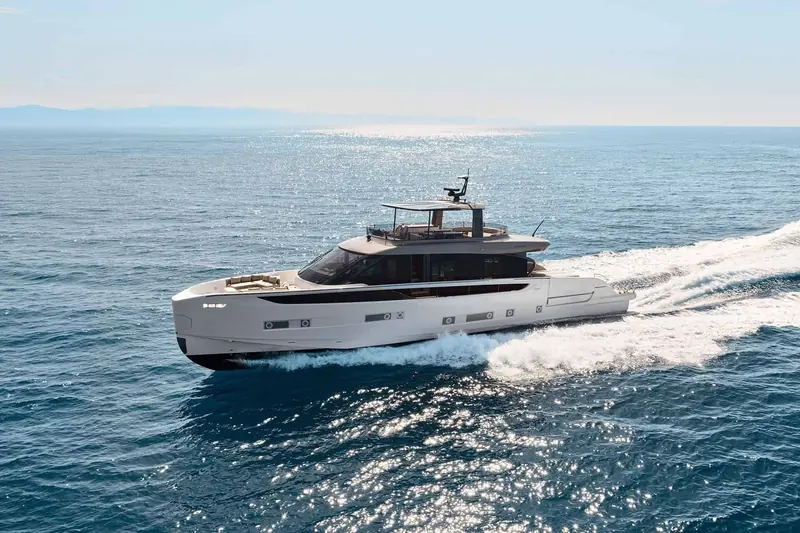
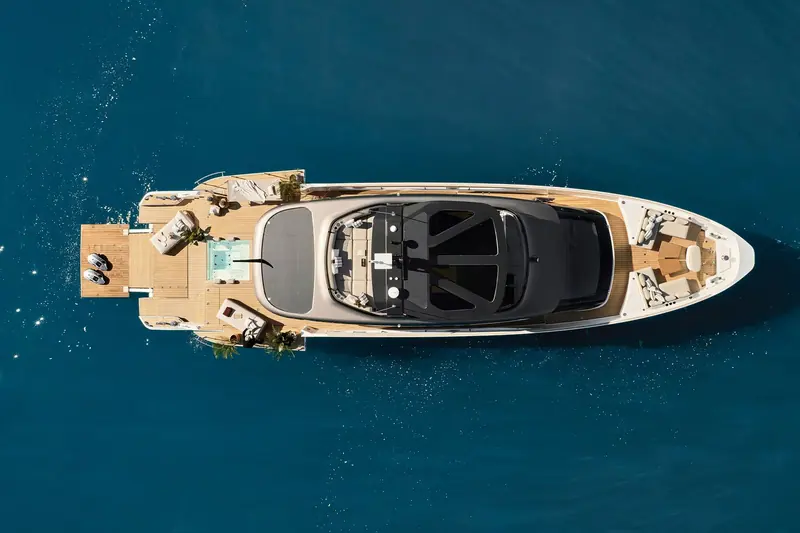
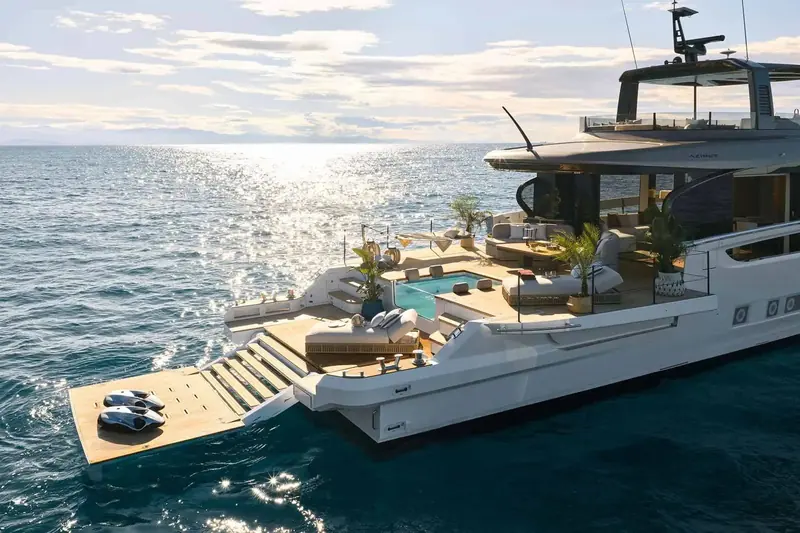
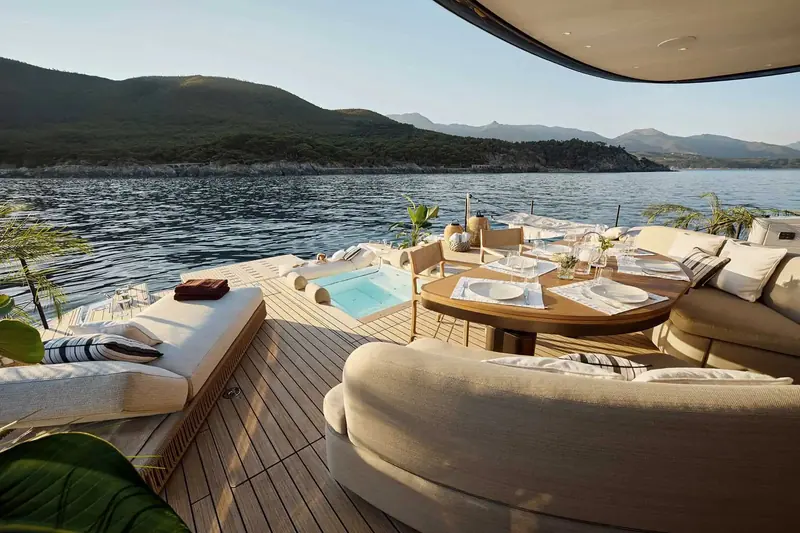
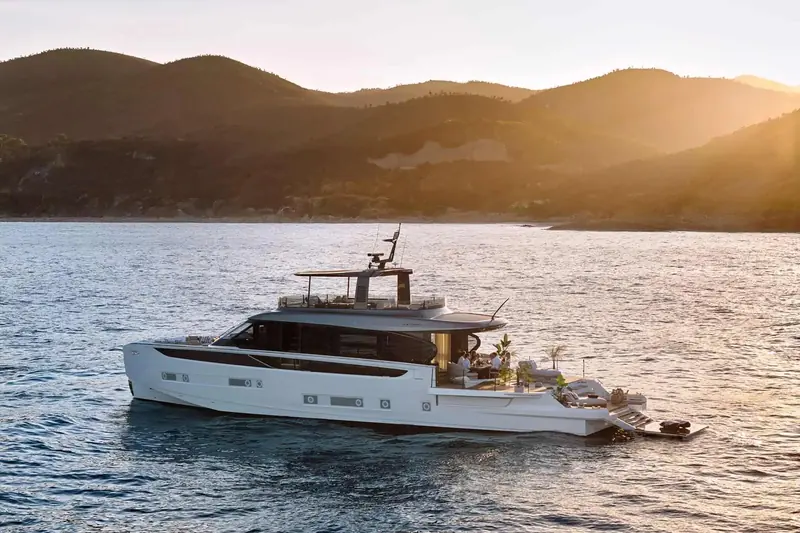
The Seadeck line is Azimut's answer to owners who spend more time on the water than under way, and the new 26-metre Seadeck 9 is its flagship. The whole aft end is given over to a stepped pool deck that drops in terraces toward the sea, with fold-down side terraces that widen the boat at anchor. Alberto Mancini drew the exterior, and the first hull came out of Azimut's Avigliana plant ahead of its public debut.
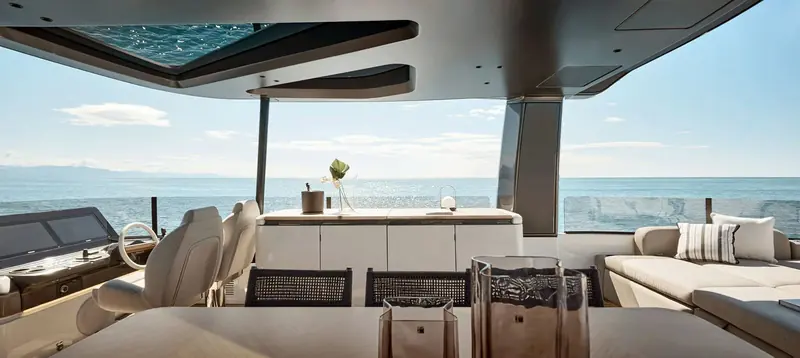
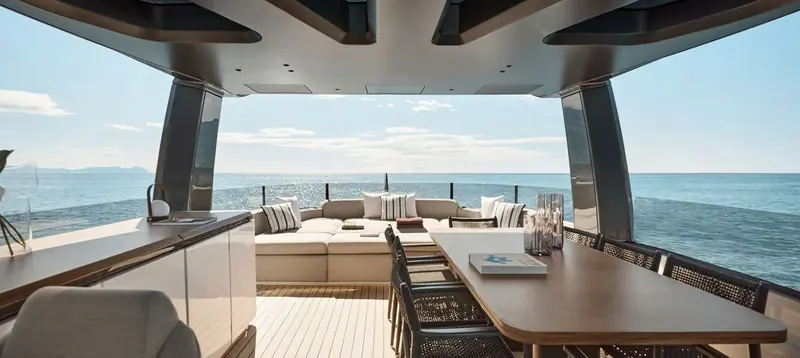
Inside, Matteo Thun and Antonio Rodriguez kept the look light and low, with long horizontal glazing that pulls the water into the saloon. The point of the boat is the transition from inside to outside rather than any single grand room, which is a design brief owners in this size have been asking builders to take seriously for years.
Wired for hybrid, priced as a production boat
The Seadeck 9 sits on a hull developed with the studio Names and is built to take Volvo Penta's IPS hybrid system, so an owner can run in and out of harbour and lie at anchor on battery before the diesels come on. That matters less for fuel saved on a single passage than for where a 26-metre boat can go as ports tighten their rules on emissions and noise at the quay.
None of this is one-off engineering. It is a series boat, sold from a price list, which is the difference between the Seadeck 9 and a semi-custom yacht that reads the same on deck. A buyer gets the outdoor plan and the hybrid option without commissioning a hull, and can see the result at Cannes rather than on a render.
Why the volume flagship is the one to watch
Most owners do not buy a 60-metre yacht. They buy in the low-to-mid twenties, and that is the band where builders fight hardest on design and resale. Putting its newest deck thinking and a hybrid platform at the top of a volume range, rather than reserving them for a bigger custom line, is Azimut defending the part of the market that actually turns over.
For a buyer weighing a new build against a recent used boat, the question the Seadeck 9 poses is whether a hybrid-ready platform holds its value better than a conventional one over the next few years. The Cannes Yachting Festival in September is where that gets tested against the crowd, and where the order book for the model will start to show.
Does hybrid-ready change how the Seadeck 9 drives, or just how it sits at anchor?
The hybrid part is a battery for house power, not a new propulsion mode; the diesels still do all the pushing.
The word hybrid on this boat describes a battery, not a new way to drive it. The Seadeck 9 keeps Azimut's usual triple Volvo Penta IPS pod drive layout: three IPS1200 units at 900 hp each as standard, or three IPS1350 units at 1,000 hp each as an option, giving a top speed sources put anywhere from 27 to 30 knots depending on engine choice and a 24 knot cruise. What Azimut brands hybrid-ready is a separate 60 kWh lithium battery pack feeding what it calls Hotel Mode, stored power to run the yacht's systems with both generators switched off, rated at up to four hours during the day or eight hours overnight at anchor. The diesels do not get a battery-assisted cruising mode.
That distinction matters because it is easy to read hybrid-ready as electric cruising and it is not that. The gain is silence and cleaner air at anchor, not a battery-electric low speed mode underway. Azimut's own efficiency case rests less on the battery than on weight: about 40 percent of the structure is built in carbon fiber, paired with a planing hull tuned to get onto the plane earlier than a comparable GRP boat, which is where most of the claimed fuel saving, up to 30 percent against a similarly sized conventional yacht over an average year, actually comes from. Fuel capacity is 5,800 litres, fresh water 1,500 litres, and the hull carries CE Class A certification for open water use.
How does the Seadeck 9 compare with the smaller Seadeck 6 and 7?
It is the third and largest hull in a range built around the same sustainability pitch, launched with a named quote from Azimut's own chair rather than anonymous copy.
Seadeck 9 is the third and largest hull in a range Azimut built specifically around this sustainability pitch, and the sizes below it explain why the 9 reads as a flagship rather than a one-off. The Seadeck 6 is a 17.25 metre hardtop coupe with triple IPS pod drives, a 33 knot top speed and a 315 nautical mile range. The Seadeck 7 is a 21.7 metre sportsfly launched at Cannes in 2025, carrying the same IPS1200 propulsion and four guest cabins. The 9 keeps that sportsfly layout but adds a full 180 degree pool deck at the stern, a transformer swim platform of roughly 7 square metres, and four to five guest cabins including a full beam owner's suite. Hull one was built at Azimut's Avigliana plant, the yard's largest yacht to date from that facility, and hit the water in February 2026 ahead of the Cannes debut.
Azimut put a name behind the launch rather than leaving it to house copy. Giovanna Vitelli, chair of the Azimut Benetti Group, called Seadeck 9 the product of 50 years spent making the unthinkable possible, 50 years of challenges overcome, and framed the open stern directly, saying that if you cannot contain the sea, you become part of it. Interior designers Matteo Thun and Antonio Rodriguez, working alongside exterior designer Alberto Mancini, pushed the sustainability angle into the materials list rather than just the spec sheet, specifying recycled and recyclable finishes through the interior, down to a saloon carpet woven from recovered fishing net yarn. Azimut has not disclosed a price for the Seadeck 9, and with hull one only just launched there is no independent sea trial or owner feedback yet to check the fuel saving claims against.
What is good, and what to watch
Strong points
- Purpose-built planing hull, not a stretched platformDeveloped with the Names studio specifically to reach planing speed earlier and improve efficiency across a wider speed range, with roughly 40 percent of the structure in carbon fibre to control weight at this length.
- Real anchor points on price for a production boatAs a series model sold from a price list, two independently sourced dealer prices (EUR 6.4m and EUR 7.8m) give buyers a transparent starting point a semi-custom or full-custom yacht of similar size would not.
- A documented, genuine at-anchor benefitThe 60kWh pack's hotel mode gives up to 8 hours of silent, generator-off overnight running powering stabilisers and air conditioning - a disclosed capability, not a marketing claim without substance.
- The 60 kWh Hotel Mode battery is a specified system, not a vague marketing labelIt carries its own kWh figure and its own runtime at anchor.
- Roughly 40 percent carbon fiber construction is unusually high for a production flagship this sizeIt is doing more for the stated fuel saving than the battery is.
What to watch
- Hybrid-ready is not the same as hybrid propulsion includedBoat International and Pressmare both confirm the standard boat ships with conventional diesel IPS propulsion; the hybrid-electric system is an upgrade path it is engineered to accept, not standard equipment.
- No stated electric-only cruising rangeEven where the hybrid option is fitted, the disclosed battery use is hotel and anchor loads, not a cruising range or speed - unlike the smaller Seadeck 7, which has a reported roughly 11-knot electric-only mode, no equivalent figure has been published for the 9.
- Less structural flexibility than a semi-custom yachtAs a production model, buyers get an extensive option list but less layout and structural flexibility than a semi-custom yacht in the same size bracket.
- No independent sea trial exists yetAhead of the Cannes debut, cruising speed, real-world fuel burn and any hybrid performance figures are currently yard-sourced only.
- Hybrid-ready describes silent hotel power at anchor, not electric propulsion underwayBuyers expecting a battery-electric cruising mode will not get one.
- No price has been disclosed and hull one only launched in February 2026So the 30 percent fuel saving claim has no independent sea trial behind it yet.
Practical detail
| Starting price | Two independent Azimut dealer listings show EUR 6,400,000 ex-VAT for a base configuration and EUR 7,811,500 ex-VAT for a specified build with options such as the Volvo Penta IPS 1350 upgrade, Seakeeper stabiliser, teak decking and Garmin electronics. Azimut's own model page and press materials do not publish a price. |
|---|---|
| Hybrid option cost | Not disclosed. Hybrid-ready means the standard boat ships with conventional Volvo Penta IPS diesel propulsion pre-engineered to accept the Volvo Penta hybrid-electric system as an upgrade, confirmed independently by Pressmare and Boat International, but no source publishes what that upgrade costs. |
| Running costs | No figure specific to Seadeck 9 is published. As a rough guide, brokers put annual running cost at 10-15% of purchase price, which on the EUR 6.4-7.8m base price range implies costs in the low-to-mid hundreds of thousands of euros a year - an estimate, not a disclosed figure. |
| Battery use at anchor | A 60kWh pack is documented specifically for hotel mode: powering stabilisers, air conditioning, outlets and entertainment silently at anchor for up to 4 hours by day or 8 hours overnight. This is not a stated electric-only cruising range. |
| What is not published | The definitive retail starting price on Azimut's own site, the cost of the hybrid propulsion upgrade, any independent sea-trial or fuel-burn figures ahead of the Cannes debut, and whether the hybrid system, once fitted, gives any electric-only propulsion range at all. |
| Hybrid battery | 60 kWh lithium pack for generator-free Hotel Mode, not for propulsion |
| Hotel Mode endurance | Up to 4 hours by day or 8 hours overnight at anchor with generators off |
| Seadeck range siblings | Seadeck 6 (17.25m hardtop coupe, 33kn top speed, 315nm range) and Seadeck 7 (21.7m sportsfly, IPS1200 propulsion) |
| Design team | Exterior by Alberto Mancini, interiors by Matteo Thun and Antonio Rodriguez |
| Build site | Azimut's Avigliana, Italy plant, the largest hull the yard has built there to date |
Questions this story answers
What happened?
Azimut has launched the first Seadeck 9, the 26-metre flagship of the range it built around open-air living, and will show it at the Cannes Yachting Festival in September. Alberto Mancini drew the exterior and Matteo Thun with Antonio Rodriguez the interior, over a hull developed with Names and wired for Volvo Penta's IPS hybrid drive. For a buyer in the mid-twenties-metre class, it is a production boat that arrives with a semi-custom deck plan and the emissions question already handled.
What is good about it?
Purpose-built planing hull, not a stretched platform. Developed with the Names studio specifically to reach planing speed earlier and improve efficiency across a wider speed range, with roughly 40 percent of the structure in carbon fibre to control weight at this length.
What should an owner or buyer watch?
Hybrid-ready is not the same as hybrid propulsion included. Boat International and Pressmare both confirm the standard boat ships with conventional diesel IPS propulsion; the hybrid-electric system is an upgrade path it is engineered to accept, not standard equipment.
Who reported this?
BOAT International, SuperYacht Times, Motor Boat & Yachting, Pressmare, Boat International, Yachting Magazine, Press-Mare, Wallpaper.
We do this for everyone who loves this world. The people who have spent their lives in it, and the people just discovering it. Yotters exists so that what we learn belongs to all of them.
Nobody pays us for this. No ads, no sponsors, nothing for sale. We just believe the world is a little better when knowledge is shared instead of kept.
If it gave you something today, tell us to keep going. Follow us, leave a like, or write a positive comment. We read every one, and they are what keeps us going.