Brabus adds a second yard: a 1,450hp Sunreef foiler at 40 knots
What Brabus and Sunreef actually put on the table
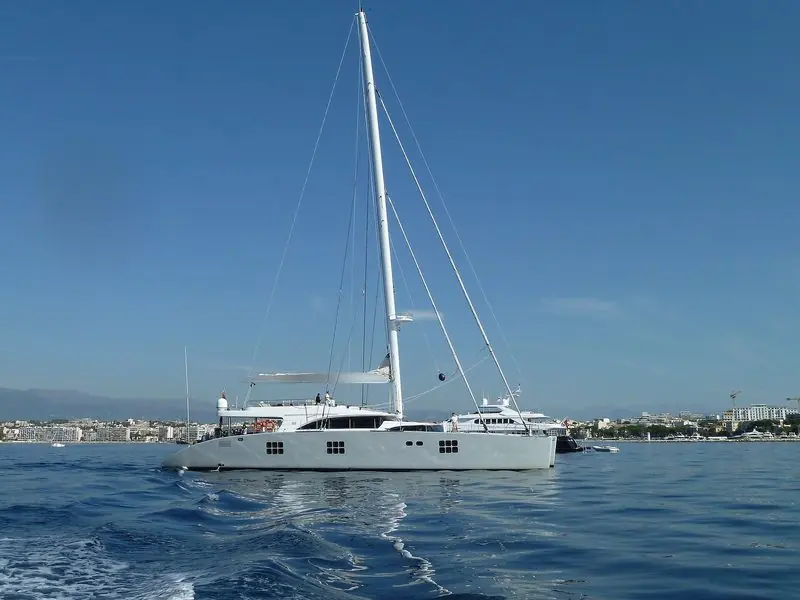
The BRABUS ULTIMA 55 was announced on 28 July. She is 17 metres overall and 5.6 metres in the beam, built in composite with carbon fibre through the structure and the deck furniture. Power is twin six-cylinder units at 533 kW, or 725 hp, each, which is 1,450 hp in a hull this size. Sunreef gives the top speed as exceeding 40 knots. The naval architecture is Sunreef's and the design work is Brabus.
Accommodation is up to six guests across two layouts, and the CE plate reads category B for 12 people and category C for 20. Fuel is 1,500 litres and fresh water 330 litres, which fixes the working radius of the boat far more firmly than the speed figure does. Inside there is Brabus Masterpiece leather, Alcantara, exposed carbon, a widescreen navigation station and a full galley. On deck the yard lists folding terraces, transformer sunpads, a wet bar and a bow sunpad. It is a day boat with beds, which is the honest description.
The foils are the whole claim
The hydrofoil system under the hulls is what separates this from a fast cruising catamaran. Francis Lapp, who founded Sunreef and runs it, puts the case plainly: once the boat rises onto the foils the ride is smoother, quieter and more comfortable. That is the standard argument for foils and it holds up in a chop, where a conventional planing cat starts slamming and the crew backs off. A 17-metre catamaran doing 40 knots is only worth the money if it can still do 40 knots when the sea gets up.
What has not been published is the figure that would settle it, which is the speed at which the foils lift the boat and what she does in the transition. Neither Sunreef nor Brabus has released a cruising speed, a range at cruise or a sea state limit. Those are the numbers a buyer needs before deciding whether the foils are engineering or trim. Ask for them on a demonstration run, in a real swell, with fuel aboard.
The badge is now on two yards at once
Brabus announced a yacht programme with AB Yachts on 7 July, with the first hull due at the Monaco Yacht Show in September. Three weeks later the badge is on a Sunreef catamaran. The two sit in different parts of the market: AB builds composite waterjet monohulls from 24 to 40 metres, and this is a 17-metre foiling cat. Read together, they say Brabus is assembling a marine portfolio rather than backing a single builder.
There is a ladder underneath already. Brabus Marine has built the Shadow range with the Finnish yard Axopar for years, from 37 feet up to a 45-foot Shadow 1500. The marque therefore now sits on hulls from three different builders. A badge carried across several yards is a styling and equipment package rather than a statement about who built the boat or who stands behind the warranty, so establish which company holds the build contract before signing.
Announced in 2024, launched in 2026
The Sunreef and Brabus partnership was announced on 8 October 2024. That release named the ULTIMA 55 as the first model and said it would launch in 2025. It arrived in July 2026, roughly a year after the date originally given. Slippage of that order is common here and it is not a scandal, but it is on the record and worth remembering when a first-hull delivery slot comes up.
Constantin Buschmann, who owns and runs Brabus, framed the 2024 agreement as an expansion of the portfolio into high-end catamarans. Lapp described it at the time as a route to a new level of bespoke work on his boats. Both statements have now been backed by a finished product, which is more than several announced marine tie-ups managed. The thing to watch is whether the models that follow arrive on schedule or slip the same way.
What the release does not say
No price has been published for the Brabus edition, and no delivery timetable. Figures circulating in listings for an ULTIMA 55 refer to the standard Sunreef boat, so treat any number quoted this week with caution. Sunreef's ULTIMA range runs 44, 55, 66, 77 and 88, and the 55 sits low in that spread, which is the tell that this is a tender or a second boat rather than a primary yacht.
The buyer for it is an owner who already has a mothership and wants something fast and recognisable on the same mooring. Priced as a toy it competes with a large custom tender or a performance monohull of similar length, and on that basis the leather and carbon do a lot of the work. What should decide it is the foil data and the paperwork. Ask for the cruising speed and the range at cruise, and get the name of the company holding the build contract, before any deposit goes down.
Questions this story answers
What happened?
Brabus and Sunreef unveiled the ULTIMA 55 on 28 July, a 17-metre catamaran on hydrofoils with 1,450hp and a quoted top speed above 40 knots. It is the second Brabus yacht programme to surface in three weeks, after the AB Yachts deal announced on 7 July. For anyone thinking of putting the badge alongside the mothership, that is the fact worth pricing: the marque now sits on hulls at two yards, and neither arrangement is exclusive.
Who reported this?
BRABUS, Sunreef Yachts, Robb Report, YachtBuyer.
We do this for everyone who loves this world. The people who have spent their lives in it, and the people just discovering it. Yotters exists so that what we learn belongs to all of them.
Nobody pays us for this. No ads, no sponsors, nothing for sale. We just believe the world is a little better when knowledge is shared instead of kept.
If it gave you something today, tell us to keep going. Follow us, leave a like, or write a positive comment. We read every one, and they are what keeps us going.