Amels 180
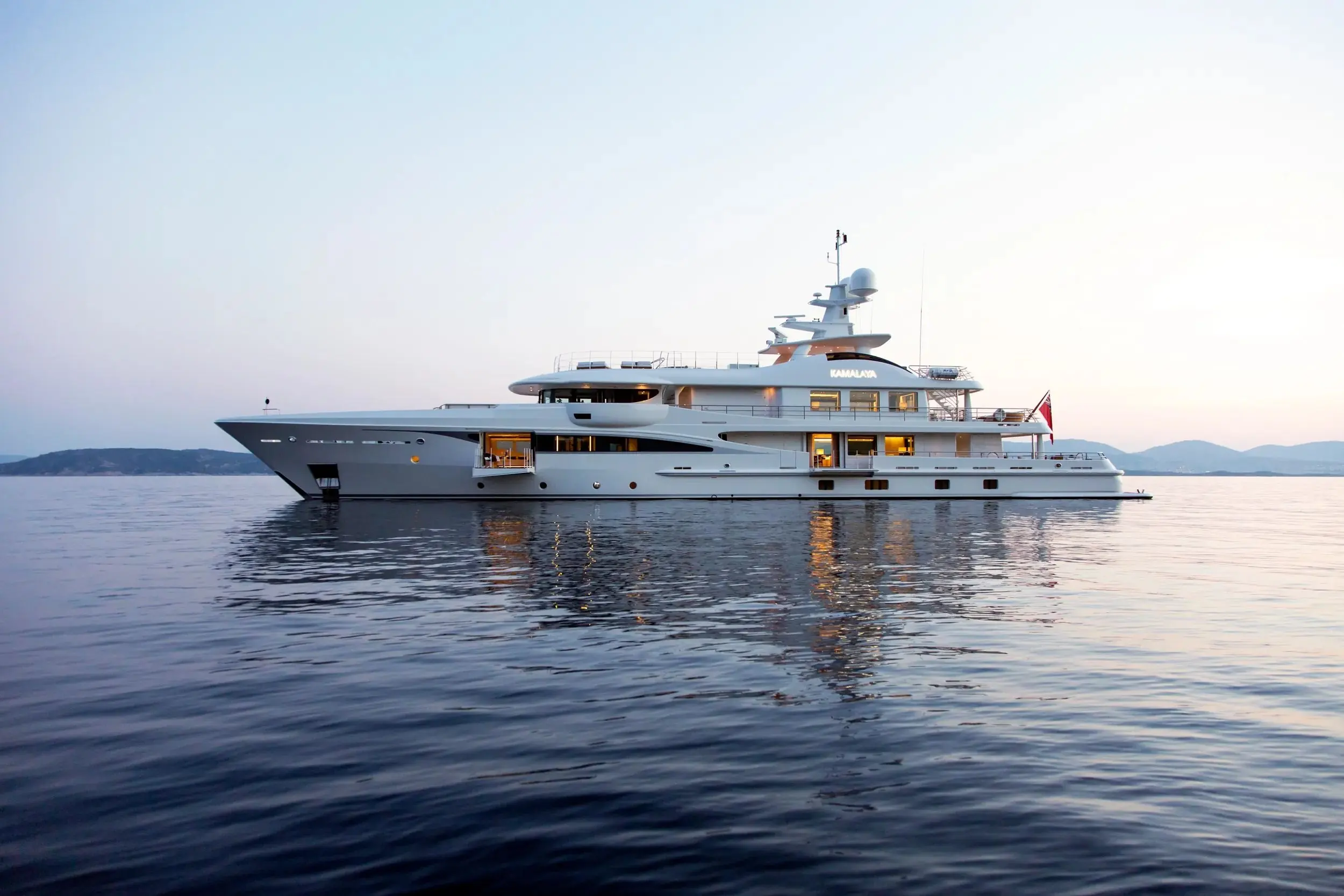
| LOA | 55 m (180 ft) |
|---|---|
| Beam | 9.4 m |
| Draft | 3.38 m |
| Gross tonnage | approx 670 GT |
| Exterior design | Tim Heywood |
| Interior | owner's choice |
| Engines | 2 x MTU 16V 2000 M70 |
| Delivered | approx 25 hulls, first in 2012 |
The boat that carried the concept
When Amels needed to show that a semi-custom superyacht could work at scale, the 180 answered the question. It launched as one of the smaller platforms in the Limited Editions family, sized to sit at 55 metres and priced to reach a broad pool of first-time and repeat owners. The engineering was fixed in advance, so a buyer could commit with a clear view of cost and timing. That certainty did much of the selling. In a market used to bespoke commissions, that certainty was a genuinely new proposition.
The numbers tell the story of its success. Around 25 examples have left Vlissingen over roughly fifteen years of production, which makes the 180 the most-built model in the range. The first hull, named 4YOU, was handed over in 2012. Few semi-custom superyachts of this size have sold in comparable numbers. The steady stream of repeat buyers said as much about the platform as any brochure could.
Heywood lines on a compact hull
Tim Heywood drew the exterior, and his signature is easy to read. The bow is long and the superstructure sits low, giving the 180 a balanced profile that has aged well against more fashion-led rivals. The proportions make a 55-metre yacht look purposeful rather than stubby. That restraint is a large part of why the design still looks current after more than a decade. Heywood gave the smaller Amels the same visual grammar as its larger sisters.
The deck arrangement puts usable outdoor space ahead of visual drama. A generous sun deck and a sheltered aft cockpit give guests separate places to gather. A foredeck seating area adds a quieter option away from the main flow. Because the platform is standardised, the exterior detailing tends to vary less between hulls than the interiors do. Owners who want a personal stamp tend to place it below decks instead.
The 180 proved a semi-custom superyacht could sell in real numbers, and roughly 25 hulls followed.
An owner's canvas below decks
Interior volume sits at roughly 670 GT, which is competitive for the length. Amels leaves the interior open to the owner rather than imposing a house style, so no two 180s read the same below decks. Layouts typically accommodate 12 guests across five or six staterooms, with a full-beam owner's suite as the usual centrepiece. The result feels custom even though the shell is shared. That freedom is a large part of the model's appeal to design-minded buyers.
The main deck generally carries the principal social spaces, with a separate and quieter arrangement for the owner. Ceiling heights and window lines were planned into the platform, so designers work with light and proportion rather than fighting the structure. Crew accommodation for around a dozen keeps service discreet. The balance of guest and working areas reflects a decade of refinement across the series. Sound and vibration control were treated as priorities from the first hull onward.
Proven machinery, ocean legs
The 180 rides on a displacement steel hull with an aluminium superstructure, the standard recipe across the Limited Editions. Propulsion comes from a pair of MTU 16V 2000 M70 diesels, a widely used and well-understood package. Top speed sits at about 15.5 knots, with an economical cruise closer to 11.5 knots. This is a yacht built for passage-making rather than headline pace. The emphasis throughout falls on comfort at sea over sprint performance.
At cruising speed the range runs to roughly 4,000 nautical miles, enough for an Atlantic crossing with margin. The engineering choices favour reliability and quiet running over novelty, which suits owners who plan to use the boat hard. Maintenance is eased by the commonality of parts across a large fleet. A captain moving between hulls finds few surprises. That familiarity keeps operating costs steadier than a one-off design would.
Who buys a 180
The 180 tends to attract owners stepping up to a full displacement superyacht for the first time, along with experienced owners who want a manageable second boat. Its size keeps running costs and crew numbers sensible while still delivering ocean capability. The strong resale record gives buyers confidence that the money is not stranded. For many, that combination is the whole point. The size sits within reach of owners who would find a larger flagship impractical to run.
On the brokerage market the 180 holds its value better than most semi-custom peers, helped by the size of the fleet and the clarity of the specification. Charter demand is steady, since the layout works for family groups and the running costs stay in check. Owners who prize predictability over one-off statement tend to gravitate here. The model set the template the rest of the range built on. Later and larger Amels models all trace their logic back to it.
Engines and systems
| Main engines | Twin MTU 16V 2000 M70 diesels, 1,410 hp (1,050 kW) each at 2,100 rpm - the standard fit cited across every hull-specific source found (2012 first hull through the 2020 final hull, Galene). No source found documents a different engine generation or alternative engine option being fitted to any Amels 180 hull. |
|---|---|
| Gearboxes | Not published by any source found. |
| Generators | 2 x 160kW generators (single aggregator source, YachtBuyer-derived; not independently corroborated by a second named source, so treat as indicative rather than confirmed). |
| Stabilisers | Quantum stabiliser system, active underway and at anchor (per YachtBuyer-derived listings and brokerage copy). Model/fin size not published. |
| Bow/stern thrusters | Fitted as standard equipment on all hulls per brokerage listings, but no source found gives thruster brand, power (kW/hp), or confirms whether both bow and stern thrusters are fitted - not published by any source found. |
| Watermaker | Not published by any source found. Freshwater tank capacity itself is also unsettled: one brokerage source cites 15,000 litres, another 17,000 litres, for what appear to be different hulls - figures not reconciled. |
| Fuel tankage | 115,000 litres - consistent across the Amels-derived aggregator figures (YachtBuyer, Boat International-sourced summaries) and not contradicted by any source found. |
| Engine-room access | Not published in technical detail by any source found. General brokerage description places the machinery space aft with crew walkways, but no primary source gives headroom, layout, or access-route specifics. |
What owners and crew report
Positive first-hand account of the newbuild process from a hull's captain
Captain Paul Bessant, captain of the Amels 180 Papa, said of Amels: 'You feel very included, you feel that you really are part of the process from the beginning to the launch,' praising the yard's teamwork during the build.
Boat International (quoting Captain Paul Bessant)
What is good, and what to watch
Strong points
- Best-selling design in its size classAmels/Damen commercial director Rose Damen is quoted by Boat International describing the 180 as 'the world's best-selling 55 metre yacht design since 2007' - repeated in Megayacht News' coverage of the same launch.
- Genuine semi-custom flexibility for a production platformMegayacht News notes that 180 buyers can still request structural changes, which it calls 'rare among shipyards offering similarly set technical platforms' - borne out by real hull-to-hull differences (accommodation layout, colour schemes, interior designers, sundeck size).
- Deep, active charter fleetMultiple individually named hulls (4You, Kamalaya, Papa, Amigos, Driftwood, Halo) are listed as available for charter by YachtCharterFleet and Charterworld, indicating sustained commercial demand for the model.
What to watch
- Platform is out of productionPer YachtBuyer, the Amels 180 is no longer built and has been superseded in Amels' current line-up by the newer Amels 60 model - a buyer today is necessarily buying an older, discontinued design.
- No single reconciled specification sheet across official and brokerage sourcesGenuine, unresolved disagreement between Amels' own current site and brokerage/press material on cruise speed (11.5kn vs 13kn), range (4,000nm vs 4,500nm) and gross tonnage (650 vs 660 GT) - a prospective buyer cannot currently get one settled figure for these from public sources.
Practical detail
| LOA / GT / Beam | 55m (180ft) LOA and 9.40m beam are consistent across Amels' own site and Boat International-derived coverage. Gross tonnage is NOT settled between sources: Boat International-derived material states 650 GT, while Charterworld's coverage of the first hull (Step One) states 660 GRT. |
|---|---|
| Built / delivered facility and years | Built by Amels (part of Damen Yachting) at Vlissingen, Netherlands. First hull (4YOU / Step One) delivered 2012; named hulls found in press coverage run through Galene, delivered 2020 (16 named hulls total found: 4YOU, Step One, Apollo, Gene Machine, Kamalaya, Astra, Serenity J, La Familia, Vega, Elixir, Amigos, Driftwood, Halo, Nomad, Papa, Galene). Amels/Damen's own marketing claims '25 yachts delivered over 15 years' - this total could not be reconciled with the 16 named hulls found in press coverage; noted as an open discrepancy. YachtBuyer states the model is no longer in production, superseded by the newer Amels 60. |
| Design credits | Exterior design: Tim Heywood. Naval architecture: Damen Yachting. Interior design is owner's choice on a semi-custom basis - Laura Sessa credited on multiple hulls (4YOU, Papa, Galene); Bonesteel Trout Hall credited on Nomad. |
| Accommodation | Typically 12 guests across 6 staterooms (Boat International coverage of Step One and Amels' general marketing), though at least one hull (Papa) is documented at 10 guests across 5 staterooms - genuine semi-custom variation. Crew: 12 plus captain (13 total) per Amels' own current spec page. |
| Engines / range / speed | 2x MTU 16V 2000 M70. Top speed 15.5 knots consistent across sources. Cruise speed and range UNSETTLED between sources: Amels' own site and a Yachting Magazine brokerage listing for Galene both state cruise at 11.5 knots with a 4,000nm range; other aggregator coverage (Boat International-derived, Megayacht News) states cruising at 13 knots with a 4,500nm range. Both figure-pairs named here rather than averaged. |
| New-build price range | No confirmed official new-build price list found from any source. A general aggregator claim of a EUR 42,000,000 standard list price surfaced but could not be traced to a named, checkable source, so it is not reported as fact. |
| Resale price range (brokerage) | Galene (2020-built) asking $44,000,000 (Yachting Magazine); Elixir asking EUR 32,500,000 (Romeo United Yachts); Step One reported sold for $33,700,000 (unconfirmed original source). Other current listings in the EUR 29,900,000-33,000,000 band. Recent secondary-market activity clusters roughly EUR 29m-44m depending on build year and condition. |
| Charter rate | Kamalaya: from $310,000 per week plus expenses (YachtCharterFleet). 4You: EUR 310,000/week July-August, EUR 280,000/week the rest of the year. Multiple other 180 hulls (Papa, Amigos, Driftwood, Halo) also active in the charter fleet, but per-hull rates for those not individually confirmed. |
| What is not published | Gearbox make/model, watermaker production capacity, thruster brand/power, engine-room dimensions or access detail, a confirmed current official new-build price, or a single reconciled total hull count (16 named hulls in press coverage vs. Amels' own '25 delivered' marketing claim). |
Questions owners ask
How big is the Amels Amels 180?
LOA: 55 m (180 ft). Beam: 9.4 m.
Who is the Amels Amels 180 for?
First-time displacement-yacht owners and experienced owners wanting a manageable, ocean-capable second boat with strong resale.
What is the Amels Amels 180 good at?
Best-selling design in its size class. Amels/Damen commercial director Rose Damen is quoted by Boat International describing the 180 as 'the world's best-selling 55 metre yacht design since 2007' - repeated in Megayacht News' coverage of the same launch.
What are the drawbacks of the Amels Amels 180?
Platform is out of production. Per YachtBuyer, the Amels 180 is no longer built and has been superseded in Amels' current line-up by the newer Amels 60 model - a buyer today is necessarily buying an older, discontinued design.
What do owners and crew report about the Amels Amels 180?
Captain Paul Bessant, captain of the Amels 180 Papa, said of Amels: 'You feel very included, you feel that you really are part of the process from the beginning to the launch,' praising the yard's teamwork during the build. (Boat International (quoting Captain Paul Bessant))
Design
| Exterior | Tim Heywood |
|---|---|
| Interior | Owner-customized (studios used include Winch Design and Laura Sessa Romboli) |
| Naval architecture | Amels / Damen Yachting (in-house) |
Who it is for: First-time displacement-yacht owners and experienced owners wanting a manageable, ocean-capable second boat with strong resale.