N47
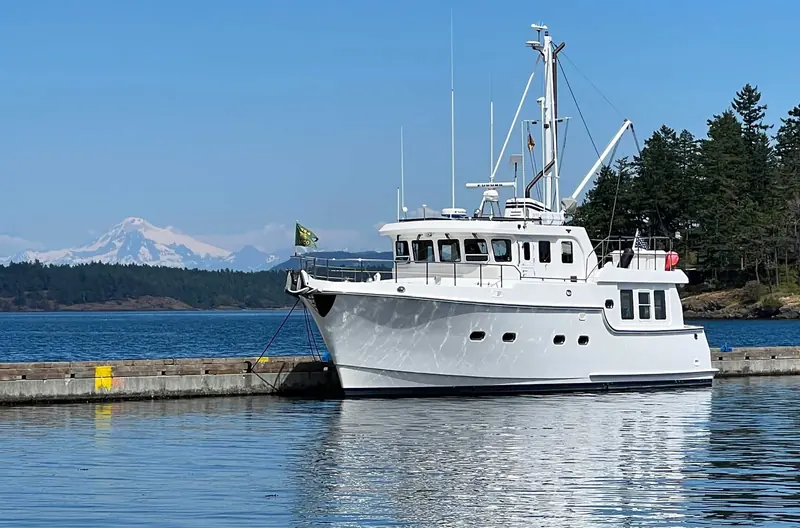
| LOA 47 ft 8 in (14.53 m), 47 ft 6 in on deck, waterline 43 ft 4 in, beam 16 ft 1 in (PAE; Nordhavn brokerage; YachtBuyer) | |
| Displacement about 84,749 lb at full load (PAE 2003); listings say 85,000 lb | |
| Main engine | single Lugger LP668T.2 (later L1066T), 173 hp at 2,400 rpm; wing engine 35 to 44 hp |
|---|---|
| Fuel 1,450 US gallons (PAE; Power & Motoryacht) or 1,470 (YachtBuyer; Nordhavn brokerage); water 400 gal | |
| Cruise 7 to 8.5 knots, maximum 9.2 knots (PAE); range 3,500 nm no-reserve estimate (PAE), 3,000 nm (Yachting) | |
| Designer Jeff Leishman; introduced 2002; built 2002 to 2009 (Yachting), about 59 hulls | |
| Base price $760,000 in January 2003 (PAE); used asking $749,000 to $850,000 (Yachting, September 2025) | |
A small ocean-crosser that became Nordhavn's best-seller before it floated
PAE's own 2003 Circumnavigator special edition calls the 47 the most successful new-model introduction in the company's history, with 22 boats ordered sight unseen before the first one launched. Hull 1, Ocean Rose, was a Southern California boat for Bob Wilkins and Janice Bolduc, and the same magazine names Hull 2 (Journey, Richard Somers), Hull 10 (Triton, Robert Healey), Hull 11 (Guilt Trip, Alex Haase), Hull 14 (Ron Montague) and Hull 17 (Preston Claytor) as early orders. The first five hulls were built in Taiwan; from Hull 6 production moved to South Coast Marine's new yard in Xiamen, China, with a target of four to five months per boat and two launches a month. Be aware that this is the maker's account: the Circumnavigator is published for PAE.
The production dates are not uniform across sources. Yachting (September 2025) says 2002 to 2009 and 59 hulls; YachtBuyer's model page dates the boat 2003 to 2008. A broker listing for a 2005 boat calls it hull 35 and Nordhavn's own brokerage calls another 2005 boat hull 31, so hull number and model year don't line up neatly. We could not find a second independent source for the figure of 59, so treat it as Yachting's count. Nordhavn's current website lists the 47 under retired models.
Single Lugger, a 40 hp wing engine and a dry stack
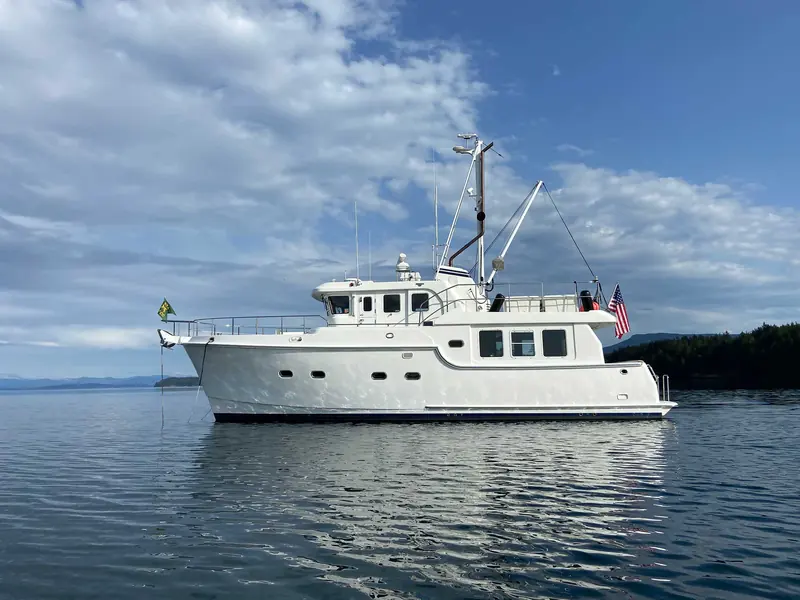
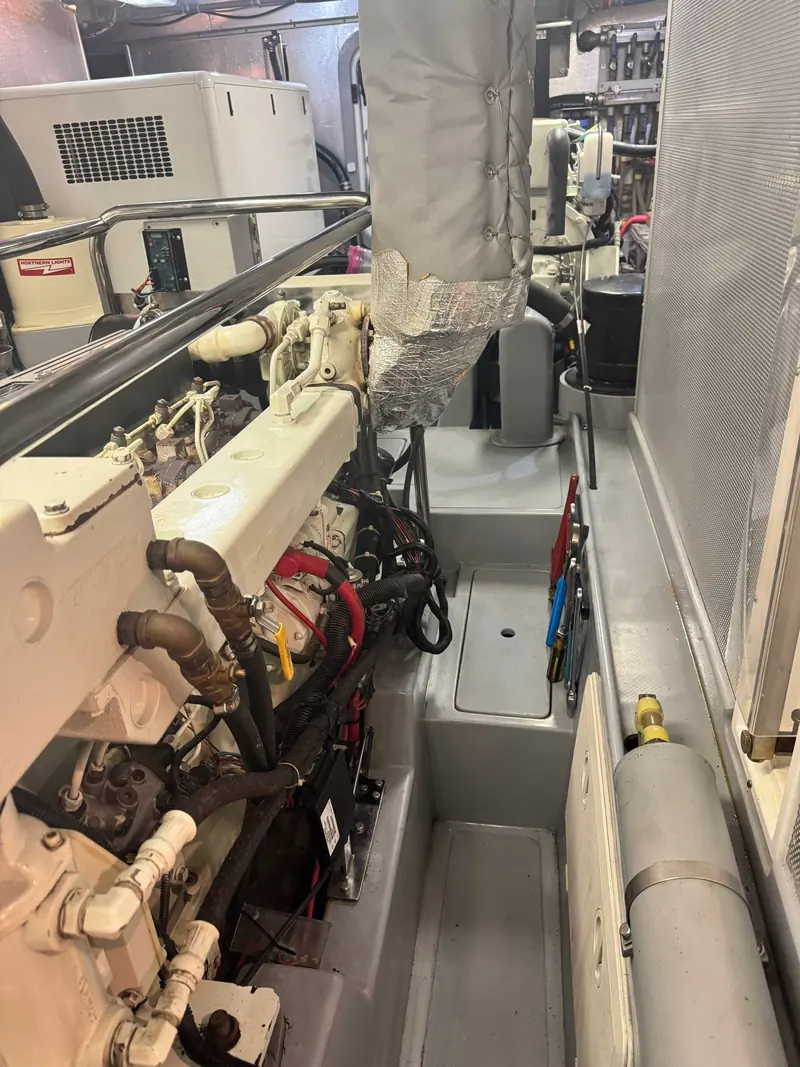
The standard engine is the Lugger LP668T.2, rated 173 hp at 2,400 rpm, turning a 34-inch four-blade bronze propeller through a 3.96 to 1 ZF gear (PAE specification, 2003, matched by Power & Motoryacht's March 2003 test sheet). Listings of later boats show the same engine badged L1066T at 170 to 174 hp. The wing engine is a 35 to 44 hp unit: Power & Motoryacht lists a 35 hp Yanmar, Yachting a 40 hp Yanmar on a V-drive with a folding propeller that Nordhavn says will push the boat at 5 knots, and two Nordhavn-era brokerage listings show a Lugger 844D of 40 to 44 hp. A 12 kW generator is standard on the specification and sits in a sound shield (Fischer Panda on early boats, Northern Lights on later listings). Exhaust leaves a stainless dry stack 29 feet above the waterline, and PAE credits the Nidacore bulkheads and dry stack for the low machinery noise.
The trade-off is spelled out by Yachting in October 2007: dry stack costs more to rig and takes up interior space. Preston Claytor's reasoning for picking the 47 over the 50 in 2003 was practical rather than romantic. The 50 came with a 250 or 300 hp Lugger, which he thought was overkill for a full-displacement hull, and PAE would only build a 50 as a Loop boat with a wet exhaust. With the mast down the 47 has an air draft of 15 ft 3 in (PAE), which is the number a Great Loop crew needs. Fuel is held in two molded fiberglass main tanks that gravity-feed an aluminum supply reservoir with a sight gauge and water probe; PAE says nearly every gallon is burnable because the pickups sit at the bottom of the tanks.
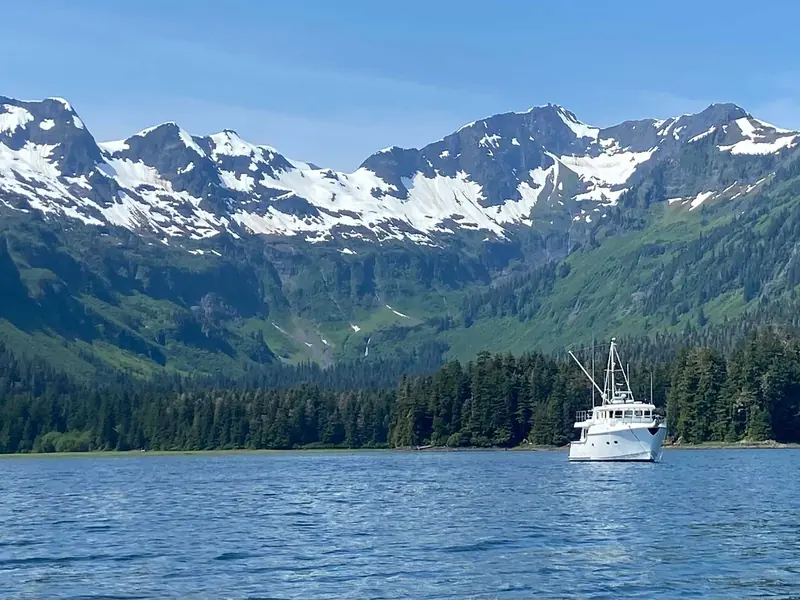
Nordhavn put a 50-foot boat's volume into a 47-foot footprint, sold 22 of them sight unseen, and then let owners find out the real range was nearer 2,500 miles than 3,500.
Speed, burn and range: the brochure and the crossing don't match
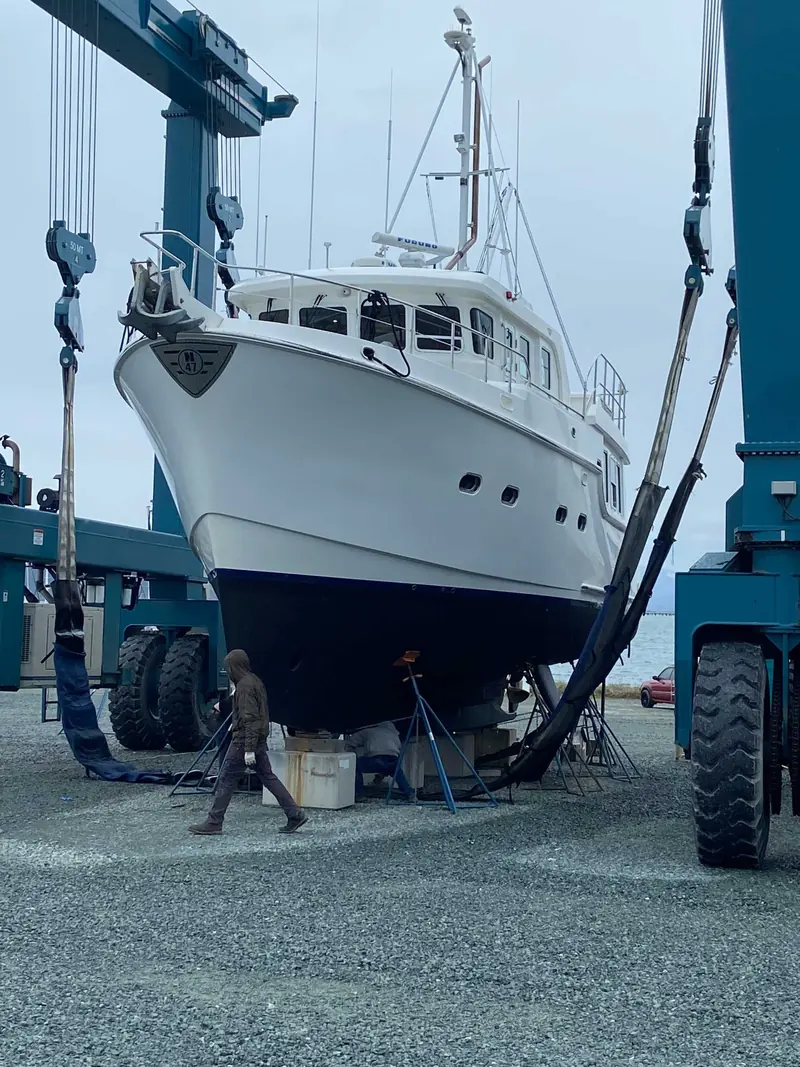
PAE's 2003 specification gives a maximum of 9.2 knots (speed/length 1.4), a coastal cruise of 8.5 knots, a long-range speed of 7.34 knots and a range of 3,500 nm at that speed, which it labels an estimate from test-tank data with no reserve. Yachting (September 2025) says 3,000 nm at 8 to 9 knots, and Nordhavn's own brokerage page for hull 31 says 3,000 nm at 7 to 8 knots. A broker listing for hull 35 gives 7.1 knots cruise and 8.5 maximum. Power & Motoryacht measured fuel flow in 2003 but didn't publish the figures, because the boat's fuel computer misbehaved out of sight of land, so we have no independent burn table at any speed.
The best real-world number we found is Scott and Teri Strickland's Atlantic crossing (Ceuta to Grenada, reported November 2006) in the N47 Strickly For Fun, reported on nordhavn.com: 3,738 nm over three legs at an average of 6.7 knots, burning 2,120 gallons. That is 0.57 gallons per nautical mile, or roughly 3.8 gallons an hour at that speed (our arithmetic, not a reported figure). At that rate a full 1,450 gallon load covers about 2,500 nm before any reserve. The two figures describe different things: the maker's is a no-reserve tank estimate and the Stricklands' is a measured passage in real conditions, so plan on the lower one.
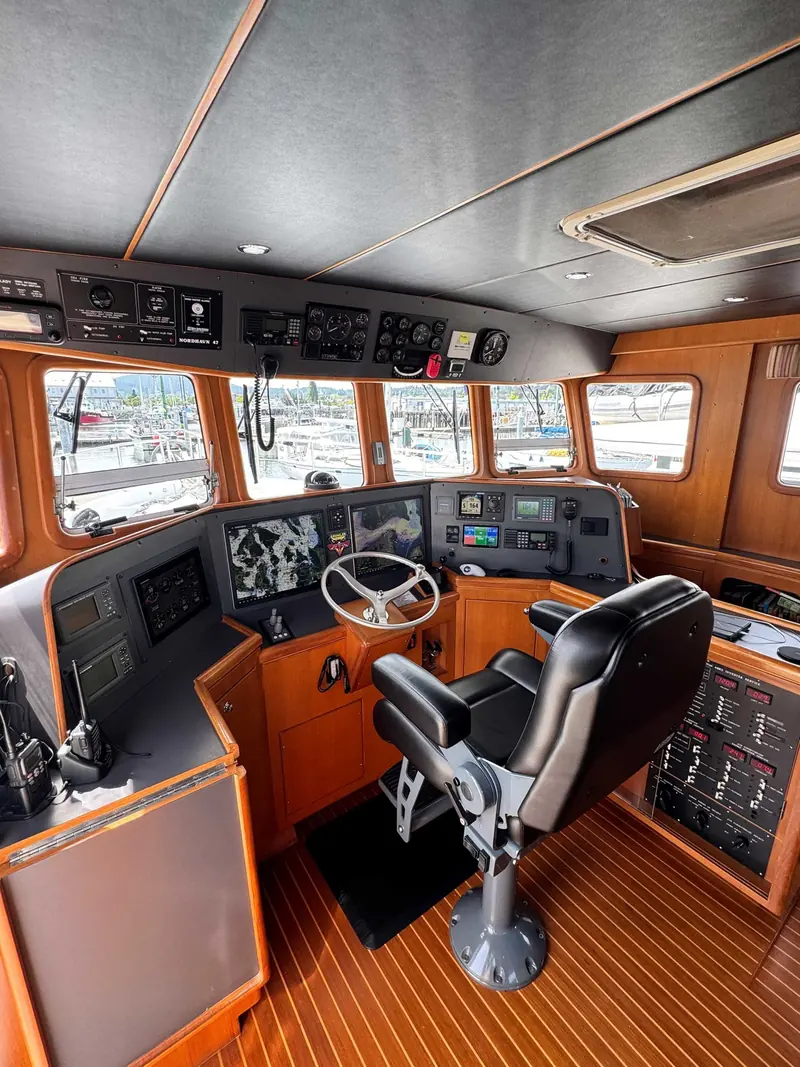
Pilothouse, owner's cabin and the boat that was always too big for its number
PAE's engineering note says the 47's deck is a full foot higher than the 50's, since the new Xiamen yard wasn't bound by the older height limits, and the extra volume went into floor space and tankage. The pilothouse seats six, has its own wet locker and a fixed helm chair, and the engine room carries 6 ft 2 in of standing headroom with access from both the owner's cabin and the lazarette. The owner's stateroom has a fore-and-aft bed and a shower sized for two; the guest stateroom forward has its head against the chain locker so the berth can sit further aft. Galley kit is granite and Sub-Zero with a four-burner range, and there is a stacked washer and dryer. Power & Motoryacht's reviewer found the engine room lined with two-inch Technicon fireproof foam.
The compromises are real and the contemporary reviewers noted them. The Circumnavigator itself says saloon seating is smaller than you'd expect because so much space went to the galley and pilothouse, and that PAE would customise the 50 but not the 47. Power & Motoryacht noted that inverter, batteries and hydraulics sit in a lazarette with stoop headroom. Yachting described the ride as a detectable yet orderly motion. And with a displacement hull and a 173 hp engine, nobody buys this boat to go fast: the early buyers quoted in the Circumnavigator conceded that the 50 is the better-looking and quicker boat.
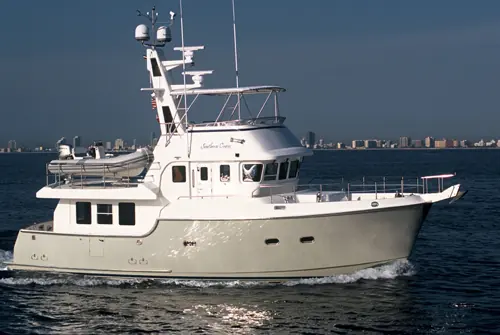
What a Nordhavn 47 costs: new in 2003, used today, and to run
PAE's 2003 specification gave the base boat at $760,000 as of January 2003, with a flybridge option at $29,746, Naiad active fin stabilizers at $32,500 or a passive paravane system at $12,500. Power & Motoryacht tested a boat at $860,000 as equipped. The model has been out of production for years, so there is no current factory quote at all. On the used side, Yachting reported in September 2025 that three N47s were for sale between $749,000 and $850,000. Other listings we saw in November 2026 searches, some of which may be stale or sold, ranged from about $795,000 (a 2004 boat) through $799,000 and $825,000 (2003 boats) up to $849,000 (a 2004 flybridge boat) and $875,000 for a 2002 boat in Australia. Nordhavn's own brokerage page for hull 31, Feisty Lady, now shows that boat as sold.
Condition varies more than year, because these are working boats. Feisty Lady's 2005 listing shows 7,650 hours on the main engine, 316 hours on the wing engine and 5,188 hours on the generator, with new toilets (2024), a 121 lb Rocna anchor (2024) and new anchor chain (2025). By contrast the hull 35 listing shows only 150 hours on its wing engine and no stated main-engine hours. Insurance, haul-out and annual running costs for the N47 specifically are not published in any source we found, and general percent-of-value rules of thumb shouldn't be treated as an N47 number.
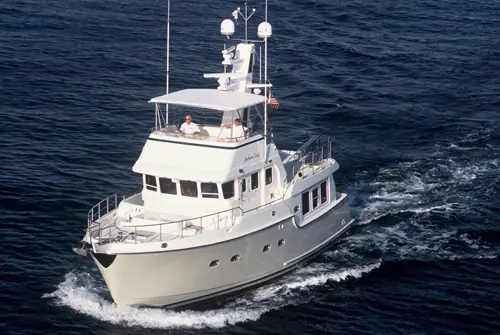
What to check before buying a used Nordhavn 47
Scott Strickland's Atlantic crossing report names the fuel filters as the worst thing aboard: he had to change them repeatedly underway, and he started with 23 spares and ended with 5. That is one owner's experience, but it tells you what to ask about tank cleanliness and polishing. Stabilizers are the other recurring theme in owner discussion on Trawler Forum, though the posts we found don't name the N47 and are general to Nordhavn, so we don't count them as N47 reports. Hull 35 carries ABT TRAC 220 fins and a Flopper Stopper; early boats used Naiad. Thruster fits also differ: Power & Motoryacht lists a 9 hp Sidepower bow thruster, while the hull 35 listing shows 10.7 hp bow and stern units.
Hull weight and draft are also worth checking against the specific boat. PAE gave draft at maximum weight as 5 ft 1 in and displacement as 84,749 lb; Nordhavn's own current brokerage page says 5 ft 11 in and about 85,000 lb. Power & Motoryacht printed 5 ft and a 61,000 lb weight in the spec box, though its text says roughly 41 tons at full load. We couldn't reconcile these, so don't rely on one without seeing the survey. Ballast is quoted as 8,000 lb (PAE) and about 7,400 lb of lead (Yachting). Finally, expect to pay for electronics: even a well-kept boat like Feisty Lady has modern additions such as Starlink and Victron monitoring, so the electronics on any used boat are unlikely to be original.
Engines and systems
| Main engine | Single Lugger LP668T.2, 173 hp at 2,400 rpm, keel-cooled with a dry stack exhaust, ZF gear at 3.96 to 1, 34 in four-blade propeller (PAE specification 2003; Power & Motoryacht March 2003). Later listings show the same engine as an L1066T at 170 to 174 hp. |
|---|---|
| Wing engine | Yanmar 35 to 40 hp on a V-drive with a separate shaft and folding propeller, able to push the boat at 5 knots (Power & Motoryacht; Yachting 2007). Listings for hulls 31 and 35 show a Lugger 844D of 40 to 44 hp. |
| Generator | 12 kW in a sound shield: Fischer Panda on early boats (Yachting; Power & Motoryacht), Northern Lights on hulls 31 and 35 (broker listings). |
| Stabilizers | Naiad fins on early test boats; ABT TRAC fins on hulls 31 and 35 (TRAC 220 on hull 35). PAE priced active fins at $32,500 and passive paravanes at $12,500 in 2003. |
| Thrusters and steering | Sidepower bow thruster, 9 hp on the Power & Motoryacht test boat; 24V bow and stern units on hulls 31 and 35. Hynautic hydraulic steering, Mathers single-stick controls. |
| Fuel and water | Two main fuel tanks totaling 1,450 gal with an 80 gal centerline aluminum day tank (PAE). YachtBuyer and Nordhavn's own brokerage page give 1,470 gal. Fresh water 400 gal, grey 110 gal, black 119 to 120 gal. |
| Range | 3,500 nm at 7.34 knots, a no-reserve test-tank estimate (PAE 2003); 3,000 nm at 8 to 9 knots (Yachting 2025); 3,000 nm at 7 to 8 knots (Nordhavn brokerage). Reported Atlantic crossing: 3,738 nm using 2,120 gal at 6.7 knots average (Nordhavn, 2006). |
| Hull and build | Solid fiberglass hull, cabin sides cored with Klegecell foam, deck cored with Baltek balsa, Nidacore bulkheads. First five hulls built in Taiwan; Hull 6 onward in Xiamen, China (PAE 2003). |
What owners and crew report
Fuel filters were the worst job on a transatlantic crossing
Scott Strickland, whose N47 Strickly For Fun crossed from Ceuta to Grenada in a passage reported on nordhavn.com in November 2006, said the worst thing was repeatedly changing fuel filters underway. He started with 23 spares and ended with 5.
Scott Strickland, owner of Strickly For Fun, quoted on nordhavn.comQuiet and steady under way
Janice Bolduc, co-owner of Hull 1 Ocean Rose, said there was virtually no noise, odor or vibration even standing in the master stateroom beside the engine room, and called the boat more than they expected. This is a first owner talking to a magazine the maker publishes.
Janice Bolduc, owner of Ocean Rose, in Circumnavigator 2003 (published for PAE)Chose the 47 over the 50 for Loop clearance and a lower-powered engine
Preston Claytor said the 47 gave much the same space as the 50 in three feet less, cleared Great Loop bridges with a dry stack, and carried a 174 hp engine rather than the 250 to 300 hp used on the 50, which he thought was overkill.
Preston Claytor, Hull 17 buyer, in Circumnavigator 2003 (published for PAE)Fuel computer unreliable, aux systems cramped
The reviewer found the fuel-flow computer moody and uncooperative out of sight of land, so fuel consumption was never published, and noted that inverter, batteries and hydraulics sit in a lazarette with stoop headroom while the engine room has standing headroom.
Capt. Bill Pike, Power & Motoryacht, March 2003Dry stack costs more and eats space; ride has a detectable motion
Yachting's October 2007 review weighed the dry stack as a noise and reliability gain against extra cost and lost interior space, and described the motion as detectable yet orderly. The same piece said Jim Leishman was satisfied with hull 1 aside from minor details it didn't list.
Scott Shane, Yachting, October 2007
What is good, and what to watch
Strong points
- Quiet, with a real stand-up engine roomCircumnavigator's editors and the first owner describe very low noise, helped by the dry stack and Nidacore bulkheads, and the 6 ft 2 in engine room is easy to work in.
- A proven single-engine layout with a get-home engineOne 173 hp Lugger plus a separate 35 to 44 hp wing engine on its own shaft has crossed oceans, with a documented 3,738 nm Atlantic crossing.
- Volume that beats its lengthThe boat has a six-person pilothouse, two en-suite cabins and a washer and dryer in a 47-foot footprint, and a 15 ft 3 in air draft with the mast down.
- Liquid used market and a long paper trailYachting counted three for sale in September 2025 at $749,000 to $850,000, and the Nordhavn brokerage lists the boats with full equipment lists and hour meters.
What to watch
- The brochure range is optimisticPAE's 3,500 nm is a no-reserve estimate and the one documented crossing works out nearer 2,500 nm on 1,450 gallons, so plan stops accordingly.
- Slow, and the owners knew itCruise is 7 to 8.5 knots with a 9.2 knot maximum, and the early owners themselves conceded the N50 is faster and better looking.
- Little independent test dataThe only published tests we found are a 2003 Power & Motoryacht test that omitted fuel-burn figures and a 2007 Yachting review, plus PAE's own magazine; there is no modern independent sea trial.
- Spec figures disagree between sourcesDraft is 5 ft 1 in, 5 ft or 5 ft 11 in; fuel is 1,450 or 1,470 gal; displacement is 84,749, 61,000 or about 41 tons depending on the source. Verify against the specific boat's survey.
- Age shows in the hoursA 2005 boat shows 7,650 hours on the main and 5,188 on the generator, and the worst owner experience reported was fuel filters on a long crossing.
Practical detail
| New build price | Not available. Production ended in 2009 (Yachting). The base boat was $760,000 in January 2003, with a flybridge at $29,746 and active fin stabilizers at $32,500 (PAE, Circumnavigator 2003) |
|---|---|
| Typical used price | About $750,000 to $875,000. Yachting reported three for sale at $749,000 to $850,000 in September 2025; other listings seen in November 2026 searches (some possibly stale) asked $795,000 to $875,000 |
| Annual running cost | No figure specific to the N47 is published in any source we found; ask the broker for the specific boat's last two years of costs |
| Fuel burn reference | The Atlantic crossing burned 2,120 gal over 3,738 nm at 6.7 knots average (Nordhavn, 2006), about 3.8 gph by our arithmetic. No independent burn table at other speeds is published |
| Hulls built | About 59 from 2002 to 2009 (Yachting, September 2025); we could not find a second source for the count |
| Options worth knowing | Flybridge, Naiad or ABT TRAC active stabilizers or passive paravanes, and a third stateroom (3 staterooms were optional, PAE 2003) |
| What to check when buying used | Main engine, wing engine and generator hours, fuel tank cleanliness and filter history, stabilizer type and age, thruster fit, the keel-cooler and dry stack, and the exact draft and displacement on the survey |
| Not publicly known | N47-specific annual running cost, insurance cost, a modern independent sea trial and a second source for the hull count |
Questions owners ask
How big is the Nordhavn N47?
LOA 47 ft 8 in (14.53 m), 47 ft 6 in on deck, waterline 43 ft 4 in, beam 16 ft 1 in (PAE; Nordhavn brokerage; YachtBuyer). Displacement about 84,749 lb at full load (PAE 2003); listings say 85,000 lb.
What does the Nordhavn N47 cost?
New: $760,000 base in January 2003 (PAE), no longer built. Used: roughly $750,000 to $875,000 in current listings. Running cost: not published.
Who is the Nordhavn N47 for?
A couple who want to cross oceans under power on one proven engine and are happy to buy used, check hours and fuel systems carefully, and accept 7 to 8 knots as the price of range and quiet.
What is the Nordhavn N47 good at?
Quiet, with a real stand-up engine room. Circumnavigator's editors and the first owner describe very low noise, helped by the dry stack and Nidacore bulkheads, and the 6 ft 2 in engine room is easy to work in.
What are the drawbacks of the Nordhavn N47?
The brochure range is optimistic. PAE's 3,500 nm is a no-reserve estimate and the one documented crossing works out nearer 2,500 nm on 1,450 gallons, so plan stops accordingly.
What do owners and crew report about the Nordhavn N47?
Scott Strickland, whose N47 Strickly For Fun crossed from Ceuta to Grenada in a passage reported on nordhavn.com in November 2006, said the worst thing was repeatedly changing fuel filters underway. He started with 23 spares and ended with 5. (Scott Strickland, owner of Strickly For Fun, quoted on nordhavn.com)
Who it is for: A couple who want to cross oceans under power on one proven engine and are happy to buy used, check hours and fuel systems carefully, and accept 7 to 8 knots as the price of range and quiet.
Guide price: New: $760,000 base in January 2003 (PAE), no longer built. Used: roughly $750,000 to $875,000 in current listings. Running cost: not published.