Contigo Charters as the First Fuel-Cell Superyacht on the Market
A production hull, not a one-off demonstrator
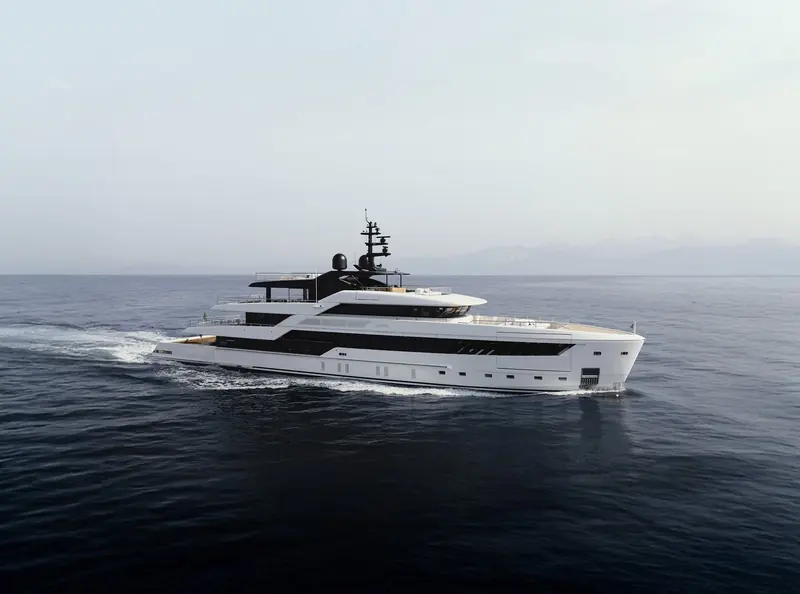
Contigo is not a boat show concept. Sanlorenzo delivered the 49.9-metre hull in May 2024 under the name Almax, the first of its 50Steel series, and her owner has now renamed her and placed her with London brokerage Cecil Wright & Partners for the 2026 Mediterranean charter season. She charters from EUR 325,000 a week for ten guests across five cabins, and Cecil Wright is marketing the booking on a line most brokers cannot write: she is the first superyacht with a certified green-methanol fuel cell available to book at all.
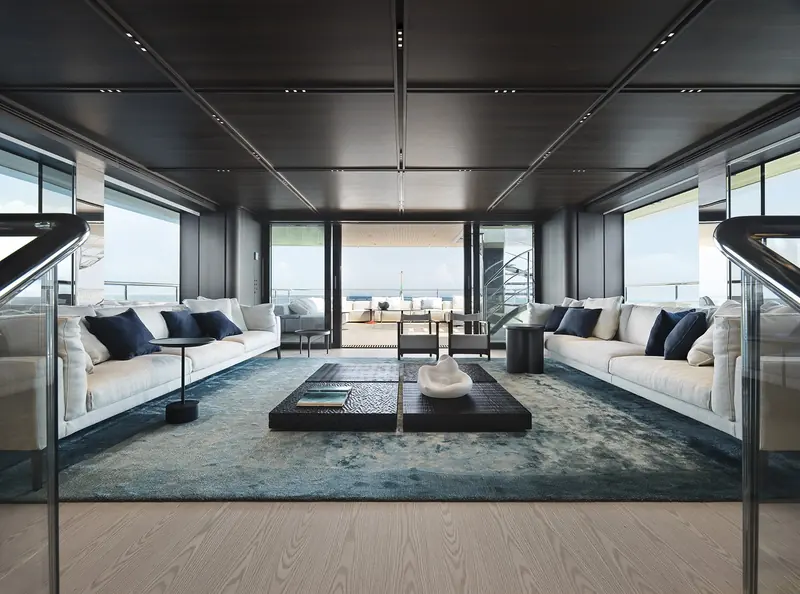
Sanlorenzo has sold four hulls in the 50Steel line since Contigo's delivery, evidence the fuel cell was a genuine product decision rather than a one-boat stunt. Exterior lines come from Zuccon International Project, continuing the low, layered profile the studio has drawn across Sanlorenzo's steel range; the interior, in a dark, textured palette rather than the brochure-white common on new Italian tonnage, is by Piero Lissoni. 'With the launch of the 50Steel, Sanlorenzo celebrates a fundamental milestone in its history, in the spirit of innovation and sustainability,' said Massimo Perotti, the yard's chairman and chief executive, when the model launched. Sanlorenzo has not named the four buyers or said whether any specified the fuel cell as standard rather than optional, a detail that would show whether the technology is becoming routine or still a special order.
How the fuel cell actually works
The system does not burn methanol directly and does not store hydrogen on board, the two problems that have stalled most marine hydrogen projects before they left the drawing board. Instead, a reformer built with Siemens Energy converts green, bio-based methanol into hydrogen inside a sealed process, then into electricity, on demand and in real time. Lloyd's Register has certified the installation on the 50Steel platform, the first classification society sign-off of its kind for a yacht this size.
Sanlorenzo rates the output at up to 100kW, enough to run Contigo's full hotel load, lighting, air conditioning, galley and systems, without the diesel generators running. The yard's own figure is that the fuel cell can cover roughly 90 percent of a typical superyacht's usage time at anchor with zero local emissions; that is a builder's estimate rather than an independently audited duty cycle, and no third party has yet published a season's worth of real consumption data to check it against. What is confirmed is the certification and the 100kW ceiling; what is not is how that holds up on a hot August week with air conditioning running continuously for ten guests.
What changes for someone chartering her
The practical difference for a charter guest is quiet. With the fuel cell carrying the hotel load, Contigo can sit at anchor with her main engines and generators off for long stretches, which matters most in the marine reserves and no-wake anchorages around the western Mediterranean where noise and wash rules increasingly restrict where a conventional yacht can spend the night. A silent, generator-free anchorage is, for many guests chartering rather than buying, the actual product being sold this season, more than the emissions figure on a press release. Superyachts.com, reporting on the charter listing, noted the fuel cell in principle opens protected bays and marine reserves that ban engine noise and wash to a conventional yacht running generators around the clock.
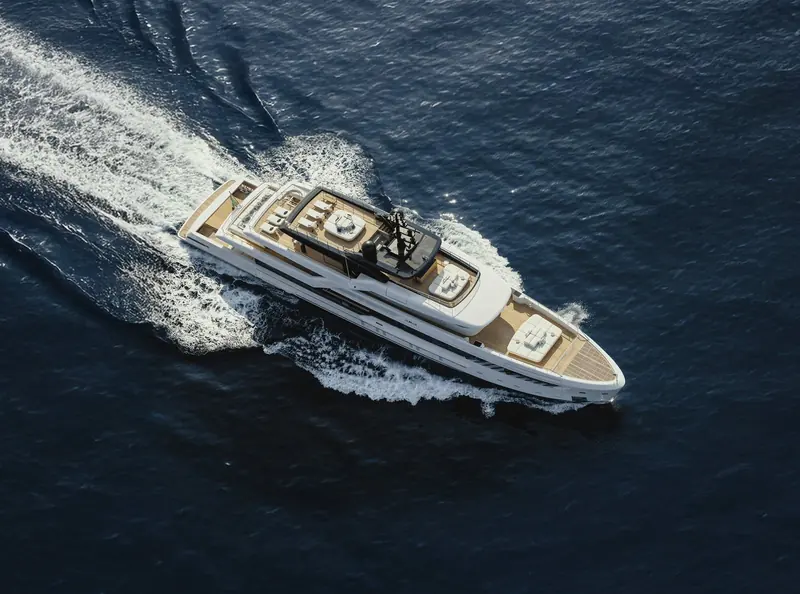
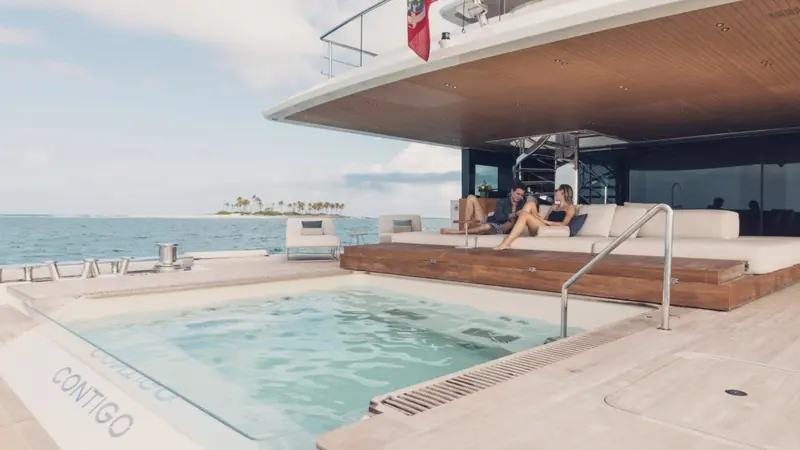
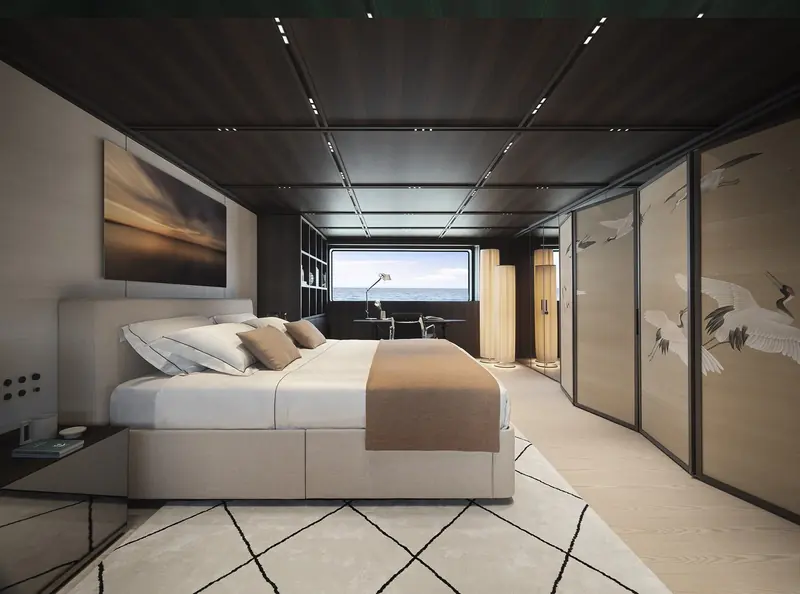
The layout supports the pitch. The main deck aft carries a lowered swim platform and a pool with her name cut into the coping; the sundeck adds a second pool and lounge; a roughly 150-square-metre Ocean Lounge beach club opens at the waterline off the stern. The owner's suite sits on the upper deck in what Sanlorenzo calls a floating penthouse arrangement, with a private office and dual dressing rooms, connected to a full-beam lounge rather than tucked forward on the main deck as on most 50-metre yachts. A Wajer 55 chase tender, jet skis, SEABOBs and wakeboards round out the toy list.
The engines still do the moving
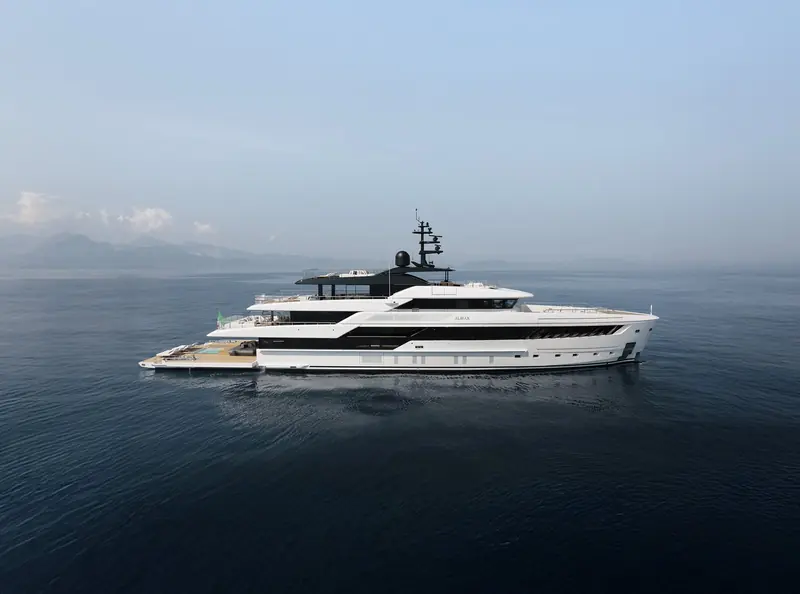
None of this changes how Contigo gets from anchorage to anchorage. Underway she runs on twin MAN D2862-LE489 diesels rated at 1,430hp each, the same propulsion fitted to any 50Steel, for a top speed of 16 knots, a cruising speed of 12.5 knots and a range of 4,000 nautical miles at 11 knots. The fuel cell is a hotel-power system, not a propulsion one; a charter itinerary that covers real distance between islands still burns diesel exactly as it would on a sister ship without the technology.
At 9.4 metres beam and a 2.96-metre draught, she carries the modest air draught and shoal capability the 50Steel range was built around, and stays under the 500GT threshold that keeps crewing and flag-state paperwork lighter than on a larger yacht. That size band, not the fuel cell, still sets most of her running cost.
What this means for an owner watching from the sidelines
For an owner not chartering Contigo but weighing a new build of their own, the relevant fact is not the green messaging, it is that a classification society has now certified a reformer fuel cell on a delivered yacht and a charter broker is renting the result at a real weekly rate. That is a different order of proof than a boat show mock-up or a builder's white paper; the technology has cleared the two gates, class approval and paying customers, that usually decide whether a system becomes a standard option or stays a one-off.
No independent charterer has yet completed and reviewed a full week aboard her under the new name, and neither Sanlorenzo nor Cecil Wright has published where Contigo bunkers green methanol on a Mediterranean itinerary, so the practical case is not fully proven. What is proven is that the option now exists to book, not just to read about.
What is good, and what to watch
Strong points
- A certified production fuel cell, not a concept renderLloyd's Register has certified the installation on a delivered, chartering hull, not a boat show mock-up.
- Genuinely quiet at anchorWith the fuel cell running the hotel load, generators can shut down for most of a typical charter day, per Sanlorenzo's own estimate.
- A market position no sister hull can copy yetBeing first to charter the technology gives Contigo a booking pitch rivals cannot match until another yard matches the certification.
What to watch
- Propulsion is still dieselThe fuel cell covers hotel power only; underway, Contigo runs on the same twin MAN engines as any conventional 50Steel, at the same 4,000nm range.
- The headline efficiency figure is the builder's, not an auditor'sSanlorenzo's 90 percent hotel-load claim has not been independently measured over a full charter season.
- Methanol bunkering is not yet routineGreen-methanol refuelling infrastructure in most charter grounds is thin, and neither Sanlorenzo nor Cecil Wright has published where or how Contigo restocks it.
Practical detail
| Length / model | 49.9m, Sanlorenzo 50Steel, hull one of the series |
|---|---|
| Delivered | May 2024 as Almax; renamed Contigo, chartering from 2026 |
| Engines | Twin MAN D2862-LE489 diesels, 1,430hp each |
| Speed | 16kn top, 12.5kn cruise |
| Range | 4,000nm at 11kn |
| Fuel cell | Up to 100kW, Siemens Energy system, Lloyd's Register certified |
| Guests / cabins / crew | 10 guests in 5 cabins, 11 crew |
| Charter rate | EUR 325,000 a week, per Cecil Wright & Partners' own listing |
| Not published | Sanlorenzo's 90 percent hotel-load-coverage figure is the builder's own estimate; no independent duty-cycle audit, methanol-bunkering cost data or completed charterer review has been published |
Questions this story answers
What happened?
Sanlorenzo's 50-metre Contigo has joined Cecil Wright's charter fleet for 2026, the first superyacht with a certified green-methanol fuel cell available to book. The system, built with Siemens Energy and certified by Lloyd's Register, produces up to 100kW of hotel power with the engines off. She charters from EUR 325,000 a week for 10 guests in 5 cabins.
What is good about it?
A certified production fuel cell, not a concept render. Lloyd's Register has certified the installation on a delivered, chartering hull, not a boat show mock-up.
What should an owner or buyer watch?
Propulsion is still diesel. The fuel cell covers hotel power only; underway, Contigo runs on the same twin MAN engines as any conventional 50Steel, at the same 4,000nm range.
Who reported this?
Sanlorenzo, Cecil Wright & Partners, Lloyd's Register, Massimo Perotti, Sanlorenzo chairman and chief executive.
We do this for everyone who loves this world. The people who have spent their lives in it, and the people just discovering it. Yotters exists so that what we learn belongs to all of them.
Nobody pays us for this. No ads, no sponsors, nothing for sale. We just believe the world is a little better when knowledge is shared instead of kept.
If it gave you something today, tell us to keep going. Follow us, leave a like, or write a positive comment. We read every one, and they are what keeps us going.