ClubSwan 50
| LOA | 15.24 m hull, 16.74 m overall including fixed bowsprit / 50 ft |
|---|---|
| Beam | 4.20 m / 13.78 ft |
| Draft | 3.50 m standard, 2.20 m with shoal-draft keel option |
| Displacement | 8,250 kg / 18,188 lb |
| Sail area (upwind) | 158 sq m (mainsail 93 sq m plus foretriangle 65 sq m) / 1,700 sq ft |
| Keel/bulb | carbon fin keel with cast lead bulb, standard or shoal-draft option |
| Mast/rig | carbon fractional sloop, swept spreaders, fixed carbon bowsprit |
| Class rule | World Sailing International One-Design class, recognized 2018, strict owner-driver |
| Crew | around 8, with a class-rule cap of four professional sailors plus one boat captain |
A break from four decades of Frers
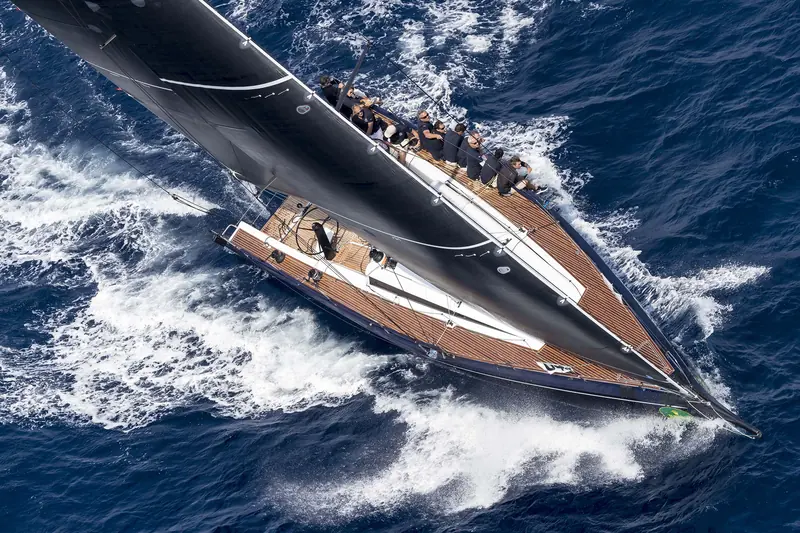
For the first fifty years of Nautor's Swan, the company's racer-cruisers had one signature: German Frers penned nearly every hull. The ClubSwan 50 broke that streak. Nautor ran an open design competition for its 50th anniversary boat with a one-line brief, that the result had to be cool, and the winner was the Argentine designer Juan Kouyoumdjian, known through the fleet as Juan K, whose resume ran through three Volvo Ocean Race winners, ABN Amro, Ericsson 4 and Groupama 4, and the record-breaking maxi Rambler 88. His hull for Swan looked nothing like the yard's back catalogue: a reverse sheer and reverse bow, hard chines aft, maximum beam carried almost to the transom, twin rudders and a mast stepped well aft and raked back, feeding a big square-top mainsail and a foretriangle sized for flying sails off a fixed carbon bowsprit. Yachting World's Toby Hodges called it simply the most extreme-looking production yacht he had tested.
Juan K has said the brief forced a balancing act: keep the DNA of what Frers had built for Swan while making a boat that was, in his words, a racing boat that could cruise rather than the other way round, with weight treated as the top priority throughout. The build backs that up. The hull and deck are laid up in carbon-epoxy Sprint laminate over a foam core, with an all-carbon keel fin, a fitting normally reserved for grand-prix raceboats such as the Volvo Ocean 65s, and over 40 percent of the boat's total displacement concentrated in the lead bulb at the foot of that keel. The result is a boat of 8,250 kg dry weight, carrying a sail area to displacement ratio Hodges measured at 36.5, which he judged the highest he had seen on any series-built yacht, alongside a light displacement to length ratio of 86.
What she is like to sail
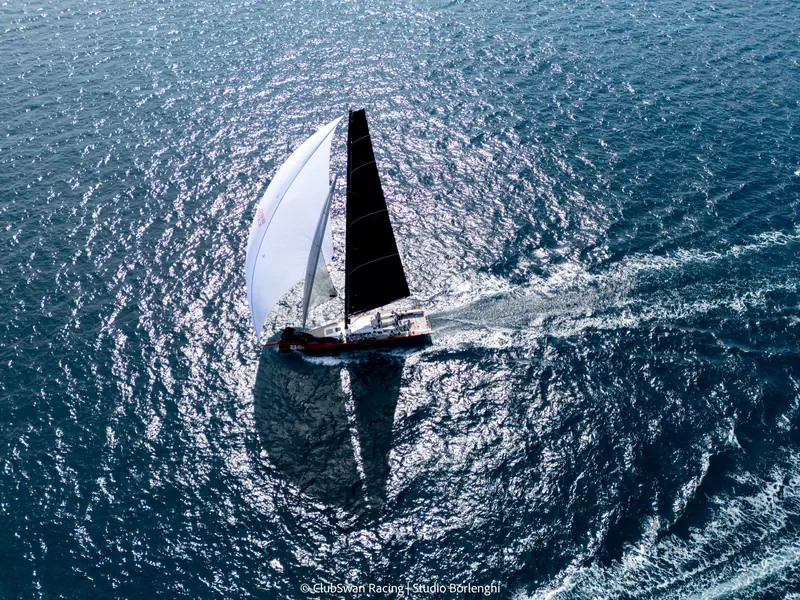
On Yachting World's first test sail out of Nautor's home yard in Pietarsaari, in just 5 to 10 knots of true wind, the ClubSwan 50 held 7 to 7.5 knots upwind with barely a wake, performance Hodges called astonishing for the breeze on offer. Under the big asymmetric, which sets at 235 square metres, the boat matched the true wind speed through most of the test and pointed up to roughly 60 degrees apparent. The boat is designed to sail heeled hard, with optimum angles Nautor and Hodges both put at 20 to 25 degrees upwind and 15 to 22 degrees reaching, a stance that stretches the waterline and increases righting moment while cutting wetted surface. At that heel the windward rudder's leading edge breaks the surface, so Juan K gave both blades a sawtooth, whale-tubercle profile, carried over from his Rambler 88 rudders, to limit drag and delay stalling as the blade dips in and out of the water.
Despite the raceboat engineering, the class was built to stay manageable for an owner-driver and a shorthanded crew. Below 10 knots of wind the running backstays can stay locked at the mast base; above that, the mainsail carries two reefs so the boom clears the runners on every tack and gybe. Under-deck furling on the headsail and electric winches in place of a coffee-grinder pedestal both cut down on crew work, and a synthetic teak deck saves weight without giving up grip. Hodges reported 9.5 knots of boat speed motoring at 2,500 rpm on the standard 40 hp Volvo diesel, more than enough range for the short hops between regattas that most owners actually sail. His verdict after that first sail was blunt: the boat was, in his word, addictive.
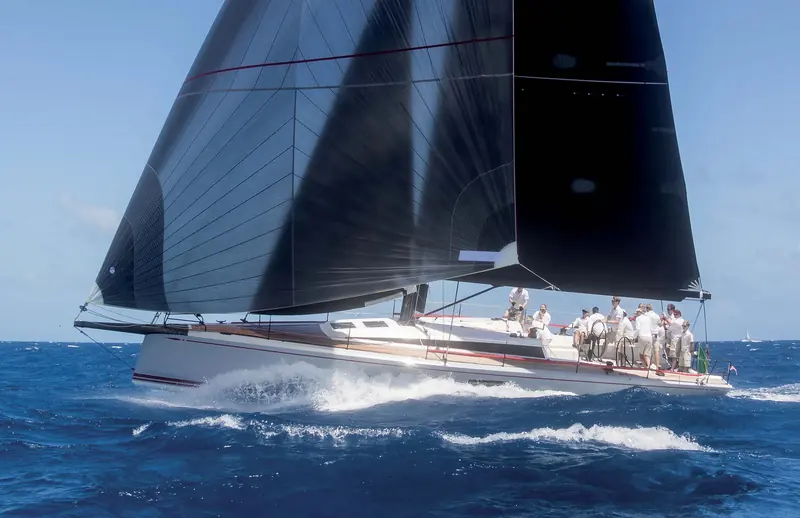
It was, in Toby Hodges's word for Yachting World, simply addictive to sail.
A one-design built to stop an arms race
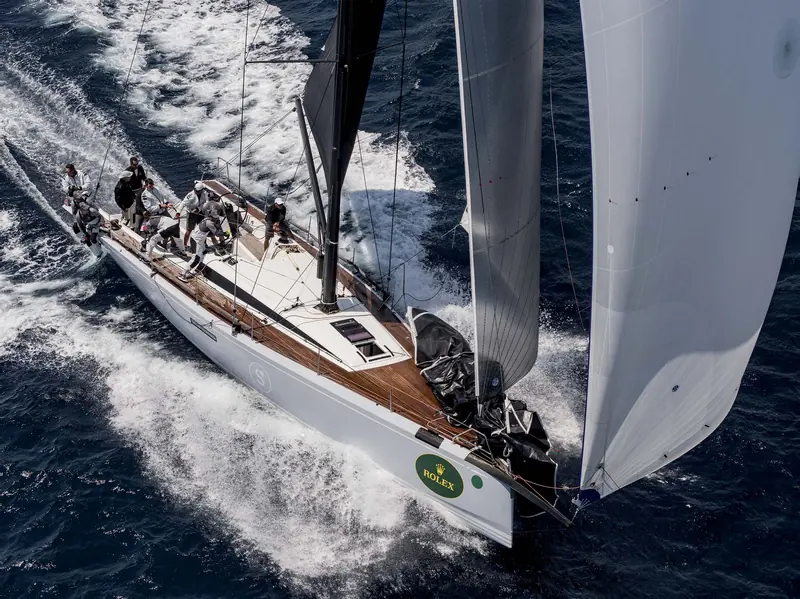
The ClubSwan 50 is not a development class where owners can spend their way to an edge. It is a strict one-design, meaning every hull, keel, rig and sail plan is built and measured to the same class rule, and racing is decided by crew work and tactics rather than a design office. World Sailing recognized the ClubSwan 50 as an International Class in 2018, putting it on the same regulatory footing as Olympic and grand-prix fleets. The class rule also enforces owner-driver racing directly: World Sailing's published rules for the class limit each boat to no more than four professional sailors plus one boat captain on board, and cap the number of new sails a boat can buy each season, both aimed squarely at keeping a campaign's cost predictable rather than open-ended.
Nautor has described the philosophy behind the class as sitting in a deliberate niche between excessive spending and competent racing. That framing matters because the ClubSwan 50 was launched into a market that already had development classes like the TP52 at a similar size, where campaign budgets can run far higher once a syndicate starts chasing incremental design gains. By fixing the boat and limiting the crew, Nautor's pitch to owners is that a ClubSwan 50 fleet stays close and competitive for years without any single owner being able to simply outspend the fleet into obsolescence, an argument the class's own regatta results, covered next, back up reasonably well.
A decade of racing, and a fleet that found its size
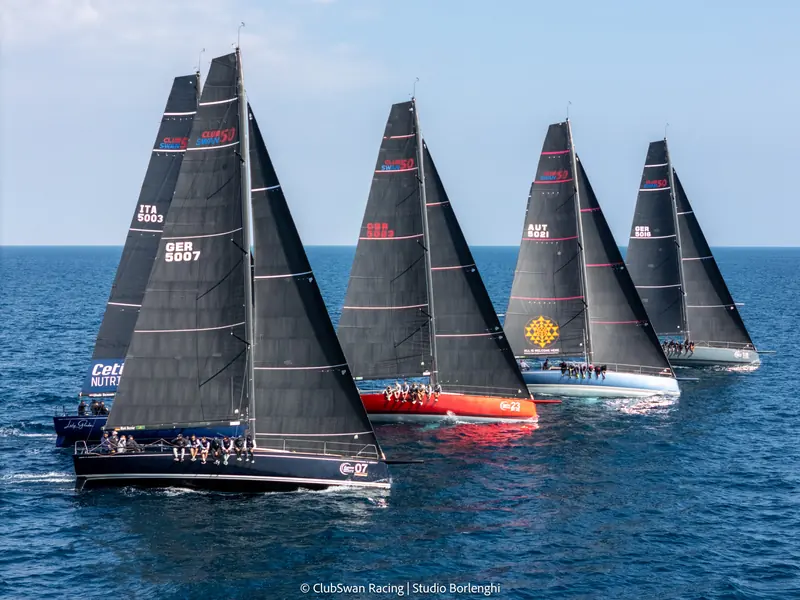
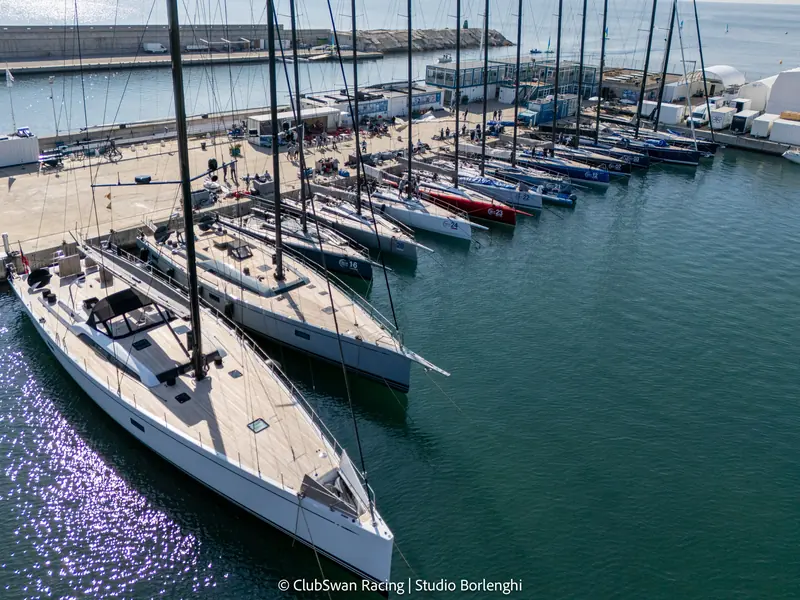
The first three ClubSwan 50s were delivered in September 2016 for that year's Rolex Swan Cup in Porto Cervo, and the class grew fast at first: Sailing Scuttlebutt counted 17 boats sold by December 2016, and Sailing World put the tally at roughly 24 owners within the boat's first year, enough to support Mediterranean fleet racing at Palmavela, the Giraglia Rolex Cup, Copa del Rey and an inaugural Nations Trophy at Real Club Nautico de Palma in October 2017, with a jump to sanctioned events in North America mapped out for 2018 and 2019. Seahorse Magazine reported the fleet at 28 boats by the end of 2020, with around 15 typically making a given start line, a pattern that has essentially held since. Nautor's own fleet page counted 27 ClubSwan 50s sold as of April 2025, sailed by owners from more than a dozen nations spanning Italy, Japan, Germany, Russia, Great Britain and Norway among others.
The racing itself has stayed genuinely tight. World Sailing-recognized ClubSwan 50 World Championships have been won by Dmitry Rybolovlev's Skorpios in 2019, Marcus Brennecke's Hatari back to back in 2020 and 2021, Leonardo Ferragamo's Cuordileone in 2022 and Hendrik Brandis's Earlybird in 2025, a run that shows the podium rotating among a small group of committed campaigners rather than one boat running away with the class. At the 2024 Rolex Swan Cup, Graeme and Raquel Peterson's Moonlight took the class title by a single point over Mark and Louis Bezner's Olymp and Brennecke's Hatari after seven races, with the result only settled by Moonlight's third place finish in the final race. Nautor also notes that owner crews across the fleet have included Olympic gold medallists, America's Cup sailors and veteran ocean racers, evidence that the class draws serious sailing talent even at owner-driver level.
Buying in
Yachting World priced a new ClubSwan 50 at nearly a million euros when it tested the first hull in 2016, describing that as roughly twice the price of the Solaris 50, a performance cruiser it had rated highly the previous year, and noted that a buyer chasing pure grand-prix racing without the cruising conversion might look instead at a TP52. Nautor's Swan has not published a current list price for the model. On the brokerage market, listings and price-reduction notices seen in 2025 show used ClubSwan 50s changing hands from roughly 650,000 euros up to around 980,000 euros depending on hull number, age and sail inventory, a wide enough spread that hull history and sail condition clearly matter as much as the model itself.
What that price buys is access to the fleet and its regatta circuit as much as the boat itself: Nautor markets the ClubSwan 50 as one of five one-design classes racing at the Rolex Swan Cup, alongside events like the Nations Trophy, and campaigning one seriously means budgeting for professional coaching and crew within the class's four-professional cap, sail purchases within the seasonal limit, and international regatta travel on top of the boat's own price. None of Nautor, World Sailing or the sailing press reviewed here publishes an all-in annual campaign budget for the class, so a prospective owner should treat the boat's purchase price as a floor rather than the full cost of racing it competitively.
Motores y sistemas
| Keel and bulb | Carbon fin keel with a cast lead bulb; standard 3.50 m draft or a 2.20 m shoal-draft option, both built to the same class rule so hulls stay identical (Nautor's Swan; Wikipedia). |
|---|---|
| Rig | Carbon fractional sloop, mast stepped well aft and raked, with swept spreaders that let the running backstays sit at the mast in light air; fixed carbon bowsprit for the asymmetric (Yachting World; Nautor's Swan). |
| Sail wardrobe | Square-top mainsail of 93 sq m and a foretriangle of 65 sq m upwind, with a 235 sq m asymmetric for downwind; the class rule caps new sail purchases each season to hold down campaign cost (Nautor's Swan; Wikipedia). |
| Deck hardware and systems | Under-deck headsail furling, electric winches instead of a coffee-grinder pedestal, and a synthetic teak deck as standard to save weight and improve grip at high heel angles (boats.com; Yachting World). |
| Construction | Hull and deck in carbon-epoxy Sprint laminate over a foam core, with painted rather than faired surfaces and CNC-machined keel fins and rudders to hold every hull to the same one-design tolerances (boats.com; Seahorse Magazine). |
Lo que cuentan armadores y tripulaciones
Designed as a racer that could cruise, not the reverse
Juan Kouyoumdjian said he kept the Swan DNA in mind but treated the ClubSwan 50 first as a racing boat with cruising ability layered on, with weight the single biggest priority in the design.
Juan Kouyoumdjian, quoted in Yachting WorldTight one-design racing rewards boat handling over budget
At the 2024 Rolex Swan Cup the top three ClubSwan 50s, Moonlight, Olymp and Hatari, were separated by a single point after seven races, decided only by Moonlight's third place in the final race.
Nautor's SwanThe class has settled at a stable core fleet rather than keeping growing
Nautor counted 27 ClubSwan 50s sold from more than a dozen nations by April 2025, with owner crews that include Olympic gold medallists and America's Cup sailors, but around 15 boats is still the typical regatta turnout.
Nautor's SwanSails fast even in very light air
On its first test sail the ClubSwan 50 held 7 to 7.5 knots upwind in just 5 knots of true wind, a result the reviewer called astonishing for a boat of this size and weight.
Toby Hodges, Yachting World
Lo bueno y lo que conviene vigilar
Puntos fuertes
- Genuine one-design racing at the top levelA strict owner-driver class rule with a cap of four professionals plus one boat captain keeps racing about tactics and crew work rather than budget, and the fleet has produced single-point finishes at the Rolex Swan Cup and the World Championship.
- Serious performance for the displacementJuan Kouyoumdjian's carbon hull and deep bulb keel give an 8,250 kg boat enough righting moment to sail comfortably at 20 to 25 degrees of heel and hold hull speed in barely 5 knots of true wind, per Yachting World's test.
- Backed by Nautor's own global regatta networkOwners buy into the Rolex Swan Cup, the Nations Trophy and the ClubSwan World Championship circuit, a level of organized one-design racing few other 50-foot classes outside the true grand-prix fleets can match.
A tener en cuenta
- One-design means no room to develop the boatClass rules that lock the hull, keel and rig and cap sail purchases per season mean an owner cannot chase performance gains the way they could in a box-rule or handicap fleet like the TP52; you buy into the fleet as it is.
- Fleet growth has plateaued well short of Nautor's early ambitionsAfter 17 boats sold by the end of 2016 and 28 by 2020, the class stood at 27 boats in April 2025, short of the 50-boat fleet Nautor once hoped for, and a typical regatta still sees only around 15 boats on the start line.
- A near-million-euro price for a boat with limited cruising accommodationYachting World priced the new boat at nearly a million euros in 2016, about twice a comparable performance cruiser of similar size, for a yacht whose interior is deliberately stripped back to save weight for racing.
Información práctica
| New price | Around EUR 1 million when new, per Yachting World's 2016 test; Nautor's Swan does not publish a current list price for the model |
|---|---|
| Used/resale | Brokerage listings seen in 2025 show used ClubSwan 50s trading from roughly EUR 550,000 for an early 2017 hull up to around EUR 980,000 for a later, better-equipped one, depending on hull number, age and sail inventory |
| Running/campaign costs | Not separately published by Nautor or World Sailing; the class rule constrains cost structurally, by limiting professional crew to four plus a boat captain and capping new sail purchases each season, rather than by publishing a campaign budget figure |
| What is not published | An official righting moment figure and the exact per-season sail quota under the current class rule; a third-party ORC certificate lists a righting moment number but Yotters could not corroborate it from a second independent source, so it is omitted here |
Para quién es: An owner-driver who wants genuine grand-prix one-design racing against an international fleet, at a fixed and predictable campaign cost, rather than an open development class or a boat built primarily for cruising.