W130
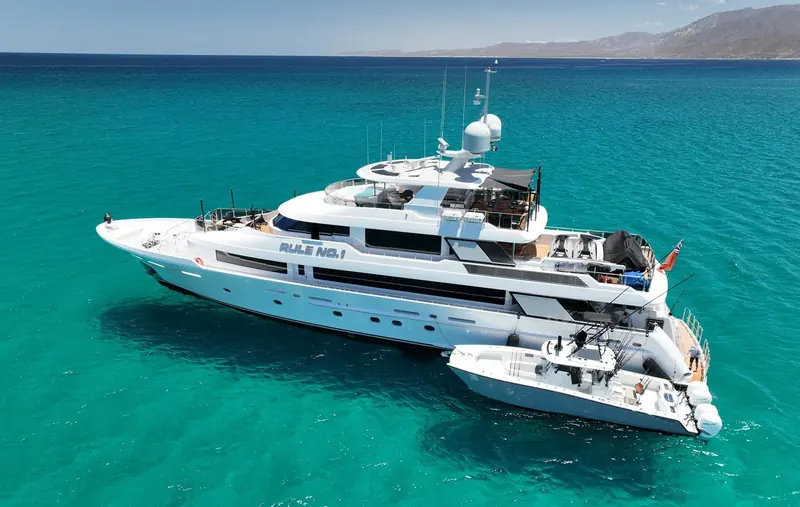
| 39.62 m LOA (130 ft), 7.98 m beam, tri-deck | |
| 333 GT ITC, ABS classed, MCA compliant | |
| Twin MTU 16V2000 M96L diesels, 2,600 hp each on later hulls | |
| 20 knots cruise, 24 knots top speed | |
| 36,075-liter fuel capacity for legs beyond 2,500 nm at displacement speeds | |
| 10 guests in 5 ensuite staterooms, on-deck master | |
| Crew of 7 including captain and aft engineer cabin | |
| Well over 40 hulls delivered between 2001 and 2023 |
The series that defined the American 40-meter
Westport introduced the W130 at the Fort Lauderdale Boat Show in 2001, pairing naval architecture by William Garden with exterior styling by Taylor Olson and the yard's in-house interiors. The market answered immediately and kept answering: trade press counted 33 hulls delivered by mid-2011, the 38th hull arrived in October 2013 with two more due the following year, and new W130s were still being completed as late as 2023.
The design was restyled and updated around 2010 into what the yard marketed as the 40 m generation, with refreshed lines and upgraded systems on the same proven platform. Production only ended when Westport moved the size bracket to the new W135 raised pilothouse, which means the W130 retired as a current, continuously developed product, and the fleet on the water reflects every stage of that evolution.
Five staterooms and a crew of seven
Ten guests sleep in five ensuite staterooms. The master is on the main deck with a king bed and separate his and her baths sharing a central shower, the classic on-deck arrangement that keeps the owner a few steps from the saloon and the aft deck. Two equal VIP suites with centerline king beds sit aft on the lower deck, with two twin-bed guest staterooms amidships, each with private facilities.
Crew quarters take seven: a captain's cabin to port, two crew cabins forward with four berths, and an engineer's cabin aft with a double berth and private head, positioned by the machinery he looks after. The tri-deck arrangement adds an upper sky lounge to the main saloon and formal dining for ten, and the full walkaround side decks, a very American priority, keep crew circulation off the guest spaces. Every hull's joinery and stonework came out of Westport's own cabinet shop, in solid woods and veneers selected with the owner.
More than forty hulls of the same 40-meter tri-deck, delivered across two decades, make the W130 the most liquid American superyacht ever built.
Twenty-four knots, ocean legs at twelve
Later hulls run a pair of MTU 16V2000 M96L diesels of 2,600 hp each through ZF 5050A gears, while earlier boats of the restyled generation carried 2,735 hp MTUs. Either way the performance envelope is the same one that sold forty-plus hulls: a genuine 20-knot cruise and 24 knots flat out from a semi-displacement composite hull.
Fuel capacity of 36,075 liters supports long-range work at displacement speeds, with trade reviews putting realistic legs beyond 2,500 nautical miles at 10 to 12 knots. At 333 gross tons ITC the W130 carries ABS class with an A1 commercial yachting notation and an MCA Red Ensign compliance statement, so charter registration and experienced-crew recruitment are straightforward.
Systems specified like a working ship
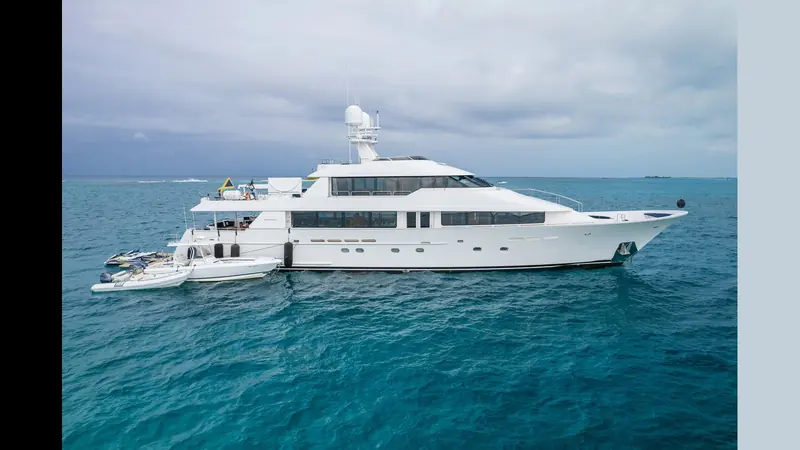
Stabilization underway comes from Naiad 525 fins with fly-by-wire control, powered off the central hydraulics for zero-speed duty at anchor, and recent hulls added a pair of VEEM VG120 gyros for fin-free stillness in a rolling bay. Two 99 kW Northern Lights generators with seamless power transfer carry the hotel load, and twin watermakers deliver 3,700 gallons a day.
The deck kit is equally serious: a 3,000-pound Nautical Structures davit for the 17-foot AB tender with its 115 hp outboard, a double-telescoping wheelchair-capable passerelle, twin Furuno radars, and Novec clean agent fire suppression in the engine room. Frameless chemically strengthened glazing is bonded directly to the structure, and the Alexseal Snow White finish is the fleet's visual signature.
Why the brokerage market loves it
No 40-meter series offers more sisterships, and that changes the ownership math at both ends. Surveyors know the boat, captains know the boat, and the parts commonality across dozens of hulls keeps maintenance predictable through the American service network. When it is time to sell, the market comps are real and recent, which is why W130s trade faster than one-off yachts of the same age.
With the W135 now occupying the new-build slot, the W130 has become the value route into a 40-meter Westport, with well-kept examples spanning two decades of delivery years and a wide band of USD price points. For a first superyacht owner who wants ten-guest capability, a crew of seven and no experimentation risk, the case is about as clean as brokerage gets.
Buying a used W130: what the two generations mean
The W130 was never a single static design. Westport ran two distinct generations across its twenty-two year, forty-plus hull production life, and the difference matters more to a used-boat buyer than the model year alone suggests. Early hulls, built 2000 to 2008, carry twin MTU 12V4000 M90 engines at 2,735 hp each, a simpler electrical and deck-hardware package, and, per an experienced captain describing the type on the YachtForums owners' board, can be run comfortably with six crew, seven if actively chartering. The restyled generation from around 2009 switched to the lighter MTU 16V2000 M96L at 2,600 hp each, a broadly similar top speed, but added glass guardrails, more teak decking, larger sundecks and more onboard systems, all of which the same captain describes as making the newer boats a lot more work to crew and maintain despite the lower-horsepower engines.
That split shows up in asking prices: early hulls trade roughly USD 6.5 to 11 million, later hulls USD 14.6 to 19.5 million, based on current YachtWorld listings. But condition and refit history swing the number more than the generation line does. Plan A, a 2007 hull, needed a refit exceeding USD 4.3 million in 2014 just to stay presentable, plus further work in 2023, before selling at a last ask of USD 8.9 million, brokered by JD Ducanes of Reel Deal Yachts and John Varga of Westport Brokerage. In practice the real due-diligence question on a used W130 is not which generation but what has actually been reinvested in that specific hull. Engines and gears are durable and well proven across both generations; teak, glasswork, air conditioning and interior soft goods on a twenty-plus-year-old GRP hull are where the six and seven figure surprises tend to live.
Motores y sistemas
| Main engines | Two generations. Early hulls (2000 to 2008) run twin MTU 12V4000 M90 diesels at 2,735 hp each for about 29 knots top speed and 25 knots cruise. Hulls from around 2009 carry the lighter MTU 16V2000 M96L at 2,600 hp each through ZF 5050A gears, for 24 knots top speed and 20 knots cruise (YachtBuyer spec pages for each generation) |
|---|---|
| Generators | Twin Northern Lights units of about 99 kW each (YachtBuyer, general W130 overviews agree) |
| Stabilisers | Naiad fin stabilisers, one detailed listing citing model 3520 with 22 sq ft fins and Multisea 2000 control (YachtBuyer). A separate general overview mentions gyro stabilisation on later boats; that claim could not be confirmed against a primary source and should be treated as unverified |
| Fuel and water | Fuel capacity about 36,075 litres on later hulls, closer to 37,480 litres on the earliest boats. Fresh water runs 1,620 to 1,744 gallons depending on generation, with grey and black water tanks varying by hull (YachtBuyer spec pages) |
| Range | Reported inconsistently across sources, from about 2,500 nautical miles at 10 to 11 knots on later hulls to around 3,450 nm at 12 knots on early ones, with one general overview separately estimating 3,000 nm. The spread likely reflects different generations and loadings rather than one wrong figure; there is no single authoritative number |
| Construction | All-GRP hull and superstructure, no steel or aluminium. A W130 takes roughly 150,000 man-hours to build, with wood and stone joinery done in-house by Westport's own craftsmen rather than outsourced (Yachting Magazine) |
Lo que cuentan armadores y tripulaciones
Newer hulls need more crew, not fewer
Most older 130s run with six crew, seven if actively chartering. The newer 130s are a lot more work than the older ones, with glass railings, teak decking and larger sundecks adding to the load
a working captain, YachtForums owners' board
Lo bueno y lo que conviene vigilar
Puntos fuertes
- Full walkaround decks despite an on-deck masterUnusual at 40 metres and specifically praised by YachtBuyer's Carl Richardson as a practical advantage for families and general cruising, not only Caribbean charter use
- Deep sistership comps make it the most liquid boat in its classSurveyors, captains and the American service network all know the boat, and with well over forty hulls delivered, resale comps are real and recent, which is why W130s change hands faster than one-off yachts of the same age
A tener en cuenta
- Running costs are a genuinely large numberRealistic annual running cost sits at 8 to 12 percent of current value (Nick Burnham, YachtBuyer), which at a USD 9 to 19 million valuation band means USD 720,000 to over 2.3 million a year, plus crew salaries YachtBuyer puts at 500,000 dollars or more
- Two distinct generations complicate buying oneThe 2,735 hp MTU 12V4000 of early hulls and the 2,600 hp MTU 16V2000 of later ones carry materially different range and speed figures depending on source, so a buyer needs to know which generation a specific hull is before trusting any single spec sheet
- Later hulls are more work to run, not lessAn experienced captain describing the type on the YachtForums owners' board says most older 130s run with six crew, seven if chartering, while the newer, restyled hulls with glass guardrails, more teak decking and larger sundecks are a lot more work to crew and maintain despite their lower-horsepower engines
Información práctica
| Asking prices | Roughly USD 6.5 to 11 million for early (2000 to 2008) hulls and USD 14.6 to 19.5 million for later (2009 to 2019) hulls on current YachtWorld listings, though condition and refit history move the number more than generation does |
|---|---|
| A named recent sale | Plan A, a 2007 hull, needed a refit exceeding USD 4.3 million in 2014 plus further work in 2023 before a last ask of USD 8.9 million, brokered by JD Ducanes of Reel Deal Yachts on the sell side and John Varga of Westport Brokerage on the buy side (Boat International) |
| Running cost | About 8 to 12 percent of current value a year, plus crew salaries of USD 500,000 or more (Nick Burnham, YachtBuyer) |
| Charter | Weekly rates on boats currently offered run from about USD 95,000 to 115,000 plus expenses (Select Yachts, RJC Yachts, Worth Avenue Yachts), all early-generation hulls. Advertised weekly rates typically cover only 60 to 80 percent of a real trip once tax, APA and gratuities are added |
Para quién es: A brokerage buyer who wants a proven 40-meter with ten-guest capability, deep sistership comps and predictable running costs, at a USD entry point the new-build market cannot match.