Five studios share one Hargrave hull, and Teruzzi drew the tri-deck
A fifth name above the tank deck
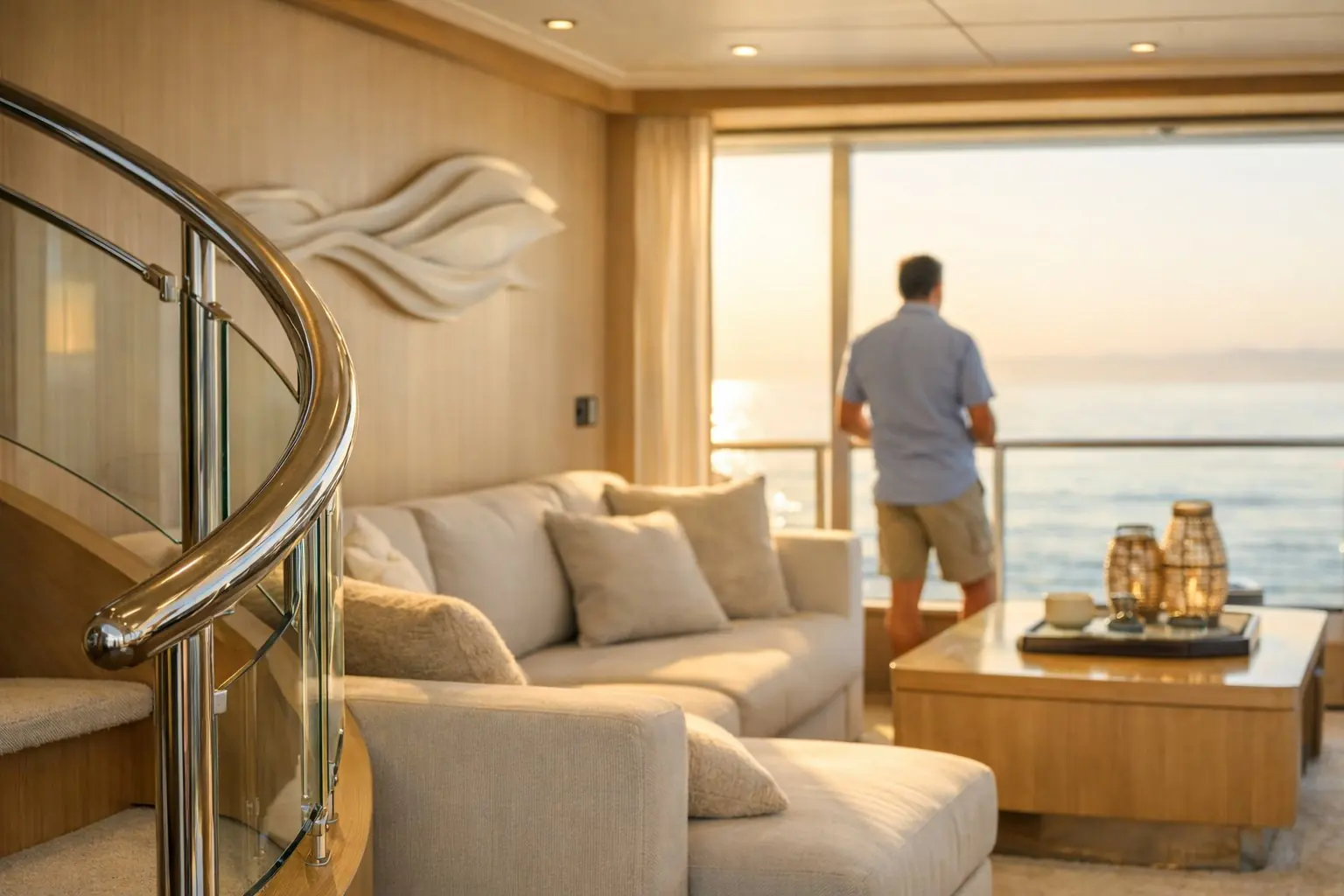
On 28 July, Hargrave Custom Yachts showed a tri-deck drawn by Gabriele Teruzzi Yachts and Design, the Italian studio's first work for the Florida builder. It joins the Signature programme, which until now attached four studios to the raised pilothouse line called Anemos: Satura of Rome, Tony Castro of the United Kingdom, Edoardo Ridoli of Milan and Facheris of Miami. Teruzzi's contribution is a tri-deck rather than a pilothouse boat, and the feature the yard is pushing is an aft deck that can be ordered as a covered veranda. The designer has described the exterior as built around harmony, rhythm and proportion, borrowed from classical music.
The studio is not a small name. Teruzzi has drawn for Fincantieri Yachts in the 65 to 80 metre band and produced a 110 metre concept for Lurssen, which is a different altitude of client from a Florida semi-custom yard. That is the point of the exercise. Hargrave has stopped selling its own styling and started selling access to studios an owner would otherwise meet only at the top of the market.
The hull nobody is redrawing
Everything above the tank deck moves. Everything below it does not. The E Series sits on hull forms engineered by Jack Sarin, and Hargrave says more than 30 yachts have been built and are in service on that foundation. The platform covers 80 to 140 feet, offered in FRP with carbon reinforcement or in aluminium, and minimum ceiling height is held at 2.15 metres throughout.
The numbers that decide whether a boat is pleasant to live on are fixed as well. On the Anemos version the yard quotes a maximum of 58 dB-A at 80 per cent engine load, and the boats are classed by RINA. None of it appears in a rendering, but it is the part of a yacht that is expensive to get wrong and close to impossible to fix afterwards. Buying it pre-solved is the whole commercial argument for a platform boat.
What the pilothouse boat carries, and what it costs
The Anemos line is the better documented half of the programme. It runs from 30 to 38 metres, with beam between 7 and 7.92 metres and interior volume of 250 to 270 GT. Accommodation is ten guests in five cabins, an owner's suite and four guest cabins, with seven crew. Power is twin Caterpillar C32s, and BOAT International reports a cruising speed of 22 to 24 knots, a maximum around 25 to 26, and range of 2,000 nautical miles at 10 to 11 knots.
The price quoted is USD 18.5 million. That is a serious number for a boat past 30 metres carrying 250 GT of volume, and it explains why a builder would go to the trouble of assembling five studios. An owner at that level is choosing between a European semi-custom hull with a waiting list attached and an American one that can be styled to look like neither. Hargrave has decided the styling is the ground worth fighting on.
Mixing the drawings
The process is more open than a studio badge suggests. A buyer can take one studio's exterior and another studio's interior, or ignore the roster and bring a designer of their own. The yard holds the engineering, the headroom and the core systems constant and lets the rest move. It is the logic a car maker uses when it sells one platform under four bodies, and it works for the same reason: the costly part is the part nobody sees.
The risk sits on the other side of the transaction. A hull built 30 times over is a hull 30 owners already have, and a signature exterior is a thinner form of distinction than a genuinely bespoke boat. Whether a Teruzzi profile holds value better than a Facheris one is not a question anyone can answer yet, because none of the Signature boats has come back to the brokerage market. An owner who cares about that should treat the design credit as a preference rather than as an asset.
What is actually in the water
Four tri-decks on the platform have been delivered so far: a 125 completed this year, a 118 from 2024, and a pair of 116s built in 2022 and 2023. A 40 metre tri-deck is under construction and still listed as available, which means a buyer can step into a hull already in build rather than start one from a contract signature. That is a shorter route to the water than any custom order and shorter than most semi-custom slots in Europe.
The Teruzzi tri-deck itself is a design release, not a signed contract, and no hull has been announced against it. That is worth holding in view before treating it as a model. Hargrave has now published five sets of drawings on one platform, and the test of the programme is whether owners sign for a body rather than for a boat.
Questions this story answers
What happened?
Hargrave has handed its E Series tri-deck to Gabriele Teruzzi, the fifth outside studio to draw a body on the same Jack Sarin hull. For a buyer this is the cheap half of custom: the engineering is settled and paid for, and only the parts you look at are still open. What nobody can price yet is whether a studio signature above the tank deck is worth anything on resale.
Who reported this?
BOAT International, Megayacht News, Hargrave Superyachts.
We do this for everyone who loves this world. The people who have spent their lives in it, and the people just discovering it. Yotters exists so that what we learn belongs to all of them.
Nobody pays us for this. No ads, no sponsors, nothing for sale. We just believe the world is a little better when knowledge is shared instead of kept.
If it gave you something today, tell us to keep going. Follow us, leave a like, or write a positive comment. We read every one, and they are what keeps us going.