Gabe Newell Bought Oceanco Mid-Build on His 111m Leviathan
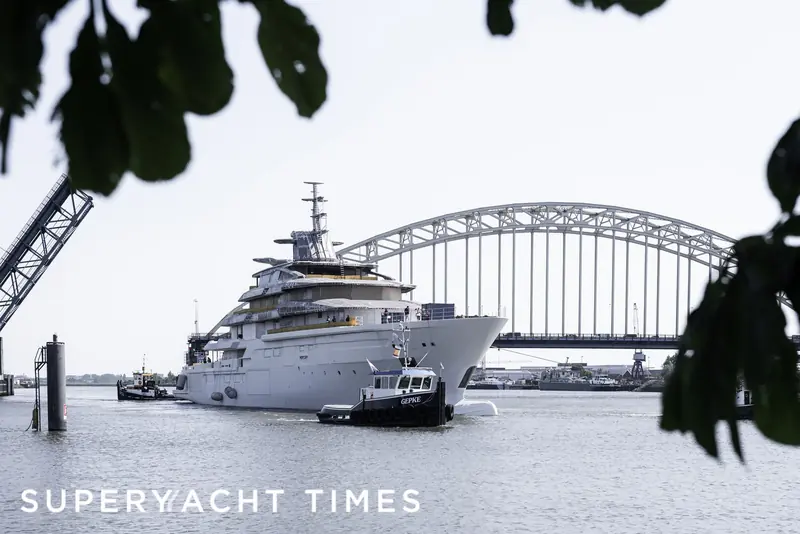
Why does Gabe Newell now own both the yacht and the yard that built her?
In August 2025, while Leviathan was still being finished, her owner Gabe Newell bought Oceanco outright from Mohammed Al Barwani, so the yacht and the yard that built it now answer to the same person.
Newell, a co-founder of the video game company Valve, took delivery of the 111-metre Leviathan from Oceanco's Alblasserdam yard in the Netherlands in August 2025, the same month he acquired the shipyard itself. Oceanco has not published a sale price for either transaction. What is on the record is the working relationship the deal formalised: Newell had already been closely involved in Leviathan's build, and BOAT International's report on the project quotes him describing the process with Oceanco chief executive Marcel Onkenhout as collaborative rather than transactional, saying it felt like working toward shared goals rather than buying a product off a list.
For an owner, buying your own builder mid-project is not a common move, and it changes the usual calculus around warranty, service and re-sale. A yard under its own client's ownership has less reason to walk away after handover, and Newell now has a direct line to the design team behind both Leviathan and her support vessel Draak for any future project. Oceanco's sales team frames the arrangement as validation rather than acquisition risk: sales director Wim Verhoeff told BOAT International the yard has built a portfolio that attracts owners who want to do something different, and Newell's purchase is the clearest evidence yet of how far that difference now extends.
What makes Leviathan's layout different from a standard 111-metre superyacht?
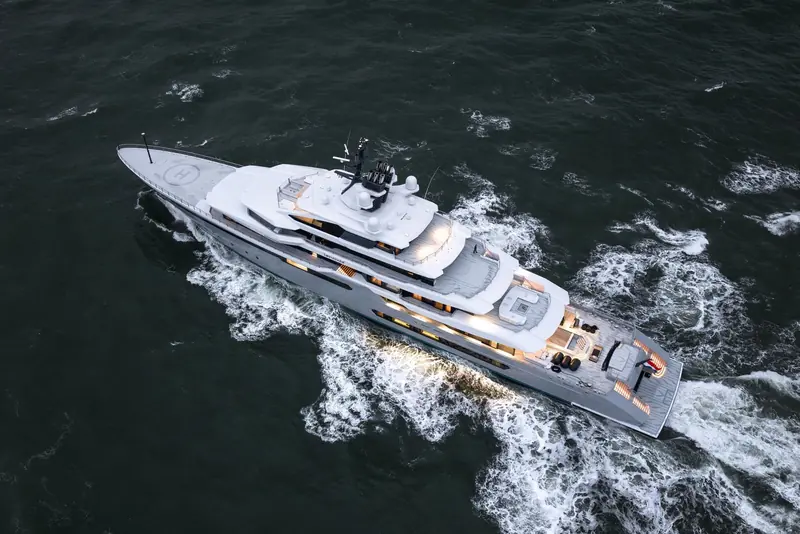
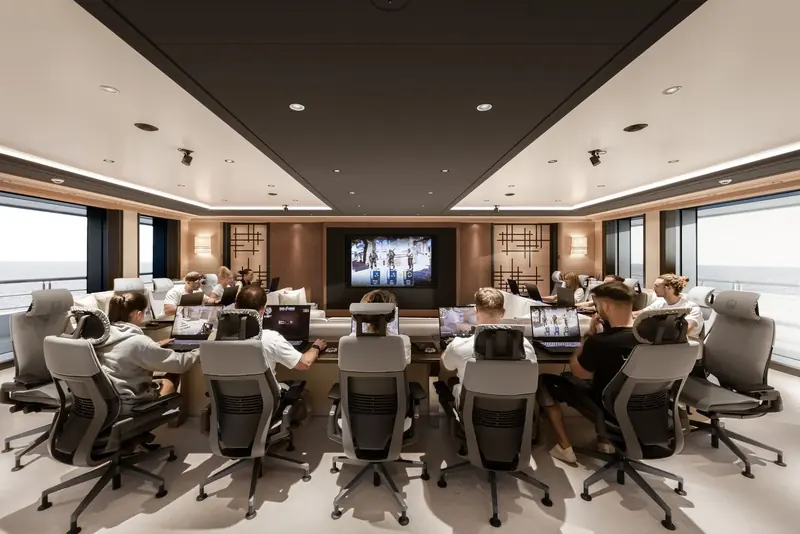
Leviathan gives crew space that a comparable superyacht would give to guests: a communal mess for up to 56 people, a training galley, a spa pool and a basketball hoop on the bridge deck, all driven by an owner's brief that treats the crew's working life as part of the design problem.
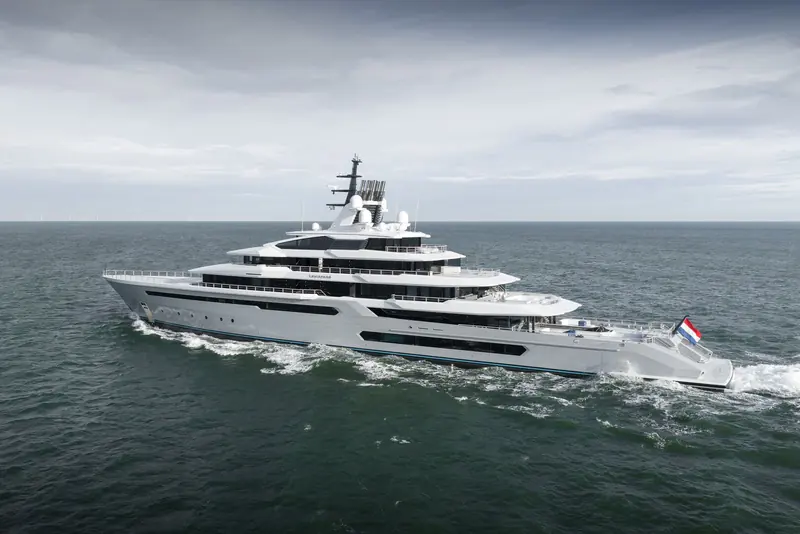
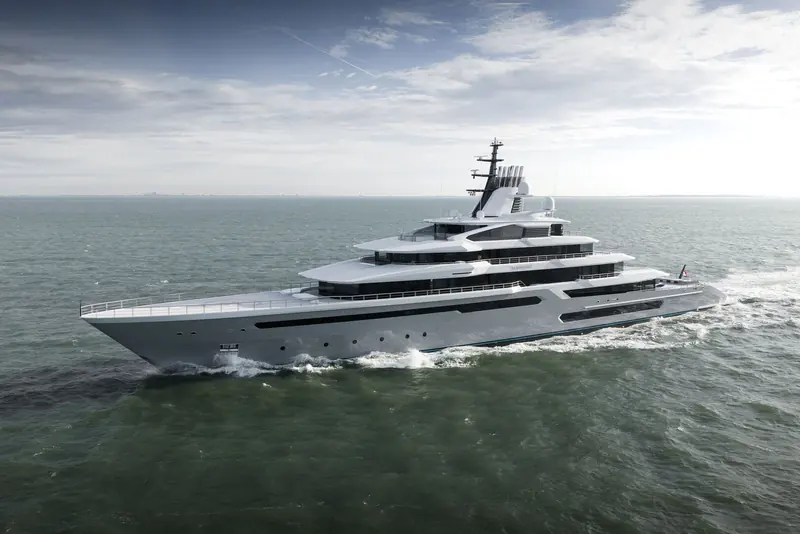
Interior designer Mark Berryman told BOAT International he was asked to convert what would ordinarily be the main deck saloon, prime real estate on any superyacht, into a crew mess, and said his own reaction was to question whether the owner was certain. The answer held. The finished layout puts a large buffet and pantry-linked dining space at the centre of the boat for guests and crew together, a regulation beer pong table and a spa pool on the sundeck, and work stations built into every cabin rather than reserved for officers. Oceanco's head of design, Gilles Vernhet, has described the exterior as a forward-leaning, relatively compact silhouette for the 4,970 GT hull, a deliberate choice to keep the superstructure modest even though the 17.8-metre beam had room to spare.
The brief also ruled out teak decking entirely, on cost, maintenance and environmental grounds, which sent Oceanco to Bolidt for a custom synthetic deck and matching synthetic caprails, and pushed the design team toward noise and vibration damping that Oceanco senior designer Patrick Casanova called one of the most ambitious targets the yard has set for a yacht this size. None of this reads as a cut-price build. It reads as a very expensive yacht spending its budget on crew welfare and acoustic engineering instead of the usual beach club and chrome, which is a genuinely different spending decision for an owner to make, not a cheaper one.
Can Leviathan actually do scientific work, or is the research framing decoration?
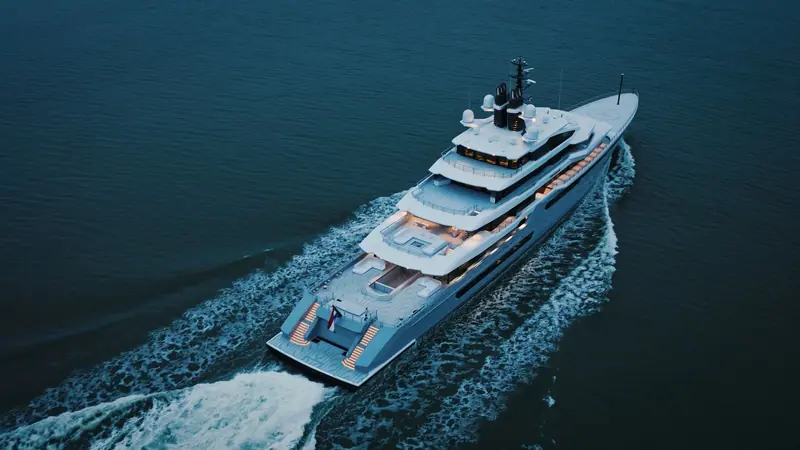
Leviathan carries a real laboratory with a 3D printer, a dive centre converted from what would normally be a beach club, and an onboard hospital, built to support Newell's Inkfish organisation rather than to dress up a standard charter yacht.
Inkfish is Newell's own description for the operation behind the yacht: what BOAT International's report calls a service organisation for scientists, reflecting Newell's stated interests in ocean exploration, neuroscience and marine research alongside his gaming background. The practical result on board is a laboratory, a dive centre in place of the usual beach club, and hospital facilities, backed by a diesel-electric propulsion plant built for the job rather than for speed: two ABB D0980P azipods drawing on a 5.3 megawatt-hour battery pack that Oceanco says supports around ten hours of silent, emission-free running at anchor, useful for observing marine life without disturbing it and for genuinely quiet overnight stays.
The tradeoff is speed. Leviathan cruises at 13 knots and tops out at 17.6 knots, slow for a 111-metre yacht of this cost, with a 6,500 nautical mile range at cruise. That is a research-vessel performance profile, not a superyacht one, and it is the clearest evidence that the science brief was not marketing dressed over a normal build: a yard does not sacrifice speed on a flagship commission unless the owner asked it to.
What is Draak, and why is she showing alongside Leviathan at Monaco?
Draak is a 92.8-metre Oceanco support vessel, rebuilt from the 91.5-metre Y709 delivered in 2014, converted with cranes, a dive centre and a decompression chamber so she can operate as Leviathan's working partner rather than as a separate yacht.
Oceanco reworked Draak specifically to pair with Leviathan: the original helipad came off, sturdy cranes went on, the beach club became a dive centre with its own decompression chamber, and the galley was converted into what the design team has called a chefs' lab. Both vessels carry a matching grey hull scheme and were designed by the same Oceanco in-house Monaco team, and Vernhet has described reuniting the two projects under one owner as a genuinely interesting moment for the studio, since each was designed separately before Newell's ownership connected them.
For Monaco Yacht Show visitors this week, seeing Leviathan and Draak together is the point: a support vessel is normally an afterthought bought or chartered separately, and pairing a purpose-built one at the same show as the flagship is a statement about how seriously Newell is treating the operational side of ownership, not just the yacht itself.
What would it cost, and what would an owner give up, to build something like Leviathan?
Independent estimates put Leviathan's build cost near 500 million US dollars, a figure neither Newell nor Oceanco has confirmed, and the published capacity numbers for the yacht itself do not agree with each other, which is the honest state of the public record on a vessel this new.
Third-party listings disagree on basic figures that are normally settled by the time a yacht reaches its first show. BOAT International's direct report on the build puts guest capacity at 12 across six lower-deck cabins plus the owner's suite, with a 43-person crew. Brokerage and charter listing sites cite figures ranging from 22 to 26 guests across 11 cabins and a crew of 33 to 37. Neither Oceanco nor Newell has published a definitive specification sheet to resolve the gap, which likely reflects how flexibly the cabins convert between guest and crew use rather than an error on either side, but it means a prospective owner asking what a boat like this sleeps cannot get a single answer from the public record yet.
The build cost sits in the same uncertain place. Wikipedia's entry on Leviathan cites an estimate near 500 million US dollars, sourced to outside reporting rather than to Oceanco or Newell directly, and no party involved has confirmed a number. What is confirmed is that Leviathan won Robb Report's 2026 Gigayacht award and is a finalist in the Sciences and Exploration, and Innovation and Technology categories at the 2026 La Belle Classe Explorer Awards, external recognition that at least corroborates the scale of what was built, even where the price of building it remains an outsider's guess.
What owners and crew report
The build felt collaborative, not transactional
Newell described working with Oceanco chief executive Marcel Onkenhout as feeling like a shared-goals collaboration rather than a standard commission.
BOAT International (report on Leviathan, 2026)The interior designer was surprised by the crew-first brief
Mark Berryman said he questioned the owner directly when asked to turn the main deck saloon, normally the most valuable guest space on the yacht, into a crew mess.
BOAT International (report on Leviathan, 2026)The yard sees the sale as proof of its niche, not a risk
Oceanco sales director Wim Verhoeff said the yard's portfolio attracts owners who want to do things differently, pointing to Newell's purchase as the clearest case yet.
BOAT International (report on Leviathan, 2026)
What is good, and what to watch
Strong points
- The owner now owns the yardNewell's August 2025 purchase of Oceanco puts warranty, service and future builds in the hands of the same person who commissioned the yacht, a continuity most owners never get.
- The research capability is real, not decorativeA working laboratory, a dive centre with its own support vessel, and a propulsion system built for quiet, long-range operation are genuine tradeoffs against speed, not marketing language over a standard hull.
- External recognition backs the scale of the projectA Robb Report Gigayacht award and two 2026 La Belle Classe Explorer Awards finalist nods corroborate the build's ambition independently of Oceanco's own account.
What to watch
- Top speed is slow for the size and cost17.6 knots maximum and 13 knots cruise is a research-vessel profile, not what most buyers at this budget level expect from a flagship.
- The published numbers do not agreeGuest and crew figures vary by more than double depending on the source, and no party has issued a definitive spec sheet to settle it.
- The cost figure is a guessThe widely cited near-500-million-dollar estimate traces to outside reporting, not to Oceanco or Newell, so any owner comparing budgets against it is comparing against a rumour, not a confirmed number.
- A crew this large is a running cost, not just a build costIf BOAT International's 43-person figure is the accurate one, that is a heavy annual operating commitment even against other yachts in the 100-metre-plus class.
Practical detail
| Length / beam / GT | 111 metres LOA, 17.8 metre beam, 4,970 GT |
|---|---|
| Builder / delivery | Oceanco, Alblasserdam, Netherlands; delivered August 2025 |
| Propulsion / speed | Diesel-electric, 2 x ABB D0980P azipods, 5.3 MWh battery; 13 knots cruise, 17.6 knots max, 6,500nm range at cruise |
| Guest / crew capacity | Disputed: 12 guests / 43 crew per BOAT International's direct report; 22-26 guests / 33-37 crew per brokerage listings. No confirmed figure published by Oceanco |
| Design team | Naval architecture by Oceanco and Lateral Naval Architects; interiors by Mark Berryman Design |
| Estimated cost | Near USD 500 million per outside estimates; not confirmed by Oceanco or Newell |
| What is not published | A definitive guest and crew count, and any official build price |
| Sister vessel | Draak, 92.8 metres, rebuilt from the 2014-delivered Y709 as a dedicated dive and support platform |
Questions this story answers
What happened?
Gabe Newell took delivery of Leviathan, a 111-metre Oceanco explorer built around a diving lab and a crew mess rather than a beach club, and bought the shipyard that built her before she left the dock. Both vessels are at Monaco Yacht Show this week, and the brief behind them is a real test case for any owner weighing how far a build can move from the standard luxury template before it stops being a yacht at all.
What is good about it?
The owner now owns the yard. Newell's August 2025 purchase of Oceanco puts warranty, service and future builds in the hands of the same person who commissioned the yacht, a continuity most owners never get.
What should an owner or buyer watch?
Top speed is slow for the size and cost. 17.6 knots maximum and 13 knots cruise is a research-vessel profile, not what most buyers at this budget level expect from a flagship.
What do owners and crew report?
Newell described working with Oceanco chief executive Marcel Onkenhout as feeling like a shared-goals collaboration rather than a standard commission. (BOAT International (report on Leviathan, 2026))
Who reported this?
BOAT International, Oceanco, SuperYachts.com, YachtCharterFleet, Lateral Naval Architects.
We do this for everyone who loves this world. The people who have spent their lives in it, and the people just discovering it. Yotters exists so that what we learn belongs to all of them.
Nobody pays us for this. No ads, no sponsors, nothing for sale. We just believe the world is a little better when knowledge is shared instead of kept.
If it gave you something today, tell us to keep going. Follow us, leave a like, or write a positive comment. We read every one, and they are what keeps us going.