Heysea Signs First European Client for a 36m Chinese-Built Explorer
What did Heysea just sign, and for whom?
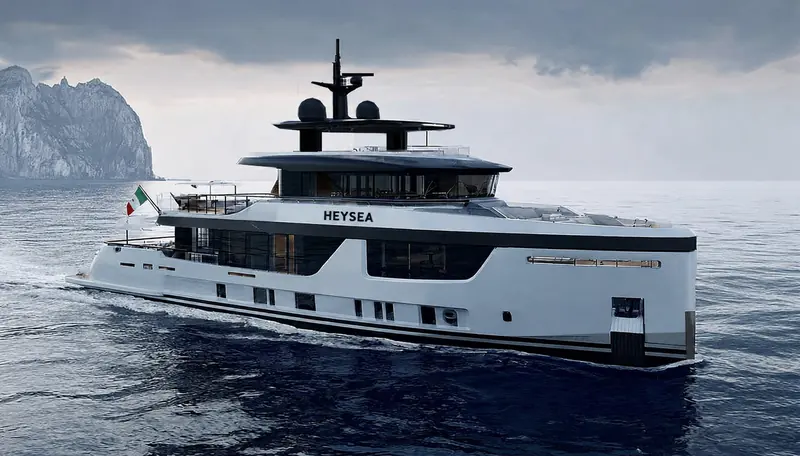
Heysea Yachts has signed its first contract for a 35.96-metre Explorer, the opening hull in a new three-model series, with a European client who plans to base and cruise the yacht in the Mediterranean once she is delivered in January 2028.
The contract, confirmed 20 August 2026, covers the first hull of Heysea's new Explorer platform at the builder's Jiangmen yard in Guangdong, China. The company says the boat is being customised for this particular owner but that the underlying platform is intended for series production rather than a one-off custom build - the same logic production builders use to spread tooling and engineering cost across multiple hulls rather than one. Delivery is set for January 2028, roughly two years after the design was first shown in May 2026, and RINA plan approval has already cleared, with fabrication of the steel hull blocks now underway at the yard.
Heysea is not a newcomer. The company states it was founded in 2004 and has delivered more than 200 composite and steel yachts since, building its reputation on the Asteria motor yacht series and, more recently, the Seaview sailing catamaran line. This contract marks its first formal entry into the explorer-yacht category, a segment it has not previously competed in and one dominated by established European names - Bilgin, Rossinavi and Tankoa among the yards this desk tracks. Heysea itself frames the move in similar terms: its own announcement calls the contract the yard's official entry into the aluminium explorer yacht segment, language that reads as an admission the category is new territory rather than an extension of existing expertise.
Why would a European owner sign with a Chinese yard rather than an established Italian or Dutch explorer builder?
Neither Heysea nor the owner has disclosed a price, so the honest answer is that nobody outside the deal can yet weigh the value case - what is visible is a yard offering full in-house engineering control and an existing design relationship with an Italian studio, rather than a discount alone.
Heysea is handling hull structure, machinery integration, electrical and piping systems, and interior fit-out entirely in-house at Jiangmen, while exterior and interior design come from VYD Studio, the Italian house founded by Paolo Dose that Heysea says it already has a working relationship with. That pairing - Chinese build capacity with an established European design signature - is the same formula several Chinese yards have leaned on this decade to court buyers who want Mediterranean styling without a Mediterranean order book's wait times. The material choice reinforces that pairing: a steel hull carries the weight of fuel and equipment low and cheaply where corrosion resistance matters most, while the lighter aluminium superstructure keeps top-heavy weight down and preserves range - the same hull-and-superstructure split used by most established explorer yards, rather than a shortcut specific to Heysea's price point.
What is missing is the number that would actually settle the question: neither party has published a contract price, and no broker listing exists to benchmark against. A buyer comparing this against a similarly specified 36-metre steel-hulled explorer from Tankoa or Rossinavi is, on the public record, comparing a full technical specification against a blank line where the cost sits - not a small gap to close on a purchase of this size.
What does staying under 500 GT actually buy the owner?
Keeping the Explorer's gross tonnage below 500 GT keeps her outside the heavier survey, crewing and safety-management requirements that apply to larger commercially registered yachts under several international maritime conventions - the same reason Heysea is designing all three planned models in the series, 35, 45 and 54 metres, to sit under that same line.
Gross tonnage measures a vessel's enclosed internal volume, not its weight or length, and 500 GT is a widely used regulatory boundary: cross it and a yacht typically falls under additional flag-state survey regimes and crew-certification requirements that add cost and administrative overhead, particularly relevant for an owner who plans to run the boat with a hired crew rather than owner-operate it. Designing three different hull lengths to each land under that threshold is a deliberate engineering choice, not a coincidence - the beam and depth have to be held down as the length grows, which is one reason the Explorer's 8.15-metre beam looks modest against her 35.96-metre length. Commercially registered yachts that cross the 500 GT line typically move into large-yacht codes such as the UK's LY3, which add survey scales, manning levels and safety-management requirements roughly in step with those for small commercial ships - exactly the compliance layer an owner cruising privately with hired crew has no need to take on if the tonnage stays under the line.
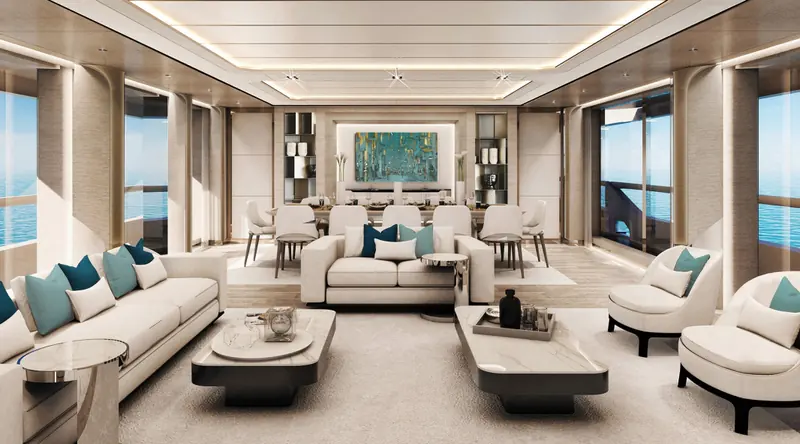
The tradeoff is interior volume. A wider, deeper hull would give more usable space at the same length, but would also risk pushing the boat over 500 GT and into the regulatory band Heysea is deliberately avoiding. Buyers used to the generous volume of a similarly sized European explorer built without that constraint may notice the difference below decks, even if the length-overall figures on a spec sheet look comparable.
What's next for Heysea's explorer program, and how does it stack up against the established players?
Heysea plans 45-metre and 54-metre siblings using the same steel-hull, aluminium-superstructure recipe, putting it into direct competition with far more established explorer yards - but without their delivery track record at this size or a published price to compare against.
The 35.96-metre hull now under construction is explicitly the entry point to a three-model family, with the 45-metre and 54-metre versions still in development. All three share the same construction approach - steel hull, aluminium superstructure, sub-500 GT target - which lets Heysea reuse engineering and supply-chain decisions across the range rather than developing each hull from scratch. The yard says it has built in steel and aluminium for more than a decade, dating custom projects back to 2014, which is the experience it is drawing on for this jump into a larger, more technically demanding category than its motor-yacht and catamaran lines.
The yards this owner is implicitly being compared against - Tankoa, Rossinavi, Bilgin - have decades of explorer and expedition-yacht deliveries, established resale markets and, in most cases, publicly discussed pricing that lets a buyer benchmark cost against specification. Heysea has none of that yet: this is its first hull in the category, no price is public, and no independent sea trial exists to confirm the yard's own performance figures. None of that makes the boat a poor choice - it makes it a first-of-line purchase, with the particular risks and potential upside that status always carries. Shipyards often price a first hull below what later sisters will cost, to compensate an early buyer for absorbing the risk of an unproven design - though neither Heysea nor its client has said whether that dynamic applies to this contract, and the missing price means nobody outside the deal can check.
What is good, and what to watch
Strong points
- An established Italian design partnerVYD Studio, founded by Paolo Dose, has an existing relationship with Heysea and leads both exterior and interior design - a European styling signature rather than an in-house first attempt.
- A real three-model programThe 35m is the first of a planned 35/45/54m family sharing one construction approach, which should build a larger parts, service and eventual resale pool than a one-off custom yacht.
- Over a decade of steel-and-aluminium build experienceHeysea says its custom steel-and-aluminium projects date back to 2014, ahead of this being a first attempt at the technique.
- Sub-500 GT engineering across the whole rangeKeeping all three planned models under the 500 GT threshold is a deliberate design discipline that keeps flag-state survey and crewing requirements lighter for a private owner running hired crew.
What to watch
- No price publishedNeither Heysea nor the buyer has disclosed the contract value, leaving nothing to benchmark against comparable explorer builds from established yards.
- No independent verification yetEvery performance figure - speed, range, displacement - comes from Heysea itself; no sea trial or class survey of a completed hull exists.
- No track record in this categoryHeysea has built motor yachts and catamarans, not explorer yachts; this contract is its first in the segment it is now trying to compete in.
- Modest interior volume for the lengthThe 8.15m beam needed to stay under 500 GT is narrow relative to length, which will likely cost interior volume compared with an explorer built without that constraint.
Practical detail
| Contract signed | 20 August 2026 |
|---|---|
| Delivery | January 2028 |
| LOA | 35.96 metres |
| Beam | 8.15 metres |
| Design draft | 2.45 metres |
| Full-load displacement | 372.5 tonnes |
| Gross tonnage | Under 500 GT |
| Construction | Steel hull, aluminium superstructure |
| Main engines | 2 x 900 hp MAN |
| Top speed | 14 knots |
| Range | 4,000 nautical miles at 10 knots |
| Fuel / fresh water | 38,000 litres / 7,000 litres |
| Accommodation | Owner's suite plus 3 guest cabins; crew for 6 plus a separate captain's cabin |
| Class | RINA, unrestricted navigation |
| Designer | VYD Studio (Paolo Dose), Italy |
| Yard | Heysea Yachts, Jiangmen, Guangdong, China |
| Price | Not disclosed by Heysea or the buyer |
| Not yet published | Independent sea trial results, a confirmed contract price, the buyer's identity |
Questions this story answers
What happened?
Heysea Yachts has signed its first European contract for a 35.96-metre Explorer, the opening hull in a new three-model series from the Chinese builder better known for motor yachts and catamarans. For an owner weighing a Chinese-built explorer against an established Italian or Dutch shed, the yard has published full technical numbers but no price - which is exactly the gap a buyer has to close before signing.
What is good about it?
An established Italian design partner. VYD Studio, founded by Paolo Dose, has an existing relationship with Heysea and leads both exterior and interior design - a European styling signature rather than an in-house first attempt.
What should an owner or buyer watch?
No price published. Neither Heysea nor the buyer has disclosed the contract value, leaving nothing to benchmark against comparable explorer builds from established yards.
Who reported this?
SuperYacht Times, YachtBuyer, Heysea Yachts.
We do this for everyone who loves this world. The people who have spent their lives in it, and the people just discovering it. Yotters exists so that what we learn belongs to all of them.
Nobody pays us for this. No ads, no sponsors, nothing for sale. We just believe the world is a little better when knowledge is shared instead of kept.
If it gave you something today, tell us to keep going. Follow us, leave a like, or write a positive comment. We read every one, and they are what keeps us going.