MAIB Final Report: Bayesian Was Never Assessed at Anchor, Sails Down
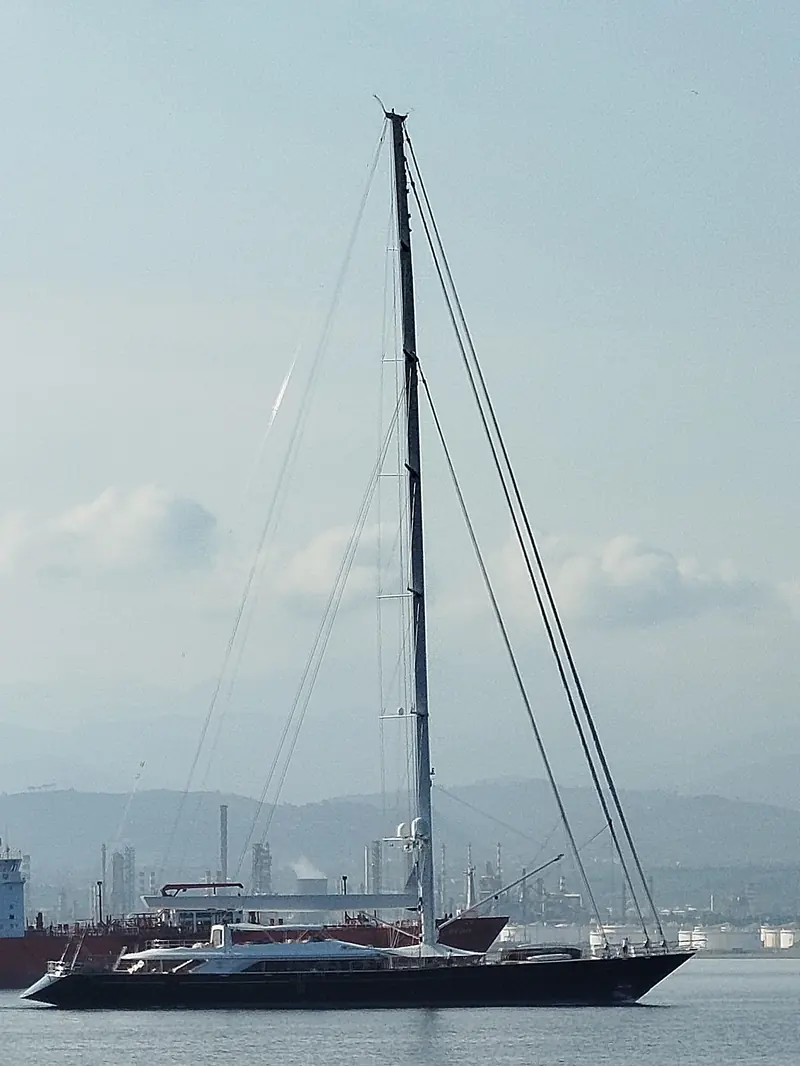
What did the MAIB find caused the Bayesian to capsize?
The MAIB found that Bayesian, with no sails set, was vulnerable to a knockdown in severe wind, and that the stability information approved for her never identified it. The report, Accident Investigation Report 22/2026, came out on 19 November 2026.
At 04:06 on 19 August 2024 the yacht lay at anchor about half a nautical mile south-east of Porticello, near Palermo. A violent downburst with hurricane-force winds laid her on her starboard side. She could not right herself, flooded and sank in 50 metres of water. Seven of the 22 people aboard died: six guests and one crew member. The 15 survivors got into a liferaft, and a nearby vessel took them ashore. The MAIB lists two safety issues. The first is the vulnerability itself, which depended on how the yacht was loaded, the apparent wind angle and where the centreboard sat. The second is that mariner guidance did not give enough detail on how weather can affect a vessel, so the forecast, though mostly accurate, did not flag the downburst risk from the thunderstorms it predicted.
Yachting World, which reported the findings on the morning of publication, puts the crew's position plainly: they were unaware of a critical risk to the vessel and could not have allowed for it. The report describes the wind as most likely a violent downburst and says no weather warning had been issued for the area. That framing matters to an owner, because it moves the question away from what a crew did in the last quarter of an hour and towards what anyone had told them about the boat beforehand.
What did Bayesian's stability information leave out?
Bayesian's Stability Information Book covered the yacht under sail, including her critical heel angle, and said nothing about knockdown at anchor or under engine with the centreboard up and no sails set. Investigators say she had never been assessed in that condition.
That gap is the centre of the report. Anchored, canvas furled and the lifting keel raised was, by the crew's account, her ordinary condition at anchor, and it is exactly where the book was silent. The MAIB's commissioned stability work from the Wolfson Unit at the University of Southampton tested the effect of a roughly 72m mast, furled sails, downflooding points and tankage on how she behaved. It found the vulnerability changes with loading, with the angle the wind arrives at and with the centreboard position. Outlets differ on the angle of no return, quoting between about 70 and 73 degrees of heel, so treat the exact figure as one to read in the report itself. All agree that past it she would not come back.
The centreboard detail has a practical history. Yachting World reports that the yacht tended to yaw at anchor with the board down, which made her snatch at the cable and raised the risk of dragging, so it was rarely lowered when she was anchored. One outlet adds that lowering it would have taken about two and a half minutes. That is a single report and we haven't seen it in the MAIB summary, so we give it as a reported figure only. The detail shows how a routine choice, made for good seamanship reasons, can put a yacht into a condition nobody had calculated.
How quickly did Bayesian go over, and what could the crew do?
Bayesian went from 10 to 20 degrees of heel to lying flat in under 15 seconds, after winds of at least 68 knots arrived out of calm conditions. None of her liferafts inflated or released automatically.
Yachting World reports calm conditions giving way to winds of at least 68 knots in roughly a quarter of an hour, and a second outlet agrees on a knockdown of about 15 seconds. The same coverage puts the sinking at around 18 minutes. The MAIB's own summary does not give a wind figure beyond hurricane force, so the 68 knots comes from press reading of the full report and we attribute it that way. What the official page does say is clear: the liferafts had to be launched by hand, and the crew gathered survivors and helped them into one.
The coverage describes the chief officer and master moving guests from the saloon to the flying bridge, three crew trapped in the wheelhouse until a guest helped them out, first aid given in the water, and two crew swimming back to release a liferaft. It says survival depended heavily on individual training, experience and initiative. As the crew focused on the dragging anchor, closing hatches and doors was not the first thing on anyone's mind, because the capsize risk had never been put in front of them. An owner reading that should hear a sober point about preparation: drills are only as good as the scenarios the paperwork supports.
What does the MAIB want changed after Bayesian?
The MAIB's report page lists four safety recommendations, to the Red Ensign Group, the Maritime and Coastguard Agency, the Met Office and the UK Hydrographic Office. None is addressed to a builder or an owner.
The Red Ensign Group is asked to study the vulnerabilities in the report and amend its Yacht Code and associated guidance. The Maritime and Coastguard Agency is asked to add downbursts and severe wind gusts to the yacht master training syllabus. The Met Office is asked to raise with the World Meteorological Organization how low-likelihood, high-impact weather hazards should be represented in its data services. The UK Hydrographic Office is asked to develop and update guidance on extreme weather in its publications. Some press summaries have counted seven recommendations. We follow the four on the MAIB's own page, and the difference is a reason to read the full report rather than any summary of it.
For an owner of a UK-flagged yacht, the Yacht Code is the document to watch. A revised code could change what a stability assessment has to cover for a vessel that is anchored with sails stowed. Nothing in the recommendations forces a retrofit today, and the MAIB is a no-blame safety body whose findings cannot be used to apportion liability. What they do give an owner is a published reason to ask his flag office, his surveyor and his manager what the yacht has been assessed for, and to ask before the code changes rather than after.
Does the report settle who is to blame for the Bayesian sinking?
The report does not apportion blame, and Italian prosecutors have reached a different view that has yet to be tested in court. Both the Italian case and the UK civil claims are still to be heard.
Italian prosecutors at Termini Imerese attribute the sinking to crew error. Three people are under investigation in Italy, the skipper James Cutfield, the chief engineer Tim Parker Eaton and crew member Matthew Griffith, and no charges have been brought. Reports say the MAIB was refused early access to the raised hull and did not receive some dive records, and that its findings could change if withheld evidence emerges. Survivors, including Charlotte Golunski, have criticised the crew, while Yachting World reports that The Italian Sea Group has filed a EUR 456m claim in Italy against the owner's widow Angela Bacares, and that the registered owner and Camper & Nicholsons have asked the UK High Court to cap personal injury payouts, which survivors contest.
So what should a sailing-yacht owner do this week? Ask three things in writing. Does the stability book cover the condition the yacht spends most nights in, meaning at anchor, sails furled, keel or board up? If not, who will assess it and when? And what does the crew's weather routine do when a thunderstorm is forecast and no warning has been issued? None of this is an accusation against any yard or crew. It is the one practical thing the report hands to the person whose name is on the registry.
What owners and crew report
Survivors' view of the crew
Charlotte Golunski and James Emslie, who escaped with their infant daughter, have described the crew as reckless. Ms Golunski has accused the crew of 18 errors and is suing for damages.
Yachting World and Yahoo News reports, 19 November 2026The prosecutors' view
Italian prosecutors say the sinking came from crew error and an underestimated forecast, and have described the wind as little more than a squall, which conflicts with the MAIB's findings.
Yachting World, 19 November 2026The builder's parent
The Italian Sea Group, parent of Perini Navi, has filed a EUR 456m claim in Italy against the owner's widow for reputational and financial damage.
Yachting World, 19 November 2026
What is good, and what to watch
Strong points
- It names a specific, checkable gapThe approved stability information did not cover the anchored, sails-down condition, and the yacht had never been assessed in it. An owner can check the same thing on his own boat.
- It looks beyond the crewTwo of the four recommendations address weather information, which the forecast missed as a downburst risk.
- It records what the crew managedSurvivors reached a liferaft because of individual initiative, and the report says so.
What to watch
- Evidence the MAIB could not seeReports say access to the raised hull was initially refused and some dive records were not received, and the MAIB has said its picture may change.
- No recommendation reaches a builder or an ownerThe four go to a flag group, a training body and two weather and chart agencies, so no one is told to re-assess existing sailing yachts.
- A contested storyItalian prosecutors point to the crew. Neither case has been heard, and the MAIB cannot apportion blame.
Practical detail
| Report | MAIB Accident Investigation Report 22/2026, published 19 November 2026. Press outlets give page counts of 120 and 137, so check the PDF. |
|---|---|
| Yacht | Bayesian, a 56m (184 ft) Perini Navi sailing yacht, UK flag, rig of roughly 72m. Sank 19 August 2024 in 50m of water. |
| People aboard | 22 (12 guests and 10 crew at the time of the interim report). Seven died: six guests and one crew member. 15 survived. |
| Recommendations | Four: Red Ensign Group, Maritime and Coastguard Agency, Met Office, UK Hydrographic Office. |
| What to ask your own yacht | Whether the stability book covers anchored with sails stowed and the keel or board up, who assessed it, and when. |
| Not published | A wind figure on the MAIB page (it says hurricane force only), the Italian experts' full report, any charge against any crew member, and the outcome of the Italian and UK civil cases. |
Questions this story answers
What happened?
The UK investigators published their final report on the Bayesian sinking on 19 November. They found a 56m yacht whose approved paperwork never covered the condition she was lying in, with no sails set and her centreboard raised. For an owner, the question it leaves is which conditions his own stability book was never asked about.
What is good about it?
It names a specific, checkable gap. The approved stability information did not cover the anchored, sails-down condition, and the yacht had never been assessed in it. An owner can check the same thing on his own boat.
What should an owner or buyer watch?
Evidence the MAIB could not see. Reports say access to the raised hull was initially refused and some dive records were not received, and the MAIB has said its picture may change.
What do owners and crew report?
Charlotte Golunski and James Emslie, who escaped with their infant daughter, have described the crew as reckless. Ms Golunski has accused the crew of 18 errors and is suing for damages. (Yachting World and Yahoo News reports, 19 November 2026)
Who reported this?
MAIB (GOV.UK report page, Accident Investigation Report 22/2026), Yachting World, Yahoo News, Marine Industry News.
We do this for everyone who loves this world. The people who have spent their lives in it, and the people just discovering it. Yotters exists so that what we learn belongs to all of them.
Nobody pays us for this. No ads, no sponsors, nothing for sale. We just believe the world is a little better when knowledge is shared instead of kept.
If it gave you something today, tell us to keep going. Follow us, leave a like, or write a positive comment. We read every one, and they are what keeps us going.