Awake
| Category | electric jetboards and eFoils |
|---|---|
| Founded | 2017 by Philip Werner, Daniel Aronsson and Mikael Kajbring, following Werner's earlier electric surfboard venture of 2013 |
| Origin | designed and developed in Scandinavia, in the company's own words |
| Jetboards | RAVIK Explore, RAVIK Adventure, RAVIK Ultimate, plus a BRABUS limited edition |
| RAVIK Explore | 21 kg, 121 litres, 11 kW, up to 40 km/h, up to 60 minutes, EUR 9,990 excluding VAT |
| RAVIK Adventure | 23 kg, 71 litres, up to 50 km/h, up to 45 minutes, EUR 13,990 excluding VAT |
| RAVIK Ultimate | 16 kg of carbon composite, 51 litres, up to 55 km/h, up to 35 minutes, EUR 15,990 excluding VAT |
| eFoil | VINGA Carve at EUR 11,990 excluding VAT, with Adventure and Ultimate variants |
| Batteries | Flex Battery LR 4 at EUR 2,990 and XR 4 at EUR 4,990, both excluding VAT |
| Flex Battery XR 4 | 18.5 kg, about an hour of riding, waterproof to 10 metres, 5.5 kg lighter than the pack it replaced |
| Warranty | two years across boards and batteries |
| Cross-compatibility | the same Flex 4 battery and hand controller run both the jetboards and the eFoils |
| Charge time | Awake publishes none on its own battery or charger pages. A dealer listing read in July 2026 gives the Flex Battery Charger at two hours or less, against about 60 minutes of riding on an XR 4 |
| Flex Battery Charger | USD 1,390 net on Awake's own United States store, July 2026. Awake sells only one charger and describes it as a speed charger |
| Flag reach | Part A Chapter 14 of the Red Ensign Group Yacht Code covers the United Kingdom, the Cayman Islands, Gibraltar, the Isle of Man and the other British Overseas Territories and Crown Dependencies |
| Marshall Islands | the 2026 edition of Yacht Code MI-103, effective 1 January 2026, adds specific rules for spaces used to store or charge lithium-ion powered toys and tenders |
| Malta | a Transport Malta Commercial Yachting Notice of 22 June 2022 and Information Notice 45 of 7 September 2022, written as strong recommendation, with the Commercial Yacht Code 2025 Revision 1 as the surveyed document |
| IMO | no mandatory instrument covering portable lithium battery powered craft aboard yachts as of July 2026. Class: DNV's Battery (Safety) notation triggers only above 50 kWh aggregate, and Lloyd's Register LR-GN-052 of 10 June 2025 is advisory |
| Charging locker | no marine manufacturer publishes a price. EN 14470-1 Type 90 industrial cabinets listed at EUR 3,270 net (asecos ION-CHARGE 90) and GBP 4,571.04 net (asecos ION-CORE-90), both July 2026, neither UK marine type approved |
A second attempt at the same idea
Philip Werner built his first electric surfboard in 2012 and started a company around the idea in 2013. It did not become what he wanted. In 2017 he set up Awake with Daniel Aronsson and Mikael Kajbring to build electric jetboards properly, and the second attempt is the one that reached yachts. The eFoil line, VINGA, followed in the spring of 2022 on the same battery and controller architecture.
Awake is unusually quiet about itself. The company describes its boards as designed and developed in Scandinavia and does not put much corporate detail on its own site, which is worth knowing before an owner relies on it for support in a distant market. What it does publish is a clear specification for every board and battery, which is more than several competitors manage.
The RAVIK jetboards
Three boards share an 11 kW motor and differ in hull and volume. The Explore is the beginner board at 21 kg and 121 litres, with a dual channel hull, a top speed of 40 km/h and up to an hour of riding, at EUR 9,990 before VAT. The Adventure drops to 71 litres on a V-shaped hull, weighs 23 kg, runs to 50 km/h and lists at EUR 13,990. The Ultimate is the carbon composite board at 16 kg and 51 litres, good for 55 km/h.
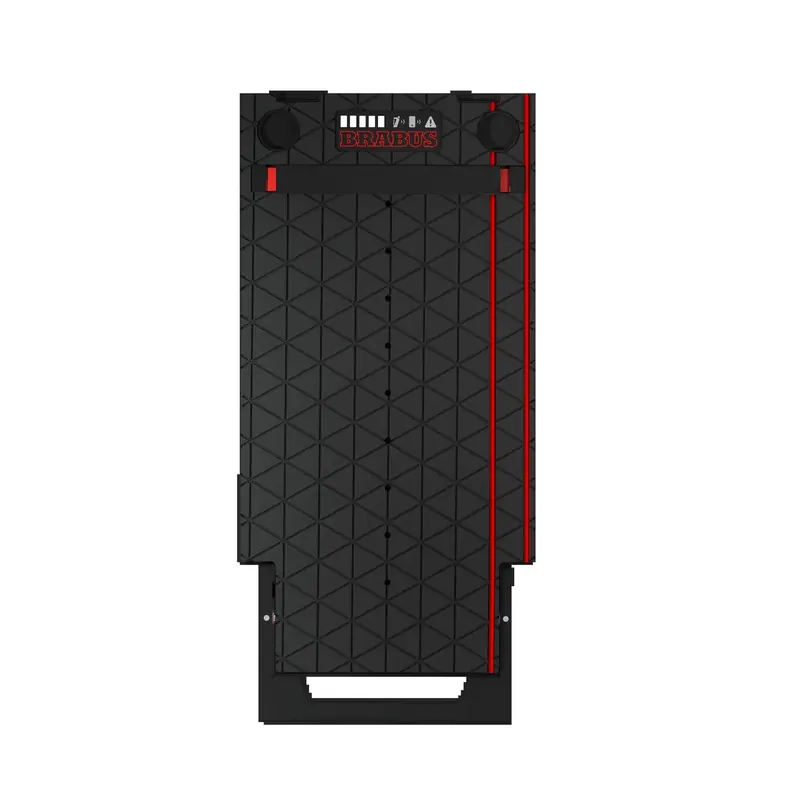
The Ultimate costs EUR 15,990 before VAT and buys 35 minutes of riding, which is the trade the whole range makes visible. More speed and less volume mean less time on the water. There is also a BRABUS x Awake Shadow Explore at EUR 15,900, a limited edition built with the German tuning house that also builds Brabus Marine tenders. It is the Explore hull in different clothes.
The board price is half the story and the battery is the other half.
Flex 4, and the arithmetic that decides how many packs
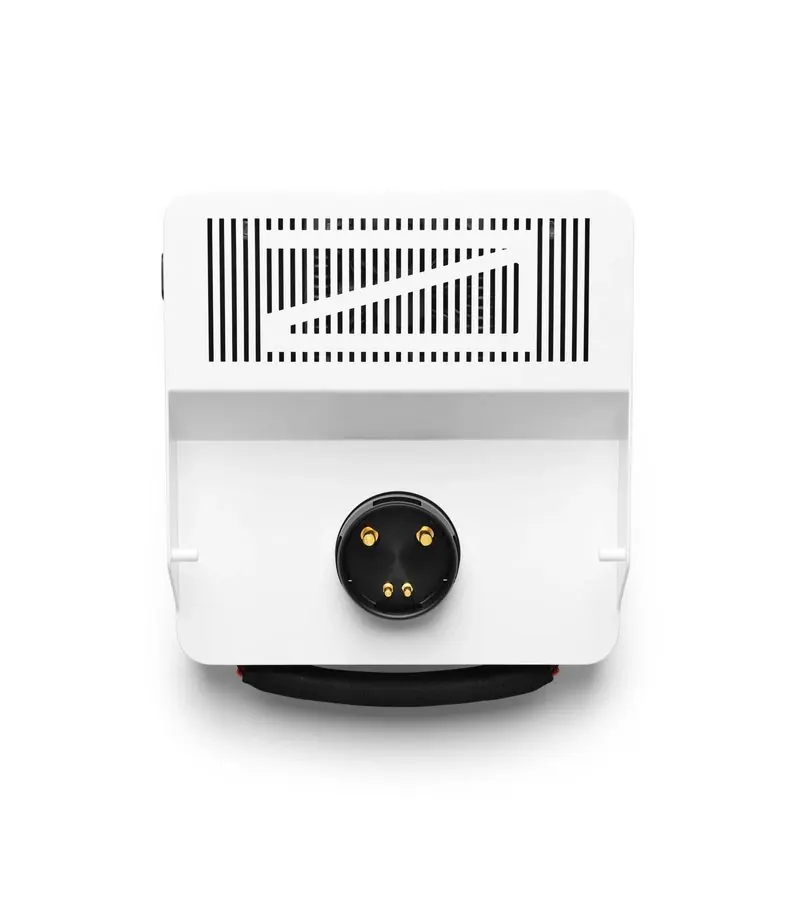
Every current board runs the Flex 4 system, a modular pack that clicks into the board without tools and pairs with the HC 4 hand controller automatically. The Flex Battery LR 4 lists at EUR 2,990 before VAT and weighs 12 kg. The larger XR 4 lists at EUR 4,990 before VAT, weighs 18.5 kg, gives about an hour of riding, is rated waterproof to 10 metres and is 5.5 kg lighter than the pack it replaced. Awake sells batteries and hand controllers as separate items on its own store, so what a quoted price covers should be established line by line before signing.
The number Awake does not publish is the charge time, and it is the number that decides the order. Neither the battery pages nor the charger page gives one, and the company sells only a single charger, which it describes as a speed charger, at USD 1,390 net on its own United States store in July 2026. A dealer listing read in the same month puts that charger at two hours or less for a full pack. Set that against about sixty minutes of riding on an XR 4 and one pack is one session, two packs still leave a gap, and three packs and one charger are what keeps a board continuously in the water. Three XR 4 packs come to EUR 14,970 before VAT, which is more than the VINGA Carve costs, and it is the single most commonly under-ordered item on the whole toy list.
VINGA, the eFoil side
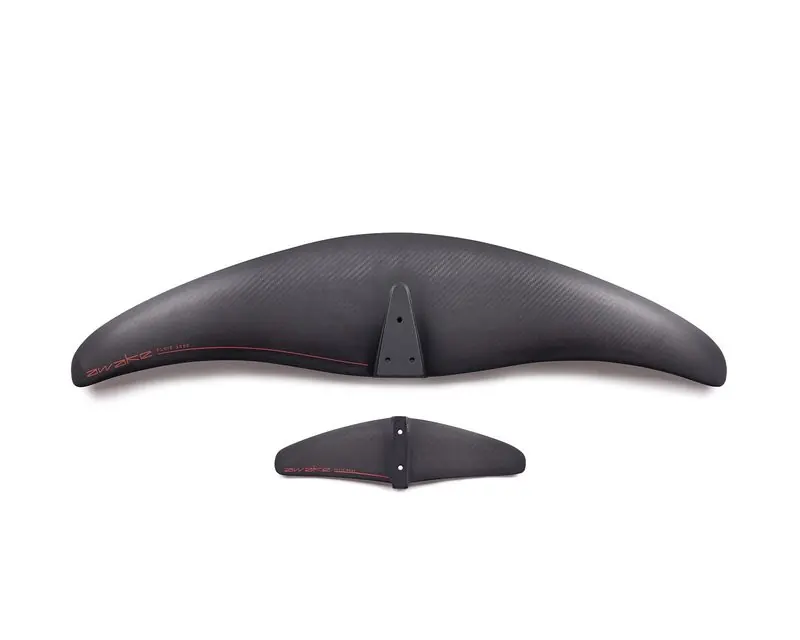
VINGA is Awake's answer to Lift and Fliteboard, launched in 2022 and built to run on the same Flex battery and hand controller as the jetboards. The Carve is the intermediate board at EUR 11,990 before VAT, with Adventure and Ultimate variants above and below it for cruising and for performance. The Click-to-Ride system snaps the whole assembly together without tools.
Sharing the battery across both product lines is the strongest argument for buying Awake at all. A yacht that carries two RAVIK jetboards and a VINGA eFoil needs one type of pack, one charger and one charging locker, which simplifies the part of water toy ownership that causes the most trouble. Against that, the VINGA is a newer and less proven eFoil than the boards it competes with.
Riding it, and where it stops
A jetboard is easier than a foil to start and harder to master. The rider lies on the board, comes to their knees under power and stands when the board is planing, and the throttle is a trigger in one hand. The Explore is genuinely forgiving, which is why Awake positions it for guests who have no instructor and minimal supervision. The Ultimate at 51 litres will not float an adult at rest and demands a competent rider.
Top speeds of 40 to 55 km/h are real but the useful cruising range sits well below that. Chop punishes a jetboard more than it punishes a foil, because the hull stays in contact with the surface. In a busy August anchorage the water is usually only good early. Ride times of 35 to 60 minutes are quoted for a light rider in good conditions, and a heavy rider on full throttle will see materially less.
Getting it aboard, and which flag governs the charging
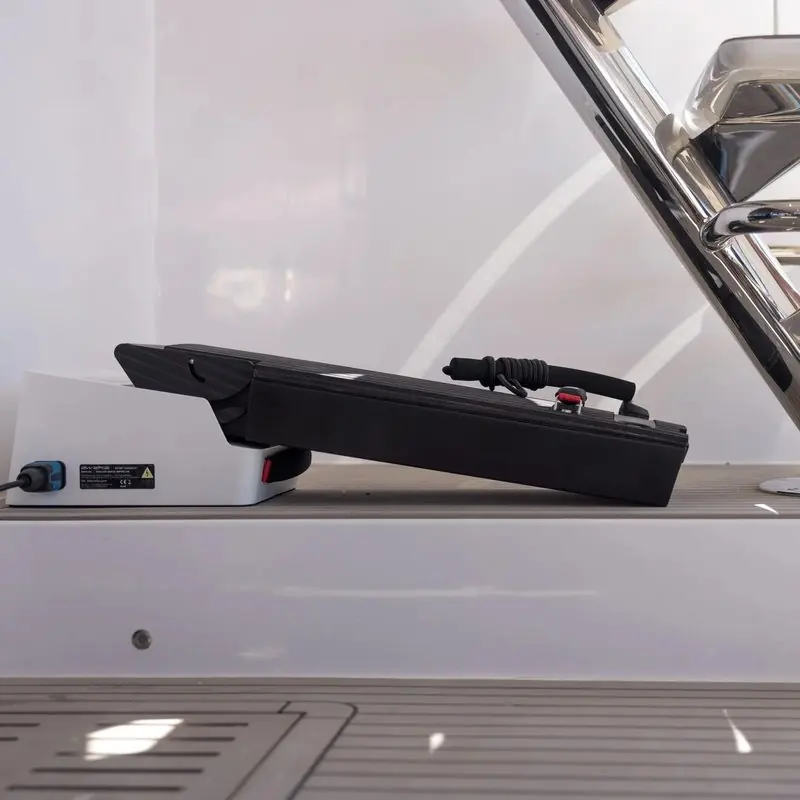
The boards are the easy part. At 16 to 23 kg a RAVIK is a one-person carry and needs a wall rack or a locker of about two metres, with no crane, davit or lifting plan involved. The Flex battery comes out and goes to a charging point, which is where the complication starts. An 18.5 kg pack is not something a guest carries up a passerelle, and it is also the item that the regulations are written about.
The UK Maritime and Coastguard Agency published MGN 681 (M) Amendment 1 on 19 December 2025, covering fire safety, storage and charging of small electric craft aboard yachts, with dedicated cabinet stowage to EN 14470, EN 16121 or EN 16122 required for spare batteries above 100 Wh and UK type approval required for new charging containers from 1 January 2027. Awake packs are far above that threshold, and crew training on thermal runaway is now part of the expectation. The reach is wider than the letters MCA suggest, because the note sits on Part A Chapter 14 of the Red Ensign Group Yacht Code, and the group is the United Kingdom together with the Cayman Islands, Gibraltar, the Isle of Man and the other British Overseas Territories and Crown Dependencies. A Cayman-flagged yacht is inside the same chapter, and the Cayman Islands Shipping Registry has gone further: Guidance Note 06/2023, read July 2026, annexes the United Kingdom's MGN 681(M) on the fire safety and storage of small electric powered craft and strongly recommends it be followed on every yacht carrying them until it is folded into the REG Yacht Code. The Republic of the Marshall Islands legislated separately, with a 2026 edition of Yacht Code MI-103 effective 1 January 2026 that introduces specific rules for spaces used to store or charge lithium-ion powered toys and tenders. Malta stayed at recommendation, through a Transport Malta Commercial Yachting Notice of 22 June 2022 and Information Notice 45 of 7 September 2022, and surveys against the Commercial Yacht Code at its 2025 revision. Only the 2027 type-approval date is genuinely UK-only.
What it costs, and the number under the headline
The published prices exclude VAT, which in most European markets adds a fifth or more to the delivered figure. The specification that actually works aboard is a board, three batteries and the charger rather than two, because the charger takes roughly twice as long as a pack lasts. Each additional Flex pack is EUR 2,990 before VAT for an LR 4 or EUR 4,990 for an XR 4, so the third battery takes a realistic Adventure package from around EUR 24,000 before tax to somewhere between EUR 27,000 and EUR 29,000, depending on which pack is specified. These are small numbers against a yacht. They are also roughly double what the board price alone suggests, and the whole of the gap is batteries.
Running costs are modest. Electricity for a charge is negligible against a yacht's daily draw, and there is no fuel, no oil, no impeller wear ring in the sense a petrol board has and no seasonal engine service. The consumable is the battery, and Awake's two year warranty is the yardstick for how long an owner should expect a pack to hold its rated performance before replacement. The cycle life is published, but not where an owner would look for it. Lift Foils warrants its pack to the earlier of two years or 600 battery cycles, and Awake's warranty terms, read July 2026, put the figure at 24 months or 300 full charge cycles, whichever comes first. Half the cycle life for the same two year clock is the number to plan the replacement against.
Service, parts and the Brabus connection
Awake sells through dealers and through the specialist yacht toy suppliers who serve the Mediterranean and Caribbean, and boards can be rented or supported through those channels in most of the usual cruising grounds. The company is small, which cuts both ways. Direct contact is easy and firmware updates arrive through its own app, but there is no equivalent of a Brunswick or a BRP parts network standing behind it.
The BRABUS relationship gives the brand a second route into the yacht world, because Brabus Marine builds tenders and day boats that already sit alongside larger yachts. A failed battery remains the difficult case. Loose lithium packs travel by air as UN3480 dangerous goods, cargo aircraft only and capped at 30 percent state of charge, so a replacement is a matter of days at best in high season.
Against JetSurf, Radinn and the foils
JetSurf's petrol boards are lighter, faster to refuel and cheaper to run, and they are the choice for a rider who wants a racing machine. Radinn, also Swedish, competes directly with Awake on electric jetboards. The eFoil makers, Lift and Fliteboard, compete for the same guest and win on run time, because a foil uses a fraction of the energy to travel the same distance.
Awake wins on the combination of silence, no fuel aboard and one battery family across two kinds of board. It loses on endurance against a foil and on support depth against the large groups. No licence is generally required to ride one, but a powered board is a powered craft to most Mediterranean harbour authorities, and the beach distance rules apply. The wrist strap cut-off should be worn every time.
Class, the IMO, and the price of the locker
Nothing above the flag adds a binding requirement. The International Maritime Organization has no mandatory instrument reaching a portable battery aboard a yacht as of July 2026, and its lithium work sits in the Maritime Safety Committee's review of alternative fuels and new technologies, where MSC 109 added swappable traction battery containers to the list under review and identified nineteen regulatory gaps and MSC 110, sitting from 18 to 27 June 2025, closed the review of regulatory barriers. DNV's Battery (Safety) notation becomes mandatory only above 50 kWh of aggregate installed capacity, which no locker of jetboard packs approaches. Lloyd's Register published LR-GN-052, Guidance Notes on Lithium-Ion Battery Powered Crafts and Vehicles carried on Yachts, on 10 June 2025, addressed to designers, builders and operators as advice rather than rule. ISO 23625:2025 governs lithium-ion batteries above 500 Wh installed in small craft, which catches an electric tender and not a board.
The locker itself is the line nobody prices. The marine active-suppression systems sold against MGN 681, the RACLAN boxes and the modular RAMBSS, and the passive ZARGES BatterySafe cases, were all quotation only in July 2026, with no manufacturer publishing a figure. What is priced publicly is the shore-side industrial cabinet built to EN 14470-1 Type 90, one of the standards the note names. In July 2026 a German supplier listed an asecos ION-CHARGE 90 with pull-out shelves at EUR 3,270 net of VAT, with an internal envelope of 470 by 452 by 582 mm and shelves rated at 25 kg, and a United Kingdom supplier listed the taller asecos ION-CORE-90 at GBP 4,571.04 net or GBP 5,485.25 gross. An 18.5 kg XR 4 pack is the heaviest of the mainstream toy batteries and still inside that 25 kg shelf rating, though two per shelf is not. Neither cabinet carries UK marine type approval, the thing that becomes mandatory on UK-registered yachts from 1 January 2027, and MCA Safety Bulletin 35, updated 15 November 2024, found that a container advertised as fully MGN 681 compliant was not able to comply fully and warned that no international standard governs these products.
Practical detail
| RAVIK Explore price | EUR 9,990 ex. VAT (about EUR 11,900 with 19% German VAT), per Awake's own EU store |
|---|---|
| RAVIK Adventure price | EUR 13,990 ex. VAT (about EUR 16,650 with VAT) |
| RAVIK Ultimate price | EUR 15,990 ex. VAT (about EUR 19,030 with VAT) |
| BRABUS x Awake SHADOW Explore (limited edition) | EUR 15,900 ex. VAT |
| VINGA Carve (eFoil) price | EUR 12,900 ex. VAT on Awake's own site; Ritz Marine's independent 2026 model guide puts the wider VINGA range (Carve through Adventure/Ultimate) at roughly EUR 11,900-14,990 |
| Extra or replacement battery | Flex Battery LR4 EUR 2,990 ex. VAT / Flex Battery XR4 EUR 4,990 ex. VAT on the EU store; the US store lists the same batteries at $3,990 and $5,990 ex. VAT respectively, so US pricing runs noticeably higher than the EUR list price even after currency conversion |
| Battery charger and accessories | Flex Battery Charger EUR 1,090 ex. VAT (EU) / $1,390 (US); Battery Backpack about $130; hand controllers EUR 590-690 ex. VAT |
| How to buy | Order directly at awakeboards.com or awakeboards.us (an account manager follows up after checkout), or through authorized dealers such as Luxury Surf (Fort Lauderdale), SHAKA Jetboards (Mystic, CT), and E-Surfer (Berlin); Awake and its retail partners offer free test rides at locations including Germany, Mallorca and Ibiza |
| Service and long-term reliability data | No public, standardized annual-service price could be confirmed from two independent sources, so no figure is given here; Awake publishes a global warranty policy covering material and workmanship defects, but buyers should confirm current service-plan cost with a dealer directly. No independent long-term reliability or durability track record is publicly available -- reviews so far are first-ride or short-term tests, not multi-season ownership reports |
| Comparable alternatives for price context | Fliteboard runs from about $6,995 for the entry Air up to roughly $14,000-20,000 for Ultra/designer editions; Lift Foils is priced around EUR 15,999 for a comparable set, positioning it near Awake's upper range; Radinn's X-Sport jetboard is the budget outlier at roughly EUR 6,000. This puts Awake in the same premium tier as Lift, above Fliteboard's entry-level options, and well above Radinn |
Request a quote for Awake.
Tell us the model and where it needs to go. The desk obtains a written offer from the maker or an authorised dealer, checks it against the prices published on this page, and comes back to you by email. No obligation, no fee.
- 01A written offerPriced in your currency, with VAT, delivery and lead time stated, not a brochure figure.
- 02Delivered where the yacht isTo the marina, the yard or your address, with the paperwork a lithium pack or a crane lift needs.
- 03IndependentYotters is tied to no single dealer, so the offer is compared before it reaches you.
What owners and crew report
First-hand test found the entry jetboard genuinely easy to learn
Micah Toll tested the RAVIK 3, RAVIK S, and VINGA for Electrek and got up and riding the RAVIK 3 within his first attempts, calling it noticeably more beginner-friendly and stable than other electric surfboards he had tried. He struggled far more on the narrower RAVIK S and could not get up on the VINGA eFoil even after about 30 minutes, showing the learning curve rises sharply across Awake's own range.
Micah Toll, ElectrekRepeat industry tester rates the VINGA a clear step up
Mike Zed, who runs Jetsurfing Nation and had previously tested Awake's RAVIK ONE, RAVIK 3, and RAVIK S, reviewed the VINGA and concluded 'we have a winner here' and said he was excited to see Awake enter the eFoil category, though he gave no detailed breakdown of flaws in that particular piece.
Mike Zed, Jetsurfing NationHands-on European reviewer confirms strong high-speed handling but shorter real-world range than spec
E-Surfer's tester (roughly 90 kg) rode the RAVIK 3 and RAVIK S with the Flex XR battery and reported constant grip even on rough water and in radical curves and clean acceleration, but only got about 30 minutes of riding time with an aggressive style despite the XR battery being marketed for longer sessions. He also noted the board bag is sold separately and the board ships in a large wooden crate rather than a soft case.
Andreas, E-Surfer (Jetboard Experte)Review team flags weight and control layout as real day-to-day friction
Boat & Sail Magazine's reviewers (Christos Nicolaou, Bradley Axmith, and Torben Lonne) praised the RAVIK 3's speed and jump capability but called out the ~88 lb (with battery) board as cumbersome to carry on land, said the thumb throttle controller needs an adjustment period, and described the deck control layout as cluttered.
Boat & Sail Magazine
What is good, and what to watch
Strong points
- Jet-drive propulsion holds grip in chop where prop-driven rivals struggleMultiple hands-on testers (E-Surfer, Electrek) specifically called out the linear jet drive for maintaining traction and control in rough water and tight turns, which is the main mechanical differentiator Awake cites against prop-based jetboard competitors.
- Genuinely accessible for a first-timer on the entry jetboardElectrek's Micah Toll, testing cold, got from prone to standing and riding on the RAVIK 3 within his first session and called it easier to learn than other electric surfboards he had tried, which supports Awake's beginner-friendly positioning for the Explore/RAVIK 3-class board specifically.
- Shared battery ecosystem across the whole lineAwake's own product pages show the RAVIK jetboards and VINGA eFoils draw on the same Flex battery family (LR4/XR4), so an owner who buys into both product lines is not maintaining two incompatible battery systems, a point also highlighted in Ritz Marine's 2026 brand comparison as a structural advantage over single-category rivals.
What to watch
- Price puts it well outside mainstream watersports spendEven the cheapest current model, the RAVIK Explore, lists at EUR 9,990 ex. VAT (about EUR 11,900 with German VAT) on Awake's own site, and the top RAVIK Ultimate and VINGA Adventure/Ultimate variants run well into the EUR 15,000-20,000 range with an XR battery. Electrek's Toll called cost a bigger barrier to entry than the riding skill itself, and GearJunkie's write-up said the high price caters to a slim, exclusive market.
- Heavy and awkward to move around on landBoat & Sail Magazine measured the RAVIK 3 with battery at roughly 88 lb and called it cumbersome to carry; forum discussion on the E-Surfer community forum flagged board weight (cited around 35 kg for an early model) as a recurring complaint, with posters wanting something closer to 25 kg.
- Top-performance model trades away range and beginner usabilityRitz Marine's 2026 model comparison notes the RAVIK Ultimate is rated for only up to 35 minutes of ride time on its standard battery and explicitly warns its low-volume hull makes it less stable at slow speeds and harder to mount from the water -- the fastest board in the range is also the least forgiving and shortest-legged one.
- eFoiling remains genuinely hard even on Awake's hardwareElectrek's Toll, who succeeded on the RAVIK jetboard the same day, could not get up on the VINGA eFoil even after about 30 minutes of attempts, illustrating that Awake's engineering does not remove the underlying difficulty of learning to foil, regardless of brand polish.
Who it is for: Owners who want a fast board with no petrol aboard and no engine to service, and who are willing to buy the second and third battery up front.