Williams Jet Tenders
| Category | jet-driven rigid inflatable and rigid yacht tenders |
|---|---|
| Founded | registered in September 2004 by Roy Parker with the brothers Mathew and John Hornsby |
| Based | Berinsfield, Oxfordshire, in a purpose-built plant of about 80,000 sq ft or 7,400 sq m, with more than 140 staff |
| Output | about 1,200 boats a year, the figure Motor Boat and Yachting reports, making Williams the highest-volume boatbuilder in the United Kingdom by unit count |
| Range | six families and roughly eighteen boats, from the MiniJet 280 at 2.79 m to the EvoJet 70 at 7.10 m |
| MiniJet 280 | 2.79 m, 1.54 m beam, 227 kg dry, Rotax ACE 903 of 60 hp, three seats, 28 litres of fuel, about 35 knots |
| TurboJet 285 | 2.90 m, 1.70 m beam, 315 kg dry, 90 hp, three plus one seats, 40 litres, about 40 knots |
| DieselJet 415 | 4.16 m, 1.96 m beam, 828 kg dry, Yanmar 4JH of 110 hp, six seats, 68 litres, about 31 knots |
| DieselJet 625 | 6.32 m, Yanmar 4LV of 195 hp, eleven seats, about 38 knots |
| EvoJet 70 | 7.10 m, 2.65 m beam, 2,000 kg dry, Yanmar 4LV of 250 hp, thirteen seats, 200 litres, aimed at yachts of 40 m and above |
| EvoJet 70e | 58.5 kWh lithium-ion pack with control electronics from Evoa, presented by the company's commercial director as a technology demonstrator, with no catalogue listing |
| Warranty | two years from delivery, conditional on the owner returning the warranty document within ten days |
From an Oxfordshire shed to the busiest yard in Britain
Mathew and John Hornsby were servicing and modifying other people's boats in Oxfordshire when they took on a problem nobody had solved well. A yacht garage is a fixed box with a fixed door, and the tenders available in the early 2000s were designed for trailers and slipways. Companies House records the business from September 2004, founded by the brothers with Roy Parker. The boat that made the company was the TurboJet 325 of that year, which Williams describes as the first small luxury tender driven by a four-stroke jet engine.
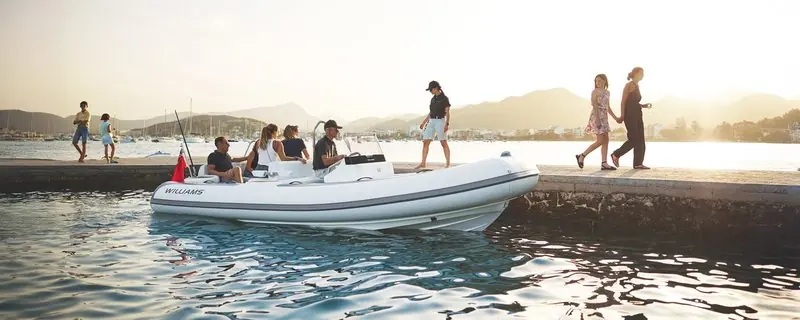
Williams now builds at Berinsfield in a purpose-built plant of about 80,000 square feet, roughly 7,400 square metres, employing more than 140 people. Motor Boat and Yachting puts annual output at about 1,200 boats, which by unit count makes Williams the largest boatbuilder in the United Kingdom. For an owner the consequence is mundane and useful. A Williams is usually sized and quoted by the yard before he has seen the garage, and parts for it sit on a shelf near his marina.
The small boats, with the numbers
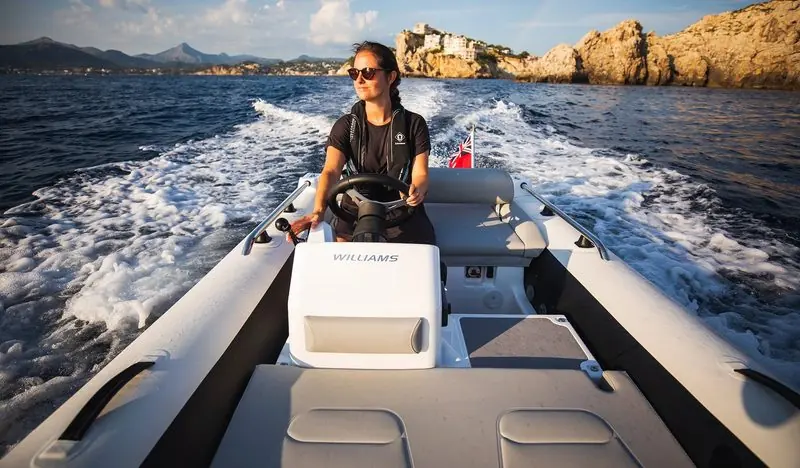
The MiniJet 280 is 2.79 m long and 1.54 m in the beam, weighs 227 kg dry, carries three people on a Rotax ACE 903 of 60 hp and holds 28 litres of petrol. Williams aims it at yachts from about 12 m. Top speed is published as 40 mph, about 35 knots. It exists because some garages will not take anything bigger, and the compromise is a fuel range measured in a couple of hours of hard use.
The TurboJet 285 is the workhorse: 2.90 m by 1.70 m, 315 kg dry, 90 hp from the same Rotax family, three plus one seats, 40 litres and about 40 knots. The TurboJet 325 sits above it on the same architecture. Five SportJet models then run from the 345 at 3.45 m and 340 kg to the 520 at 5.19 m, the newest carrying a 170 hp Rotax in the 460 for about 42 knots and a supercharged 230 hp in the 520 for about 49 knots.
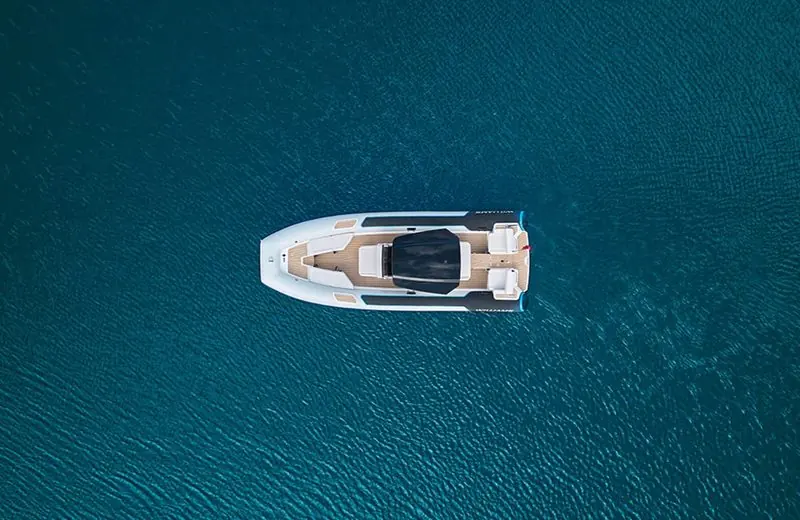
Two tonnes of EvoJet is not a tender the transom crane will lift, and that number decides the boat long before the upholstery does.
The diesel boats and the EvoJet 70
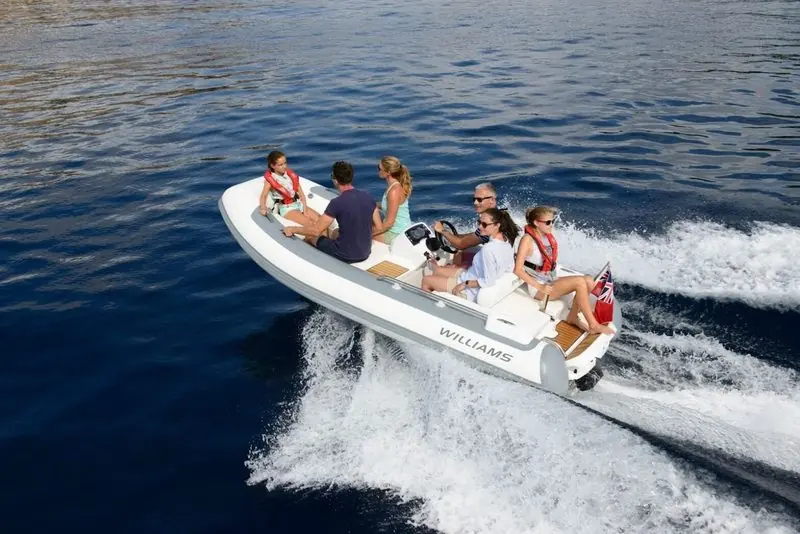
Many yachts above about 30 m carry no petrol at all, because insurers and yards dislike it and a garage full of vapour is a genuine hazard. That is why the DieselJet range exists. The DieselJet 415 is 4.16 m by 1.96 m, 828 kg dry, six seats, a Yanmar 4JH of 110 hp, 68 litres and about 31 knots. The 505 is 5.03 m and 880 kg with eight seats plus a driver, and the 625 stretches to 6.32 m on a 195 hp Yanmar 4LV with eleven seats.
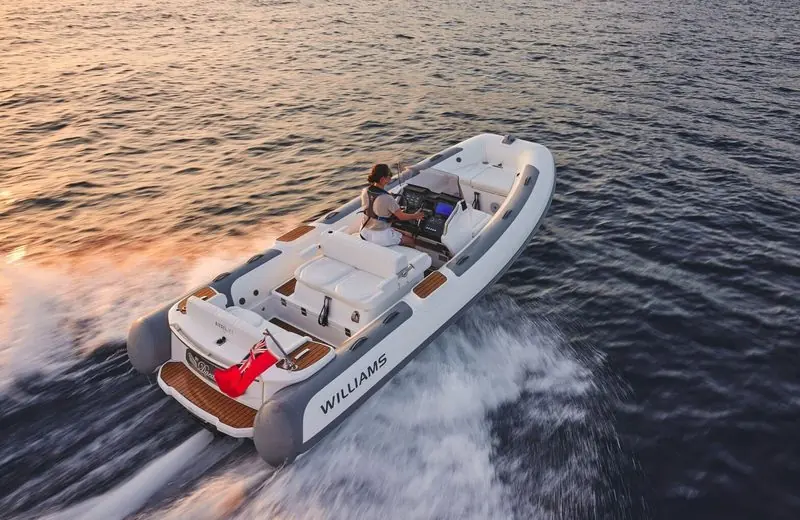
The EvoJet 70 is the boat Williams built for yachts of 40 m and above. It is 7.10 m long, 2.65 m in the beam, 2,000 kg dry, carries thirteen guests behind a Yanmar 4LV of 250 hp and does about 35 knots. Two tonnes is the number to hold onto, because it puts the EvoJet beyond many transom cranes and into davit territory. A separate SOLAS line covers rescue-certified craft of 16 ft to 20 ft for commercially registered yachts.
The three numbers that decide whether it fits
Length, beam and dry weight settle the question before anyone talks about upholstery. The garage door is usually the binding constraint on beam, the cradle sets the length, and the crane sets the weight. Across the catalogue the spread runs from 227 kg to 2,000 kg, close to a factor of nine. An owner refitting should measure the door opening and the swing of the crane at full extension before he shortlists anything.
One published discrepancy is worth catching. Williams announced the MiniJet as weighing under 200 kg and about 100 kg less than the equivalent TurboJet, and the maker's current specification sheet gives 227 kg dry. Dry weight also excludes fuel, battery, cover, cradle and whatever the crew stows aboard. Get the number for the exact build in writing from the dealer, with the options fitted, before the yard cuts the garage.
What a jet drive gives, and what it takes away
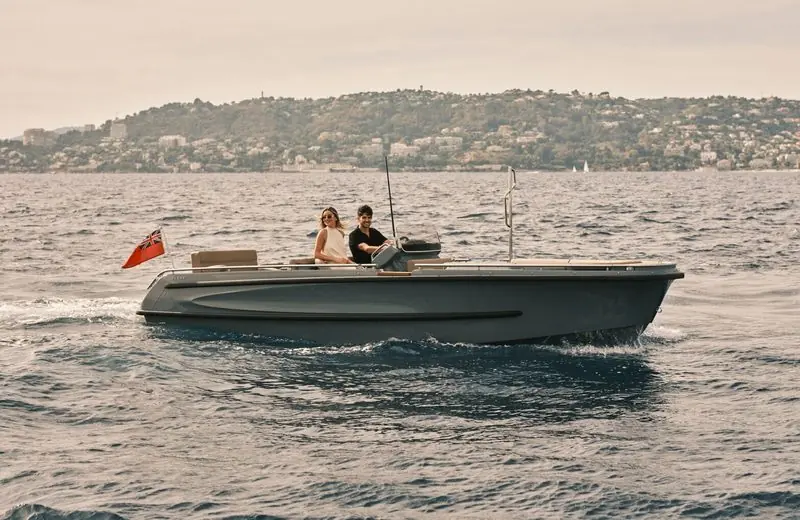
The reason Williams chose a jet is that there is no propeller. A tender spends its life nosing onto beaches and idling among swimmers, and an exposed blade in that environment is the worst risk in the whole toy inventory. A jet also draws very little water, so the boat can run right onto a sand bar, and the flat underside slides onto a cradle cleanly.
The costs are real and rarely volunteered by the sales side. A waterjet is less efficient than a propeller at displacement speeds, so a slow potter across an anchorage burns more than an equivalent outboard would. Handling astern takes practice, and a guest who drives a car well will not automatically dock a jet boat. The intake grate swallows weed, rope and plastic, and clearing it means someone in the water. Salt demands a freshwater flush after every use.
Fuel, charging and the electric question
Petrol on a large yacht is a stowage and insurance problem, and the DieselJet range solves it by drinking what the yacht already carries. On smaller boats the calculation flips, because a 90 hp petrol Rotax is far lighter than any diesel of equivalent output and the weight matters more than the fuel type. Choosing between a TurboJet and a DieselJet is really choosing between crane capacity and fuel logistics.
Williams has shown the EvoJet 70e, an all-electric version running a 58.5 kWh lithium-ion pack through control electronics from the American firm Evoa, with the same thirteen seats and the same published top speed. The company's commercial director called it a technology demonstrator built to prove what could be achieved. Williams publishes no range figure, no charge time and no price. Treat the missing range number as the whole question, because a tender that needs shore power for hours between beach trips changes a day at anchor.
What it costs to buy and to keep
Williams publishes no list prices, and the dealer network quotes against the specification. Motor Boat and Yachting listed the SportJet 520 from GBP 47,178 including VAT in its 2025 coverage. A UK tender guide consulted in July 2026 put TurboJet and SportJet boats at roughly GBP 30,000 to GBP 90,000, DieselJets at roughly GBP 100,000 to GBP 250,000 and the EvoJet 70 from roughly GBP 300,000, and described those as guidance bands with no quote behind them.
The running cost is not the fuel. It is the annual service, the impeller and wear ring that erode on any waterjet, the anodes, the tubes on the inflatable models and the hours the crew spend flushing and cleaning. Tubes are a consumable in Mediterranean sun, and a reasonable owner should budget to retube once in a long ownership. The tender also takes far more cosmetic abuse than the yacht, because it is the thing that touches docks.
Warranty, parts and a breakdown in August
Williams warrants its boats free of material defect for two years from delivery, conditional on the owner returning the completed warranty document within ten days. That clause is the sort of administrative trap that costs owners real money, and it is worth confirming with the yard's project manager that it was actually done at handover. The company runs an owners centre with manuals and parts catalogues, and sells parts through the dealers.
Coverage follows the volume. Factory-trained dealers sit across Europe, the Middle East and North America, so the Riviera, the Balearics, Italy, the Solent and Florida are well served. Caribbean cover is thinner, and a boat wintering in the islands should carry a spare impeller and a service kit. In August on the Cote d'Azur every dealer in the region is at capacity, and a failure in the first fortnight of the month is realistically a failure for the week.
Where it wins, and who should buy elsewhere
Against the custom yards, Williams competes on availability and price and loses on fit. Pascoe International and Compass Tenders design a hull around one specific garage and one owner's arrival ritual, and they will build an enclosed air-conditioned limousine that no Williams matches. Castoldi and Novurania sit between the two. What Williams offers is a boat the yard has already fitted a hundred times, delivered on schedule, with a parts network behind it.
The owner who should buy a Williams has a production or semi-custom yacht up to about 45 m, wants the tender to be a solved problem, and cares that guests can drive it safely off a beach. The owner who should look elsewhere is building full custom with the garage drawn around the tender, wants guests delivered dry and enclosed in a passing squall, or needs to move more than thirteen people in one trip.
Practical detail
| Price | no list prices published; Motor Boat and Yachting quoted the SportJet 520 from GBP 47,178 including VAT in 2025, and a July 2026 tender guide put TurboJet and SportJet boats at roughly GBP 30,000 to 90,000, DieselJets at roughly GBP 100,000 to 250,000, and the EvoJet 70 from roughly GBP 300,000 |
|---|---|
| Running cost | annual service, the impeller and wear ring that erode on any waterjet, anodes, and tube retubing on the inflatable models, budgeted roughly once in a long ownership |
| Fit before you order | garage door opening sets the beam limit, the cradle sets the length, and the transom crane's rated lift sets the weight; get the dry weight for the exact build, with options fitted, in writing from the dealer |
| Warranty | two years from delivery, conditional on the owner returning the completed warranty document within ten days of handover |
| Service network | factory-trained dealers are dense across the Riviera, the Balearics, Italy, the Solent and Florida; Caribbean cover is thinner, so a boat wintering there should carry a spare impeller and service kit |
| What is not published | no list prices anywhere in the range, and no range, charge time or price for the electric EvoJet 70e demonstrator |
Request a quote for Williams Jet Tenders.
Tell us the model and where it needs to go. The desk obtains a written offer from the maker or an authorised dealer, checks it against the prices published on this page, and comes back to you by email. No obligation, no fee.
- 01A written offerPriced in your currency, with VAT, delivery and lead time stated, not a brochure figure.
- 02Delivered where the yacht isTo the marina, the yard or your address, with the paperwork a lithium pack or a crane lift needs.
- 03IndependentYotters is tied to no single dealer, so the offer is compared before it reaches you.
What owners and crew report
No independently attributable owner or captain testimony found
trade coverage and dealer pages describe Williams as the tender most new yacht specifications already assume, but this research did not find a named owner or captain willing to be quoted on the record about handling, reliability or after-sales service for a specific model
Yotters research desk
What is good, and what to watch
Strong points
- A solved problem, off the shelfat roughly 1,200 boats a year Williams is the highest-volume boatbuilder in Britain by unit count, so the yard has usually sized and quoted the boat before the owner has shown anyone the garage
- No exposed propellerthe jet drive is the safer choice around swimmers and beaches, and the shallow draft lets the boat nose onto sand that would ground a propeller-driven tender
- The widest size and fuel spread in one cataloguepetrol, diesel and an electric demonstrator run from the 227 kg MiniJet 280 to the 2,000 kg EvoJet 70, a factor of nine, covering yachts from about 12 m to 40 m and above
What to watch
- No published prices anywhere in the rangeevery figure comes from a dealer quote against the owner's own specification, and Williams has form on a weight figure that did not match the eventual spec sheet: the MiniJet was announced at under 200 kg and the current sheet gives 227 kg dry
- A jet drive costs efficiency and ease of dockinga waterjet burns more than an equivalent outboard at displacement speed, astern handling takes practice guests do not have, and the intake grate fouls on weed, rope and plastic
- Service cover thins out where owners actually cruisethe Caribbean has fewer factory-trained dealers than Europe, and every dealer on the Cote d'Azur is at capacity in August, so a breakdown in high season is realistically a week's wait
- The EvoJet 70e is not yet a real optionWilliams calls it a technology demonstrator and publishes no range, no charge time and no price, so an owner who wants the diesel garage solved electrically cannot yet buy one
Who it is for: Owners of production and semi-custom yachts up to about 45 m who want the tender to be a solved problem with parts on a shelf in the Med.