U-Boat Worx
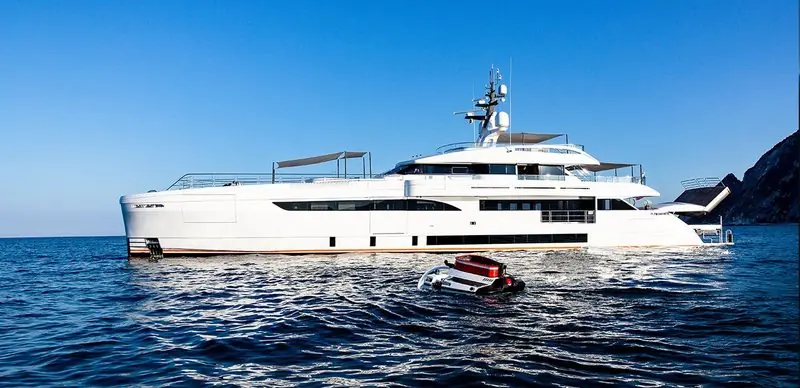
| Category | crewed personal submersibles, classed for private, charter and research use |
|---|---|
| Founded | 2005 by Bert Houtman, working from Canadian inventor Peter Mitton's C-Quester design |
| Based | Breda, the Netherlands, with a training and operations base at Sub Center Curacao |
| Fleet | more than sixty submersibles in operation, the largest private submarine fleet in the world |
| Certification | every model classed by DNV, with annual surveys carried out with DNV, and the Super Sub granted full DNV approval announced on 3 February 2026 |
| NEMO | 100 m depth, one pilot and one passenger, 2,500 kg, 280 by 231 by 155 cm, up to 3 knots, up to 8 hours |
| Super Yacht Sub 3 | 300 m depth, one pilot and two passengers, 3,800 kg, 320 by 244 by 174 cm, 21.6 kWh battery, 3 knots, 12 hours |
| NEXUS 7 and 8 | 200 m depth, seven or eight occupants, 11,000 kg and 12,000 kg, 490 by 290 by 245 cm, 62 kWh, 3 knots, 18 hours |
| Super Sub | 300 m depth, three occupants, 9,000 kg, 650 by 327 by 214 cm, 62 kWh, four 25 kW and two 6 kW thrusters, 10 knots, 8 hours, about 10 nm range |
| Deep models | C-Researcher rated to 3,000 m, Cruise Sub to 1,700 m, and a 120-occupant underwater entertainment platform rated to 150 m |
| NEMO price | EUR 1,650,000 excluding VAT in July 2026, against EUR 545,000 and EUR 590,000 announced in September 2022 |
| NEMO options, July 2026 | sonar EUR 38,000, underwater navigation EUR 35,000, extra lights EUR 24,000, visual package EUR 25,000, 4K camera EUR 69,000, manipulator arm from EUR 85,000 |
A software fortune and a Canadian design
Bert Houtman sold his stake in the Dutch software company Exact and went looking for a personal submarine, which in 2005 barely existed as a product. He founded U-Boat Worx that year and built the first machines on the C-Quester design of the Canadian inventor Peter Mitton. The company is private, based at Breda in the Netherlands, and employs somewhere above seventy people.
Two decades later it has more than sixty submersibles in service and is the largest builder of private submarines in the world. It put the first submarine operation aboard a cruise ship in 2015. The engineering is done in house because the alternative is buying a pressure hull from someone else and inheriting their assumptions about what happens at 300 m.
The two small subs an owner actually chooses between
The NEMO is the series-built machine. It takes a pilot and one passenger to 100 m, weighs 2,500 kg, measures 280 by 231 by 155 cm, runs four electric thrusters at up to 3 knots and gives up to eight hours of operation. It is small enough to launch from a boat ramp or a trailer, which is unusual in this field and useful for an owner whose yacht garage is already full.
The Super Yacht Sub 3 is the one designed around a garage. It carries a pilot and two passengers to 300 m, weighs 3,800 kg, measures 320 by 244 by 174 cm, runs a 21.6 kWh lithium-ion pack for twelve hours and lifts on a single point. Three seats instead of two is the difference between a private dive and something an owner can share with a guest and a child on the same trip.
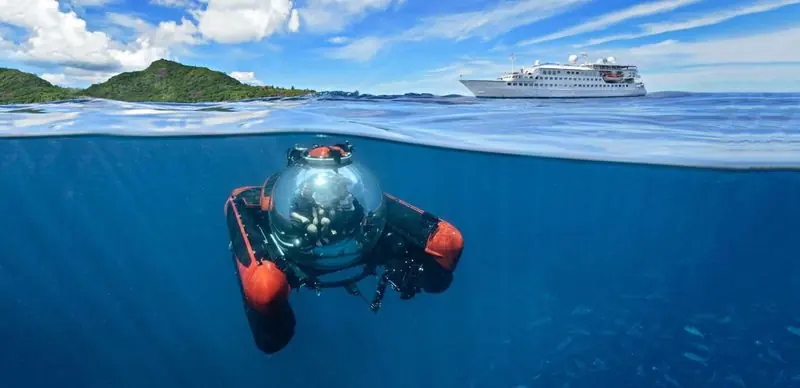
The NEMO that cost EUR 545,000 in 2022 lists at EUR 1,650,000 today, and the cheap private submarine turned out not to be a lasting category.
The passenger subs and the deep divers
Above the small subs the machines get serious. The NEXUS 7 and NEXUS 8 go to 200 m carrying seven and eight occupants, at 11,000 kg and 12,000 kg on a hull 490 by 290 by 245 cm, with a 62 kWh battery and eighteen hours of endurance. Seating revolves so nobody is looking at somebody's back. These are built for a group and for commercial operation, and they will not fit a normal yacht garage.
The Cruise Sub line runs from five to eleven occupants and 200 m to 1,700 m. The C-Researcher family goes to 3,000 m with two people aboard, which is deep enough for genuine science and well past anything a yacht owner needs for pleasure. There is also a 150 m underwater entertainment platform rated for 120 occupants and a seventeen-person Nautilus, both aimed at commercial operators.
The Super Sub, and what ten knots buys
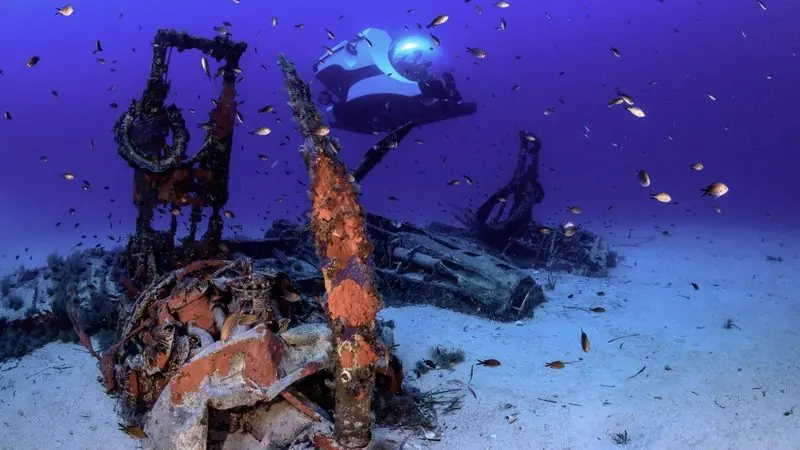
Almost every submersible in the world does about 3 knots, which is walking pace. The Super Sub does 10, using a droplet hull, wings and tilting thrusters delivering roughly 100 kW of horizontal thrust, and it will climb and dive at 45 degrees. It takes three people to 300 m, weighs 9,000 kg, carries the same 62 kWh battery as the NEXUS and runs for eight hours with an operating range around 10 nm.
DNV granted the Super Sub full approval after sea trials in Curacao, announced on 3 February 2026, and the first boat went to its owner shortly afterwards. Press reporting has put the price at roughly USD 5.75 million, which U-Boat Worx has not confirmed publicly. It is also offered on a wet lease, which is a sensible way to find out whether an owner actually wants one.
Three knots, eight hours, and the honest limits
A submersible does not cover distance. At 3 knots a dive is a slow hover over one reef or one wall, and the pilot picks the site because there is no repositioning underwater. Endurance figures of eight to eighteen hours describe the life support and the battery, and they are not how long anyone actually stays down. A typical dive is measured in an hour or two before people want a lavatory and a coffee.
Depth is also less useful than it sounds. Below about 60 m there is very little colour and almost no light, so the experience is what the floodlights reach. The other constraint is the surface. Launching and recovering a nine-tonne machine in any swell is a serious operation, and a marginal day for the tender is a cancelled day for the sub.
What it does to the yacht
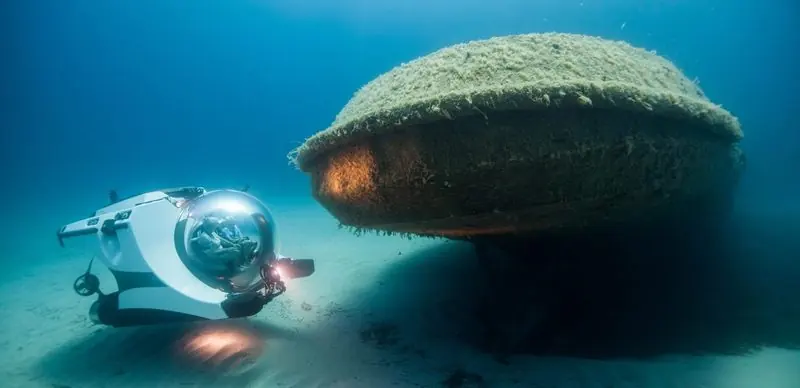
The lifting weight decides everything. A NEMO at 2,500 kg is within reach of a substantial deck crane, a Super Yacht Sub 3 at 3,800 kg needs a purpose-specified one, and a NEXUS 8 at 12,000 kg needs a crane and a deck designed for it from the first drawing. Confirm with the yard whether the maker's published figure is the dry weight or the weight as it comes out of the water.
Then there is volume. The Super Yacht Sub 3 is 3.2 m long, 2.44 m wide and 1.74 m high before any cradle, which is the footprint of a large tender in a garage that probably already holds one. Charging comes off the yacht's power, and a lithium-ion pack of 21.6 kWh or 62 kWh in an enclosed space is a fire-safety item the yard has to design around.
What it costs, and what the price has done
The NEMO story is worth following closely. U-Boat Worx cut the price by around 40 percent in September 2022, to EUR 545,000 for the one-seat NEMO 1 and EUR 590,000 for the two-seat NEMO 2, and set a target of 1,000 submarines in operation by 2030. In July 2026 the standard NEMO lists at EUR 1,650,000 excluding VAT. Anyone quoting the 2022 figure is three years out of date and about a million euros short.
The list price also buys a fairly bare boat. In July 2026 the published options run to EUR 38,000 for sonar, EUR 35,000 for underwater navigation, EUR 24,000 for extra lights, EUR 25,000 for custom colour and interior, EUR 69,000 for 4K cameras and from EUR 85,000 for a manipulator arm. The company sells pre-owned machines and runs a SubCharter scheme through charter brokers for owners who want the asset to earn.
Class, surveys and who is allowed to drive
Every U-Boat Worx submersible is designed, built and delivered to DNV rules, including the classification of its lithium-ion battery application, and the annual survey is carried out with DNV inspecting every critical system. That survey is the recurring cost and the recurring logistics problem, because it has to happen somewhere and the yacht has to be there. Each machine comes with a warranty, and U-Boat Worx does not publish the term.
Guests need no qualification at all. They sit inside a dry, air-conditioned acrylic sphere and look out. Somebody has to be a certified pilot, and the course runs two weeks full-time at Sub Center Curacao or aboard the owner's own vessel. That is either a crew member the owner pays to train and retain, or a pilot supplied by the company for the season.
Against Triton, and who should buy elsewhere
Triton Submarines in Florida is the direct competitor and the two split most of the private market between them, with SEAmagine in the smaller sizes. Triton has the deeper record on record-setting and film work. U-Boat Worx has the broader catalogue, the series-production NEMO and a training and charter operation attached. On a yacht-sized machine an owner should price both and compare the lift weight, not the depth rating.
The owner who should buy one has a yacht of about 60 m or more, cruises somewhere with water worth looking at, and will use it more than twice a season. The owner who should not is anyone treating it as a status object, because a submersible that sits in a garage still needs its annual DNV survey, its battery care and a pilot on the payroll. Wet leasing one for a season answers the question honestly.
Practical detail
| The one published price | The NEMO is the only model in the catalogue with a number on it: EUR 1,650,000 excluding VAT on the company's own NEMO site, read August 2026. Every other model, including the Super Yacht Sub 3, the Super Sub, the NEXUS and the Cruise Sub line, carries an Enquire Now button and a brochure download instead. For comparison, published figures put a Triton 3300/3 at roughly USD 4 million and a 3300/6 at about USD 5.35 million, so this is a market where a buyer negotiates without a reference price. |
|---|---|
| What the options add to a NEMO | The list price buys a fairly bare submarine. Standard equipment is air conditioning, a wireless underwater communications system and a searchlight. Published options in July 2026 run to EUR 38,000 for sonar, EUR 35,000 for underwater navigation, EUR 24,000 for extra lighting, EUR 25,000 for a custom colour and interior package, EUR 69,000 for 4K cameras and from EUR 85,000 for a manipulator arm. A working specification is comfortably a fifth above the headline. |
| Which way the price has moved | U-Boat Worx cut the NEMO by around 40 percent in September 2022, to EUR 545,000 for the one-seat NEMO 1 and EUR 590,000 for the two-seat NEMO 2, and set a target of 1,000 submarines in operation by 2030. Yachting quoted roughly USD 593,000 and USD 642,000 in May 2023. The same boat lists at EUR 1,650,000 excluding VAT today. Anyone working from the 2022 or 2023 coverage is about a million euros short. |
| What it costs to run, which nobody at the factory publishes | A specialist submarine support-vessel guide read in August 2026 budgets over EUR 1 million a year for the submersible alone, before the mothership's own running cost: EUR 120,000 to EUR 350,000 a year for the maker's maintenance programme, EUR 280,000 to EUR 500,000 for a pilot and engineer on the payroll, and EUR 60,000 to EUR 150,000 for insurance carrying manned-dive cover. U-Boat Worx publishes none of these figures and does not publish its warranty term. |
| How to find out before you buy one | The wet lease is the honest test. U-Boat Worx launched a turnkey programme in May 2025 starting at about EUR 50,000 a month on multi-year contracts, with a three-month minimum and shorter terms at a premium, bundling the submersible, the pilot and surface officer, insurance, servicing, logistics, operational planning and regulatory compliance. The first contract was a Cruise Sub 7 on a one-year global deployment with a set number of dive days. The NEMO and Super Yacht Sub are also offered. |
| Who is allowed to drive it | Guests need no qualification at all; they sit inside a dry, air-conditioned acrylic sphere. Somebody aboard has to be certified. Sub Center Curacao publishes three courses, all taught in English in Curacao and all priced on request: the Introduction Pilot Course at one day, the Surface Officer Course at ten days and the Chief Pilot Course at eighteen days. Training can be run aboard the owner's own vessel instead. That is either a crew member the owner trains and then has to retain, or a pilot supplied for the season. |
| Class, and the survey that has to happen somewhere | Every model is designed, built and delivered to DNV rules, including classification of the lithium-ion battery application. DNV inspects annually, covering all essential and safety-related systems and including a trial dive with functional tests, with a fuller survey every five years, and it can suspend class if it is not satisfied. The recurring problem is logistics rather than money: the boat, the yacht and the surveyor have to be in the same place, in season. |
| What it does to the yacht | Lifting weight decides everything: NEMO 2,500 kg, Super Yacht Sub 3 3,800 kg, Super Sub 9,000 kg, NEXUS 7 and 8 at 11,000 kg and 12,000 kg. SuperyachtNews reports the working rule that crane safe working load should exceed the submersible's weight by at least 100 kg to allow for optional equipment. A specialist guide calls for a 15 to 25 tonne deck crane with constant-tension or motion-compensation capability to launch in any sea, and a moonpool or wet dock on hulls above about 60 m for launching in bad weather. Add deck footprint, lashing, and a dedicated charging connection for a 21.6 kWh or 62 kWh lithium-ion pack in an enclosed space. |
| What is NOT published | One price in the whole catalogue. No list price for the Super Yacht Sub 3, the NEXUS or the Cruise Sub. Press figures for the Super Sub range from about EUR 5.2 million to about USD 5.75 million and U-Boat Worx has confirmed none of them, so treat the Super Sub as unpriced. No warranty term, no annual DNV survey cost, no training price, no scheduled maintenance price and no spares pricing are published. There is also no independent third-party endurance or performance test of any model in the public record: every operating figure on this page traces to the maker or to DNV. |
Request a quote for U-Boat Worx.
Tell us the model and where it needs to go. The desk obtains a written offer from the maker or an authorised dealer, checks it against the prices published on this page, and comes back to you by email. No obligation, no fee.
- 01A written offerPriced in your currency, with VAT, delivery and lead time stated, not a brochure figure.
- 02Delivered where the yacht isTo the marina, the yard or your address, with the paperwork a lithium pack or a crane lift needs.
- 03IndependentYotters is tied to no single dealer, so the offer is compared before it reaches you.
What owners and crew report
The helm is designed so the pilot can hand over the controls
Reporting on the NEMO, the magazine noted the helm is arranged so a trained pilot can temporarily transfer control to anyone aboard, which is what turns a two-seater into a guest experience rather than a solo machine. The same article quoted the NEMO at roughly USD 593,000 for the one-seater and USD 642,000 for the two-seater, a useful marker of how far the price has since moved.
Yachting (Kim Kavin, May 2023)The yacht side says design the crane for the next submarine, not this one
Filippo Rossi of Lynx Yachts and Veronika Schmid of Gill Schmid Design set out the practical rules: crane safe working load should exceed the submersible's weight by at least 100 kg to cover optional equipment, a stern A-frame suits daily use while a single-arm main-deck crane suits occasional use, and deck fixation, lashing and floor-to-ceiling access all have to be drawn in. Rossi's advice is to always build in the option to carry something bigger later.
SuperyachtNews (August 2019)What the annual class survey actually involves
Jonathan Struwe, DNV's senior inspection engineer and surveyor for pressure and underwater technology, describes yearly inspection of all essential and safety-related systems including a trial dive with functional tests, a fuller survey every five years, and the rules requiring redundancy in every essential system so the craft can surface after a failure. Before a craft is deployed with people aboard, he says, the pressure hull and all pressurised components are tested significantly beyond design diving pressure.
DNV (Jonathan Struwe)Budget over a million euros a year before the yacht's own costs
A specialist support-vessel guide breaks the annual submersible operating cost into EUR 120,000 to EUR 350,000 for the manufacturer maintenance programme, EUR 280,000 to EUR 500,000 for a pilot and engineer, and EUR 60,000 to EUR 150,000 for insurance including manned-dive cover, and it puts the total at over EUR 1 million a year for the submersible alone.
Superyacht TendersThere is no independent owner report on any of these machines
Private submarine owners are anonymous, deliveries are announced by the builder rather than the buyer, and no magazine has published a long-term test or an independent performance trial of a U-Boat Worx submersible. Every speed, depth, weight and endurance figure in circulation traces back to the company or to DNV. That absence is itself a finding for a buyer who is used to reading sea trials before he signs.
Yotters desk, checked August 2026
What is good, and what to watch
Strong points
- Classed by DNV, every model, every yearDesign, build and delivery follow DNV rules including the lithium-ion battery application, the annual survey includes a trial dive with functional tests, and a fuller inspection follows every five years. In a category where the consequences of a shortcut are absolute, a third party with the power to suspend class is the single most valuable thing the buyer gets.
- The deepest operating record in private submersiblesMore than sixty machines in service, the largest private fleet in the world, and the first submarine operation aboard a cruise ship in 2015. Pressure hulls and control systems are engineered in house rather than bought in, which is the difference between owning the assumptions and inheriting somebody else's.
- One honest published price, which nobody else in the field offersThe NEMO at EUR 1,650,000 excluding VAT, with an itemised options list from EUR 24,000 to EUR 85,000, lets a buyer build a real budget before he ever speaks to a salesman. Triton and the rest quote privately.
- The wet lease answers the question before the capital doesFrom about EUR 50,000 a month on multi-year terms, three-month minimum, with pilot, surface officer, insurance, servicing and regulatory compliance included. An owner who is unsure whether the family will actually dive can find out for a season without buying a crane, a pilot and an annual survey.
- The catalogue covers far more than one useFrom a 100 m two-seater light enough for a trailer or a boat ramp to a 3,000 m C-Researcher, a 1,700 m Cruise Sub, a seventeen-person Nautilus and a 120-occupant underwater platform. The Super Sub, granted full DNV approval on 3 February 2026, does 10 knots against about 3 knots for essentially everything else in the world.
What to watch
- The entry price has tripled in under four yearsEUR 545,000 in September 2022 against EUR 1,650,000 excluding VAT today for the standard NEMO. The affordable private submarine was announced, reported everywhere, and did not last as a category, which also makes any residual value estimate on a used machine guesswork.
- Only one model in the range carries a price at allThe Super Yacht Sub 3, the NEXUS and the Cruise Sub are quoted privately, and the Super Sub is reported anywhere between EUR 5.2 million and USD 5.75 million with no confirmation from the company. A buyer comparing two yards cannot compare two numbers.
- The running cost is the real number and the maker publishes none of itThird-party budgeting puts over EUR 1 million a year on the submersible alone once the maintenance programme, a pilot and engineer and manned-dive insurance are counted. No warranty term, survey cost or training price is published either, so the whole cost of ownership has to be assembled from outside sources.
- Three knots, and a dive that is shorter than the endurance figureAlmost every machine here does walking pace, so a dive is a slow hover over one site chosen in advance. Endurance figures of eight to eighteen hours describe life support and battery, not how long anyone stays down. Below about 60 m there is very little colour or light, so the experience is whatever the floodlights reach.
- Launch and recovery is the binding constraint, not depthA specialist guide calls for a 15 to 25 tonne crane with constant-tension or motion compensation, and a moonpool or wet dock above about 60 m for bad weather. A marginal day for the tender is a cancelled day for the submarine, and a machine that the existing crane cannot recover is a bad acquisition whatever its depth rating says.
Who it is for: Owners of yachts of about 60 m and above who cruise clear water and will dive more than twice a season.