Castoldi
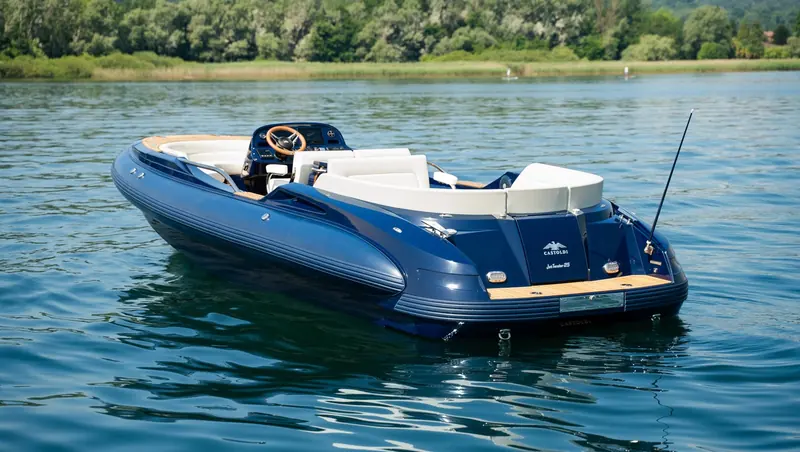
| Category | marine waterjet propulsion systems and jet tenders |
|---|---|
| Founded | 1962 |
| Based | Albairate, Lombardy, west of Milan |
| Site | 18,000 square metres, including 8,000 square metres of production sheds and offices, a test basin and a helicopter landing area |
| Waterjets | nine Turbodrive models, from the Turbodrive 224 D.D. to the Turbodrive 600 H.C.T. |
| Jet tenders | fourteen models, from the JT 14 to the JT 34 LIMO |
| Size range | 14 to 34 feet, roughly 4.3 m to 10.4 m |
| Rescue variants | JT 14, JT 18 and JT 19 offered in RB/SOLAS form |
| Quality system | ISO 9001 certified |
| Class approvals | ABS, BV, DNV, RINA, RMRS and RRR |
| Markets | superyachts, coast guard and military |
| Published data | dry weight, LOA, beam, stowage height, passengers and engine power for all fourteen jet tenders on the range page, with top speeds on each model page. No prices |
| Dry weight, from Castoldi's own range page, read July 2026: 790 kg for the Jet Tender 14, 1,270 kg for the 19, 1,580 kg for the 21, 2,480 kg for the 28 and 3,740 kg to 4,100 kg for the 34 LIMO | |
| SOLAS penalty | the RB/SOLAS variants weigh roughly 70 kg to 95 kg more than the equivalent guest boat, 860 kg against 790 kg on the 14 |
| Turbodrive 240 H.C.T., the drive in a Jet Tender 21: up to 309 kW or 420 mHP input, 238 mm impeller, 130 kg dry including gearbox, clutch, intake, duct, anodes and levers | |
| Waterjet unit dry weight ranges from 61.7 kg for the Turbodrive 224 D.D. to 1,700 kg for the 600 H.C.T. | |
| Intake protection | a movable grid at the duct water inlet, with the patented Clear-Duct system reversing the impeller and opening the grid together to back-flush the duct |
| US after-sales | Castoldi USA Inc., Seattle, announced 25 October 2022 |
| Not published | prices, lead times and any service-point directory by country |
The company that made the waterjet work
Castoldi started research into waterjet propulsion in 1962 and describes itself as the innovator of the system. The claim is defensible in the sense that the company was working on jets for small craft when almost nobody else was, and it has stayed on the same problem for more than sixty years. A waterjet takes water in beneath the hull, accelerates it through a pump and pushes it out astern.
The engineering that makes it useful on a tender is the steering and reversing arrangement. Castoldi builds reversible thrust deflectors and a system that can hold vertical neutral thrust independently of pump speed, which means the boat can sit still with the engine running and then move in any direction without a gear change. That is what makes a jet tender easy for a guest to handle alongside.
Albairate
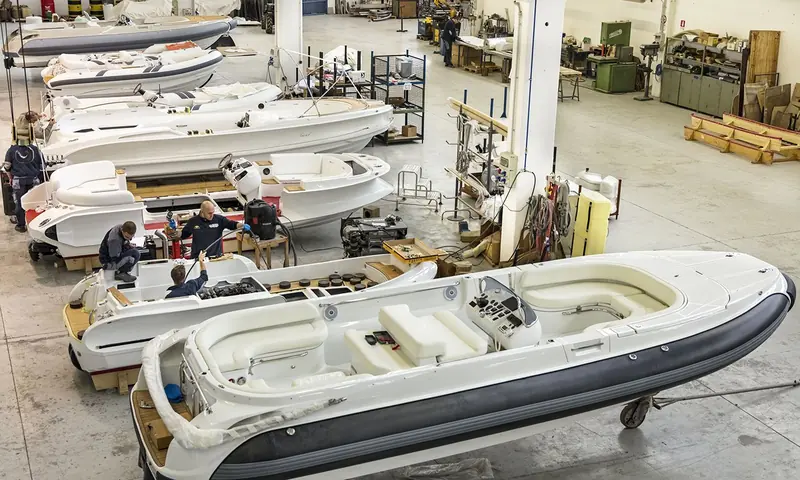
The plant sits at Albairate in Lombardy, west of Milan, on a site of 18,000 square metres with 8,000 square metres of production sheds and offices. There is a water basin for testing on site, which is unusual and says something about how the company develops product. There is also a helicopter landing area, which says something about who visits.
The operation is certified to ISO 9001 and holds approvals from the major classification registers, including ABS, Bureau Veritas, DNV, RINA, the Russian Maritime Register and the Russian River Register. Those approvals exist because the jets go into commercial and naval craft as well as yacht tenders, and they are the reason a builder specifying a Castoldi drive does not have to justify it to a surveyor.
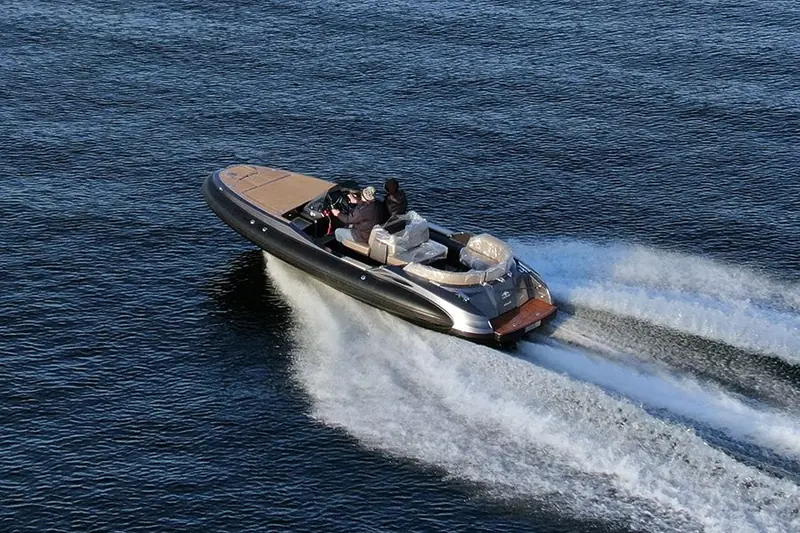
The drive that lets a tender idle among swimmers, usually wearing somebody else's badge.
What the jet buys, and what it costs below 25 knots
The case for the jet is swimmers and draught, and both hold up. Castoldi describes the arrangement as eliminating all under keel protrusions, which is what lets a tender idle among people in the water, nose onto a sandbar and be handed to a guest for the run ashore. Thrust is set by the bucket rather than by a gearbox, so the boat holds station with the impeller still gripping the water and then moves in any direction without a shift. That is the handling a captain notices in the first ten minutes.
The cost lands exactly where a tender spends most of its life. Wartsila puts the crossover at 25 knots to 30 knots, above which a waterjet can beat a conventional propeller and below which it does not. A tender making five minute hops around an anchorage at displacement speed is working in the worst part of that curve, and the season's fuel figure shows it. A sterndrive of the same power will out-thrust it at low speed, and because astern thrust comes from deflecting the jet rather than reversing a propeller, it will also hold a heading better going backwards in a crosswind.
The Turbodrive range
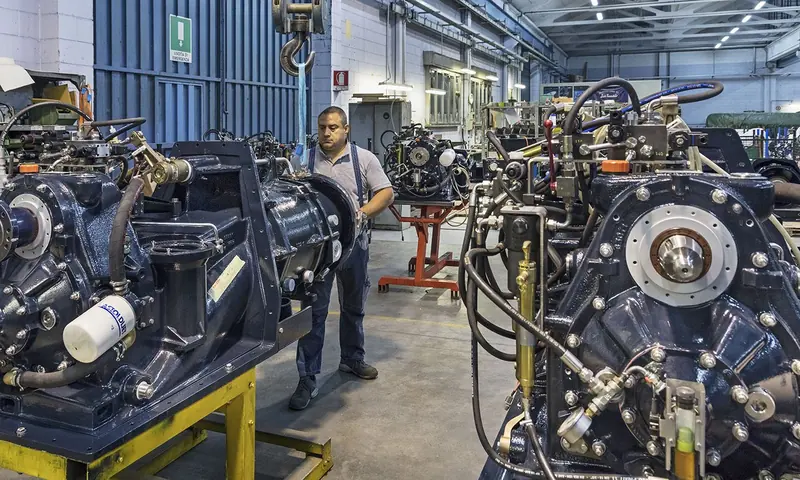
Nine Turbodrive models cover the range, from the Turbodrive 224 D.D. at the small end up through the 240 and 284 in both H.C.T. and L.V.T. forms, the 340 H.C., the 400 and 490 H.C.T., and the 600 H.C.T. at the top. These are sold to boatbuilders, so most owners meet a Castoldi drive inside somebody else's tender.
That is the important commercial fact about the company. A Castoldi waterjet may be under a tender built by an Italian, British or Dutch yard, and the badge on the transom is not Castoldi. Owners choosing a tender should ask which drive is fitted, because the drive determines the service parts, the impeller availability and the handling more than the hull does.
The jet tenders
Castoldi also builds complete boats. Fourteen jet tender models run from the JT 14 at about 4.3 m to the JT 34 LIMO at about 10.4 m, taking in the JT 15, 16, 17, 18, 19, 21, 23, 25 and 28 in between. They are rigid inflatable boats with diesel engines and Castoldi's own jet drives, which is an unusual combination in a yacht tender of that size.
Diesel matters aboard. A yacht that runs diesel machinery and does not want petrol on the swim platform can specify a diesel jet tender and avoid a second fuel entirely. The step from a 4.3 m boat to a 10.4 m limousine covers most of what a yacht from 30 m upwards actually needs, and the naming steps through the sizes in single feet, which suggests how closely these boats are matched to garages.
The SOLAS rescue variants
The JT 14, JT 18 and JT 19 are offered in RB/SOLAS form, built as rescue boats to the international convention standard. That is a different product from a guest tender. A SOLAS rescue boat has to be launchable and recoverable in defined sea states, has to self-right or stay stable when swamped, and has to be maintained and inspected on a schedule.
For a large yacht this matters directly, because commercially registered vessels above a certain size are required to carry a compliant rescue boat. Being able to buy that boat from the same maker as the guest tender simplifies training, spares and service. It is also a reminder that Castoldi's engineering is validated in a market where a failure is not an inconvenience.
Dry weight, and the crane that has to lift it
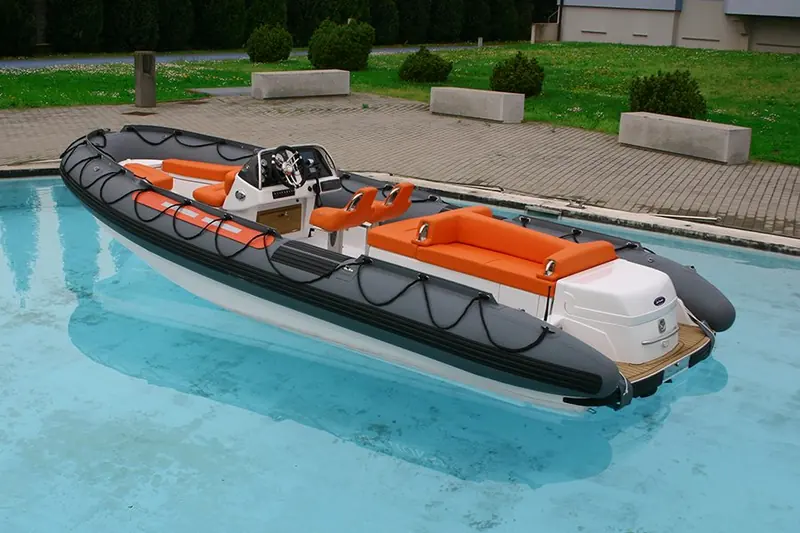
Castoldi publishes a complete weight ladder on its range page, and it is the first number to put against the yacht's deck plan. Dry weight runs from 790 kg for the Jet Tender 14 at 4.28 m, through 1,270 kg for the 19 and 1,580 kg for the 21 at 6.30 m, to between 3,740 kg and 4,100 kg for the 34 LIMO depending on the engine pair. A 4.28 m boat at 790 kg dry is heavy for its length, and the diesel engine and the jet unit are why.
Dry weight is not lifting weight, and the gap between them is where davits get specified wrong. A Jet Tender 21 carries 155 l of fuel, roughly 130 kg of diesel at a nominal 0.84 kg per litre, before water, ground tackle, fenders or the lifting frame. A crane rated at 1,600 kg safe working load does not lift a 1,580 kg boat with a full tank. The figure that belongs in the specification is dry weight plus fuel plus the sling arrangement, confirmed by the builder for the boat as fitted, and it should be settled before the passerelle crane or the garage davit is ordered.
Parts, and who actually holds them
Castoldi builds at Albairate and sells through distributors rather than through a published service network. The company shows a network map and invites distributor enquiries at a dedicated address, but it lists no service points by country, so the question to answer before signing is which named business holds impellers and wear rings for that specific drive in the cruising area. The one firm expansion the company has announced is Castoldi USA Inc. in Seattle, set up in October 2022 to handle American sales and after-sales.
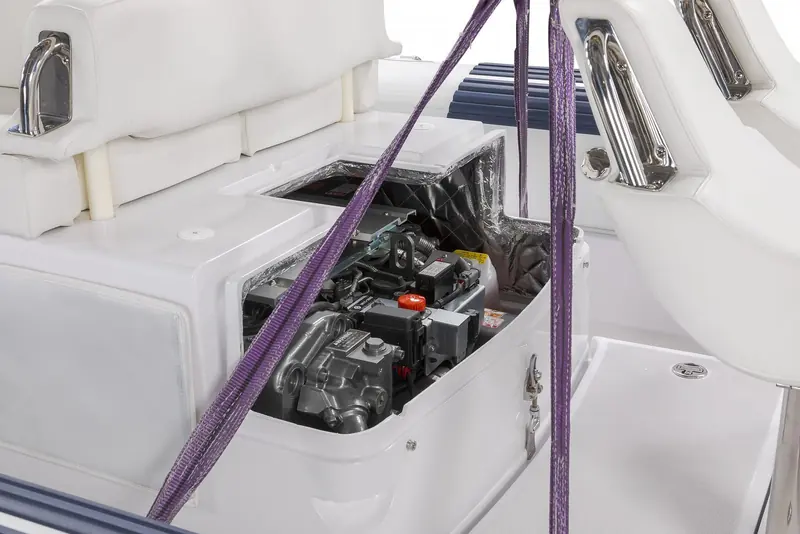
In the Mediterranean the answer is usually an Italian marine engineer and a courier out of Lombardy, which is quick in June and slower in the middle of August when Italian industry takes its holiday, which is also the fortnight the tender is running hardest. The parts worth carrying aboard are an impeller and a wear ring for the fitted drive, because those are what an ingestion event damages and what a diver or a short haul-out can change. A Turbodrive 240 H.C.T. is 130 kg dry complete, which is a lift and a workshop rather than a pontoon and an afternoon.
Against outboards, sterndrives and Williams
For a small tender the comparison is with Williams Jet Tenders, which built its business on petrol jet tenders sized for yacht garages and is specified as standard by many yards. Williams is the volume answer. Castoldi's tenders are heavier, diesel and closer to a working boat, and its real reach is through the drives fitted inside other builders' hulls.
Against an outboard, a jet gives up efficiency and simplicity and buys safety around swimmers and access to shallow water. Against a sterndrive it gives up low-speed thrust and buys the absence of anything vulnerable under the hull. On a yacht where guests swim off the platform and the tender comes and goes all day, that trade usually settles in favour of the jet.
Weed, sand and what the crew does about it
Every waterjet shares one failure mode. The intake is an opening in the bottom of the boat, and sooner or later it takes in weed, a plastic bag, a trailing line or a load of sand off a beach, at which point thrust falls away and the tender is unusable until it is cleared. Castoldi fits a movable grid at the duct water inlet on its drives to keep debris out in the first place.
What matters more is the drill after something gets past the grid. The Clear-Duct system reverses the impeller and opens the intake grid together, back-flushing the duct from the helm, and it is not reserved for the large commercial units: the Turbodrive 240 H.C.T. fitted to a Jet Tender 21 carries it. The consequence for a crew is that routine clearance is a lever at the console rather than somebody in the water with a knife, and only a blockage that survives a back-flush needs a diver. In a weedy anchorage that is worth more than a knot of top speed.
Price, lead time and the three numbers to get in writing
Prices and lead times are the real omission. Castoldi publishes neither, dealers quote on request, and the specialist tender brokers list every current model as built to order with no figure attached. Brokerage asking prices for used boats cover a decade of model years across a wide band and are no guide to a new hull or a refit replacement. Cost cannot be shortlisted from the websites at all, which is an argument for making the enquiry before the garage dimensions are frozen.
Three numbers decide the outcome and all three should come back in writing: lifting weight for the boat as actually fitted, length and beam against the garage opening and its door, and the guest number the boat will really carry. The published capacities are CE design category figures, 12 people on a Jet Tender 21 and 16 on a 25, which is not the number who will sit in one with towels, a cooler and a crew member driving. The drive model belongs in the same document, because it sets the spares list for the next ten years.
Practical detail
| Turbodrive unit pricing | No public list price. Distributor listings (e.g. the Turbodrive 490HC) show call-for-price / enquire-now -- this is a quote-only B2B market and Castoldi does not publish unit prices. |
|---|---|
| Jet Tender pricing (new) | No public factory price list found; Castoldi jet tenders are sold and specified through dealers, so new pricing is quote-only like the drive units themselves. |
| Jet Tender pricing (secondary market, for context only) | Used listings on DailyBoats (Europe) range from about $19,800 for the smallest models up to about $182,000; YachtWorld/Boat Trader show used Castoldi tenders from roughly $32,000-$42,000 up to $99,500-$318,000 depending on size and age. The two aggregators disagree on the top end, so treat this only as a rough band, not a reliable ceiling. |
| How a yard or owner specifies a unit | Through Castoldi's own dealer and qualified-service network rather than direct factory retail -- named distributors include Heavy Seas (UK, Castoldi Qualified Service), Golden Arrow Marine (UK), Performance Diesel and Maucour (France) and Varriale (Italy), several of which also stock Castoldi/Williams spare parts. |
| Service and parts network | Multiple independent marine distributors across Europe (UK, France, Italy, Germany via Maritimus) carry Castoldi/Williams jet-drive parts and offer qualified servicing, in addition to Castoldi's own factory support -- a broader independent-dealer network than a single-source OEM-only support model. |
| Comparable propulsion alternatives | At the small-craft end, Castoldi's largest Turbodrive (490 H.C.) tops out around 1324kW/1800hp. At the larger commercial/naval end, Kongsberg (Rolls-Royce) Kamewa waterjets scale from about 450kW to over 30,000kW with a stated average 15,000-hour interval between overhauls, and HamiltonJet focuses heavily on the passenger-ferry segment -- both operate mostly above Castoldi's leisure/patrol-boat scale rather than competing model-for-model on small tenders. No public price comparison was found between Castoldi and these alternatives, or between waterjet and propeller/sterndrive cost for an equivalent small tender; industry commentary consistently describes waterjets as carrying a higher initial and maintenance cost than propeller drives, but without a specific published figure. |
Request a quote for Castoldi.
Tell us the model and where it needs to go. The desk obtains a written offer from the maker or an authorised dealer, checks it against the prices published on this page, and comes back to you by email. No obligation, no fee.
- 01A written offerPriced in your currency, with VAT, delivery and lead time stated, not a brochure figure.
- 02Delivered where the yacht isTo the marina, the yard or your address, with the paperwork a lithium pack or a crane lift needs.
- 03IndependentYotters is tied to no single dealer, so the offer is compared before it reaches you.
What owners and crew report
Italian Coastguard patrol boat exceeded its design speed on a demanding delivery trip
FB Design's 16m CP335 patrol vessel, fitted with twin Castoldi Turbodrive 400 HCT waterjets, ran a winter delivery voyage from Venice to Puglia and recorded speeds up to 38 knots, higher than the designers' forecast maximum. FB Design's commercial director Ebe Buzzi credited the ease of installation and the performance of the units.
Marine Industry NewsGerman fisheries patrol authority runs twin Turbodrive 400 HCT on a North Sea patrol vessel
A 17m fisheries patrol vessel for North Sea duty in Germany was completed at Tamsen Maritim shipyard in Rostock with dual Castoldi Turbodrive 400 HCT installations, reported alongside the Italian Coastguard trial as one of two successful newbuild sea trials.
Marine Industry NewsIndependent sea-trial test of the Jet Tender 17 published real performance numbers
A road-test style write-up of the Castoldi Jet Tender 17 (170hp diesel with Castoldi waterjet drive) recorded 34 knots maximum light-ship and 32.5 knots fully loaded, describing it as a can-do RIB with the performance, reliability and safety of waterjet drive.
Yachting Magazine
What is good, and what to watch
Strong points
- No exposed propeller and near-zero draft restrictionThe waterjet has no rotating parts below the keel, so Castoldi tenders can land on beaches and cross sandbanks and are inherently safer to operate around swimmers and water-sports guests, a genuine differentiator over a shaft-and-propeller tender of the same size.
- High power density for the installed weightThe largest Turbodrive, the 490 H.C., is rated to take up to 1324kW (1800hp) of input power at a dry weight of about 890kg in an aluminum-alloy housing, giving a strong power-to-weight figure versus a comparable shaft/strut/propeller installation, corroborated by both the manufacturer's spec sheet and independent industry summaries of waterjet advantages.
- Proven at the high end of leisure/patrol speed envelopes, independently verifiedThe Turbodrive 400 HCT pushed a 16m coastguard patrol hull to 38 knots in a real winter sea trial, beating the naval architect's own forecast; this is a third-party (FB Design) verified result, not a manufacturer claim in isolation.
- Long, continuous manufacturing pedigree since 1962Castoldi states more than 40,000 units have been delivered worldwide since it began producing scaled waterjets in 1962 and mass-produced its first unit (Jet 05) in 1969; the company's waterjets also won long-distance offshore powerboat races in the 1970s-80s and powered the support boat for the 1992 transatlantic speed record attempt by Destriero, indicating decades of field-proven use rather than a recent market entrant.
What to watch
- Waterjets lose efficiency to propellers at low-to-moderate speedThe propulsive coefficient of a typical propeller at 16 knots (around 65 percent) is markedly better than a waterjet at the same speed (around 40 percent); waterjets only pull ahead of propeller efficiency at higher speeds (industry figures put the crossover in the 20-50 knot range depending on hull and load). This is a genuine physics tradeoff of the Turbodrive product line, not specific to Castoldi's execution.
- Real-world fuel consumption can run noticeably higher than an equivalent propeller boatOwner/operator discussion on jet-vs-prop performance reports comparable-power jet boats needing significantly higher engine RPM to match a propeller boat's cruise speed and burning roughly twice the fuel in some like-for-like comparisons, because pump power absorption rises with the cube of RPM. This is anecdotal rather than a controlled test, but it is a consistent, independently-reported theme.
- Debris and weed ingestion is a known failure mode that Castoldi has had to engineer aroundFloating weed, sea grass and other debris can be drawn to the intake grate and restrict flow in any waterjet; Castoldi's own Turbodrive line addresses this with a movable intake grid and a Clear-Duct unclogging system, which is itself evidence the vulnerability is real enough to need a dedicated feature, and matches the general clogging problem documented for jet propulsion craft.
- Impeller and wear-ring clearances need active maintenance; cavitation erosion is commonJet pressure and thrust depend on tight impeller-to-wear-ring clearances that open up over time, and cavitation erosion at the impeller is a recognized wear mechanism in waterjets generally; clean, well-maintained units can run for years, but this is a maintenance dependency that a fixed-pitch shaft propeller does not have to the same degree.
Who it is for: Owners who want a diesel tender with nothing turning under the hull, and anyone specifying a tender who should be asking which waterjet is inside it.