Caterpillar Marine
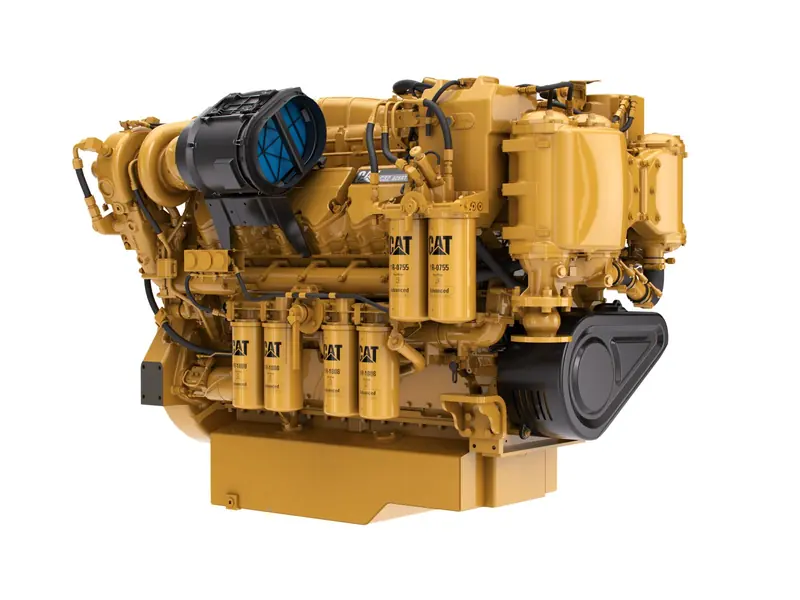
| Category | main propulsion diesel engines for motor yachts, inline and V-configuration, mechanical or SCR-aftertreated |
|---|---|
| Maker | Caterpillar Inc., Peoria/Deerfield, Illinois. Cat Marine is a division of the same company that builds Cat's construction and mining equipment, not a separate marine specialist the way MTU or MAN are |
| Yacht-rated propulsion range | C9.3 (inline-6, roughly 800 to 900 bhp), C12 and C18 (inline-6, roughly 800 to 1,150 bhp), C32 and C32B (V12, roughly 1,000 to 2,400 bhp), and 3406C, 3512C/3512E (V8 and V12, up into the low thousands of bhp) for the largest motor yachts and displacement superyachts |
| Newest yacht engine | the C32B, launched 2020 and expanded through 2024-2025 with 1800, 2000, 2200 and 2400 bhp ratings at 2,300 rpm, a 5 to 20 percent power increase over the equivalent C32 rating in the same physical envelope, with a quieter unit-injector fuel system Caterpillar says cuts low-speed noise by up to 25 percent |
| Emissions | EPA Tier 3 Recreational and IMO II as standard; a factory SCR aftertreatment option certifies the C32 and C32B to EPA Tier 4 Final and IMO III, and Caterpillar's own literature notes the SCR system can be switched off outside IMO III emission-control areas, when only the lighter IMO II standard applies |
| Alternative fuel | Cat's 3500E-series marine engines were announced in September 2022 as convertible to dual-fuel methanol running; the smaller yacht-rated range (C9.3 through C32B) runs on HVO renewable diesel today with no hardware changes, the same claim MTU makes for its own range |
| No published price list anywhere on cat.com; every product page ends at a 'Request A Price' button routed to the buyer's regional dealer. Third-party European resellers have listed indicative new-engine prices (a C18 from about EUR 90,850 and a C32 from about EUR 181,070, both excluding VAT and before yard integration), but these are broker list prices, not Caterpillar's own | |
| Named yacht in service | the 55m Christensen motor yacht Here Comes The Sun runs twin 3,150 hp Caterpillar 3516 engines, one of several documented large motor yachts running Cat's biggest V16 propulsion option |
What Caterpillar Marine Actually Makes
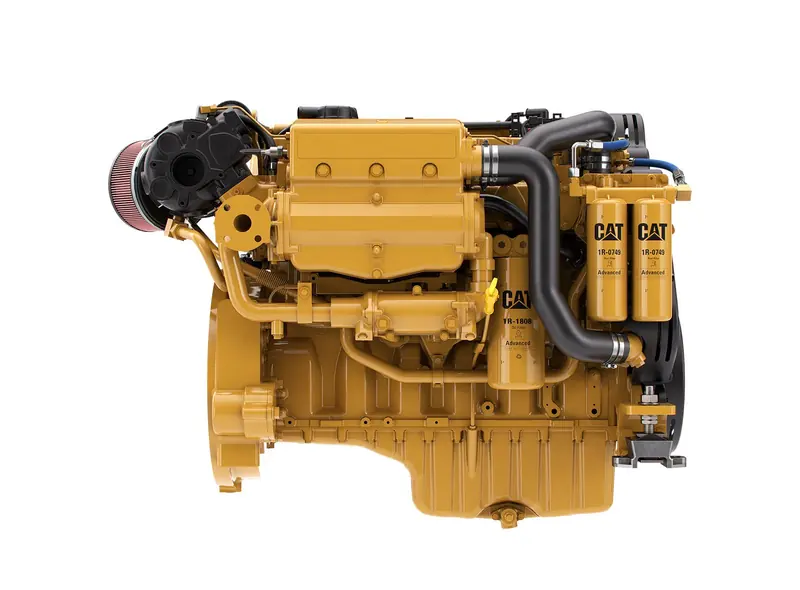
Cat's yacht-rated commercial propulsion range currently runs from the inline-6 C9.3 at the small end, through the C12 and C18 (also inline-6, aimed at 45 to 70 foot yachts in the 800 to 1,150 bhp band), up to the V12 C32 and its newer, more power-dense sibling the C32B, and finally the V8/V12 3406C and 3512C/3512E for the largest motor yachts and slower-turning displacement hulls. It is a wider spread of small-to-midsize ratings than MTU offers, which is one reason Cat, not MTU, tends to be the default on 50 to 90 foot production motor yachts rather than superyachts over 100 feet. At the top of that range, the 55-metre Christensen motor yacht Here Comes The Sun runs twin 3,150 hp Cat 3516 engines, one of several documented large motor yachts built around Cat's biggest V16 propulsion option rather than a competitor's superyacht-class engine.
Unlike MTU, which was bought by Rolls-Royce specifically to be a power-systems business, marine is one application among many for Caterpillar, alongside construction, mining, oil and gas, and stationary power. Forum owners read that two ways: a wider parts and service network built for a much bigger installed base of non-marine Cat equipment, against a marine product line that gets a smaller share of a much larger company's engineering attention than MTU's does inside Rolls-Royce Power Systems.
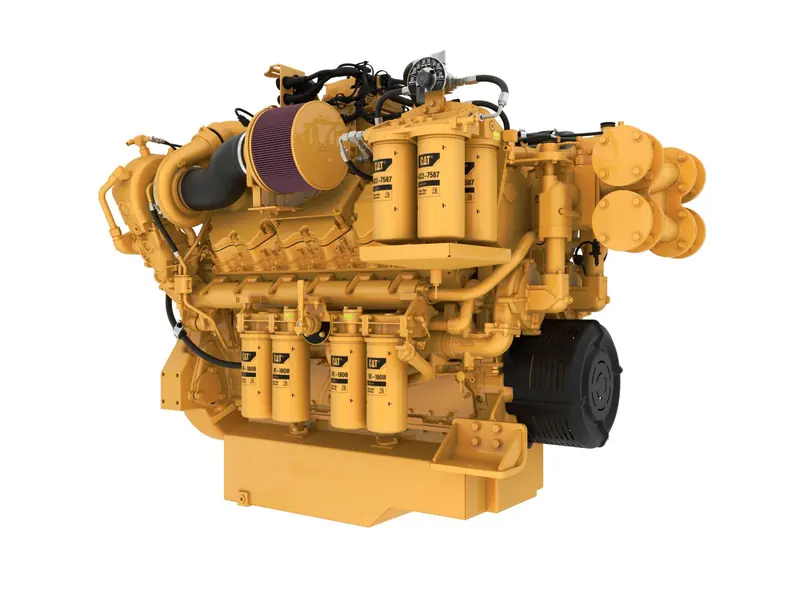
The C32B: Caterpillar's Newest Yacht Engine
The base C32B is rated from about 1,200 to 1,700 bhp, expanded through 2024-2025 with higher 1,800, 2,000, 2,200 and 2,400 bhp ratings at 2,300 rpm, and a Triple Turbo variant reaching 2,433 mhp. Caterpillar's own press material puts the C32B's power increase at 5 percent over the equivalent C32 rating at launch, since expanded to a full family running 1,800, 2,000, 2,200 and 2,400 bhp at 2,300 rpm; a Triple Turbo top rating brings that as high as 2,433 mhp. An updated unit-injector fuel system allows multiple injections per cycle, which Caterpillar says cuts noise at low speed by up to 25 percent, and the engine carries an updated ADEM 6 electronic control module over the outgoing C32.
On emissions, the C32B is certified to EPA Tier 3 Recreational, IMO II and RCD II as standard, with a factory SCR system available for boats that need IMO III. That SCR system is switchable: Caterpillar's own literature notes it can be turned off once a yacht leaves an IMO III emission-control area, since only the lighter IMO II standard applies in open water, which keeps urea consumption and dosing-system wear down on a boat that spends most of its time outside ECA zones.
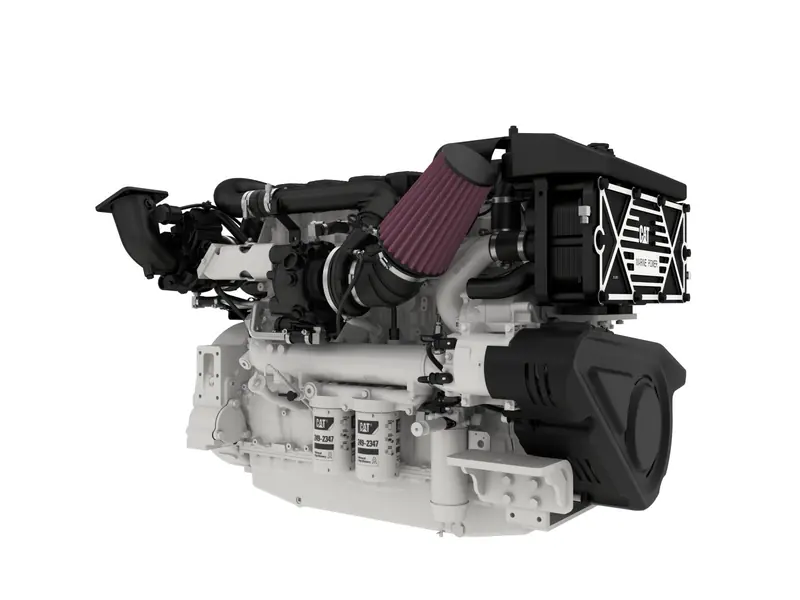
Caterpillar publishes no price for the engine that runs most production motor yachts under 2,000 hp; owners on three separate forums put its real advantage over MTU in the service bill, not the spec sheet.
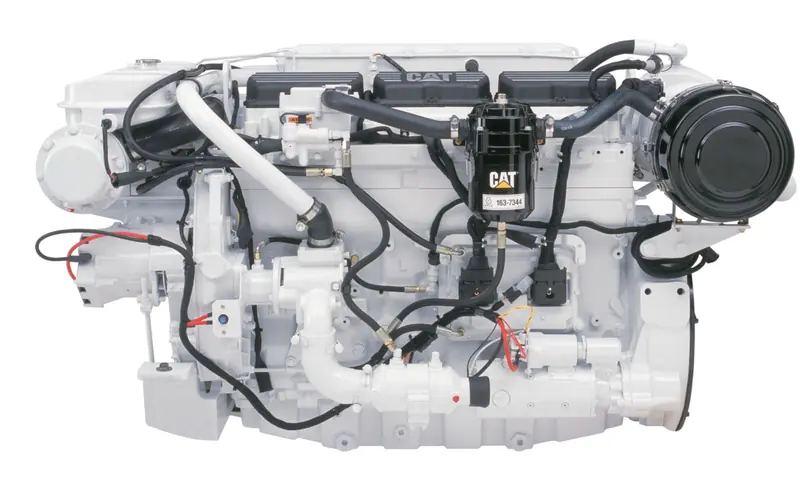
What A New Engine And Its Service Actually Cost
No official price list exists anywhere in Caterpillar's own material. A German reseller (conso-shop) has listed a new C18 from around EUR 90,850 and a new C32 from around EUR 181,070, both excluding VAT and before a yard's integration, mounting and commissioning costs are added; treat those as one broker's list prices, not Caterpillar's own figures, since Cat itself will not confirm a number without a specific boat and rating. Every one of Caterpillar's commercial propulsion engine pages, from the C9.3 up to the 3512E, ends the same way: full published specifications, torque and fuel curves, and a 'Request A Price' button that routes to a regional authorized dealer rather than a checkout.
On service, a 1,000-hour C32 service quoted through dealer HO Penn came in around USD 19,000 for a single engine, at roughly USD 280 an hour labor, according to an owner's account on YachtForums; a separate owner on the same forum reported an aftercooler core alone running about USD 5,200 several years earlier. Against that, Sam's Marine forum members comparing MTU and Cat directly described MTU's parts as considerably pricier for equivalent work, with Cat's far larger non-marine dealer footprint making routine parts easier to source on short notice.
Overhaul Life And What Determines It
An experienced captain on YachtForums, discussing the pre-ACERT C32 specifically, put the top-end overhaul at 10,000 hours or 120,000 gallons of fuel consumed, and the major overhaul at 200,000 gallons, whichever comes first, then added the practical point that a pleasure boat will hit the hour limit long before it burns through the fuel figure. That lines up with the newer ACERT-era C32's factory documentation, which some sources put closer to 18,000 to 20,000 hours depending on load and duty cycle.
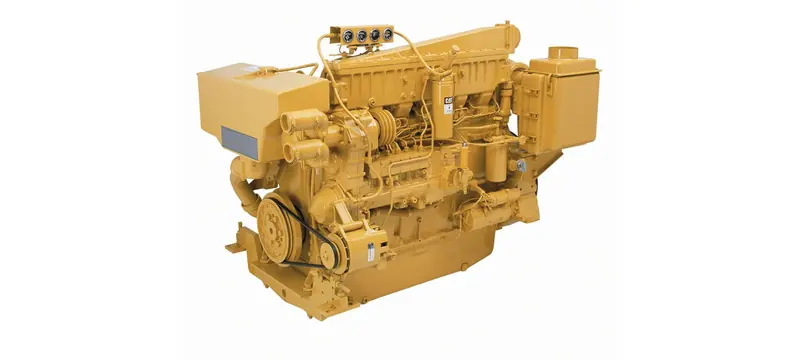
Forum consensus across Sam's Marine and Trawler Forum treats the older 3412 as one of the best engines Caterpillar ever built, simple and stout with a long service history, while newer electronically controlled engines trade some of that mechanical simplicity for the fuel efficiency and emissions compliance the older engines cannot meet. A pre-purchase survey with a documented maintenance log, not just an hour-meter reading, is the standard advice on both forums for judging how much overhaul life is actually left. On the same forum, one poster named the Cat 3412 one of the best engines Caterpillar ever made, and another separately ranked MTU's 16v2000 among the best diesels ever built, which reads less as one brand beating the other and more as both companies' older, simpler engines earning a trust newer electronically controlled models have not yet had time to prove.
How Caterpillar Compares To MTU And Volvo Penta
A Sam's Marine Hatteras Owners Forum thread comparing the two directly for a repower concluded both are reliable when properly maintained, while singling out MTU's more rigorous service schedule and pricier parts; a separate poster on the same thread noted MTU's maintenance costs run in line with MAN's, considerably higher than Cat's for comparable engines. A YachtForums thread on the same question reached a similar split: Cat for robust, low-RPM torque and longevity and lower running cost, MTU where outright speed and power-to-weight matter more than operating cost.
Neither forum treated the choice as a clean win for either brand. Boats built for outright speed and running above roughly 2,000 hp per engine tend toward MTU, which is also the more common OEM fit on superyachts over 100 feet; boats built for lower-RPM cruising efficiency and a wider US service network tend toward Cat, which dominates the 45 to 90 foot production motor yacht market MTU barely competes in at the smaller end of its own range.
The Emissions And Alternative Fuel Picture
HVO approval across the C9.3 to C32B range removes the most common near-term decarbonization question for an owner: no engine swap or warranty risk is needed to run on renewable diesel where it is available at the fuel dock. For IMO III compliance, Caterpillar's factory SCR system for the C32 and C32B works the same way MTU's does, and Cat's own literature is explicit that owners can switch it off once clear of an emission-control area, cutting urea consumption on a boat that spends most of its time outside ECA waters. Caterpillar's own Tier 4 Final/IMO III open order board for the C32 spans ratings from about 1,000 bhp at 1,600 to 1,800 rpm up to 1,450 bhp at 2,050 to 2,150 rpm with the SCR system fitted, a narrower band than the unregulated engine's full range since the aftertreatment hardware and closed-loop NOx sensing add real weight and cost that Caterpillar's own material frames as offset by lower long-run owning and operating costs.
In September 2022 Caterpillar announced its 3500E-series marine engines, its larger commercial and workboat range rather than the yacht-rated line covered here, would be developed to run as dual-fuel methanol engines; nothing in Caterpillar's public material extends that program to the C9.3 through C32B engines a yacht owner would actually buy today. Read together with MTU's own HVO and SCR position, the two main propulsion makers are at effective parity on emissions readiness for a yacht ordered now; neither has committed a firm date for methanol or hydrogen propulsion reaching a yacht-sized engine.
Practical detail
| New engine and dealer pricing | No price list is published anywhere in Caterpillar's own material; every commercial propulsion engine page on cat.com ends at a 'Request A Price' button routed to the buyer's regional authorized dealer. Third-party European resellers have listed indicative new prices (a C18 from about EUR 90,850, a C32 from about EUR 181,070, both ex-VAT and before yard integration), but Caterpillar itself will not confirm a figure without a specific boat and rating. |
|---|---|
| 1,000-hour service cost | One owner's HO Penn dealer quote for a single C32's 1,000-hour service ran about USD 19,000, worked out at roughly USD 280 an hour labor for a 50-hour job, reported on YachtForums. A separate owner recalled an aftercooler core alone costing about USD 5,200 several years earlier, plus roughly USD 2,000 labor to fit it. |
| Overhaul interval (TBO) | A pre-ACERT C32 is rated for a top-end overhaul at 10,000 hours or 120,000 gallons of fuel consumed, and a major overhaul at 200,000 gallons, whichever comes first; owners note a pleasure boat's duty cycle reaches the hour limit long before the fuel limit. Newer ACERT-era engines are cited closer to 18,000 to 20,000 hours depending on load. |
| Emissions compliance route | EPA Tier 3 Recreational and IMO II as standard across the yacht-rated range; a factory SCR aftertreatment option certifies the C32 and C32B to EPA Tier 4 Final and IMO III, switchable off once outside an emission-control area. The full range from C9.3 to C32B is approved to run on HVO renewable diesel with no hardware changes. |
| How it compares to MTU on cost | Independent owners on Sam's Marine and Trawler Forum both describe MTU as having a more rigorous service schedule and pricier parts than Caterpillar for comparable engines, with Cat's much larger non-marine dealer network making routine parts easier to source; MTU is generally chosen instead where more power per engine or a faster top speed matters more than running cost. |
What owners and crew report
More rigorous service schedule and pricier parts than Cat, describing the comparison from the MTU side
A poster on Sam's Marine Hatteras Owners Forum comparing MTU and Caterpillar for a repower wrote that MTU's service schedule is more rigorous and parts are very expensive compared to CAT, while rating both engines reliable when properly maintained.
Sam's Marine Hatteras Owners Forum (MTU vs CAT thread)The older 3412 is regarded as one of Caterpillar's best engines ever built
A forum member called the Cat 3412 one of the best engines Caterpillar ever made, simple and stout with a long service history, a view echoed by other posters on the same thread describing it as a gold standard engine even against newer electronically controlled models.
Sam's Marine Hatteras Owners Forum (MTU vs CAT thread)A documented 1,000-hour C32 service quote ran about USD 19,000 per engine
An owner posted a dealer quote from HO Penn for a single C32's 1,000-hour service at roughly USD 19,000, working out to about USD 280 an hour for 50 hours of quoted labor, and asked whether that price was in line with what other owners were paying.
YachtForums (Cat C-32 1000 hour service price thread)A pre-ACERT C32 is good for 10,000 hours or 120,000 to 200,000 gallons before overhaul, hours usually come first
An experienced captain specified the pre-ACERT C32's top-end overhaul at 10,000 hours or 120,000 gallons of fuel consumed and its major overhaul at 200,000 gallons, whichever comes first, adding that a pleasure boat's duty cycle will reach the hour ceiling long before the fuel ceiling.
YachtForums (C32 Engine life and rebuild cost thread)
What is good, and what to watch
Strong points
- The default engine below roughly 2,000 hp, on the strength of its dealer network as much as the engine itselfMultiple owner forums independently point to Caterpillar's dealer and parts network, built on a vastly larger non-marine installed base than any dedicated marine engine maker can match, as the practical reason Cat dominates the 45 to 90 foot production motor yacht market.
- Cheaper to service than MTU for comparable work, on record from two separate forumsSam's Marine and Trawler Forum members comparing the two brands directly both describe MTU's service schedule as more rigorous and its parts as pricier, while rating Cat's running costs as the more predictable of the two for an owner budgeting a repower.
- The newer C32B is a real power-density gain, not just a rebadgeCaterpillar's own figures show a 5 to 20 percent power increase over the equivalent older C32 rating in the same physical envelope, plus a unit-injector fuel system the company says cuts low-speed noise by up to 25 percent, both measurable engineering changes rather than marketing language.
- HVO-ready today, IMO III certified where the market requires itThe full yacht-rated range from C9.3 to C32B runs on HVO renewable diesel with no hardware changes, and a factory SCR option certifies the C32 and C32B to EPA Tier 4 Final and IMO III, switchable off outside an emission-control area to reduce urea use and dosing-system wear.
What to watch
- No published price, anywhere, for the actual productLike MTU, Caterpillar publishes no price list for any yacht engine; a buyer only gets a real number once a yard or an authorized dealer is asked, which makes early-stage comparison shopping against a competing engine materially harder than it should be.
- Marine is a smaller part of a much bigger, non-marine companyForum owners weighing Cat against MTU note that marine propulsion is one application among many for Caterpillar, alongside construction, mining and stationary power, against MTU's position as a business built specifically to be a power-systems maker inside Rolls-Royce; some read that as less dedicated marine engineering attention per engine.
- Not the engine for the highest-power, highest-speed buildsAbove roughly 2,000 hp per engine, and on boats built primarily for top speed rather than running cost, forum consensus and OEM contract patterns both point toward MTU rather than Caterpillar; Cat's largest yacht-rated V12 tops out well short of MTU's Series 4000 superyacht range.
- Real service quotes run into five figures per engine even at routine intervalsA single documented 1,000-hour C32 service quote came in around USD 19,000 for one engine; on a twin-engine boat, routine scheduled maintenance alone is a five-figure line item every service interval, before any unscheduled repair.
Who it is for: Buyers, owners and captains of motor yachts from about 45 to 100 feet choosing, refitting or repowering a main engine below roughly 2,000 hp per side, and anyone budgeting the service and overhaul schedule behind that choice against a Volvo Penta IPS or MTU alternative.