Fliteboard
| Category | electric hydrofoil boards, known as eFoils |
|---|---|
| Founded | 2016, Byron Bay, New South Wales, by David Trewern |
| Owner | Brunswick Corporation since September 2023, operated within Mercury Marine |
| Leadership | David Trewern remained founder and chief executive after the sale |
| Operations | Byron Bay headquarters with bases in the Netherlands and the United States |
| Network | more than 330 Flite dealers and Fliteschools worldwide |
| Current range | Series 6, announced 18 January 2026, seven models |
| Entry model | ICON, 100 litres, 5 ft 8 in, from USD 10,999 |
| Batteries | Flitecell Nano 806 Wh, Sport 1.6 kWh, Explore 2.1 kWh |
| Ride time | up to 45 minutes on Nano, 90 minutes on Sport, 2.5 hours on Explore |
| Propulsion | Flite Jet 2 with a fully shielded impeller, or Flite Prop for heavier riders |
| Speed | dealer testing records 40 km/h for an 80 kg rider on the Flyer wing |
| Fast charger, 25 A, USD 1,210 July 2026: Nano in 50 minutes, Sport in 1 hour 15 minutes, Explore in 1 hour 45 minutes | |
| Slow charger, 6 A, USD 260 July 2026 | Nano under 3.5 hours, Sport under 6 hours, Explore under 9 hours |
| Flag reach | Part A Chapter 14 of the Red Ensign Group Yacht Code covers the United Kingdom, the Cayman Islands, Gibraltar, the Isle of Man and the other British Overseas Territories and Crown Dependencies |
| Marshall Islands | the 2026 edition of Yacht Code MI-103, effective 1 January 2026, adds specific rules for spaces used to store or charge lithium-ion powered toys and tenders |
| Malta | a Transport Malta Commercial Yachting Notice of 22 June 2022 and Information Notice 45 of 7 September 2022, written as strong recommendation, with the Commercial Yacht Code 2025 Revision 1 as the surveyed document |
| IMO | no mandatory instrument covering portable lithium battery powered craft aboard yachts as of July 2026. Class: DNV's Battery (Safety) notation triggers only above 50 kWh aggregate, and Lloyd's Register LR-GN-052 of 10 June 2025 is advisory |
| Charging locker | no marine manufacturer publishes a price. EN 14470-1 Type 90 industrial cabinets listed at EUR 3,270 net (asecos ION-CHARGE 90) and GBP 4,571.04 net (asecos ION-CORE-90), both July 2026, neither UK marine type approved |
A windless day in Byron Bay
David Trewern was a serial entrepreneur and a former kitesurfing world record holder waiting out a flat day at a kitefoiling event in 2016 when he asked what it would take to foil without wind. He sketched the answer at home in Belongil Beach and flew a prototype the same year. Video of a first proper ride, filmed at Belongil in September 2017, travelled far enough to build a waiting list before the product existed. The first employee was hired late that year.
What followed was unusually fast for a marine business. Fliteboard raised a Series B round led by Victor Smorgon Partners with backing that included the golfer Adam Scott, built a dealer and school network across Europe and North America, and filed more than fifty patents covering propulsion and safety. Boards are designed in Byron Bay. The company now runs operations in the Netherlands and the United States alongside the Australian base.
Brunswick, and what an owner should read into it
Brunswick Corporation bought Fliteboard in September 2023 and placed it inside Mercury Marine, its outboard engine business. Trewern stayed on as founder and chief executive. For a buyer this matters more than corporate news usually does, because Brunswick is the largest recreational marine group in the world and its dealer and parts infrastructure is exactly what a water toy brand normally lacks.
The practical effect is warranty and spares. A board sold through a Brunswick-linked dealer sits in a supply chain built for engines, which means parts availability behaves more like a marine product than a surf product. It also means the brand is now subject to the priorities of a listed American company. Fliteboard has continued to release annual generations since the sale, most recently Series 6 in January 2026.
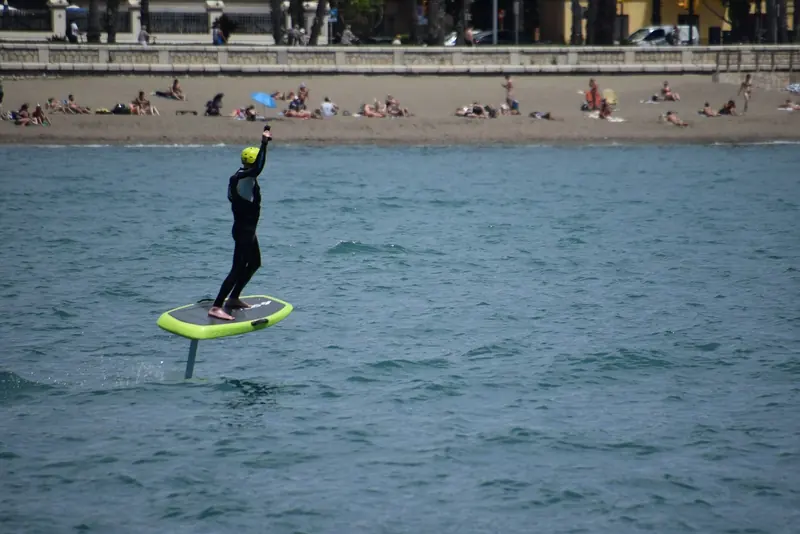
The eFoil that stopped being a novelty and became a line on the delivery specification.
The Series 6 range
Series 6 was announced on 18 January 2026 and splits into seven models by rider type. ICON is the 100 litre all-rounder at 5 ft 8 in by 28 in, priced from USD 10,999 and the board a first-timer should be on. PRO drops to 67 litres of carbon for riders coming from board sports. ULTRA L3 is a 49 litre wave board with the mast set 2 cm forward and a propulsion unit only 46 mm across. RACE is the speed model.
Below the carbon boards sit the inflatables and the scooter. Flite AIR is 110 litres and packs down, AIR PRO is 80 litres and closer in feel to the carbon PRO, and the Flitescooter is a 237 litre platform of about 38 kg with a handlebar for people who have never stood on a board. At the top is the Flite x Marc Newson collection. A Maltese dealer listed the Newson boards from about EUR 18,595 in March 2026.
Batteries, charge times, and the accessory that decides the day
Every Series 6 board takes the same three Flitecells. The Nano holds 806 Wh, weighs 6.2 kg and is rated at up to 45 minutes. The Sport holds 1.6 kWh, weighs 10.6 kg and is the standard choice at up to 90 minutes. The Explore holds 2.1 kWh, weighs 14.5 kg and is rated up to two and a half hours. Those are ceilings measured with a light rider on an efficient wing, and a 90 kg guest learning on an ICON will drain a Sport pack in well under an hour, because time spent falling off and restarting costs more than time spent flying.
The number that actually governs a day at anchor is the charge time, and Fliteboard publishes it for both chargers. On the 6 A slow charger, listed at USD 260 in July 2026, a Nano takes under 3.5 hours, a Sport under 6 and an Explore under 9. On the 25 A fast charger, listed at USD 1,210, the same packs take 50 minutes, 1 hour 15 and 1 hour 45. That USD 950 difference is the most consequential accessory decision in the catalogue. An Explore on the slow charger needs about three and a half times as long to fill as it takes to empty, so no realistic number of packs keeps a board running. On the fast charger the Explore charges in less time than it rides, so two packs and one fast charger keep a board in the water all afternoon. Buy the charger before the third battery.
Riding it, and what it will not do
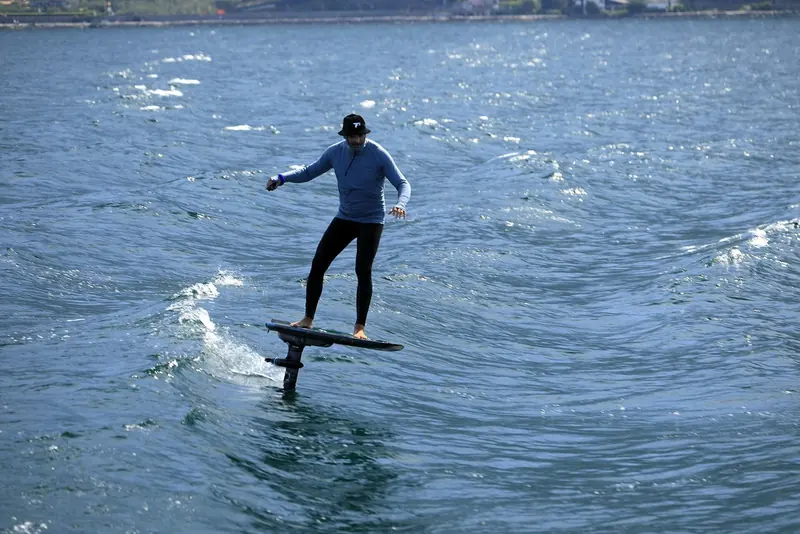
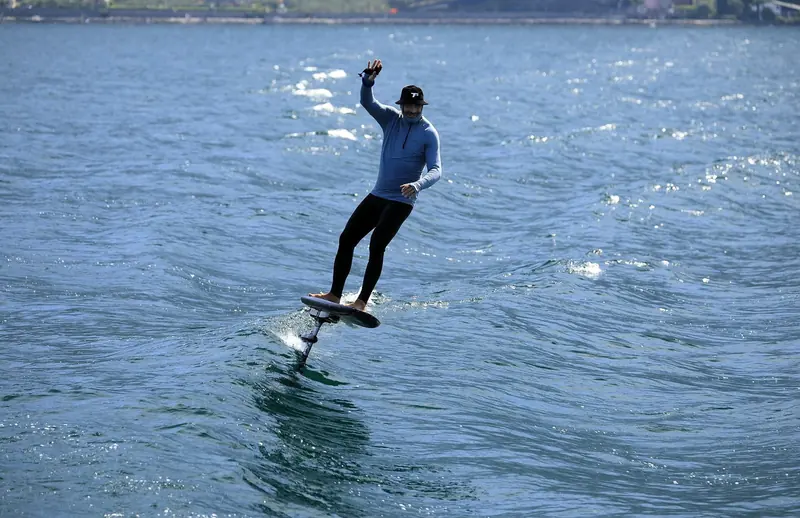
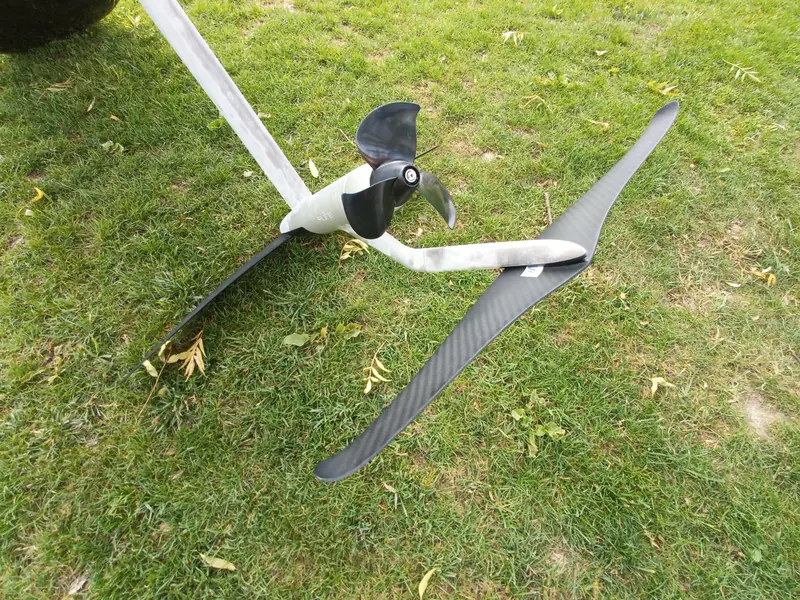
Propulsion is by Flite Jet 2, a fully shielded impeller with no exposed moving parts, which is the reason many charter yachts prefer Fliteboard for guests who have never foiled. Flite Prop is the open propeller alternative and is offered for heavier riders who need the extra thrust. Dealer testing puts an 80 kg rider at 40 km/h on the Flyer wing and 34 km/h on the Cruiser. Cruising speed for an ordinary rider is nearer half that.
No licence is needed to ride one in most countries, but a powered board is a powered craft in the eyes of most Mediterranean harbour authorities and coastal municipalities, and the beach restrictions are real. A helmet and an impact vest are standard at any credible Fliteschool. Chop kills the experience faster than anything else. By late morning in a busy August anchorage the water is usually no longer worth foiling on.
Stowage, weight, and which flag governs the charging
An ICON with a Nano pack weighs about 31 kg complete and breaks into board, mast, propulsion, wings and battery, so no crane or davit is required. The inflatable AIR models are the ones to look at if garage space is genuinely tight, because they deflate into a bag. A carbon board still needs roughly 1.8 m of clear rack or locker length for the ICON. The battery is the part that is regulated, and it is also the part that has to leave the board and travel to a charging point.
The UK Maritime and Coastguard Agency published MGN 681 (M) Amendment 1 on 19 December 2025, covering fire safety, storage and charging of small electric craft aboard yachts. Spare batteries above 100 Wh require dedicated cabinet stowage to EN 14470, EN 16121 or EN 16122, and from 1 January 2027 new charging containers fitted to UK-registered yachts must hold UK type approval from a nominated body. Every Flitecell is far above that threshold. The reach is wider than the letters MCA suggest, because the note sits on Part A Chapter 14 of the Red Ensign Group Yacht Code, and the group is the United Kingdom together with the Cayman Islands, Gibraltar, the Isle of Man and the other British Overseas Territories and Crown Dependencies, so a Cayman-flagged yacht is already inside the same chapter. The Cayman Islands Shipping Registry adds to it. Guidance Note 06/2023, read July 2026, annexes the United Kingdom's MGN 681(M) on the fire safety and storage of small electric powered craft and strongly recommends it be followed on every yacht carrying them. The Republic of the Marshall Islands went its own way, with a 2026 edition of Yacht Code MI-103 effective 1 January 2026 that introduces specific rules for spaces used to store or charge lithium-ion powered toys and tenders. Malta stayed at recommendation, through a Transport Malta Commercial Yachting Notice of 22 June 2022 and Information Notice 45 of 7 September 2022, and surveys against the Commercial Yacht Code at its 2025 revision. Only the 2027 type-approval date is UK-only.
What it costs to buy and to keep
A Maltese dealer's March 2026 list put a complete ICON or PRO between about EUR 9,750 and EUR 11,150 depending on battery and propulsion, the ULTRA L3 at about EUR 12,999, Flite AIR at about EUR 6,495 and AIR PRO at about EUR 8,349. The Flitescooter sat near EUR 11,149. Fliteboard's own United States pricing starts at USD 10,999 for an ICON. Spare Flitecells are a four figure purchase each.
The battery is the consumable and the charger is the fixed cost. Beyond that, running an eFoil is cheap. Electricity for a full charge is trivial against a yacht's daily consumption, and the wear items are wings, seals and mast hardware. The expensive failure is a flooded battery, which is not a repair. Rinsing the propulsion unit and the mast joint in fresh water after every use is what prevents most of it.
Service and parts through a season
More than 330 dealers and Fliteschools carry the brand, and the density in Europe is the strongest argument for Fliteboard over its rivals. There are Flite outlets and schools across the French and Italian Riviera, the Balearics, Croatia and Greece, plus the Caribbean, which means a board can usually be repaired or swapped inside the same cruising leg. Brunswick ownership has added a second route to parts through Mercury's network.
The hard case remains the battery. Loose lithium packs move by air as UN3480 dangerous goods, restricted to cargo aircraft only and capped at 30 percent state of charge under IATA rules, so a replacement Flitecell will not appear overnight in Sardinia in August. Owners who use the toy properly carry a spare from day one. Local rental through a yacht supplier is the realistic fallback when a pack dies mid-season.
Fliteboard against Lift and the cheaper end
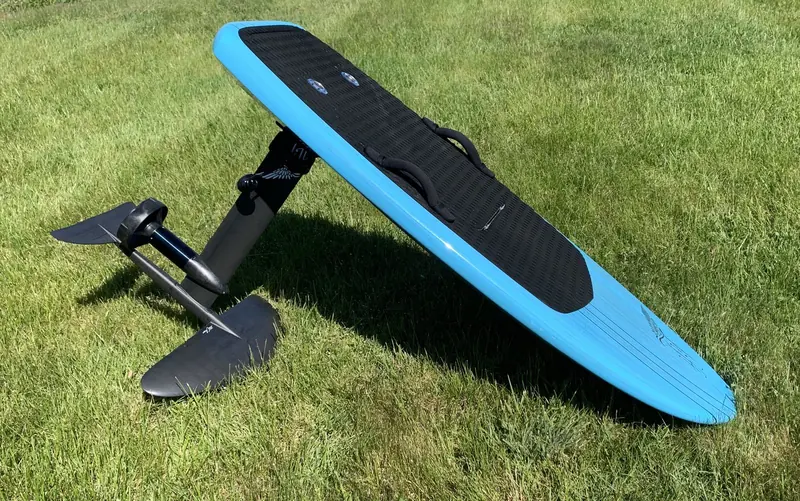
Lift Foils created the category in 2018 and remains the reference for carbon build quality, with a complete LIFT5 at USD 14,999. Fliteboard's answer is range. It sells lower, higher and wider, and the inflatable AIR models and the Flitescooter reach guests who would never get up on a carbon board. Audi's e-tron foil and Takuma sit in the same premium band, and Waydoo undercuts everyone.
Where Fliteboard loses is exclusivity. The brand is now common enough on charter yachts that it no longer signals anything, and the entry models are visibly built to a price. Where it wins is the second week of a bad season, when a board needs a part and there is a dealer forty minutes away. An owner choosing between the two should ask the crew where the yacht will actually be in August.
Class, the IMO, and the price of the locker
Neither class nor the IMO adds anything binding on top of the flag. The International Maritime Organization has no mandatory instrument reaching a portable battery aboard a yacht as of July 2026. Its lithium work runs through the Maritime Safety Committee's review of alternative fuels and new technologies, where MSC 109 added swappable traction battery containers to the list under review and identified nineteen regulatory gaps, and MSC 110, sitting from 18 to 27 June 2025, closed the review of regulatory barriers. DNV's Battery (Safety) notation becomes mandatory only above 50 kWh of aggregate installed capacity, roughly twenty-four times a Flitecell Explore, so a rack of boards never triggers it. Lloyd's Register published LR-GN-052, Guidance Notes on Lithium-Ion Battery Powered Crafts and Vehicles carried on Yachts, on 10 June 2025, and it is advice rather than rule. ISO 23625:2025 covers lithium-ion batteries above 500 Wh installed in small craft, which catches an electric tender rather than a board carried aboard.
The certified locker is the one line in the whole exercise that nobody prices. The marine active-suppression systems sold against MGN 681, the RACLAN boxes and the modular RAMBSS, and the passive ZARGES BatterySafe cases, were all quotation only in July 2026. Published prices exist only for shore-side industrial cabinets built to EN 14470-1 Type 90, one of the standards the note names. In July 2026 a German supplier listed an asecos ION-CHARGE 90 with pull-out shelves at EUR 3,270 net of VAT, internal envelope 470 by 452 by 582 mm with shelves rated at 25 kg, and a United Kingdom supplier listed the taller asecos ION-CORE-90 at GBP 4,571.04 net or GBP 5,485.25 gross. A 14.5 kg Explore pack fits either. Neither carries UK marine type approval, which is what becomes mandatory on UK-registered yachts from 1 January 2027, and MCA Safety Bulletin 35, updated 15 November 2024, found that a container advertised as fully MGN 681 compliant could not comply fully and warned that no international standard governs these products at all. A quotation that claims compliance is worth reading against that bulletin.
Practical detail
| Entry price | ICON from USD 10,999; Flite AIR and AIR Pro inflatable boards from about USD 6,995, positioned as the value entry point against hardboard rivals starting nearer USD 9,695. |
|---|---|
| Top of range | Flite Ultra L2 at about USD 15,780 and the Flite x Marc Newson limited edition at USD 19,995, both July 2026 prices. |
| Ride time and charging | 45 minutes on the Nano battery up to 2.5 hours on the Explore pack; a 25 A fast charger (USD 1,210) refills the Explore in about 1 hour 45 minutes, versus under 9 hours on the standard 6 A charger. |
| Weight | Roughly 33 to 34 kg (about 74 lb) for a standard board and mast without battery, per independent testing, which is a two-person or crew lift for stowage and launch on most yachts. |
| Warranty and service | Sold and serviced through Fliteboard's own dealer and Fliteschool network of more than 330 locations, under Brunswick Corporation ownership since September 2023, which gives it wider service coverage than most eFoil brands still run independently. |
| What is not published | Fliteboard does not publish a standard warranty term or battery-cycle-life figure on its public pricing pages, so a buyer should get both in writing from the dealer before ordering rather than assuming a figure. |
Request a quote for Fliteboard.
Tell us the model and where it needs to go. The desk obtains a written offer from the maker or an authorised dealer, checks it against the prices published on this page, and comes back to you by email. No obligation, no fee.
- 01A written offerPriced in your currency, with VAT, delivery and lead time stated, not a brochure figure.
- 02Delivered where the yacht isTo the marina, the yard or your address, with the paperwork a lithium pack or a crane lift needs.
- 03IndependentYotters is tied to no single dealer, so the offer is compared before it reaches you.
What owners and crew report
Independent testers call the ride surprisingly approachable
Trialling a Fliteboard for Robb Report, Viju Mathew found it surprisingly stable and easy to manoeuvre, which is the opposite of what a first-time rider expects walking up to a hydrofoil board.
Robb Report (Viju Mathew)Noise, vibration and battery life beat testers' expectations
The Foiling Magazine's test centre found motor noise and vibration far better damped than rival boards, and both boards they tested still had more than half their charge left after a 90-minute session, ahead of the published ride-time figures.
The Foiling Magazine, test centreThe Pro board is a real step up in difficulty, not a marketing label
The same test centre described getting the Fliteboard Pro up and flying as a genuine challenge, closer to learning a small tow board than to the standard board's more forgiving pitch and roll, and said initial acceleration needs a rider to hold a fairly severe angle of attack that catches people used to unpowered foiling off guard.
The Foiling Magazine, test centre
What is good, and what to watch
Strong points
- One of the fastest genuine learning curves in the categoryFliteboard's own guidance of most riders up and flying within about 20 minutes holds up against independent testing, and reviewers consistently rate the standard board's pitch and roll as forgiving enough for a first-time guest to progress in a single session.
- Backed by the largest dealer and service network in the categoryMore than 330 Flite dealers and Fliteschools worldwide, plus Brunswick Corporation's ownership since September 2023, means a board bought for a yacht based in the Mediterranean has a real chance of parts and qualified service wherever it actually cruises, which is not true of every eFoil brand.
What to watch
- The Pro and race-tuned boards are not beginner equipmentTesters who found the standard board approachable still described the Fliteboard Pro as a genuine challenge to get flying, with a steeper angle of attack required on take-off, so a yacht outfitting its toy locker for mixed-ability guests needs at least one standard-range board alongside anything faster.
- It is heavy enough that guests will not be carrying it themselvesA standard board and mast run to roughly 33 to 34 kg (about 74 lb) before the battery, which is manageable with the grab handles but is a two-handed lift on and off a swim platform, so it is a crew task on most boats rather than a guest grabbing it solo from a rack.
Who it is for: Owners who want guests of every ability on the water and value a dealer network within reach of the anchorage over the last five percent of build quality.