FunAir
| Category | inflatable slides, sea pools, climbing walls and docks for yachts |
|---|---|
| Founded by | Eric Goldreyer, who remains chief executive |
| Based | Austin, Texas, with design and engineering in house |
| Yachting side | led by managing director John Courtney, who joined in 2014 |
| Team | about twenty people |
| Slides | FunSize at 1.5 m for yachts to 20 m, up to Riser at 9.5 m and beyond for yachts over 60 m |
| Slide materials | 0.6 mm and 0.9 mm 1000 denier PVC with fire retardant and ultraviolet ratings, 316 stainless steel hardware |
| Deployment | under 15 minutes for the smallest slides, about 20 for a standard Hanger, about 60 for a Riser |
| Sea pools | typically 5 m by 5 m, about 30 minutes to set up |
| Sea pool warranty | five year limited |
| Netting | welded or removable QuickZip, with a 1 cm weave option for jellyfish |
| QuickShip | finished units held in stock at multiple locations worldwide for delivery within days |
| Packed weight, from FunAir's product pages, read July 2026: 21.5 kg for a 1.5 m FunSize, about 97 kg for a 2.5 m Hanger Mini, about 158 kg for a 6 m Hanger, about 254 kg for an 8.4 m Hanger Extreme and about 300 kg for a 10 m Riser | |
| Packed volume barely tracks slide size | about 0.84 cubic metres for the 2.5 m Hanger Mini against about 0.79 for the 6 m Hanger and about 0.99 for the 8.4 m Hanger Extreme |
| Lagoon sea pool | 4.5 m by 4.5 m by 2.0 m inflated, 36 kg, packed to 90 cm by 70 cm by 30 cm, about 15 minutes to set up |
| Crew | one pair of hands for the FunSize, two crew for the Hanger Mini |
| Lead time | 35 days standard for a custom inflatable, QuickShip units from stock in a few days |
| Warranty per the frequently asked questions: five years on custom yacht products, two years on water-based products, 90 days on accessories and pumps | |
| Not published | prices, any wind or sea state limit, any certification standard, service life in seasons, and climbing wall weights and packed sizes |
A lake house idea that became yacht equipment
Eric Goldreyer started FunAir after looking for something more interesting to do at his own lake house. The yachting side of the business is the part that grew, and it has been led since 2014 by managing director John Courtney. The company is headquartered in Austin, Texas, employs about twenty people and keeps design and engineering under its own roof.
That size is worth noting. FunAir is a small specialist supplier serving an industry of very large customers, which is why the company sells through direct relationships with captains and build managers. It works in the same way a custom canvas or a passerelle supplier does. The products look like pool toys and are engineered as marine equipment.
The slides, size by size
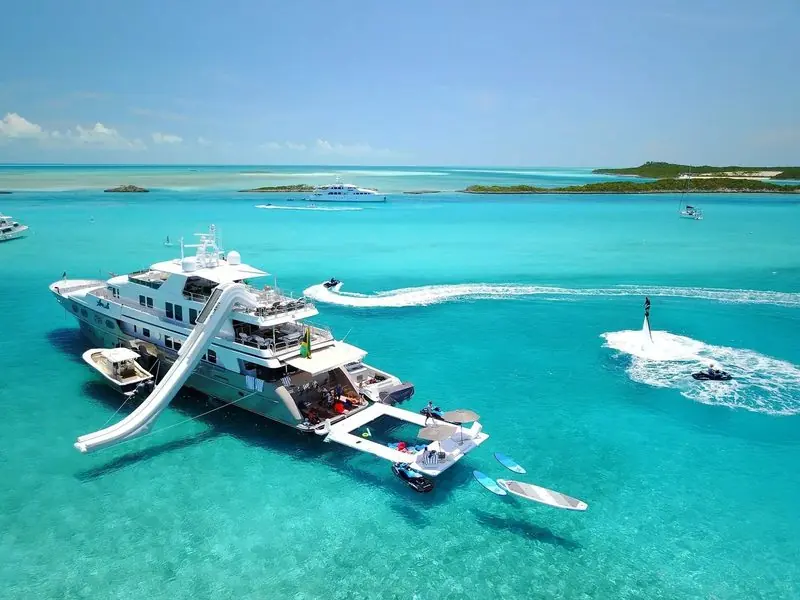
The slide range is organised by the drop from the deck to the water, which is set by the yacht. FunSize is a 1.5 m slide for yachts up to 20 m. Hanger Mini covers 2 m to 3.5 m for yachts up to 30 m. The standard Hanger runs 4 m to 6.5 m for 30 m to 50 m yachts, and Hanger Extreme reaches 7 m to 9.5 m for anything above 50 m.
Above that are the Riser at 9.5 m and beyond, designed for top deck entry on yachts over 60 m, and a self-lifting version aimed at busy charter yachts. Bow, stern and curved slides run 3 m to 12 m and solve particular geometries, with the bow slide aimed at sailing yachts. The Flume is fully custom and can be run from almost any position on almost any yacht.
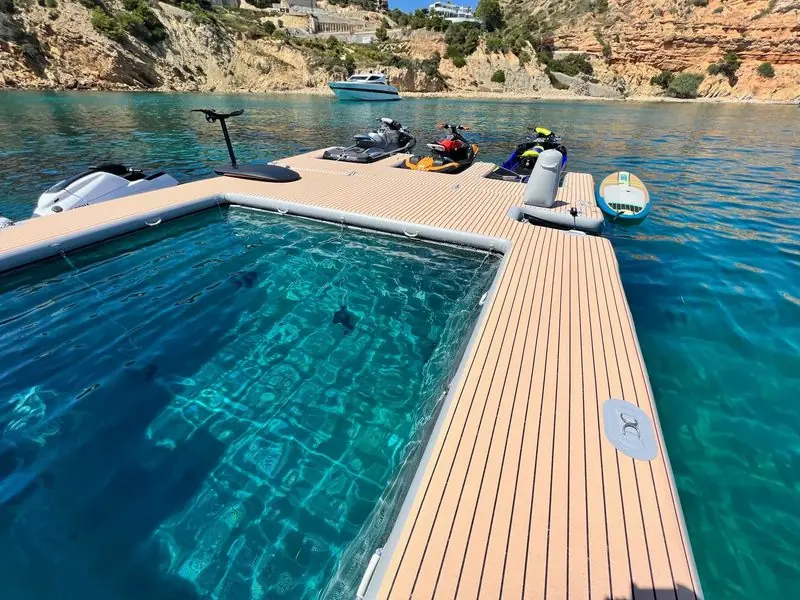
The slide is the photograph, and the sea pool is the thing guests actually use twice a day.
Sea pools
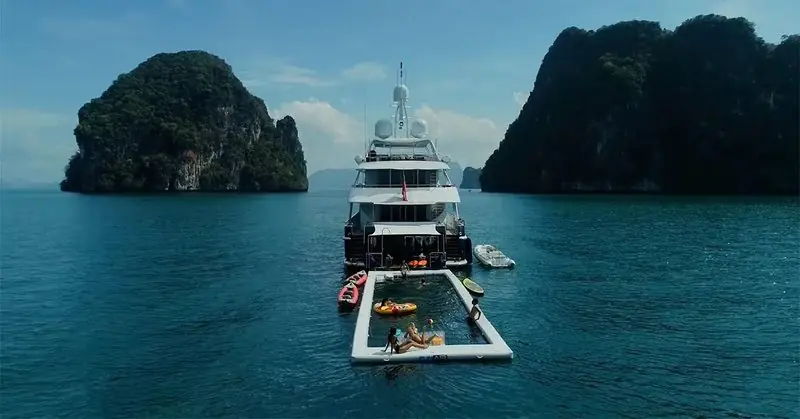
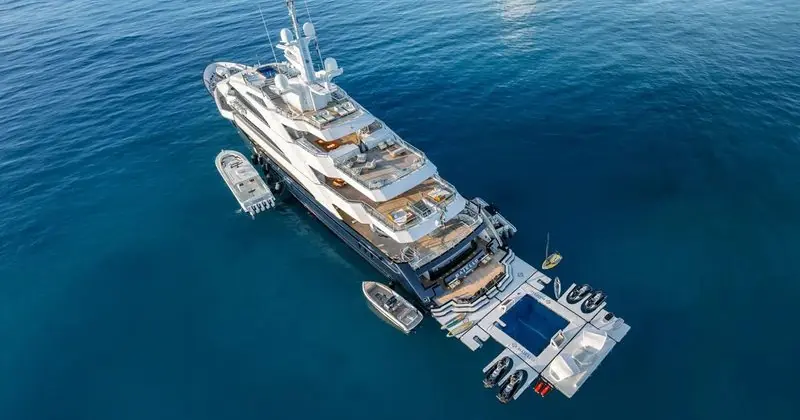
A sea pool is a floating enclosure alongside the swim platform, and it has become the most requested product in the range. A typical unit is 5 m by 5 m and takes about half an hour to set up. Netting comes welded in place or as a removable QuickZip system in white, blue or black, and a 1 cm weave is available where jellyfish and small marine life are a problem.
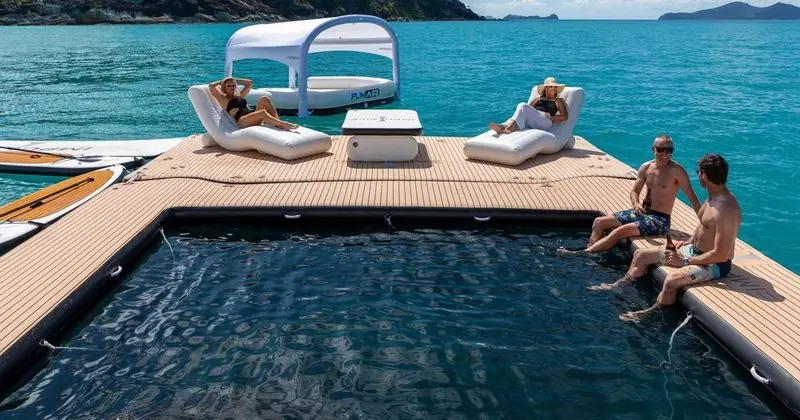
There are several formats. The Beach Club version adds a deck around the pool for lounging, the Lagoon is ultra compact for yachts short of stowage, the modular and stacking versions break into sections that contour to the swim platform, and the FunSize Beach Club is up in under 30 minutes. Sea pools carry a five year limited warranty.
Climbing walls, docks and the rest
The climbing wall is the second signature product, offered in custom and QuickShip forms including water entry versions where the climber falls into the sea. Inflatable docks cover jet ski docks and work platforms, which is the least glamorous and most used part of the catalogue. A jet ski dock keeps a personal watercraft off the swim platform and gives crew somewhere to work on it.
Around those sit floating islands, beach furniture, aqua parks and sports equipment, each sized to a particular yacht and built from the same materials. The climbing walls are the one part of the range where the numbers are missing. FunAir gives a height of 4 m to 12 m and a width of 2 m to 3 m, but no weight, no packed dimension and no set-up time, saying only that these vary with the design and come on request. On a product that can reach 12 m those are the first figures to ask for.
How they are made
The construction specification is more marine than it looks. Slides use 0.6 mm and 0.9 mm 1000 denier PVC with fire retardant and ultraviolet ratings, 12 oz 1000 denier baffling and 316 stainless steel hardware. Sea pools use drop stitch or 0.9 mm PVC with the same stainless fittings. Those materials are the reason a FunAir product survives seasons of Mediterranean sun where a consumer inflatable would not.
Fire retardant rating matters aboard a yacht in a way it does not on a lake, because anything stowed in a garage or a lazarette sits within the vessel's fire arrangements. The 316 stainless hardware is the other tell. Salt destroys ordinary fittings within a season, and the anchor points on a slide are load bearing.
Crew time, and the limit nobody publishes
The deployment figures are published and they are the running cost. A 1.5 m FunSize inflates and deflates in under 15 minutes and needs one pair of hands. A 2.5 m Hanger Mini takes around 15 minutes with two crew, and a standard Hanger about 20. A 10 m Riser is quoted at about 60 minutes to set up and return, which across a full charter week is an hour of crew time every day before anyone has rinsed the thing or packed it away. That is why the self-lifting version exists, and it belongs in the calculation alongside the purchase price.
The limit that decides how many days a season the equipment is actually in the water is not published anywhere. FunAir gives no maximum wind speed and no sea state limit on any product page or in its frequently asked questions. An 8 m or 9 m slide is a large sail on a hull with no way on, and the judgement about when it can go out and, harder, when it has to come in, falls entirely to the captain. An owner budgeting for use should ask the crew for the figure they intend to work to and have it written into the safety management system.
What it weighs, and what it displaces in the locker
FunAir publishes weights and packed dimensions on its product pages, and gathered into one list they are the most useful figures the company puts out. A 1.5 m FunSize slide is 21.5 kg and packs to 94 cm by 44 cm by 29 cm. A 2.5 m Hanger Mini is about 97 kg at 120 cm by 100 cm by 70 cm. A 6 m Hanger is about 158 kg at 110 cm by 90 cm by 80 cm, an 8.4 m Hanger Extreme about 254 kg at 110 cm by 100 cm by 90 cm, and a 10 m Riser about 300 kg at 130 cm by 110 cm by 95 cm.
Worked into volumes those numbers do not behave as expected. The 2.5 m Hanger Mini packs into about 0.84 cubic metres and the 6 m Hanger into about 0.79, so the smaller slide takes the larger bag, and the 8.4 m Hanger Extreme needs only about 0.99. The weight nearly triples across that span while the stowed volume grows by under a fifth, so a locker that swallows a Hanger Mini will very nearly swallow a Hanger Extreme, and above roughly 150 kg the binding constraint stops being space and becomes handling. A Lagoon sea pool, 4.5 m square and 2 m deep, is 36 kg in a bag of about 0.19 cubic metres.
Lead time, price and how a unit is specified
The lead time is published and it is short. FunAir quotes 35 days as the standard manufacturing time for a custom inflatable, with QuickShip units held finished at what the company calls all key yachting locations and shipped in a few days. That is weeks where a tender or a davit is months, and it changes when the decision has to be taken. A slide is not a long-lead item and does not have to be settled at contract signing. The fixing points are the part that does, because those are drawn into the yacht and the inflatable is not.
Specification runs off the vessel. FunAir designs in 3D CAD from the yacht's General Arrangement, or sends a measuring guide where drawings are not to hand, and the governing dimension is the drop from the rail or the deck to the waterline. Prices are not published for any product and are quoted per unit, so a comparison against another supplier only works if the enquiry fixes the drop height, the deck position and the netting specification first. Quotes built on different assumptions about any of those three are not comparable, and the difference will not show in the numbers that come back.
Against the rest, and who should have one
The competing names are NautiBuoy Marine in the Netherlands for platforms and docks, YachtBeach, AquaGlide and Superyacht Inflatables, all of which appear in the same superyacht supplier catalogues. FunAir's position is the slides and the sea pools, where its size range and its engineering are the deepest. For docks and simple platforms the market is broader and the price differences are wider.
Safety is the part owners underestimate. A sea pool with netting is genuinely safer for children and weak swimmers than open water off a platform, and a slide with a 9.5 m drop is not. Crew supervision is what makes these products work, and a yacht that does not have a spare pair of hands during guest swimming should buy the sea pool and skip the slide.
Anchor points, lifting and what has to exist first
FunAir builds the handling into the product. Slides carry ring points for securing, lifting handles along their length and reinforced crane straps, and the company states that proper anchor points and rigging are essential to a safe setup and will put together a lifting plan for a specific vessel. Where those points should sit on a given yacht is not published, because it is settled on the drawings for each order.
The weights are what make that matter. A 254 kg Hanger Extreme or a 300 kg Riser is not carried up from a lazarette by two crew, so the route from the stowage to the deck edge, a lifting point above it and secure fixings at the rail all have to exist before the slide arrives. At new build that is a note on a drawing and costs nothing. At refit it is the constraint that decides whether the largest slide the drop height allows is the largest slide the yacht can actually handle.
Certification, warranty and who carries the risk
There is no certification to lean on. FunAir publishes no standard for any of its products, and the two standards that cover inflatables, ASTM F2374 in the United States and EN 14960 in Europe, are written for land-based amusement devices and the operators who rent them out. No marine rulebook covers a yacht slide at all, which leaves the vessel carrying the exposure when a guest is hurt on one. Two questions belong in writing before an order: which standard, if any, the unit is designed and tested to, and whether the yacht's liability cover names inflatable equipment and the drop height in use.
The warranty is the only published statement about how long any of it lasts, and it is not consistent. Product pages carry a five year limited warranty across slides, sea pools and climbing walls, while the frequently asked questions separate five years on custom yacht products from two years on water-based products and 90 days on accessories and pumps. Which tier applies to a given unit is nowhere resolved and should be fixed per order. No service life in seasons and no replacement price is published for anything in the range.
Practical detail
| Reference price | FunAir Adjustable Yacht Slide launched at USD 6,995 in November 2014, positioned by the company as about half the going rate for a custom slide at the time; no current 2026 price list is published for comparison. |
|---|---|
| Lead time | 35 days standard for a custom-built inflatable; QuickShip units held in stock worldwide ship within days for a late charter request. |
| Warranty | Five years on custom yacht products, two years on water-based products, 90 days on accessories and pumps, per FunAir's own published terms. |
| Crew workload | Deflating, drying and storing an inflatable without mildew is the most commonly reported crew task; FunAir pre-treats products against mold and mildew and built RapidFlate specifically to cut inflate/deflate time. |
| Repairs | Field-repairable with an HH-66 glue patch kit; valve debris, not fabric puncture, is the most common cause of a slow leak per FunAir's own repair guidance to Dockwalk. |
| Not published | Current prices for any model, any wind or sea-state deployment limit, a certification standard, service life in seasons, and climbing wall weights and packed sizes. |
Request a quote for FunAir.
Tell us the model and where it needs to go. The desk obtains a written offer from the maker or an authorised dealer, checks it against the prices published on this page, and comes back to you by email. No obligation, no fee.
- 01A written offerPriced in your currency, with VAT, delivery and lead time stated, not a brochure figure.
- 02Delivered where the yacht isTo the marina, the yard or your address, with the paperwork a lithium pack or a crane lift needs.
- 03IndependentYotters is tied to no single dealer, so the offer is compared before it reaches you.
What owners and crew report
The captain who tests FunAir products before they reach the market rates the partnership on crew training, not novelty
Captain Tane Rewi runs the 50.5m Lazy Z as FunAir's official test yacht. His rule is that crew must master a new inflatable before any guest touches it: "The crew have to be the masters because they have to be able to show the guests how to use the toys." He feeds product changes back directly: "After trialling an inflatable, I'll say, Look, it would be better if you do X, Y and Z, and they'll do that."
SuperyachtNews (Captain Tane Rewi, June 2016)
What is good, and what to watch
Strong points
- RapidFlate answers the single biggest crew complaint about inflatablesFunAir's own crew feedback identified deflating, drying and storing an inflatable as the recurring pain point, and its RapidFlate system is built to inflate and deflate up to six times faster than a standard pump, which is a real reduction in the deck time a crew has to spend on changeover.
- QuickShip stock genuinely removes the lead-time risk for a charterFinished units held in stock at multiple locations worldwide can ship within days against the usual 35-day custom lead time, so a charter broker taking a late slide request is not stuck waiting on a build slot.
What to watch
- Pricing is opaque beyond one nine-year-old anchorFunAir does not publish current prices for its slide range. The only concrete figure findable is the ,995 Adjustable Yacht Slide from a November 2014 launch, quoted by co-founder Mark Anastasia; a 2026 buyer has no way to compare cost across the current range without contacting a dealer.
- Inflatables need active maintenance, and valves are the weak pointPer a Dockwalk repair guide written with FunAir co-founder Mark Anastasia, most leaks trace to debris in the valve rather than a puncture in the fabric, and a badly cured patch is a common repair failure, meaning a crew genuinely has to learn the repair procedure rather than assume five-year warranty coverage means zero deck-time downtime.
Who it is for: Owners with young families or a charter programme, enough deck crew to deploy the equipment and somewhere to stow it when the wind gets up.