Intellian
| Category | marine VSAT satellite data antennas, satellite TV (TVRO) antennas and Eutelsat OneWeb low-earth-orbit terminals |
|---|---|
| Founded | 2004 in South Korea by Eric Sung and a group of RF engineers, initially as an unbranded OEM antenna supplier to Raymarine, before launching its own Intellian-branded line in 2007 |
| Headquarters | Seongnam-si, Gyeonggi-do, South Korea, with roughly 400 employees worldwide, 6 service centres, 3 distribution hubs and more than 50 service partners across over 68 countries |
| Public company | listed on the Korean exchange KOSDAQ as 189300 since an October 2016 IPO |
| Yacht range | i-series and t-series TV antennas from 45cm to 1.5m, NX-series Ku-to-Ka convertible VSAT from the 65cm v60E to the 1.5m v150NX, XEO-series electronically switched flat antennas and a 2.4m v240 line for the largest yachts and cruise ships |
| Milestone | the v150NX launched as the first Ku-to-Ka band convertible VSAT antenna built to track GEO, MEO and LEO satellites on one dish; Eutelsat OneWeb OW-series flat-panel LEO terminals followed |
| Financials, reported through September 2026: revenue rose from KRW 257.8 billion in 2024 to KRW 319.6 billion in 2025, and trailing twelve-month revenue reached KRW 363.5 billion, up 41 percent year on year | |
| Pricing, read September 2026 | the i4 TV antenna kit runs USD 3,680 to 4,188 and the i6 kit USD 5,495 to 5,527 depending on retailer; VSAT hardware and airtime are quote-only through dealers, with no published list price found anywhere Intellian or its resellers sell it |
What Intellian Actually Builds, From A 45cm Dome To A 2.4 Metre Antenna
The television side runs from the i3 up through the i6, sized for boats from roughly 40 feet to 65 feet and above, built around Intellian's iQ2 technology, Wide Range Search and Dynamic Beam Tilting, which the company says locks onto a satellite four to five times faster than a conventional peak-scanning antenna while cutting motor noise by up to 80 percent. The i-series ships with an All Americas LNB as standard so a yacht cruising between the United States, the Caribbean and Mexico never has to swap hardware. Alongside it sit the s-series for DIRECTV HD reception and the t-series, Intellian's true global satellite TV line: the t85N through t150N and the large t240CK and t360CK, all three-axis stabilised and built around a patented WorldView LNB that switches band and polarity automatically as a yacht crosses satellite regions, removing the old need to physically change a component when cruising between continents. The t100N's 1.05 metre radome is styled to match the v100NX VSAT dome beside it, a small but deliberate detail for owners who care what the flybridge looks like.
The data side starts with the v60E, a 65cm, 42kg antenna light enough to install without a crane, and climbs through the 85cm v85NX and the 105cm v100NX, which Intellian markets as one of the world's most popular 1 metre VSAT systems, to the 130cm v130NX and the 1.5 metre flagship v150NX. A separate XEO series, the X100D, X130D and X150D, uses electronically switched flat-panel technology rather than a moving dish and is built to work with SES's O3b mPower network. At the top of the range, the 2.4 metre v240 family, in C-band, Ku-band and combined C/Ku/Ka configurations, is aimed at cruise ships and the very largest superyachts rather than a typical private yacht.

How A Raymarine Supplier Became Its Own Satellite Brand
Sung and a few colleagues from a previously successful software company partnered with engineers who had been developing small stabilised antennas for another employer that had just cancelled the project, and turned that stranded work into Intellian. For its first four years the company existed almost invisibly, manufacturing antennas that Raymarine badged and sold as its own, a relationship marine electronics writer Ben Ellison later described as still strong even after Intellian began selling under its own name in 2007. Growth from there was fast by the industry's own standards: Panbo reported Intellian's staff count rising from 77 in 2010 to 160 by 2013, alongside a roughly 1 million US dollar investment in dome material research alone. The company listed on the Korean exchange KOSDAQ as ticker 189300 in October 2016.
Two decades on, Intellian describes itself as the global leader in maritime VSAT by market share, employing roughly 400 people worldwide from a headquarters in Seongnam-si, Gyeonggi-do, just outside Seoul, with six service centres, three distribution hubs and more than 50 service partners covering upwards of 68 export countries. Where KVH built its business around a single Rhode Island plant and a network it owns outright, Intellian's model has always been a Korean engineering base selling through a large independent dealer and integrator network, roughly 300 contracted dealers by the company's own count, a structure closer to how Raymarine or Furuno sell marine electronics than to KVH's more vertically integrated approach.

Intellian's own dealers will quote a price for a 45cm TV dome in a browser tab and refuse to quote a price for the VSAT antenna that actually delivers the ship's internet.
The Multi-Orbit Pitch: What A Convertible NX Antenna Actually Means
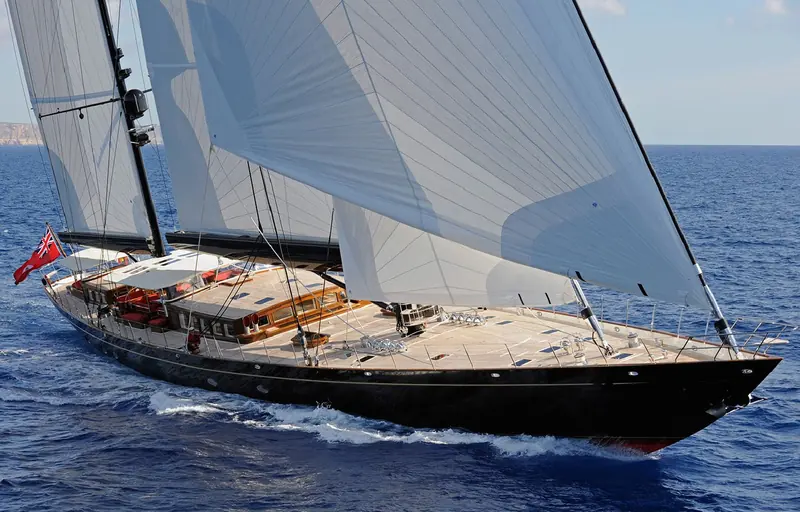
The mechanism is specific rather than marketing shorthand: a v150NX bought for Ku-band service can be converted toward Ka-band and different orbit classes by replacing the radio-frequency module behind the reflector, not by pulling the whole antenna and radome off the mast and fitting a different one, and the flagship model supports up to a 200 watt Ku-band BUC or a 100 watt wideband Ka-band BUC without extra weight balancing. A real installation shows what the pitch is actually for: on the sailing superyacht Marie, the integrator OceanWeb rejected a two-antenna mast installation because the combined weight and windage were judged too much for a performance sailing hull, and fitted a single v100NX with a 25 watt BUC instead, high powered enough to punch through the signal attenuation caused by the sails and mast that a lower-power antenna would struggle with. Marie's captain, Chad Thieken, and OceanWeb's engineers commissioned much of the system remotely during pandemic travel restrictions, using Intellian's AptusNX software for setup and diagnostics rather than a technician travelling to New Zealand.
For a buyer the real value is avoiding a second capital purchase as satellite networks change: a convertible antenna bought today is built to keep working as GEO operators lease capacity differently and as MEO and LEO constellations expand, rather than becoming obsolete hardware the way a single-network terminal can. The honest limitation is that a convertible antenna is still one dish tracking one network at a time, not two connections running simultaneously, so multi-orbit here describes flexibility over the years a yacht owns the antenna, not redundancy at any single moment at sea. A yacht that wants true simultaneous redundancy, a VSAT link and a LEO link both live at once, still needs two separate antennas and a network-blending router, exactly the kind of installation OceanWeb and similar integrators design around Intellian hardware rather than something the antenna does by itself.
What It Actually Costs: Published TV Prices, Quote-Only VSAT
On the television side the numbers are consistent and public: the i4, a 45cm reflector for boats over about 50 feet, is listed with the SWM30 satellite receiver kit at USD 4,188 by American Satellite and at USD 3,679.99, discounted from a USD 5,235 list, by NVN Marine. The i5, sized for 40 to 60 foot cruising boats, runs USD 4,748 at Africa Satellite and USD 5,268.33 at Trionics, both against a USD 5,935 list. The i6, for boats over 65 feet, is priced at USD 5,526.96 by Hodges Marine and USD 5,495.00 by Citimarine, both against the same USD 7,535 list, two independent dealers agreeing to within half a percent of each other. None of this pricing is hidden and none of it requires a phone call.
The VSAT side is the opposite. Every dealer checked, SatellitePhoneStore, SATMARIN, Orbital Connect, DigiSat and Pulsar Solutions among them, publishes full technical datasheets for the v60E, v85NX, v100NX and v150NX and attaches no price to any of them, directing a buyer to request a quote instead. Large 1.5 metre systems are quoted ex-works Korea and built to order around the specific BUC power a buyer selects, with lead times that follow BUC availability rather than a catalogue. Airtime is a separate purchase again, sold through third-party network operators and integrators such as OceanWeb rather than Intellian itself, and is equally unpublished. A buyer comparing brands will find Intellian's television antennas the easiest of any maker in this category to price from a browser, and its data antennas, the part of the system that actually matters for a yacht's business and connectivity, among the hardest.

The OneWeb Turn: How Intellian Is Answering Starlink
The OW10, the smaller of the two, is a maritime terminal in half-duplex form, OW10HM, aimed at fishing boats, leisure vessels and other small craft, with a land sibling rated up to 75 Mbps down. The OW11, launched in 2024, is the enterprise-grade terminal, its maritime version, OW11FM, built for superyachts, shipping and larger commercial vessels, with a land sibling rated up to 195 Mbps down over the OneWeb constellation. Selling its own branded LEO hardware rather than only reselling someone else's, the path KVH has taken with Starlink, puts Intellian in competition with Starlink Maritime on low-orbit terminals directly rather than only defending its legacy GEO VSAT business against it.
The financial numbers support the strategy so far: Intellian's revenue rose from KRW 257.8 billion in 2024 to KRW 319.6 billion in 2025, a gain of about 24 percent, and trailing twelve-month revenue reached KRW 363.5 billion by mid September 2026, up 41 percent year on year, according to two independent financial data services. That accelerating growth sits against KVH's own Q2 2026 numbers showing total revenue down 15 percent and VSAT service revenue down USD 5.6 million as Starlink took share, suggesting Intellian has so far navigated the LEO shock better than its closest direct rival. It is worth reading that growth carefully rather than as a yacht-market signal on its own: a September 2026 partnership with Network Innovations for military and government flyaway terminals, and Intellian's presentations at the SMM 2026 trade show around defence and dual-use connectivity, are folded into the same company-wide revenue figures, and Intellian does not break out what share of its growth is leisure yachting specifically.
Intellian Versus KVH And Starlink Maritime: The Real Differences
Against KVH the comparison is close to symmetric: both companies sell convertible Ku-to-Ka VSAT hardware in the same size classes, KVH names Intellian's v85NX and v150NX directly as the rival hardware to its own V-series, and both companies leave VSAT pricing to a dealer quote rather than a published list. Where Intellian pulls ahead is in owner sentiment rather than specification: threads on Sam's Marine Hatteras Owners Forum, Meridian Yacht Owners Forum and The Hull Truth each lean toward Intellian being the cheaper HD option and, in one specific account, faster switching between three tracked satellites with no delay, against a wait one owner reported experiencing on their previous KVH system. KVH's advantage is the network it owns outright, mini-VSAT Broadband, and a domestically built, single-site manufacturing story that some buyers weigh on its own terms.
Against Starlink Maritime the comparison is not close on raw numbers: a Starlink terminal costs a small fraction of even Intellian's cheapest published TV antenna, and delivers materially higher throughput than any GEO VSAT dish, Intellian's included. What VSAT still offers, and what Intellian's own OneWeb terminals add to it, is coverage that does not depend on a single operator's constellation, useful in the country-by-country restrictions, China among them, that have limited Starlink specifically, and on long ocean legs where a captain wants a second network live as backup rather than betting the whole trip on one system. The realistic reading for 2026 is the one that applies to KVH as well: a well-provisioned yacht increasingly runs a fast LEO terminal, from Starlink or from Intellian's own OneWeb hardware, for daily use, and keeps a VSAT antenna as the fallback that works where the newer network has a gap.
Practical detail
| TV antenna pricing, published | i4 (45cm, boats over about 50ft): USD 3,679.99 to 4,188 for the SWM30 kit across two independent dealers, list USD 5,235. i5 (40 to 60ft boats): USD 4,748 to 5,268.33 across two independent dealers, list USD 5,935. i6 (65ft and over): USD 5,495.00 to 5,526.96, list USD 7,535, two dealers agreeing within half a percent. |
|---|---|
| VSAT hardware and airtime, not published | The v60E through the 1.5 metre v150NX carry full public datasheets and zero public prices at every dealer checked. Large systems are quoted ex-works Korea, built to order around the BUC power selected. Airtime runs through third-party network operators and integrators, not Intellian, and is equally unlisted. |
| How you actually order it | Through a marine electronics dealer or a systems integrator, such as OceanWeb, the integrator on a real superyacht v100NX installation, rather than directly from Intellian, which sells wholesale through roughly 300 contracted dealers and service partners worldwide. |
| What is not published | Installation cost, which varies with radome footprint, cable run and whether a crane is needed (the entry v60E is built light enough at 42kg to skip one); the current price of any specific NX or OW-series terminal; and Intellian's own yacht-segment revenue split from its commercial and government business. |
| Running costs | Airtime bills separately from the hardware, metered or unlimited by plan through the network operator or integrator rather than Intellian, in the same range as comparable KVH or OneWeb plans until a specific quote is in hand. |
What owners and crew report
A Meridian owner called an Intellian TV system dependable and flawless, for the most part
In a thread comparing satellite brands, an owner running an Intellian TV antenna reported it as dependable and flawless for the most part, with an occasional brief signal loss regained within seconds, not enough to be irritating.
Meridian Yacht Owners ForumA Hull Truth owner reported no delay switching satellites after moving from KVH to Intellian
One owner who moved from a KVH system to Intellian reported the new antenna tracking three satellites at once with no delay when changing channels, against a wait for the antenna to find the right satellite on their old KVH system, and a second owner described an Intellian antenna holding its signal through thunderstorms and four foot seas.
The Hull TruthHatteras forum members leaned toward Intellian as the cheaper HD option
Forum members discussing satellite choices for their motoryachts said Intellian's HD antennas ran notably cheaper than KVH's for comparable performance, and that Intellian owners on the forum seemed generally pleased, even where one member's own preference still leaned toward KVH.
Sam's Marine Hatteras Owners ForumReaders of an independent trade review confirmed good customer service across multiple accounts
Responding to Ben Ellison's review of the company, several readers left their own comments confirming positive experiences with Intellian's customer service, independent of the reviewer's own generally favourable assessment of the company.
Panbo
What is good, and what to watch
Strong points
- The broadest published hardware range in the categoryFrom the 45cm i3 TV antenna to the 2.4 metre v240MT VSAT dome, plus flat-panel Eutelsat OneWeb LEO terminals, Intellian publishes full technical datasheets across every size class a yacht might need, even where the price is not published alongside them.
- A genuine, technically specific multi-orbit upgrade pathThe NX platform converts between Ku and Ka band by RF module rather than whole-antenna replacement, and the v150NX was sold as the first VSAT terminal built to track GEO, MEO and LEO constellations on one convertible dish, a real answer to the fact that no single network is the whole answer for a cruising yacht any more.
- Ahead of KVH on real owner-forum sentimentIndependent threads on Sam's Marine Hatteras Owners Forum, Meridian Yacht Owners Forum and The Hull Truth each lean toward Intellian being cheaper than KVH and, in one specific account, faster switching between tracked satellites with no delay.
What to watch
- VSAT and airtime pricing is opaque exactly where it matters mostEvery dealer site checked lists full specifications for the v60E through v150NX with no price attached, in sharp contrast to the honestly listed i-series and t-series TV antennas; a buyer cannot price the antenna that actually carries the yacht's data without contacting a dealer directly.
- Independent, non-sponsored coverage of Intellian's yacht-specific hardware is thinThe most detailed yacht-industry writing found, Boat International's satellite guide and Northrop and Johnson's connectivity article, is company-supplied or sponsored content rather than an independent sea trial, unlike KVH's independently bylined Yachting review of the V11-HTS.
- Dome windage is still a real design constraint on sailing yachtsIntellian's own case study on the sailing superyacht Marie describes rejecting a two-antenna mast installation specifically because the added weight and windage were judged too much for a performance hull, settling instead on one higher-power antenna; a buyer on a sailing yacht needs to have that conversation before assuming a dome simply fits.
Who it is for: An owner or captain who wants the broadest published antenna range in the category, from a 45cm TV dish to a 2.4 metre VSAT terminal, plus a genuine multi-orbit upgrade path, and who is prepared to get a dealer quote for VSAT hardware and airtime rather than find either listed anywhere.