JetSurf
| Category | motorised surfboards, petrol and electric |
|---|---|
| Maker | MSR Engines s.r.o., Strelice u Brna, Czech Republic |
| Petrol range | Cruiser DFI, Adventure 2 DFI, Race DFI SL, Titanium DFI SL |
| Adventure 2 DFI | 20.5 kg, 100 cc two-stroke, 55 km/h, EUR 9,990 excluding VAT |
| Titanium DFI SL | 18.5 kg, 64 km/h, EUR 12,990 excluding VAT |
| Electric 2 | 32.9 kg with an 18 kg battery, 3 kWh, up to 55 km/h |
| Electric 2 run time | 25 to 55 minutes, three hours to charge, EUR 12,490 excluding VAT |
| Board size | 1800 mm by 600 mm across the whole range |
| Maximum rider weight | 120 kg on the petrol boards, 100 kg on the Electric 2 |
| Fuel | 2.8 litre tank, unleaded 95 with full synthetic two-stroke racing oil |
| Racing | Motosurf World Cup, with the Titanium DFI SL certified for UIM competition |
| Ski versions | Race DFI Ski, Titanium DFI Ski and Electric 2 Ski, ridden standing with a mast |
| No rebuild or overhaul interval is published by MSR Engines. The only published intervals, both from JetSurf's own manuals, are a spark plug every 6 hours of riding and a complete service inspection once every 12 months | |
| Engine parts, JetSurf's own store, July 2026: piston set EUR 113, piston ring EUR 17, engine gasket kit EUR 19, NGK BPR7HS spark plug EUR 9, crankshaft EUR 375, crankshaft bearing and seal set EUR 97, main gear set EUR 197, reed valve EUR 45 | |
| Parts cost of a top-end refresh about EUR 141, of a bottom-end rebuild about EUR 472, labour not published | |
| Warranty | twelve months on main parts for a new board, six months on new spare parts, three months on a pre-owned board with six on engine and ICU |
| Race Titanium DFI boards do not qualify for any factory warranty, per JetSurf's own service and support page, July 2026 | |
| Overall checkup at the JETSURF service centre in Florida: USD 199, July 2026 | |
An engine shop that made surfing loud
JetSurf is the product of MSR Engines, a Czech company working out of Strelice on the edge of Brno, deep in a region that has built motorcycles and light engines for a century. The boards have been in production for close to two decades, which makes JetSurf the oldest serious name in powered surfboards. The company designs and builds its own two-stroke engines, its own carbon jet pumps and its own hulls. Very little is bought in.
That vertical integration shows in what the boards are. A JetSurf is not a surfboard with a motor bolted on. It is a 1800 mm carbon hull built around a 100 cc engine and an axial flow jet pump, with the whole package held under 21 kg so one person can carry it down a passerelle. The brand also runs its own racing series, the Motosurf World Cup, which is where the model names come from.
The petrol range
Four petrol boards share the same 1800 by 600 mm platform. The Cruiser DFI is the leisure board. The Adventure 2 DFI is the all-rounder at 20.5 kg, running a 100 cc two-stroke with direct fuel injection to 55 km/h and listing at EUR 9,990 before VAT. The Race DFI SL sits above it at EUR 10,990. The Titanium DFI SL is the competition board at 18.5 kg and 64 km/h, priced at EUR 12,990 before VAT.
All four carry a 2.8 litre tank, run on unleaded 95 mixed with full synthetic two-stroke racing oil, and use a small 99 Wh lithium battery for the brushless starter that is good for around 150 starts. Each takes a rider up to 120 kg and uses FCS fin boxes borrowed from the surf industry. There are also ski versions, ridden standing with a mast and handlebar, for people who cannot get up on a board.
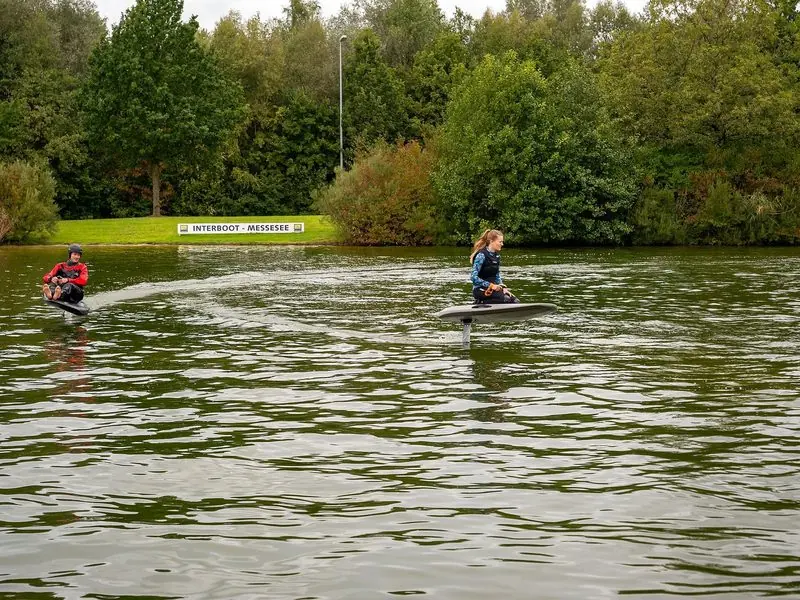
The only yacht toy that expects the guest to earn it.
The Electric 2, and what quiet costs
The Electric 2 answers the obvious complaint about a two-stroke in an anchorage. It runs a 3 kWh water-cooled battery under 60 volts, hits the same 55 km/h and costs EUR 12,490 before VAT. It is also 32.9 kg, of which 18 kg is the battery, and the maximum rider weight drops to 100 kg. The board is a third heavier than the petrol equivalent and cannot be refuelled from a can.
Run time is where the honesty is needed. JetSurf publishes 25 to 55 minutes depending on conditions, and a heavy rider pushing hard will find the lower end of that. Charging takes three hours. For a yacht this means one electric board supports roughly one guest per morning unless spare packs are carried, and an 18 kg lithium pack falls squarely inside the storage and charging rules that now govern batteries aboard.
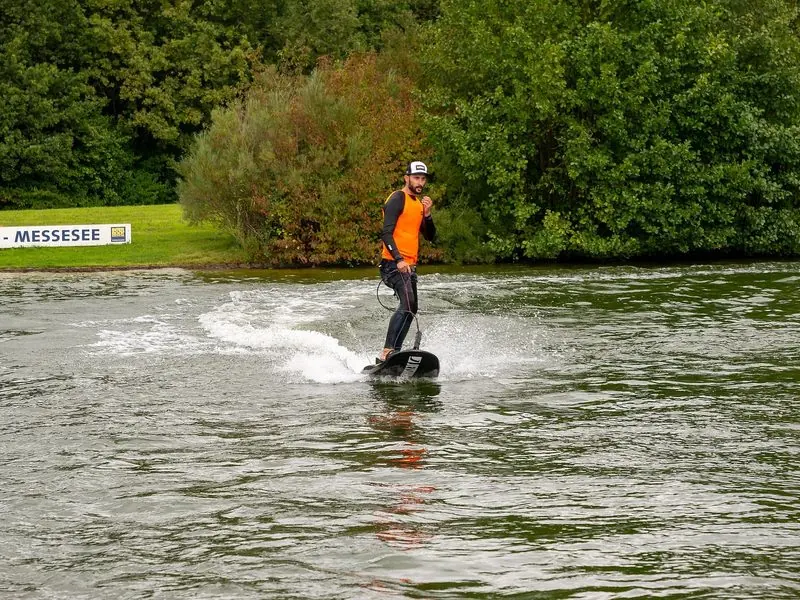
What it is actually like to ride
A JetSurf is harder than it looks and much harder than an eFoil. The board is short, narrow and has no buoyancy to spare, so the rider starts prone, comes to their knees under power and then stands, all while the board is accelerating. Most people need several sessions before they can hold a stand-up turn. Once it clicks the sensation is closer to motocross than to surfing, and the boards genuinely go as fast as the numbers say.
The dual foot bindings and ratchet straps on the racing boards are there because at 60 km/h a rider who comes out of position leaves the board entirely. Falls hurt at that speed. Flat water is essential. In the short chop of a busy bay the ride becomes physical work, and the small fins wash out in a turn. Guests who want a gentle first-day toy should be pointed elsewhere.
Carrying petrol for it
The petrol boards raise a problem the electric one does not. A yacht that carries a JetSurf has to carry unleaded 95 and full synthetic two-stroke racing oil, and premixed petrol is one of the more closely regulated things aboard. Many yachts already keep petrol for a tender outboard or a personal watercraft, in which case a board adds nothing. A diesel-only yacht is taking on a new stowage category for a 20 kg toy.
There is also noise. A 100 cc two-stroke at full throttle carries a long way across a calm bay, and the boards are audible from neighbouring yachts in a way an eFoil is not. Owners who use an anchorage repeatedly, or who moor near the same neighbours all August, tend to end up with the electric board despite its weight. The 2.8 litre tank limits a session to a short run before refuelling.
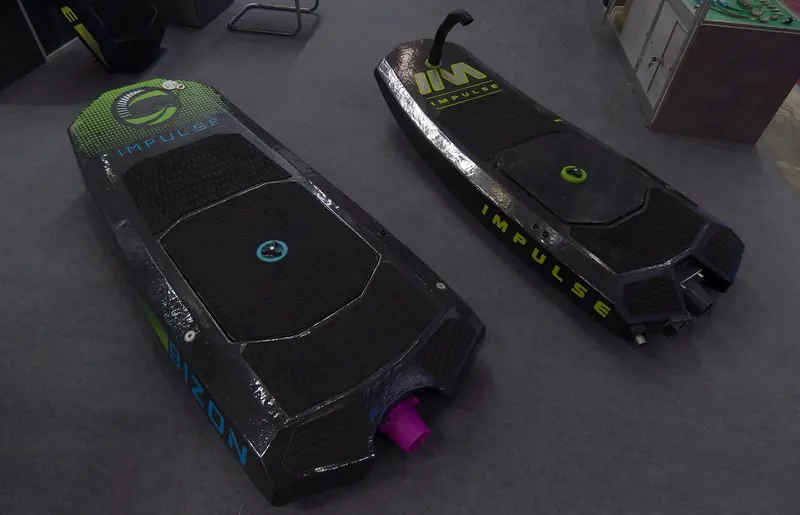
Stowage, handling and the crew's view
The stowage case is straightforward. At 1800 mm by 600 mm and under 21 kg, a petrol JetSurf goes on a wall rack or slides into a lazarette, and one crew member launches it by hand from the swim platform. No crane, no davit, no lifting plan. The Electric 2 at 32.9 kg is still a two-hand carry but no longer a casual one, and its battery has to come out and go somewhere approved to charge.
Crew opinion on these boards is divided and worth listening to. The petrol engines need warm-up, correct premix and regular flushing, and a board run in salt and left wet will punish that neglect. Against that they are simple machines with no seals to fail catastrophically and no pack to condemn. A JetSurf that is looked after is one of the more durable toys aboard.
Cost of ownership, and the interval nobody publishes
List prices from EUR 9,990 to EUR 12,990 exclude VAT, import tax and shipping, so the delivered figure in the European Union is meaningfully higher. Running costs are small in absolute terms. Fuel is a few litres a session, and the wear items are the impeller, the pump wear ring, spark plugs and the fin set. The engines are rebuildable, which is unusual in this category and matters over a five year holding period. What is missing from the documentation is the number that would let an owner budget for it. MSR Engines publishes no rebuild or overhaul interval in hours. The only intervals that appear anywhere are a spark plug every 6 hours of riding and a complete service inspection once every 12 months, both from JetSurf's own manuals, so any engine-hour figure quoted by a seller should be traced to its source before it is believed.
Service is the weak point compared with the eFoil brands. MSR Engines sells through a distributor network and parts often come from the Czech Republic, so a broken pump in Greece in August is a shipping problem measured in days. Owners who use the boards seriously carry a spare impeller and fin set aboard. In the Caribbean the dealer footprint is thinner again and Florida is usually the nearest real support, where the factory service centre listed an overall checkup at USD 199 in July 2026. The consolation is that every part is catalogued and priced, which is not true of most water toys, and a competent marine mechanic can work from the parts list without the factory.
Licences, safety and who may ride
Rules vary sharply and the boards are fast enough to attract attention. In Germany a powered board above 2.21 kW is treated as a water motorcycle and requires a licence, while lower powered craft do not. Mediterranean coastal municipalities restrict powered craft near swimming beaches and inside harbour limits, and a board at 55 km/h is unambiguously a powered craft. Local rules should be checked before the toy comes out of the garage.
Every board has a wrist strap kill switch, and it should be worn every time. A helmet and impact vest are sensible above about 40 km/h. On a commercially registered yacht the board sits inside the vessel's safety management arrangements with the tenders, and the lithium starter battery on the petrol boards, at 99 Wh, sits just under the 100 Wh threshold that triggers dedicated stowage. The Electric 2 pack does not.
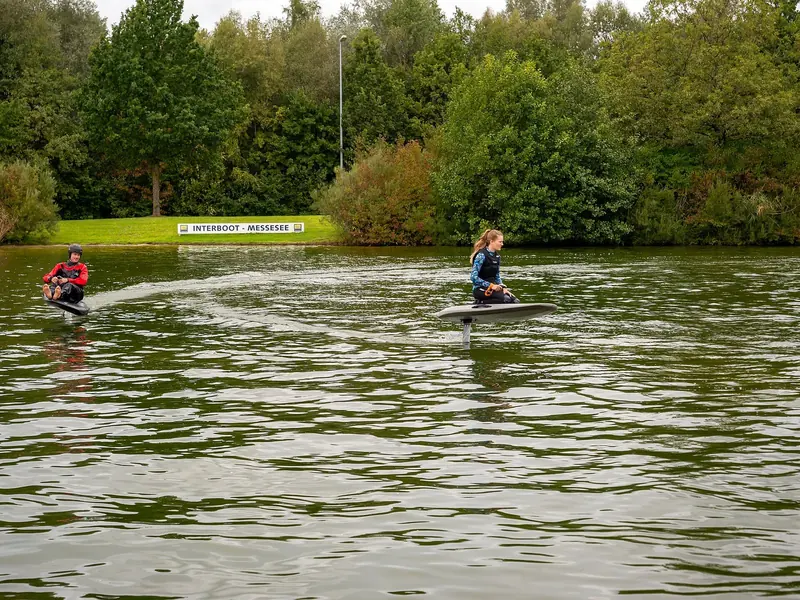
Against Awake, Radinn and the eFoils
The direct rivals are the Swedish electric jetboard makers Awake and Radinn, which offer quiet running and simpler operation at similar money and lower speeds. The broader competition is the eFoil, which most guests learn faster and which uses a fraction of the energy. JetSurf's answer is that nothing else is this light, this fast, or built by a company that makes its own engines. The racing class exists because the boards are genuinely competitive machines.
Where JetSurf loses is accessibility. A guest who has never ridden one will spend a frustrating morning, and the two-stroke boards are noisy and need fuel a modern yacht may not otherwise carry. Where it wins is with an owner or a teenager who actually wants to ride hard, learn a skill and go fast. The boards reward practice in a way that most yacht toys do not.
What a rebuild actually costs, and the board with no warranty
MSR Engines publishes no rebuild interval, but it does publish the price of every part, which is more useful than most makers manage. Read in July 2026, JetSurf's own store listed a piston set at EUR 113, a piston ring at EUR 17, an engine gasket kit at EUR 19, an NGK BPR7HS spark plug at EUR 9, a crankshaft at EUR 375, the matching bearing and seal set at EUR 97, a main gear set at EUR 197 and a reed valve at EUR 45. On those figures a top-end refresh is about EUR 141 in parts and a bottom-end rebuild about EUR 472, before labour, which is not published anywhere. Against a EUR 12,990 board those are small numbers, and they are the reason a rebuildable two-stroke ages better than a sealed lithium pack.
The warranty is where the reading has to be careful. New boards carry twelve months on main parts, new spare parts carry six months, and a pre-owned board carries three months on main parts with six on the engine and the ICU. The company's own service and support page, read in July 2026, states that Race Titanium DFI boards do not qualify for any factory warranty at all. That is the competition machine at the top of the price list, and an owner buying one is buying the fastest board in the range with no factory cover behind it. The published service price to set against that is an overall checkup at USD 199 at the Florida service centre.
Practical detail
| Electric vs petrol | The Electric 2 (EUR 12,490 excl. VAT, 55 km/h, 25 to 55 minute runtime) avoids carrying two-stroke fuel and oil aboard but needs charging infrastructure and only matches the mid-range petrol Adventure 2 DFI's top speed; the petrol Titanium DFI SL (EUR 12,990 excl. VAT) is faster at 64 km/h and refuels in minutes but means stowing fuel and mixed racing oil. |
|---|---|
| Pre-ride and post-ride routine | Because the hull is hollow, testers report checking for water ingress before and after every session as standard practice, not an occasional check, and recommend inspecting the equipment stand's stability once the battery is fitted rather than trusting it fully loaded. |
| Learning time | Most first-time riders are reported standing within about 15 minutes of instruction, with a materially steeper curve for riders near the weight cap; JetSurf Academy locations in Florida offer supervised first sessions for exactly this reason. |
| Safe Return Mode | The Electric 2 carries a limited-power Safe Return Mode good for up to about 400 metres if the main battery runs down away from the boat, worth checking before letting a guest ride it any further out than that from the swim platform. |
| Service access | JetSurf runs a service centre in Florida (general checkup USD 199, July 2026) alongside its Czech factory; an owner based outside the US or Europe should confirm turnaround time and shipping for parts before buying, since MSR Engines does not publish a wider service network. |
Request a quote for JetSurf.
Tell us the model and where it needs to go. The desk obtains a written offer from the maker or an authorised dealer, checks it against the prices published on this page, and comes back to you by email. No obligation, no fee.
- 01A written offerPriced in your currency, with VAT, delivery and lead time stated, not a brochure figure.
- 02Delivered where the yacht isTo the marina, the yard or your address, with the paperwork a lithium pack or a crane lift needs.
- 03IndependentYotters is tied to no single dealer, so the offer is compared before it reaches you.
What owners and crew report
Testers confirm the acceleration and top speed are real, not brochure numbers
Reviewing the Electric 2, Paige Swiss and Bradley Axmith reported strong take-off acceleration and a top speed in line with the roughly 34 mph (55 km/h) MSR Engines publishes, describing the ride as close to wakeboarding or surfing at speed with comfortable, tight carving turns.
Boat & Sail Magazine (Paige Swiss and Bradley Axmith, April 2025)The hollow hull means a real pre- and post-ride ritual, not just a rinse
E-Surfer's test of the Electric 2 found owners need to check for water inside the hull before and after every session, found the equipment stand shaky once the battery is fitted, and rated the printed manual as capable of misleading a new owner on setup.
E-SurferBigger riders find the learning curve noticeably harder
Boat & Sail Magazine's testers found getting up involves a real learning curve for larger riders specifically, which lines up with the hard 100 kg rider cap MSR Engines publishes for the Electric 2 against 120 kg on the petrol boards.
Boat & Sail Magazine (Paige Swiss and Bradley Axmith, April 2025)
What is good, and what to watch
Strong points
- The performance is genuine, and falls are more forgiving than they lookIndependent testers confirm real acceleration and a true 50 to 55 km/h top speed with carving that reviewers compare to wakeboarding, and most first-timers are reported standing within about 15 minutes, with crashes generally rated less punishing than other board sports because there is no tow line or kite to foul.
- Parts and service costs are unusually transparent for the categoryMSR Engines publishes individual engine part prices and service intervals rather than leaving cost of ownership to a dealer quote, which lets a buyer price a top-end refresh at roughly EUR 141 or a bottom-end rebuild at roughly EUR 472 in parts before committing.
What to watch
- It demands more day-to-day fuss than a jet ski or an eFoilBecause the hull is hollow, testers report checking for water ingress is a genuine before-and-after-every-ride task, not a formality, and the standard equipment stand was found unsteady once a battery pack is fitted, which matters on a moving swim platform.
- Hard weight caps rule out some guests outrightThe Electric 2 is capped at 100 kg (220 lb) and the petrol range at 120 kg, both firm limits rather than guidance, and reviewers found larger riders face a distinctly steeper learning curve even within those limits, which a yacht outfitting one board for a mixed group of guests needs to plan around.
Who it is for: Owners with a genuinely sporting household, a yacht that already carries petrol, and the patience for a toy that takes several sessions to master.