KVH Industries
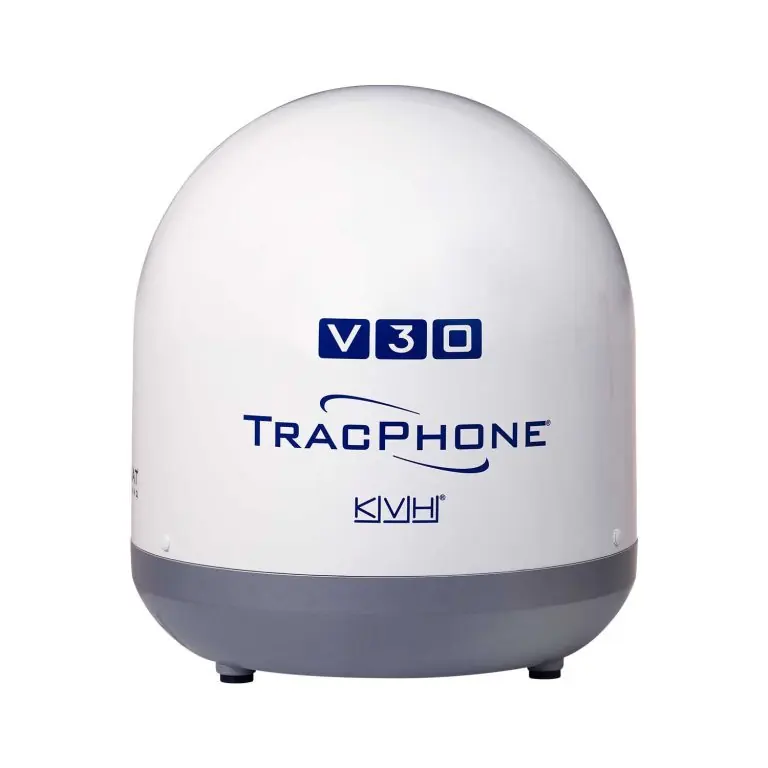
| Category | marine satellite television (TracVision) and VSAT satellite data and voice systems (TracPhone) |
|---|---|
| Founded | 1982 in Newport, Rhode Island by Arent Kits van Heyningen and his sons Martin and Robert, after building a tactical sailing computer for the America's Cup yacht France 3 |
| Headquarters and main assembly plant | Middletown, Rhode Island, about 80,000 sq ft, with additional facilities in Tinley Park, Illinois and Kokkedal, Denmark |
| Public company | listed on NASDAQ as KVHI since 1996 |
| Milestone | introduced the first stabilised TracVision marine satellite TV system in 1994; launched the mini-VSAT Broadband network in 2007 |
| Pricing, read September 2026 | TracVision TV3 satellite TV, the entry dome, USD 4,299.99 to USD 4,995 depending on retailer |
| TracPhone V30 VSAT antenna and hub | USD 11,995 list, against USD 18,000 for the higher-throughput V3-HTS with the same base performance |
| TracPhone V11-HTS, the 1-metre flagship VSAT antenna for yachts over about 110 feet: USD 74,995, delivering up to 20 Mbps down and 3 Mbps up on its high-speed channel | |
| Q2 2026 results | total revenue fell 15 percent year on year to USD 28.7 million; VSAT service revenue fell USD 5.6 million as Starlink and other low-cost alternatives took share |
| Q2 2026 response | Starlink resale service revenue rose USD 1.7 million after KVH activated more than 1,000 SpaceX Starlink terminals since the start of the year, alongside its existing OneWeb resale; about 10,700 vessels were subscribed to a KVH connectivity plan, a slight increase after three straight quarters of decline |
How A Sailing Computer Became A Satellite Company
The founding story runs through a chance introduction: a France 3 crew member met Martin van Heyningen, then working at a Newport boatyard, who told him his father could build anything, and Arent Kits van Heyningen delivered a working performance computer and, alongside it, the world's first self-calibrating digital fluxgate compass. The family business traded as SailComp before taking the KVH name from the founder's initials, went public on NASDAQ as KVHI in 1996, and by 2004 had grown to roughly 270 employees across three sites on revenue of about USD 62 million. The company has stayed a domestic manufacturer rather than outsourcing assembly to Asia, a decision it credits with the tight feedback loop between its engineers and the people building the product, and some of its assembly staff have been with the company more than fifteen years.
KVH entered the stabilised satellite TV market in 1994 with the first TracVision system and followed in 2007 with mini-VSAT Broadband, its own owned-and-operated satellite data network rather than capacity leased wholesale from someone else. That two-product structure, a TV antenna line under the TracVision name and a data and voice antenna line under TracPhone, is still exactly how the company is organised today, and both lines share the same core engineering: a gyro-stabilised antenna inside a composite dome that stays locked on a satellite while the vessel underneath it rolls, pitches and turns.
TracVision: What A Satellite TV Dome Actually Costs
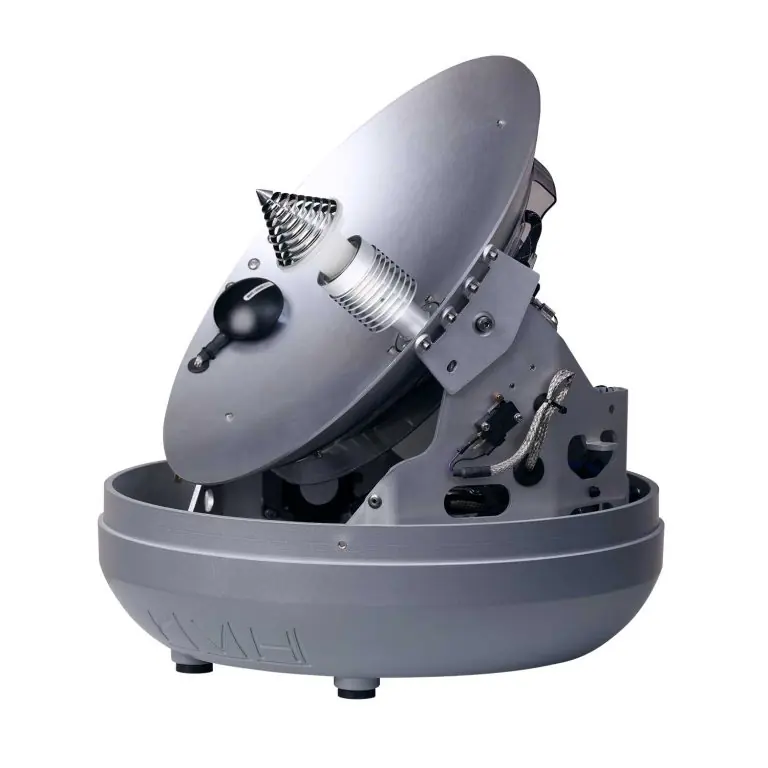
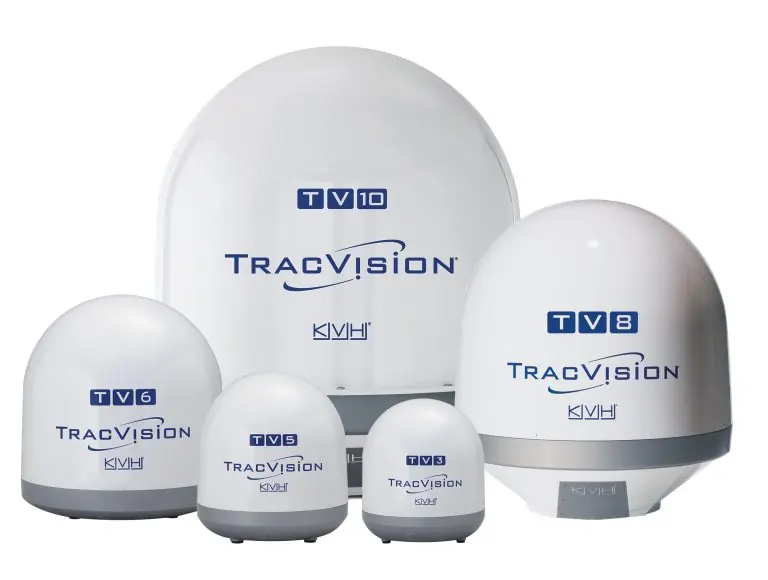
The TV3, the smallest and least expensive model at a 14.5-inch antenna, lists at USD 4,299.99 at Camping World and Overton's and USD 4,995 at West Marine, a spread that again comes down to retailer margin rather than two different products, and KVH markets it for boats staying within about 100 nautical miles of the coast. The TV6 steps up to a 24-inch antenna aimed at genuine offshore cruising and long passages, and the range continues through the TV8 and TV10 to the UHD7, KVH's model built specifically to carry 4K programming rather than only standard high-definition. None of the recreational TracVision pricing is hidden: every model in the current line has a public list price on KVH's own site and is stocked by the same marine retailers that sell the TracPhone data antennas.
What a buyer will not find published anywhere is the monthly programming subscription cost, which runs through a conventional satellite TV provider and its regional package pricing rather than through KVH, and the installation cost, which depends on the dome's footprint, the below-deck hub wiring and whatever structural work a given boat's cabin top needs. A TracVision dome is a receive-only system: it pulls in an existing direct-broadcast satellite TV signal the same way a stabilised dish on a delivery truck would, rather than generating its own data connection the way a TracPhone VSAT antenna does, and that distinction is the one KVH's own product literature is clearest about, because conflating the two has been a common buyer mistake.
KVH's own Q2 2026 numbers: VSAT service revenue down USD 5.6 million year on year, offset by a USD 1.7 million rise in Starlink resale revenue after the company activated more than 1,000 SpaceX terminals since the start of the year.
TracPhone VSAT: The Real Price Ladder, Hardware To Flagship
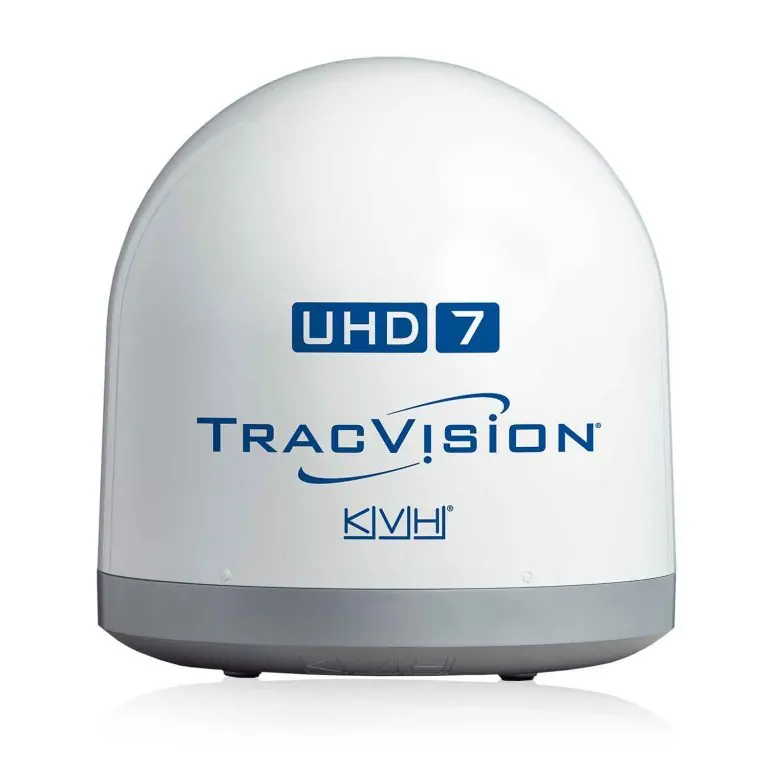
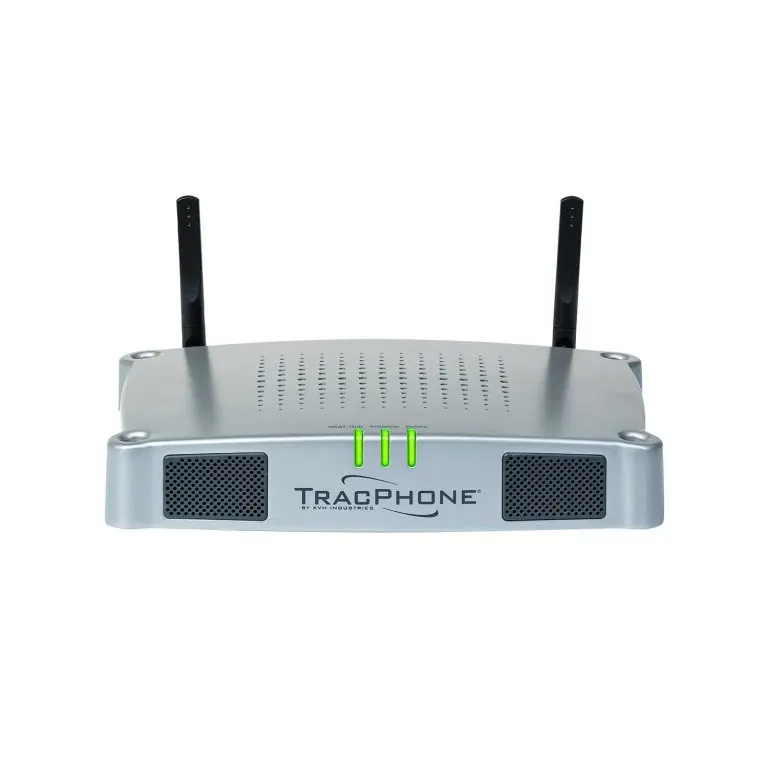
At the affordable end, the V30 carries a 15-inch continuously tracking dish, needs only a single cable between the dome and its below-deck hub, and runs on DC power alone rather than requiring a separate AC supply, at a list price of USD 11,995. KVH's own materials position it as roughly a third cheaper than the V3-HTS, an older antenna rated for the same core throughput but aimed at commercial operators who need more network-management capability than a private yacht typically does. Airtime is separate from the hardware and is metered or unlimited by plan: one published metered plan runs USD 299 a month for 64/32 kbps down and up, a voice line adds USD 31 a month with per-minute call charges, and at the top end KVH has offered unlimited streaming-grade bandwidth in the Caribbean or Mediterranean at 10 to 20 Mbps for USD 3,000 a week or USD 10,000 a month, pricing aimed squarely at charter operations rather than private owners.
At the flagship end, Yachting magazine's review of the V11-HTS recorded a list price of USD 74,995 for a 1-metre, four-axis stabilised dish delivering up to 20 Mbps down and 3 Mbps up on its dedicated high-speed channel plus a 9x2 Mbps unlimited-use secondary channel, up to five times the throughput of the V11-IP model it replaced, which the same review clocked at 4 Mbps down and 1 Mbps up. The reviewer judged it best suited to yachts over about 110 feet running genuinely remote routes, above Alaska, through Asia or to the Galapagos rather than the Caribbean and Mediterranean milk runs a smaller system can already cover well, and found the hardware upgrade path from the older V11-IP straightforward because the antenna itself is described as virtually identical.
The Real Story In 2026: Starlink Took The Market KVH Built
On KVH's Q2 2026 earnings call, CEO Brent Bruun and the company's own reporting were explicit that competition from low-cost alternatives to VSAT, including streaming-capable services, has materially hurt sales of TracVision as much as TracPhone, because a growing share of buyers now default to a flat consumer satellite antenna rather than a marine-specific stabilised system. Subscribing vessels had fallen for three consecutive quarters before Q2 2026's slight increase to roughly 10,700, and the quarter's numbers split the story cleanly: legacy VSAT service revenue down USD 5.6 million, offset in part by a USD 1.7 million rise in Starlink resale revenue after KVH activated more than 1,000 SpaceX terminals since the start of the year.
The company's strategic answer, multi-network service plans that let a customer draw a single data allowance across Starlink, OneWeb or KVH's own VSAT depending on where the vessel is and what each network covers best, is a genuine admission that no single network, including KVH's own, is now the whole answer for a cruising or commercial vessel. For a buyer today that reframes the decision: KVH's own hardware, the TracVision domes and the TracPhone antennas built and warrantied in Rhode Island, competes less on being the only way to get a signal and more on redundancy, on coverage where a low-earth-orbit constellation still has gaps, and on the kind of dedicated marine engineering, four-axis stabilisation holding a lock through a genuine sea state, that a consumer-grade flat panel was not originally built for.
The Real Alternatives, And How They Actually Compare
Intellian's v85NX and v150NX are the closest like-for-like competitors to KVH's own VSAT line: both are Ku-to-Ka band convertible antennas built for the same GEO, MEO and LEO network landscape KVH's multi-network plans are chasing, and Intellian markets the v150NX specifically as the first VSAT antenna convertible across all three orbit classes rather than locked to one network's hardware. Where KVH's advantage over Intellian is less about raw specification and more about the mini-VSAT Broadband network it owns outright, an antenna is only as good as the airtime plan behind it, and KVH controlling its own satellite capacity rather than leasing it wholesale is a genuine structural difference a spec sheet alone will not show.
Against Starlink Maritime, the honest comparison is not close on throughput or price: a Starlink Maritime terminal costs a small fraction of even the entry TracPhone V30's USD 11,995 and delivers materially higher throughput, which is exactly why KVH itself now resells it rather than pretending its own VSAT hardware competes on those two numbers. What Starlink does not yet fully match is the marine-specific engineering and the decades of stabilisation and reliability record KVH's own hardware carries, along with the regulatory patchwork, China's active restrictions on Starlink use among them, that a genuinely global VSAT network like KVH's does not face in the same way. The honest reading for a buyer in 2026 is that the best-provisioned yacht now often carries both: a low-cost, high-throughput LEO terminal for day-to-day use, and a marine-grade GEO VSAT system as the fallback that keeps working where the newer network has a gap.
Practical detail
| TracVision satellite TV pricing, published | TV3, the entry dome for boats within about 100 nautical miles of shore, runs USD 4,299.99 at Camping World and Overton's, USD 4,995 at West Marine. The range continues through TV6, TV8 and TV10 to the 4K-capable UHD7, all publicly priced on KVH's own site. Programming subscription cost is not set by KVH and runs through a conventional satellite TV provider's own regional pricing. |
|---|---|
| TracPhone VSAT hardware, entry to flagship | The ultra-compact V30 lists at USD 11,995, about a third less than the older V3-HTS at USD 18,000 for comparable core throughput. The flagship V11-HTS, a 1-metre four-axis stabilised antenna for yachts over about 110 feet, lists at USD 74,995 and delivers up to 20 Mbps down and 3 Mbps up on its dedicated channel. |
| Airtime is priced separately, and it is not cheap at the top | A published metered plan runs USD 299 a month for 64/32 kbps. A voice line adds USD 31 a month plus USD 0.59 a minute. Unlimited streaming-grade bandwidth in the Caribbean or Mediterranean, 10 to 20 Mbps, has been offered at USD 3,000 a week or USD 10,000 a month, aimed at charter operations rather than private cruising budgets. |
| What is not published: installation, and any current Starlink-resale bundle pricing | Neither TracVision nor TracPhone list prices include installation, which depends on the dome footprint, below-deck hub wiring and the specific boat's structure. KVH's Starlink and OneWeb resale plans, introduced in 2026 as network competition intensified, are not listed at a fixed public price and require a quote through a KVH dealer. |
| The company's own financial health is now a relevant fact for a buyer | KVH's Q2 2026 total revenue fell 15 percent year on year to USD 28.7 million as Starlink took share from its VSAT service business, though the company reported a slight rebound in subscribed vessels to about 10,700 after three quarters of decline. A buyer weighing a multi-decade equipment purchase should weigh that trend alongside the hardware spec sheet. |
What owners and crew report
The V11-HTS is judged a genuine tool for remote routes, not the Caribbean or Mediterranean milk runs a smaller system already covers
The review found the antenna best suited to yachts over about 110 feet running toward Alaska, Asia or the Galapagos, delivering up to five times the throughput of the older V11-IP model it replaces, with a straightforward hardware upgrade path because the dish itself is nearly identical.
YachtingA circumnavigating owner chose KVH specifically for mini-VSAT Broadband's reliability on long ocean passages
Italian yachtsman Andrea Recordati fitted a TracPhone V3 with mini-VSAT Broadband to his 100-foot Wally sailing yacht for an around-the-world cruise, a case KVH itself has publicised as evidence the network holds up on extended offshore legs.
KVH Mobile WorldOlder TracVision hardware can outlive its own spare-parts support
One owner reported a TracVision satellite TV tracking system that had run for more than 17 years before failing, by which point no parts were available for repair or replacement, a longevity story that cuts both ways: the hardware lasted, but the support did not outlast it.
Sam's Marine Hatteras Owners ForumKVH's own leadership frames 2026 as a genuine competitive turning point, not a temporary dip
On the Q2 2026 earnings call, KVH stated plainly that competition from low-cost alternatives including streaming-capable services has had a significant impact on TracVision sales specifically, and pointed to its own Starlink and OneWeb resale growth as the company's chosen response rather than a stopgap.
KVH Industries (Q2 2026 earnings call)
What is good, and what to watch
Strong points
- More than 40 years building specifically for the marine environmentKVH has designed and assembled stabilised marine antennas in Rhode Island since 1994's first TracVision, a depth of marine-specific engineering, four-axis stabilisation holding a satellite lock through real sea states, that a general-purpose consumer antenna was not originally built to match.
- A full, honestly priced range, entry to flagshipFrom the USD 11,995 V30 to the USD 74,995 V11-HTS, and from the USD 4,300 TV3 to the 4K UHD7, every current model carries a public list price, letting a buyer size a system to their boat and budget without a quote-only black box.
- Owning its own network rather than reselling onlyKVH launched mini-VSAT Broadband in 2007 as its own owned-and-operated satellite data network rather than leased wholesale capacity, and has since added Starlink and OneWeb resale on top of it, giving a customer a genuine multi-network fallback most single-network providers cannot offer.
What to watch
- Losing the market it createdKVH's own Q2 2026 results show VSAT service revenue down USD 5.6 million year on year and total revenue down 15 percent, driven explicitly by Starlink and other low-cost alternatives taking share from TracVision and TracPhone sales alike.
- GEO VSAT is now the slower, more expensive option on paperEven KVH's flagship V11-HTS tops out at 20 Mbps down for USD 74,995 in hardware alone, against Starlink Maritime terminals costing a small fraction of that with materially higher throughput, which is precisely why KVH itself now resells the competitor's hardware.
- Airtime economics can be steep at the low end and opaque at the high endA base metered plan at USD 299 a month buys only 64/32 kbps, and neither the current Starlink-resale bundle pricing nor most installation costs are published, leaving a buyer to get a quote before a real total cost of ownership is known.
Who it is for: An owner or captain who wants a marine-engineered, professionally installed satellite TV or data system with a Rhode Island-built warranty behind it, and who is weighing that against a cheaper, faster low-earth-orbit alternative like Starlink Maritime rather than assuming KVH is still the only serious option.