Lift Foils

| Category | electric hydrofoil boards, known as eFoils |
|---|---|
| Founded | Puerto Rico, early 2010s, by Nick Leason and Mike Leason |
| Based | Isabela, Puerto Rico, where the factory and test water also sit |
| First commercial eFoil | 2018, the first product of its kind sold to the public |
| Ownership | privately held and family run |
| Current range | LIFT5 in 4'4 Pro, 4'9 Sport, Laird 5'2 and 5'4 Cruiser |
| Price | USD 14,999 for a complete 4'9 Sport or 5'4 Cruiser setup, liftfoils.com, July 2026 |
| Battery | Gen5 full range, 2.2 kWh, rated up to 90 minutes, 80 percent charge in about an hour |
| Spare battery | USD 3,880 |
| Setup weight | 30.6 kg for the 4'9 Sport, 32.0 kg for the 5'4 Cruiser |
| Maximum rider weight | 100 kg on most boards, 113 kg on the 5'4 Cruiser |
| Battery warranty | two years or 600 charge cycles, whichever comes first |
| Gen5 full range pack | 2.2 kWh, 13.9 kg, 90 minutes of published ride time, 140 minutes to charge, USD 3,880, from Lift's own product page, July 2026 |
| Flag reach | Part A Chapter 14 of the Red Ensign Group Yacht Code covers the United Kingdom, the Cayman Islands, Gibraltar, the Isle of Man and the other British Overseas Territories and Crown Dependencies |
| Marshall Islands | the 2026 edition of Yacht Code MI-103, effective 1 January 2026, adds specific rules for spaces used to store or charge lithium-ion powered toys and tenders |
| Malta | a Transport Malta Commercial Yachting Notice of 22 June 2022 and Information Notice 45 of 7 September 2022, written as strong recommendation, with the Commercial Yacht Code 2025 Revision 1 as the surveyed document |
| IMO | no mandatory instrument covering portable lithium battery powered craft aboard yachts as of July 2026 |
| Class | DNV's Battery (Safety) notation triggers only above 50 kWh aggregate installed capacity. Lloyd's Register LR-GN-052 of 10 June 2025 is advisory |
| Charging locker | no marine manufacturer publishes a price. EN 14470-1 Type 90 industrial cabinets listed at EUR 3,270 net (asecos ION-CHARGE 90) and GBP 4,571.04 net (asecos ION-CORE-90), both July 2026, neither UK marine type approved |
A Puerto Rican workshop that started the category
Lift Foils began in Puerto Rico in the early 2010s as a small hydrofoil business run by Nick Leason and his brother Mike, building surf and kite foils by hand. Putting a motor and a battery into a foil board took years to reach a state the family was willing to sell. Lift launched the first commercial eFoil in 2018 and created the category. It is still privately held and family run, with headquarters, factory and test water all at Isabela on the north-west coast of the island.
The engineering problem was never the foil. Surf foils were well understood by then. What had to be solved was fitting a lithium battery of useful size inside a board a person stands on, sealing it against warm salt water, and controlling the motor from a handheld unit that survives being dropped in the sea. Lift's answer was a sealed drop-in pack and a wireless controller, and that architecture has not changed since. Every competitor that followed built a version of it.
The LIFT5 range, board by board
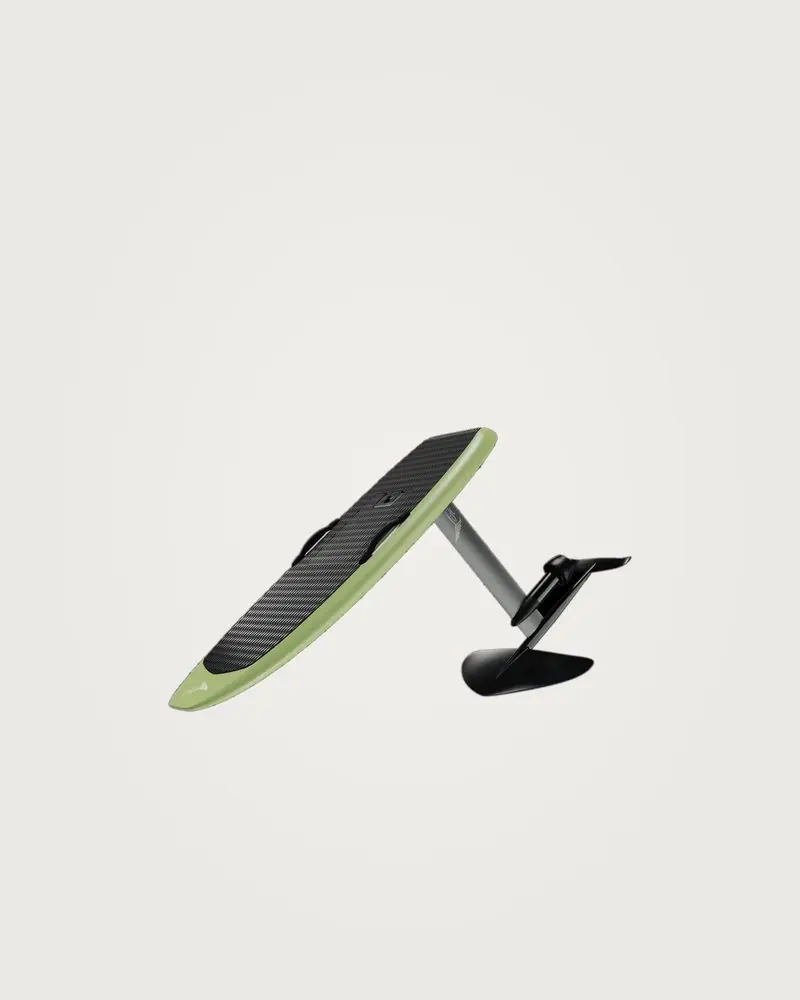
The current generation is the LIFT5, sold in four boards that differ mainly in volume and width. The 5'4 Cruiser is the most forgiving at 83 litres and 70 cm across, and carries a rider up to 113 kg. The 4'9 Sport, 67 litres and 64 cm, is the best seller and the board most dealers put a first-timer on. The 4'4 Pro drops to 55 litres for riders who already foil, and the Laird 5'2 is a narrow 64 litre board. All four take the same battery, mast and wings.
The hardware behind the shape matters more than the shape. Every LIFT5 arrives with the Gen5 full range battery, a 28 or 32 inch carbon mast, two wings, the Elite hand controller, a charger and bags. Propulsion is an enclosed jet unit at the foot of the mast, which does away with the exposed propeller older eFoils carried. Assembly is tool free, so a guest can build the board on a swim platform in minutes. Changing the front wing alters the ride more than changing the board.
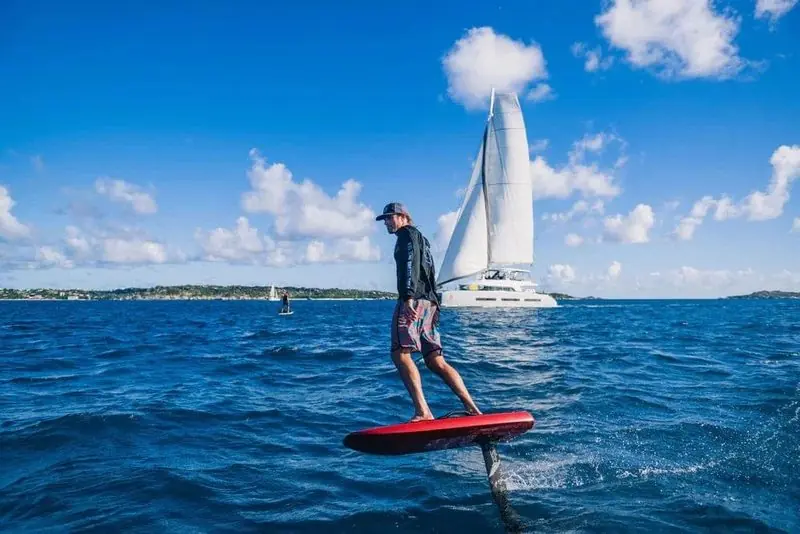
Lift invented the eFoil in 2018 and has spent every year since defending the top of a category it created.
What it is actually like to ride
A first session is spent on the knees. A trigger on the hand controller feeds power to the motor, and lifting a 30 kg board clear of the surface takes a steady throttle hand and a tolerance for falling off. Most people get short flights inside a lesson or two, then spend a season learning to turn without touching down. Once the board is flying it is close to silent, which is what surprises guests. No wake, no exhaust and nothing audible from the aft deck.
The 90 minute rating on the Gen5 pack is a ceiling and not an average. A heavy rider on a small wing at full throttle will see well under an hour, and a light rider cruising will beat the number. Lift does not publish a top speed. Flat or lightly rippled water is where a foil is best, and the chop that builds inside a busy anchorage by midday makes the ride hard work. Cold water shortens both the battery and the rider.
Getting it aboard and stowing it
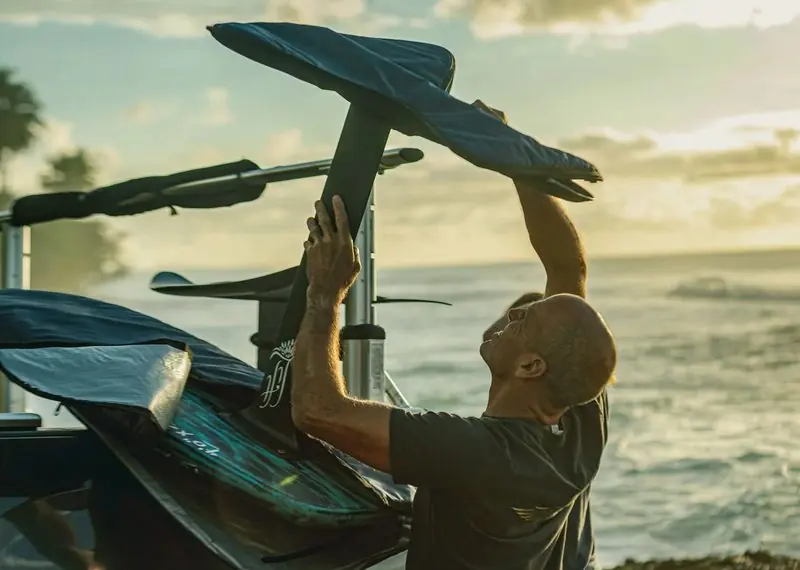
A complete LIFT5 weighs between 30.6 kg and 32.0 kg depending on the board, and never has to be lifted as one piece. The board alone is 9.5 kg, the Gen5 battery about 13.8 kg, and the mast, propulsion unit and wings come apart by hand. No crane, no davit and no lifting plan, which is why eFoils appear on 30 metre yachts as readily as on 90 metre ones. The board bag is the dimension to check. A 5'4 Cruiser needs a locker or rack of at least 1.7 m clear.
The battery dictates where the toy can live, and the carbon wings dictate how it is handled. Foil wings are thin, stiff and genuinely sharp, which is why they ship in padded bags and why experienced crew carry them separately. Salt is the other enemy. The mast joint and the jet unit want a fresh water rinse after every use, and a board left wet in a hot garage for a fortnight will show it.
The charging rule, and which flags it binds
The UK Maritime and Coastguard Agency published MGN 681 (M) Amendment 1 on 19 December 2025, replacing the original note of June 2023 and sitting on Part A Chapter 14 of the Red Ensign Group Yacht Code. It governs fire safety, storage and charging of small electrically powered craft aboard yachts, covering eFoils, electric jet skis and electric tenders. Spare or removed batteries above 100 Wh must be stowed in cabinets meeting EN 14470, EN 16121 or EN 16122, and from 1 January 2027 any new battery storage or charging container fitted to a UK-registered yacht must carry UK type approval from a nominated body. A Gen5 pack is 2.2 kWh, twenty-two times the threshold and squarely inside scope. Amendment 1 also asks for crew training on charging, damage identification, quarantine of a suspect pack and the warning signs of thermal runaway, with a named person responsible.
The initials mislead about who is caught. Chapter 14 is a Red Ensign Group instrument, and the Red Ensign Group is the United Kingdom together with the Cayman Islands, Gibraltar, the Isle of Man and the other British Overseas Territories and Crown Dependencies, so a Cayman-flagged yacht is inside the same chapter the MGN interprets. As of July 2026 the Cayman Islands Shipping Registry has published no separate lithium battery notice, leaving Chapter 14 and a vessel-specific risk assessment as the working standard. Outside the group the picture differs. The Republic of the Marshall Islands rewrote Yacht Code MI-103 with a 2026 edition effective 1 January 2026 that introduces specific rules for spaces used to store or charge lithium-ion powered toys and tenders. Malta moved earlier and softer, with a Transport Malta Commercial Yachting Notice of 22 June 2022 and Information Notice 45 of 7 September 2022, both written as strong recommendation, the hard requirement being that a suspect or defective pack is landed at once, and the document a Maltese yacht is surveyed against being the Commercial Yacht Code at its 2025 revision. Only the 1 January 2027 type-approval deadline is genuinely UK-only, and building to it anyway is the cheap decision, because flags change more often than garages get rebuilt.
What it costs to buy and to keep, and how many packs it takes
A complete 4'9 Sport or 5'4 Cruiser lists at USD 14,999 as of July 2026, which includes the board, battery, mast, propulsion, both wings, controller, charger and bags. That is one board and one battery, and one battery does not run an afternoon. Lift's own product page for the Gen5 full range pack, read in July 2026, gives 2.2 kWh, 13.9 kg, 90 minutes of ride time and 140 minutes to charge, at USD 3,880. Those two numbers settle the buying decision. Charging takes half again as long as riding, so a second pack does not close the gap: one board, two packs and one charger delivers about three hours of riding and then stops for roughly fifty minutes. Three packs and one charger run continuously.
Three packs is USD 11,640 on top of the board, so a properly equipped single-board setup is close to USD 26,500 before the charging locker. The running cost is the battery itself. Lift warrants the pack for two years or 600 charge cycles, whichever comes first, so it is a wear item with a published life and a four figure replacement price, and a yacht that charges three packs daily through a season is spending those cycles fast. The board carries a one year warranty extendable to three under Lift's protection plan. Wings, mast hardware and seals are the other consumables. None of it is expensive against the cost of the yacht, and all of it is easy to under-order at the point of purchase.
Service, parts and the August problem
Lift lists more than 300 affiliated demo locations worldwide, but for a yacht the practical route is a specialist supplier who already works with crew. Ocean Premium runs a Lift rental and support fleet along the French and Italian Riviera, Sardinia, Croatia, Montenegro, Greece, Palma, Ibiza and the Caribbean, and puts boards aboard weekly. That is why a board built in Puerto Rico is easier to keep running in the Mediterranean than the delivery address suggests. A damaged board or a bent mast is usually dealt with locally inside a week.
A failed battery is a different matter. A loose lithium battery moving by air is dangerous goods under UN3480, restricted to cargo aircraft only and capped at 30 percent state of charge under IATA rules. A replacement pack therefore does not arrive overnight in Bonifacio in the second week of August. Owners who use eFoils heavily buy the spare at the same time as the board and treat air freight as the fallback. The alternative is renting a board locally for the rest of the trip.
Lift against Fliteboard and the rest
The main rival is Fliteboard, founded in Byron Bay in 2016 and acquired by Brunswick Corporation in September 2023, where it sits inside Mercury Marine. Fliteboard offers a wider ladder of prices, including inflatable Air models, and has a large network of dealers and Fliteschools across Europe. Audi's e-tron foil and the French builder Takuma occupy the same premium band, and Waydoo undercuts all of them. The category is crowded in a way it was not five years ago.
Lift wins on build quality and on being the reference that dealers measure everything else against. It loses on entry price and, in parts of Europe, on dealer density against a rival backed by the largest marine group in the world. On the water the two are close enough that a rider who learns on one is comfortable on the other within an afternoon. For most owners the deciding question is which brand has a service point near the water the yacht will spend August in.
Training, rules and what goes wrong
No licence is required to ride an eFoil in most jurisdictions, but local rules vary and they bite. Coastal municipalities across the Mediterranean restrict powered craft near swimming beaches and inside harbour limits, and a board at 30 km/h counts as a powered craft. Every credible operator puts riders in a helmet and impact vest. The injuries come from the wings and the mast, which are carbon and hard, and from other boats in a crowded anchorage.
On a commercially registered yacht the eFoil sits inside the vessel's safety management arrangements alongside the tenders, so a documented guest briefing and a crew member watching the water are normal practice. Amendment 1 to MGN 681 adds a training expectation on the battery side of the same equipment. An owner buying one board for private use can skip most of this. An owner buying four for a charter yacht is buying a small operation.
Class, the IMO, and what the locker actually costs
Two questions follow the flag question and both have short answers. The International Maritime Organization has no mandatory instrument reaching a portable battery aboard a yacht as of July 2026. Its lithium work sits in the Maritime Safety Committee's review of alternative fuels and new technologies, where MSC 109 added swappable traction battery containers to the list under review and identified nineteen regulatory gaps, and MSC 110, sitting from 18 to 27 June 2025, closed the review of regulatory barriers. Class is similarly light. DNV's Battery (Safety) notation is mandatory only above 50 kWh of aggregate installed capacity, more than twenty times a Gen5 pack, so a rack of eFoils never triggers it. Lloyd's Register published LR-GN-052, Guidance Notes on Lithium-Ion Battery Powered Crafts and Vehicles carried on Yachts, on 10 June 2025, and it is advice to designers, builders and operators rather than a rule. ISO 23625:2025 covers lithium-ion batteries above 500 Wh installed in small craft, which reaches an electric tender rather than a board that is carried aboard.
The locker is the line nobody prices. The marine active-suppression systems sold against MGN 681, the RACLAN boxes and the modular RAMBSS, and the passive ZARGES BatterySafe cases, were all quotation only in July 2026, with no published figure from any manufacturer. What is priced publicly is the shore-side industrial cabinet built to EN 14470-1 Type 90, one of the standards the note names for spare-battery stowage. In July 2026 a German supplier listed an asecos ION-CHARGE 90 with pull-out shelves at EUR 3,270 net of VAT, internal envelope 470 by 452 by 582 mm with shelves rated 25 kg, and a United Kingdom supplier listed the taller asecos ION-CORE-90 at GBP 4,571.04 net or GBP 5,485.25 gross. A 13.9 kg Gen5 pack sits comfortably inside both. Neither carries UK marine type approval, which is the thing that becomes mandatory on UK-registered yachts on 1 January 2027, and MCA Safety Bulletin 35, updated 15 November 2024, found that a container advertised as fully MGN 681 compliant was not able to comply fully and warned that no international standard governs these products at all.
Practical detail
| New, complete board | USD 14,999 for a 4'9 Sport or 5'4 Cruiser (board, Gen5 battery, mast, propulsion, both wings, controller, charger, bags), Lift's own site, July 2026 |
|---|---|
| Spare battery | USD 3,880 each; two or three packs are needed for continuous use across an afternoon, taking a real setup toward USD 22,600-26,500 |
| Battery wear life | Warranted two years or 600 charge cycles, whichever comes first - a yacht charging packs daily through a season burns through that warranty inside it |
| Where to get it serviced in the Med | Ocean Premium and comparable operators run Lift rental and support fleets along the French and Italian Riviera, Sardinia, Croatia, Montenegro, Greece, Palma, Ibiza and the Caribbean - a damaged board is normally fixed locally within a week |
| What is NOT solved on delivery | The battery-storage locker required under UK MGN 681 Amendment 1 (from 1 January 2027 for UK-flagged yachts) has no marine-specific priced product; the only public benchmarks are shore-side EN 14470-1 industrial cabinets at roughly EUR 3,270-GBP 5,485, neither of them marine type-approved |
| Check before buying | Locker or rack length of at least 1.7 m for the 5'4 Cruiser's board bag, and a battery-replenishment plan for the flag the yacht sails under, since a failed pack cannot travel by passenger aircraft and does not arrive overnight in August |
Request a quote for Lift Foils.
Tell us the model and where it needs to go. The desk obtains a written offer from the maker or an authorised dealer, checks it against the prices published on this page, and comes back to you by email. No obligation, no fee.
- 01A written offerPriced in your currency, with VAT, delivery and lead time stated, not a brochure figure.
- 02Delivered where the yacht isTo the marina, the yard or your address, with the paperwork a lithium pack or a crane lift needs.
- 03IndependentYotters is tied to no single dealer, so the offer is compared before it reaches you.
What owners and crew report
Real-world battery range runs well under the 90-100 minute rating, especially for heavier riders
On the eFoil Forum (e-surfer.com) thread on Lift real-life range, forum member RCARL1962 struggled to reach 45 minutes on a demo board against the manufacturer's claims; member suagrolake, at 195 lb, got 60 minutes, a 40 percent cut from the rated 100; member cabosn123, 180 lb, saw 45 minutes cruising at 21-24 mph over about 15 miles. Member MLB, at 230 lb, reported a solid 90 minutes on a smaller board and a 120 lb rider on the same pack getting 1:45 - the spread is almost entirely rider weight and throttle discipline.
eFoil Forum member RCARL1962, suagrolake, cabosn123 and MLB (e-surfer.com)Published specs assume a light rider, and Lift does not hide that
A forum poster summarised the pattern other owners were reporting: the headline ride time is set for a 70-75 kg rider, not a 105 kg one, so a heavier guest should plan on a shorter session before the board is racked again.
eFoil Forum member Jetsurfingnation (e-surfer.com)Assembly and handling on deck are as tool-free as the yard promises
Testing the LIFT5 and LIFTX back to back, the board went from bag to water in under a minute with no tools, the plug-and-play battery removed any wire handling, and the board felt noticeably lighter in the hands than its spec sheet suggested it would.
Foiling Magazine test reviewThe smallest board is not a beginner's first choice
Testers who were already competent on the standard boards had to consciously re-adapt their waterstart technique for the 4'4 Pro and crashed repeatedly before it clicked - a board sold to riders who already foil, not a first purchase.
Foiling Magazine test review
What is good, and what to watch
Strong points
- Tool-free setup and handlingNo crane or davit, no tools to assemble, and the whole rig breaks down into pieces light enough for one crew member - why eFoils appear on 30 metre yachts as readily as 90 metre ones.
- The reference build in the categoryIndependent testers single out the plug-and-play battery, the enclosed jet unit and the smooth, proportional power delivery as the standard the rest of the eFoil market is measured against.
- A genuine Mediterranean support networkOcean Premium and comparable operators keep demo and loaner boards along the routes yachts actually cruise, so a damaged board or bent mast is usually sorted locally inside a week rather than shipped home.
What to watch
- Real ride time is shorter than the rating for most adultsForum-reported sessions cluster at 45-60 minutes rather than the 90-100 minute figure on the box, because the published number assumes a 70-75 kg rider; a heavier guest or a hard-throttle session will see well under an hour on one pack.
- A single battery is not a full afternoonCharging takes longer than riding, so one board and one pack cannot deliver continuous use; a properly equipped setup needs two or three packs at USD 3,880 each, pushing a real single-board budget toward USD 26,500 before a compliant charging locker.
- The charging locker is an unpriced, unresolved costNo marine manufacturer publishes a price for an MGN-681-compliant charging cabinet, and an MCA safety bulletin found at least one product marketed as compliant was not - a buyer is left pricing an industrial shore-side cabinet as the only public benchmark.
Who it is for: Owners who want the reference eFoil and have crew willing to manage lithium batteries properly, and who are not shopping on price.