Starlink Maritime

| What it is | Starlink Maritime, the marine-rated tier of SpaceX's low-earth-orbit satellite broadband, sold through Starlink's own "Starlink Business | Maritime" storefront and through authorized marine electronics resellers and installers |
|---|---|
| Launch | SpaceX announced Starlink Maritime on July 7, 2022; the 54.9-metre motor yacht Loon, under Captain Paul Clarke, was among the first to fit it, testing the service on an Atlantic crossing that August, per SuperyachtNews |
| Current hardware | the Starlink Performance (Gen 3) terminal, launched June 4, 2025 at a list price of USD 1,999, replacing the earlier Flat High Performance kit that retailed from about USD 2,500 up to USD 10,000 for a full twin-antenna setup at its 2022 launch |
| Dish spec | Starlink's own published spec sheet lists the Flat High Performance dish at 511 x 575 x 41mm, 5.9kg without cable, an electronic phased-array antenna with a 140-degree field of view, no moving parts, IP56-rated and wind-survivable above 280 kph |
| Monthly pricing | Global Priority tiers run GBP 215 (about USD 250) a month for 50GB up to GBP 1,830 (about USD 2,150) a month for 2TB, per Starlink's own maritime storefront |
| Smaller-craft tier | a USD 185-a-month Personal Maritime plan, launched August 2026, gives unlimited data within 12 nautical miles of shore; overage beyond that, sold as Ocean Mode, jumped from USD 2 to USD 6 per gigabyte on September 27, 2026 |
| Constellation | more than 11,000 Starlink satellites were in orbit as of August 27, 2026 per EarthSky's tracking count, up from just over 10,000 in March the same year per satellite tracker KeepTrack.space |
| Regulatory limits | China began actively enforcing a ban on shipboard Starlink use in its waters from around December 2025, with fines reported up to roughly 500,000 yuan (about USD 72,000); Russia and Iran also prohibit its use, and the terminal geofences itself off automatically in any unlicensed water, per Maritime Executive |
| Cargo/tanker-only plan | a USD 2,495-a-month all-inclusive "Global Priority Unlimited" plan exists with a free terminal and a published 99.9-percent uptime SLA, but it is restricted to IMO-registered cargo and tanker vessels and is not sold to yachts, per authorized reseller Elcome |
| Installers | marine electronics integrators including Concord Marine Electronics, Elcome and KVH sell and fit Starlink Maritime hardware bundled with routers, mounts and network-management gear for yachts |
What Is Starlink Maritime And How Does It Work
The hardware is a single flat panel, not a dish: Starlink's own published specification sheet lists the Flat High Performance terminal at 511 x 575 x 41 millimetres, weighing 5.9 kilograms without its cable, an electronic phased-array antenna with a 140-degree field of view and no moving parts, rated IP56 and able to survive winds above 280 kilometres an hour. Because the satellites sit in low earth orbit rather than the roughly 35,786-kilometre geostationary belt used by traditional VSAT, the round trip to a satellite and back is measured in tens of milliseconds rather than the several hundred milliseconds typical of GEO VSAT, which is what lets a video call or a live chart update feel instant rather than laggy.
SpaceX announced Starlink Maritime on July 7, 2022, and one of the earliest yachts to fit it was the 54.9-metre motor yacht Loon, whose captain, Paul Clarke, tested the service on an Atlantic crossing that August, according to SuperyachtNews. The constellation behind it has grown fast since then: EarthSky counted more than 11,000 Starlink satellites in orbit as of August 27, 2026, up from just over 10,000 in March the same year per satellite-tracking site KeepTrack.space, with SpaceX holding FCC authorization to grow the system toward roughly 12,000 satellites and beyond.
How Much Does Starlink Maritime Cost To Buy And Run
Starlink's current maritime terminal is the Performance (Gen 3) kit, launched June 4, 2025 at a list price of USD 1,999, replacing the earlier Flat High Performance kit, according to Mobile Internet Resource Center's coverage of the launch; US retailer Concord Marine Electronics currently lists the same Gen 3 terminal, bundled with a wedge mount and router, at USD 1,999 on sale against a USD 2,499 regular price. That is a sharp drop from where maritime pricing started: at its 2022 launch a full twin-antenna Flat High Performance setup, of the kind fitted for redundancy on some superyachts, cost as much as USD 10,000 in hardware alone per Boat International's 2023 reporting, with a single antenna available through reseller Anuvu at around USD 2,500 even then.
Monthly service for a yacht runs on Starlink's Global Priority tiers: Starlink's own maritime storefront lists GBP 215 a month for 50GB, rising to GBP 555 for 500GB, GBP 980 for 1TB and GBP 1,830 for 2TB, which US Mobile's pricing guide quotes in dollars as USD 250, USD 650, USD 1,150 and USD 2,150 for the same four tiers. Smaller boats that mostly stay within 12 nautical miles of shore have a cheaper option: a USD 185-a-month Personal Maritime plan, introduced in August 2026, gives unlimited data in territorial waters worldwide, though Mobile Internet Resource Center and Trio Flatmount both confirm that overage data beyond that zone, sold as Ocean Mode, jumped from USD 2 to USD 6 per gigabyte on September 27, 2026, on both the Personal Maritime and Roam Unlimited plans.

Loon's captain measured 150 to 200 Mbps for USD 5,000 a month on Starlink, against 40 to 80 Mbps for USD 10,000 a month on the yacht's previous VSAT service.
How Does It Compare To The VSAT It Is Replacing
Loon's Captain Paul Clarke gave SuperyachtNews a direct before-and-after: the yacht's previous satellite provider delivered 40 to 80 Mbps for USD 10,000 a month, against consistent 150 to 200 Mbps for USD 5,000 a month on Starlink during its 2022 Atlantic crossing test, a figure Boat International later reported still held roughly six months on, alongside Clarke's estimate that dropping satellite TV in favor of streaming over Starlink was saving Loon about USD 20,000 a year. Yachting World's Jayne Toyne measured similar real-world numbers testing Starlink mid-Atlantic under sail, logging 40 to 220-plus Mbps download, 8 to 25-plus Mbps upload and latency under 99 milliseconds, a speed and responsiveness no GEO VSAT system can match at any price.
The flat antenna is also a practical, not just financial, upgrade: Florida-licensed yacht broker Reed Nicol notes for RN Marine that eliminating the radome a traditional stabilized VSAT needs means Starlink's panel can sit flush in a hardtop rather than needing a dedicated dome housing, though he flags real trade-offs of its own, including that the terminal draws meaningfully more continuous power than an idle VSAT system and, being designed to shed snow and radiate heat efficiently, cannot be painted or color-matched to the hull, only left factory white. What Starlink does not offer, unlike the VSAT contracts it is displacing, is a guaranteed minimum service level on the Global Priority tiers a yacht actually buys; the 99.9-percent uptime SLA Starlink does publish is attached only to the separate, cargo-and-tanker-only Global Priority Unlimited plan, not to anything sold to a yacht.
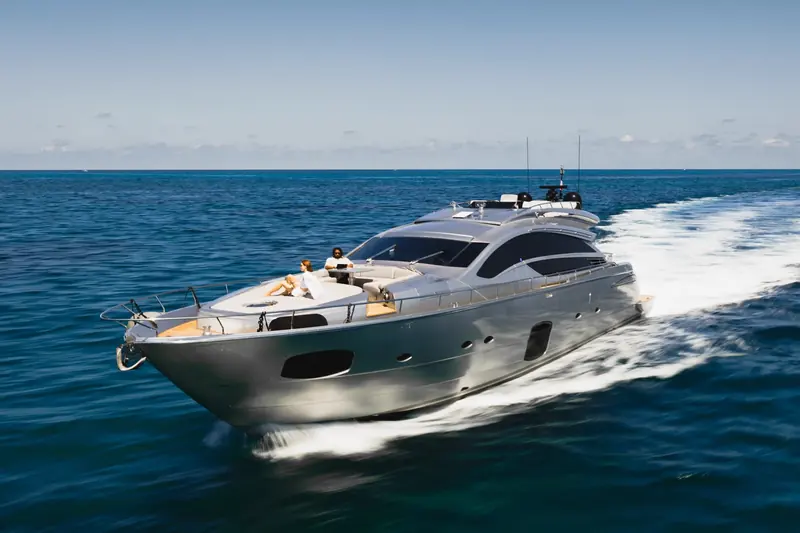
Where Is Starlink Maritime Restricted Or Unavailable
Maritime Executive reported that China's maritime safety administration opened its first known investigation into shipboard Starlink use, at the port of Ningbo, in December 2025, and that vessels are required under China's Maritime Traffic Safety Law to route communications only through licensed coast stations or gateway providers, with Starlink absent from that approved list; penalties the outlet cites run as high as roughly 500,000 yuan, about USD 72,000, for illegal radio equipment use, plus license suspension. P&I correspondent Oasis, quoted in the same report, recommends crews physically power down and disconnect Starlink terminals up to 200 nautical miles before entering China's exclusive economic zone and log the shutdown in the deck log.
China is not the only gap: Russia and Iran also prohibit importing or operating a Starlink terminal, and coverage in a number of other countries, including parts of the Middle East, has sat in a grey zone of pending or partial licensing, according to multiple maritime-connectivity trackers this page reviewed. Where Starlink does have a license, congestion is a newer, separate concern: Loon's Captain Clarke told Boat International in 2023 the yacht was "definitely noticing congestion as more and more people make the change to Starlink," and Excelerate's executive chairman David Savage, in the same piece, put it more bluntly: "the jury is out on what will happen when a large group of yachts are all trying to use Starlink in a crowded port."

What Do Owners, Captains And Crew Actually Report
Six months after Loon fitted it, Captain Paul Clarke told Boat International the crew was "still in love with it," and connectivity of this kind is increasingly framed as a crew-retention issue rather than a luxury: industry coverage from Superyacht Content and Crew Family Office describes reliable internet at sea as something younger crew now actively weigh when deciding whether to take a job, alongside genuine operational gains such as real-time weather routing and telehealth access mid-ocean. Superyacht Content also names a real technical limitation: satellite handovers within the Starlink network can cause brief connectivity drops that interrupt a live WhatsApp or video call, and the publication reports Starlink offers no dedicated technical support line tuned to superyacht-specific onboard systems, leaving integration problems with existing VSAT or AV networks to generalist troubleshooting.
Yachting World's Jayne Toyne, testing Starlink mid-Atlantic, hit a more specific problem: the system logged a full 50GB of data used over 15 days despite the crew's own estimate of only two to three gigabytes of actual use, a data-accounting discrepancy serious enough to flag directly to readers considering the same 50GB plan. Toyne is also explicit about what Starlink Maritime is not: "it is not a safety communications device," she writes, and should not replace a dedicated satellite phone such as an Iridium handset for offshore emergencies, a distinction Reed Nicol's broker-side review echoes when he notes Starlink cannot switch between satellite networks the way a multi-constellation VSAT system can if its own link drops.
Can Starlink Maritime Replace A Yachts Existing Safety Communications
Because a Starlink terminal can only talk to Starlink's own satellites, a coverage gap, a regulatory shutdown or simple congestion in a crowded anchorage leaves a yacht with no connectivity at all unless a second, independent system is standing by; this is precisely why Yachting World's Toyne insists it is not a safety communications device, and most of the installers and brokers this page reviewed, including RN Marine's Reed Nicol, describe it as a data and entertainment layer sitting on top of, not instead of, a GMDSS-compliant setup and a satellite phone such as Iridium for genuine emergencies. KVH's own Chris Watson made the same point from a rival's seat at the table, telling Boat International that in maritime communications "good enough is never good enough when you're on the water," a line aimed squarely at treating any single satellite system, Starlink included, as sufficient on its own.
The practical answer most yachts have landed on is a hybrid network rather than a single provider: Starlink or another low-earth-orbit service for everyday bandwidth, cellular data close to shore, and a traditional VSAT or Iridium link kept live as backup and for safety-grade traffic, a pattern Boat International's own coverage of superyacht connectivity describes as the current market default. OneWeb's Nick Maynard, another rival executive quoted in the same reporting, frames the stakes plainly: "connectivity is no longer regarded as a luxury, it's now right up there with reasons why a superyacht might not go to sea," which is as much an argument for keeping a second system running as it is for adopting Starlink in the first place.
Practical detail
| Hardware cost | The current Starlink Performance (Gen 3) terminal lists at USD 1,999 (launched June 4, 2025); the earlier Flat High Performance kit it replaced retailed from about USD 2,500 up to USD 10,000 for a full twin-antenna redundant setup at its 2022 launch. |
|---|---|
| Monthly service, yacht tiers (Global Priority) | GBP 215/USD 250 a month for 50GB, GBP 555/USD 650 for 500GB, GBP 980/USD 1,150 for 1TB, GBP 1,830/USD 2,150 for 2TB, per Starlink's own maritime storefront and US Mobile's pricing guide. |
| Smaller-boat tier and its recent price rise | A USD 185-a-month Personal Maritime plan (launched August 2026) gives unlimited data within 12 nautical miles of shore; Ocean Mode overage beyond that rose from USD 2 to USD 6 per gigabyte on September 27, 2026. |
| How to order and install | Direct through Starlink's own maritime storefront, or through an authorized marine electronics integrator such as Concord Marine Electronics, Elcome or KVH, who bundle the terminal with mounts, routers and network-management hardware and handle the physical fit. |
| What's next door (alternatives and backups) | Traditional stabilized VSAT from providers such as KVH, Intellian or Marlink; OneWeb's competing LEO service; and Iridium, which most installers still recommend keeping as a dedicated safety-grade backup rather than relying on Starlink alone. |
| What to check on an existing installation | Confirm which generation terminal is fitted: the Gen 3 Performance kit draws about 70W and is rated IP69K with a 3-year warranty, against the older Flat HP Gen 2's 110-150W draw, IP56 rating and 2-year warranty, a real difference in both running cost and durability. |
| What is NOT published | No source this page reviewed publishes a total installed cost covering cabling, labor and integration with a yacht's existing SATCOM; Starlink also does not publish a guaranteed service level for the Global Priority tiers sold to yachts, and its 99.9-percent SLA plan is restricted to IMO-registered cargo and tanker vessels only. |
Request a quote for Starlink Maritime.
Tell us the model and where it needs to go. The desk obtains a written offer from the maker or an authorised dealer, checks it against the prices published on this page, and comes back to you by email. No obligation, no fee.
- 01A written offerPriced in your currency, with VAT, delivery and lead time stated, not a brochure figure.
- 02Delivered where the yacht isTo the marina, the yard or your address, with the paperwork a lithium pack or a crane lift needs.
- 03IndependentYotters is tied to no single dealer, so the offer is compared before it reaches you.
What owners and crew report
Loon's captain measured roughly double the speed for half the cost of the yacht's previous VSAT
Captain Paul Clarke reported 150 to 200 Mbps for USD 5,000 a month on Starlink during a 2022 Atlantic crossing, against 40 to 80 Mbps for USD 10,000 a month on Loon's previous satellite provider.
Captain Paul Clarke (M/Y Loon), via SuperyachtNewsSix months in, still positive but starting to notice real congestion
Clarke told Boat International the crew was "still in love with it" roughly six months after fitting Starlink, while also flagging that the yacht was "definitely noticing congestion as more and more people make the change to Starlink."
Captain Paul Clarke (M/Y Loon), via Boat InternationalA tested data-usage discrepancy: 50GB logged against roughly 2-3GB of actual use
Testing Starlink's 50GB Priority plan mid-Atlantic, the reviewer found the system had recorded the full 50GB allowance used over 15 days despite the crew's own estimate of only two to three gigabytes of real consumption.
Jayne Toyne, Yachting WorldExplicitly not a safety communications device
The same review states plainly that Starlink "is not a safety communications device" and should not be relied on in place of a dedicated satellite phone such as an Iridium handset for offshore emergencies.
Jayne Toyne, Yachting WorldSatellite handovers can drop a live call, and there is no superyacht-specific support line
Brief connectivity drops during satellite handovers can interrupt a live video or WhatsApp call, and Starlink does not offer a dedicated technical support line tuned to complex superyacht onboard systems, leaving integration issues to generalist troubleshooting.
Superyacht ContentThe flush-mount panel saves a radome but draws real power and cannot be repainted
A yacht broker's review of the trade notes the flat antenna avoids the dedicated dome housing a stabilized VSAT needs, but draws meaningfully more continuous power than an idle VSAT system and, being white for heat and snow-shedding reasons, cannot be color-matched to the hull.
Reed Nicol, RN Marine
What is good, and what to watch
Strong points
- A real, measured cost and speed win over traditional VSATOn Loon, Starlink delivered 150-200 Mbps for USD 5,000 a month against 40-80 Mbps for USD 10,000 a month on the yacht's previous VSAT service, a two-to-four-times speed gain at roughly half the price, per SuperyachtNews and Boat International.
- No radome to package into the designThe flat, electronically-steered panel needs no moving parts and no dedicated dome housing, letting installers flush-mount it into a hardtop or arch in a way a stabilized VSAT dish cannot match, per RN Marine's Reed Nicol.
- A fast-growing constellation still expandingMore than 11,000 Starlink satellites were in orbit as of August 2026 per EarthSky, up from just over 10,000 in March the same year per KeepTrack.space, with SpaceX authorized to grow toward roughly 12,000 satellites and beyond.
- A genuine crew-welfare and retention upgradeIndustry coverage describes reliable at-sea internet as something younger crew now factor into whether to take a job, alongside real operational gains like live weather routing and telehealth access mid-ocean, per Superyacht Content and Crew Family Office.
What to watch
- A real regulatory patchwork, not global coverageChina has been actively enforcing a ban on shipboard Starlink use in its waters since around December 2025, with fines reported up to roughly USD 72,000; Russia and Iran prohibit it outright, and the terminal geofences itself off automatically wherever Starlink lacks a license, per Maritime Executive.
- No guaranteed service level on the plans a yacht actually buysThe 99.9-percent uptime SLA Starlink publishes applies only to the separate Global Priority Unlimited plan restricted to IMO-registered cargo and tanker vessels, not to the Global Priority tiers sold to yachts, and captains are already reporting real congestion in busy anchorages.
- Overage pricing just tripled, and there is no dedicated superyacht support lineOcean Mode overage data on the Personal Maritime and Roam Unlimited plans jumped from USD 2 to USD 6 per gigabyte on September 27, 2026, and Superyacht Content reports Starlink offers no technical support line tuned to complex superyacht onboard integration.
- Not a safety system, and the full installed cost is not publishedYachting World's own tester states plainly it "is not a safety communications device" and cannot replace an Iridium-class satellite phone for emergencies; no source this page reviewed publishes a total factory-fit or retrofit installed cost covering cabling, labor and integration with existing systems.
Who it is for: Owners and captains who want a fast, low-latency, relatively cheap primary data link for crew welfare, streaming, video calls and day-to-day operations, run alongside, not instead of, a yacht's existing GMDSS-compliant safety communications and a satellite phone such as Iridium for genuine emergencies.