Ultra Marine Anchors
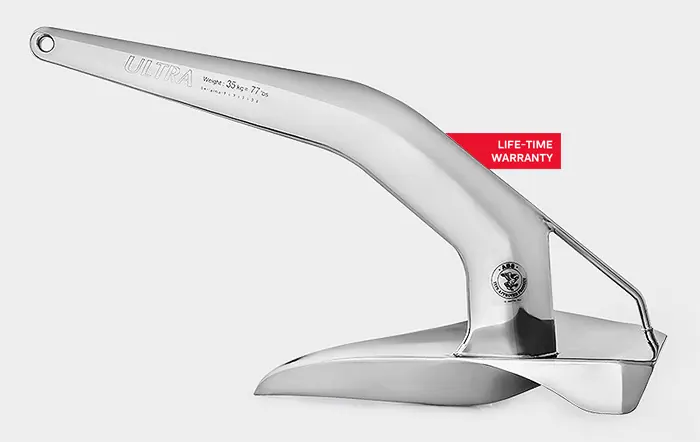
| Category | self-launching stainless steel anchors for yachts and superyachts |
|---|---|
| Origin | the Marine Department of Boyut Mechanical Industry (Turkey, precision stainless steel machining since 1978), founded 2000 by engineers Yilmaz Yucel and Nejat Ovutmen |
| Renamed ULTRA Marine in 2012 as the ULTRA brand overtook the parent name; more recently operating as ULTRA Products | |
| Certification | ABS Type Approval dated 7 February 2012, plus recognition from RINA and Lloyd's Register |
| Construction | a welded, hand-fabricated and hand-polished structure in 316L stainless steel, not a single-piece casting; the shank was upgraded from 316 to 318LN duplex stainless after early bending problems |
| Self-righting mechanism | no roll bar; a lead insert in the hollow tip lowers the centre of gravity so the anchor turns itself into the digging position on its own |
| Size range | 5 to 200 kg in standard production, to 360 kg by special order; a 21 to 33 m yacht typically needs the 60 to 130 kg band |
| Company-claimed installed base | 15,000 or 12,000 boats/customers, two different figures appear in the company's own materials and do not reconcile |
| Pricing, cross-checked across two retailers: 27 kg at EUR 2,669 to USD 3,080, 45 kg at EUR 4,199 to USD 4,840 | |
| Documented price premium versus a comparable galvanized Rocna, per one named source: roughly 2 to 2.5 times at both an 8 kg and a 50 lb-class comparison | |
| No independent lab test at the 60 to 130 kg sizes this size of yacht actually carries; every rigorous test found covers 5 to 22 kg anchors on production sailboats | |
A machining company's marine department, not a startup
Ultra Marine's anchor business began in 2000 as the Marine Department of Boyut Mechanical Industry, a Turkish precision stainless steel machining company that had been operating since 1978. It was founded by two engineer-boaters, Yilmaz Yucel and Nejat Ovutmen, friends from their student days at Istanbul Technical University, who set out to apply Boyut's existing stainless steel machining expertise to marine ground tackle rather than starting a metalworking business from nothing. The anchor itself reached the market around 2005 and built a reputation quickly on holding power and its mirror-polished stainless finish. As the ULTRA brand name overtook recognition of the parent Boyut Marine name, the division formally renamed itself ULTRA Marine in 2012, and more recent materials show the operating name shifting again to ULTRA Products.
Headquarters and manufacturing remain in Turkey; Practical Sailor's own December 2007 test of an early unit explicitly identified it as made in Turkey, and current retailers describe the range as designed and made there today. The anchor holds ABS Type Approval dated 7 February 2012, plus recognition from RINA and Lloyd's Register, real class-society credentials rather than self-certification. Yachting News has reported an ABS finding that Ultra's holding is seven times that of a traditional anchor, a claim relayed from a class society but appearing in only the one outlet found in this research, so it should be read as a single-sourced figure rather than independently confirmed twice over.
A hollow shank and a lead tip, not a roll bar
The anchor's construction is a welded, hand-fabricated and hand-polished structure in 316L stainless steel, not a single-piece casting as sometimes assumed; the tubular hollow shank gives the visual impression of a seamless one-piece shape without actually being cast that way. A lead insert sits in the hollow, curved tip, shifting the centre of gravity forward and down, which is what lets the anchor self-right: if it lands tip-up or on its back, the low centre of gravity and the absence of a snagging roll bar let it turn itself into the penetrating position on its own, according to the maker's own technical explanation. A concave base and large side wing plates are credited with stabilising the anchor once set and with letting it rotate through a full 180 degrees on its own length during a wind or tide reversal without breaking out, a specific mechanical behaviour Southern Boating and Yachting's own coverage describes directly.
The shank has a documented material history worth knowing before buying: early production used 316 stainless and suffered real bending problems under load, which the maker addressed by upgrading to 318LN duplex stainless and adding internal reinforcing webs, changes confirmed independently by multiple long-term Cruisers Forum owners rather than only by the manufacturer. Standard production runs 5 to 200 kg, with larger units to 360 kg available by special order; for anything above 100 kg, the maker's own guidance directs buyers to a Lloyd's Register-backed sizing recommendation rather than off-the-shelf selection, which is the relevant band for the 21 to 33 m yachts this site covers, typically a 60 to 130 kg anchor. Standard variants beyond the base anchor include the USAS side-pocket version for a different rode attachment geometry, a companion Ultra Flip Swivel and matched bow rollers sized per anchor model; no evidence was found of a separately named grapnel variant.
It sets faster than almost anything else on the market. It also costs about twice as much as the anchor it is fastest against.
Roughly double a galvanized Rocna, and no single published price list
No single global price list exists; every figure has to be assembled from individual dealers, and currency and promotional discounting move the number around. A German retailer, SVB24, lists the range from EUR 739 at 5 kg through EUR 4,199 at 45 kg; a US retailer, Citimarine Store, lists USD 3,080 at 27 kg and USD 4,840 at 45 kg, and its own catalogue states an overall range of USD 749 to 18,399 across the full 5 to 200 kg line. Those two retailers' figures agree closely at the sizes both stock once converted, and Motor Boat and Yachting separately quotes the smallest model at from EUR 688.80 including VAT, consistent with SVB's own low-end price, a third independent confirmation. Yachting Monthly's own 2020 test of a 12 kg unit priced it at GBP 1,104 plus a GBP 267 Flip Swivel, a fourth data point in a different currency confirming Ultra sits well above budget or galvanized anchors at every size, and its own 2022 roundup states plainly that Ultra is not the cheapest option among the eight anchors it reviewed.
The clearest documented ratio against a named competitor comes from no-frills-sailing.com, which put an 8 kg Ultra at about EUR 700 against about EUR 300 for a comparably sized Rocna, and a roughly 50 lb-class Ultra at about EUR 2,500 against about EUR 1,000 for the Rocna equivalent, a consistent 2 to 2.5 times premium at two different size points. A companion Flip Swivel adds real further cost, one owner quoting roughly EUR 500 on top of the anchor price, and each anchor size needs a correspondingly sized bow roller, a real fitment consideration for anyone retrofitting rather than buying new. No source found breaks out anchor cost as a specific percentage of a 21 to 33 m refit or new-build budget; general refit-cost literature puts total refit spend at 5 to 20 percent of a yacht's value, but nothing quantifies ground tackle within that figure specifically, so any such percentage would be an inference rather than a sourced fact.
Against Rocna, Mantus and the rest of the modern generation
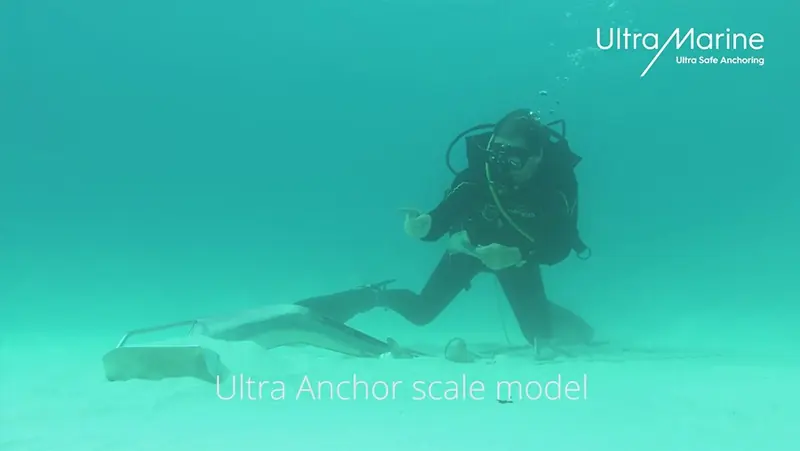
Practical Sailor's 2014 Chesapeake Bay test, on a soft mud and oyster-shell bottom, found the 45 lb stainless Ultra was not as good as the Fortress or Danforth, though it provided enough holding power for a lunch stop, while showing roughly 20 percent greater holding power than the Boss, Manson Supreme and Mantus in that specific soft-mud test; in the same round, Rocna failed to set during any of five tests and Mantus suffered roll-bar damage hitting snags, genuine, dated criticism of roll-bar designs specifically in soft bottoms that worked in Ultra's favour by comparison. Yachting Monthly's Theo Stocker tested a 12 kg Ultra with its Flip Swivel across UK anchorages including a rock bottom and a tide reversal in 2020 and reported it buried almost completely in soft sand and weed where the boat's stock 10 kg Bruce dragged, and held through a tide reversal even under reverse power on rock once the tip caught a crevice, concluding its performance amply delivers on its maker's promises and is comparable to other stainless anchors.
No single rigorous, recent test puts Ultra against Rocna, Mantus, Spade and Manson Supreme side by side at identical weight, scope and bottom type in one sitting, and none of the tests located cover the 60 to 130 kg sizes an actual 21 to 33 m motor yacht carries; every numeric test found was run on a 5 to 22 kg anchor for a cruising sailboat. A Trawler Forum thread documents a real field failure independent of any lab: an 80 kg Ultra that repeatedly failed to set in hard sand while a 60 kg unit on the same boat set immediately, which posters traced to a hardware difference, a connector called a saddle present on the newer, lighter unit's shank and absent on the older, heavier one, rather than a universal design flaw, but a genuine, specific, documented setting failure worth knowing about when checking which production revision is being sold.
What owners actually report, on both sides
One Cruisers Forum owner, CarlF, ran a 100 lb Ultra for ten years on a 55 ft ketch and reported it never dragged and reset faster after a wind or current change than any anchor he had owned, across grassy and hard bottoms with minimal wear after a decade. Another, eyschulman, judged a stainless 60 lb Ultra with a ball swivel to equal or exceed a Spade anchor, and a general-consensus Cruisers Forum thread summarised that not many users sell them on and its author had never heard of a dissatisfied owner. On the UK's YBW Forum, an owner running a 35 kg Ultra on an eighteen-tonne vessel for three years reported it sets in its own length and digs deep, and said he preferred it to roll-bar designs that bring up excessive bottom material on retrieval, a specific, practical point echoed by a separate Cruisers Forum owner who reported the Ultra comes up clean every time against a previous Rocna that brought up mud clumps.
Set against that, one long-term Cruisers Forum poster, noelex, who reported never seeing rust on an Ultra anchor, also noted occasional dents on the shank and confirmed the shank material and internal design were changed after early bending problems, adding internal webbing and upgrading from 316 to 318LN duplex stainless. A separate poster, boomerangben, raised a specific engineering concern about a standard shackle pin passing through a round hole in the shank, questioning its bending-moment safety under a veering load, a technical point rather than a reported failure. The clearest real, documented field failure is the Trawler Forum thread noted above, an 80 kg unit that repeatedly failed to set in hard sand while a lighter 60 kg unit on the same boat set first time, attributed to a hardware revision difference rather than the core design. No Ultra-specific coverage was found on superyacht-crew-facing publications such as The Triton or the Ocean Cruising Club, a real gap in independent coverage at exactly the scale this site's readers operate at.
Practical detail
| Pricing across the range, cross-checked at two retailers | 27 kg: EUR 2,669 (SVB24) to USD 3,080 (Citimarine Store). 45 kg: EUR 4,199 to USD 4,840. Overall catalogue span at Citimarine: USD 749 to 18,399 across 5 to 200 kg. Above 100 kg, buyers are directed to Ultra Marine directly for a Lloyd's Register-backed sizing recommendation rather than an off-the-shelf price. |
|---|---|
| The documented premium versus a galvanized rival | About 2 to 2.5 times a comparable galvanized Rocna at two separate size points (roughly EUR 700 vs EUR 300 at 8 kg, and roughly EUR 2,500 vs EUR 1,000 at about 50 lb), per one named source. A companion Flip Swivel adds a further EUR 500 or more, and each size needs a matched bow roller. |
| Construction and known history | Welded and hand-polished 316L stainless steel body, not a single-piece casting. The shank was upgraded from 316 to 318LN duplex stainless with added internal webbing after early production bending problems, confirmed independently by long-term owners, not only by the manufacturer. |
| Real alternatives | Rocna: failed to set in all five tries in Practical Sailor's own 2014 soft-mud test, though it is the anchor Ultra is most often benchmarked against on price. Manson Supreme and Mantus: both roll-bar designs that underperformed Ultra by roughly 20 percent in the same soft-mud test, with Mantus suffering roll-bar damage on snags. Fortress and Danforth: outperformed Ultra specifically in soft mud in the same test. |
| A documented field failure worth checking for | A Trawler Forum thread records an 80 kg Ultra repeatedly failing to set in hard sand while a 60 kg unit on the same boat set immediately, traced by posters to a hardware connector difference between production revisions rather than a universal fault. |
| What is not published | No independent lab test exists at the 60 to 130 kg sizes an actual 21 to 33 m yacht carries; every rigorous test found covers 5 to 22 kg anchors on sailboats. The company's own claimed installed base, 15,000 or 12,000 boats, does not reconcile between its own materials. No named superyacht case study exists in trade press despite the maker's OEM claims at that scale. |
What owners and crew report
Ten years, no drag, faster resets than anything else owned
An owner running a 100 lb Ultra for ten years on a 55 ft ketch reported it never dragged and reset faster after a wind or current change than any anchor he had owned, across grassy and hard bottoms with minimal wear after a decade.
Cruisers ForumSets in its own length, and comes up clean
An owner running a 35 kg Ultra on an eighteen-tonne vessel for three years reported it sets in its own length and digs deep, preferring it to roll-bar designs that bring up excessive bottom material, a point echoed by a separate owner who found it comes up clean every time against a previous Rocna that brought up mud clumps.
YBW ForumThe shank issue, confirmed by an owner rather than only the maker
A long-term owner who reported never seeing rust on an Ultra anchor also noted occasional dents on the shank and confirmed the shank material and internal design were changed after early bending problems, upgrading from 316 to 318LN duplex stainless with added internal webbing.
Cruisers ForumA real field failure traced to a hardware revision, not the core design
An 80 kg Ultra repeatedly failed to set in hard sand while a 60 kg unit on the same boat set immediately; posters traced the difference to a connector called a saddle present on the newer, lighter unit's shank and absent on the older one.
Trawler Forum
What is good, and what to watch
Strong points
- Genuinely fast, reliable setting across a wide range of bottomsIndependent reviewers including Yachting Monthly's Theo Stocker and no-frills-sailing.com both reported the anchor burying almost completely in soft sand and weed where a stock Bruce dragged, and Practical Sailor's own testing rated its setting Excellent at both short and long scope.
- Self-righting without a roll bar's snag riskThe hollow, lead-weighted shank achieves the same self-launching behaviour as a Rocna or Mantus without a roll bar to catch the chain or the bow roller, and owners on Cruisers Forum specifically credit it with coming up clean rather than bringing up mud clumps on retrieval.
- Real class-society certification, not self-certificationABS Type Approval dated 7 February 2012, plus recognition from RINA and Lloyd's Register, are genuine third-party credentials, and a widely stocked position with major chandleries and yacht builders including Princess Yachts backs up the maker's own OEM claims independently.
- Corrosion resistance and finish quality, confirmed by long-term ownersMultiple independent owner reports, including a ten-year account from Cruisers Forum, confirm no rust seen even after a decade of use, with a mirror-polish finish reviewers repeatedly single out as best in its category.
What to watch
- A real, consistently documented price premiumRoughly 2 to 2.5 times a comparable galvanized Rocna at two separate size points per one named source, and Yachting Monthly's own 2022 roundup explicitly flags it as not the cheapest option among the anchors it tested.
- A documented history of shank bendingEarly production in 316 stainless suffered real bending problems, forcing an upgrade to 318LN duplex stainless with added internal webbing, a design evolution confirmed by long-term owners rather than a resolved-and-forgotten footnote, and dents on the shank are still reported.
- Inconsistent setting without a roll bar, in the wrong bottomPractical Sailor's 2014 test found it behind the Fortress and Danforth specifically in soft mud, and a Trawler Forum thread documents an 80 kg unit repeatedly failing to set in hard sand while a lighter unit on the same boat set immediately.
- Companion hardware adds real cost and fitment complexityA Flip Swivel alone has been quoted at around EUR 500 on top of the anchor price, and each anchor size needs a correspondingly matched bow roller, a genuine consideration for a retrofit rather than an original-equipment fitting.
- Almost no independent testing at the size this market actually buysEvery rigorous holding-power test located covers a 5 to 22 kg anchor for a cruising sailboat; buyers of the 60 to 130 kg anchors that actually go on 21 to 33 m yachts have only manufacturer and class-society claims and forum anecdotes to go on, not a published large-anchor test.
Who it is for: Owners specifying ground tackle for a 21 to 33 m yacht who want an anchor that sets quickly across a wide range of bottoms without a roll bar's snag risk, and who are prepared to pay roughly double a galvanized equivalent and to get a Lloyd's Register-backed sizing recommendation directly from the maker above 100 kg.